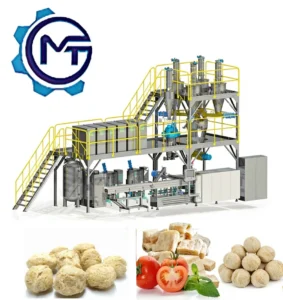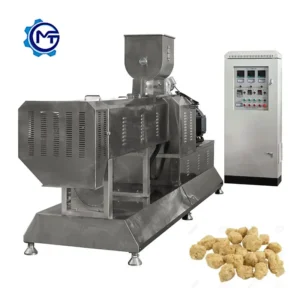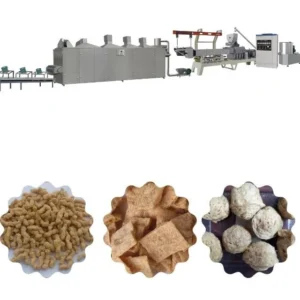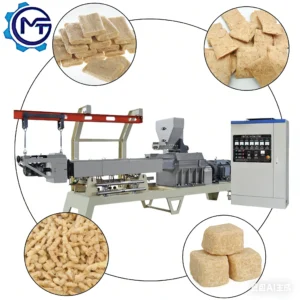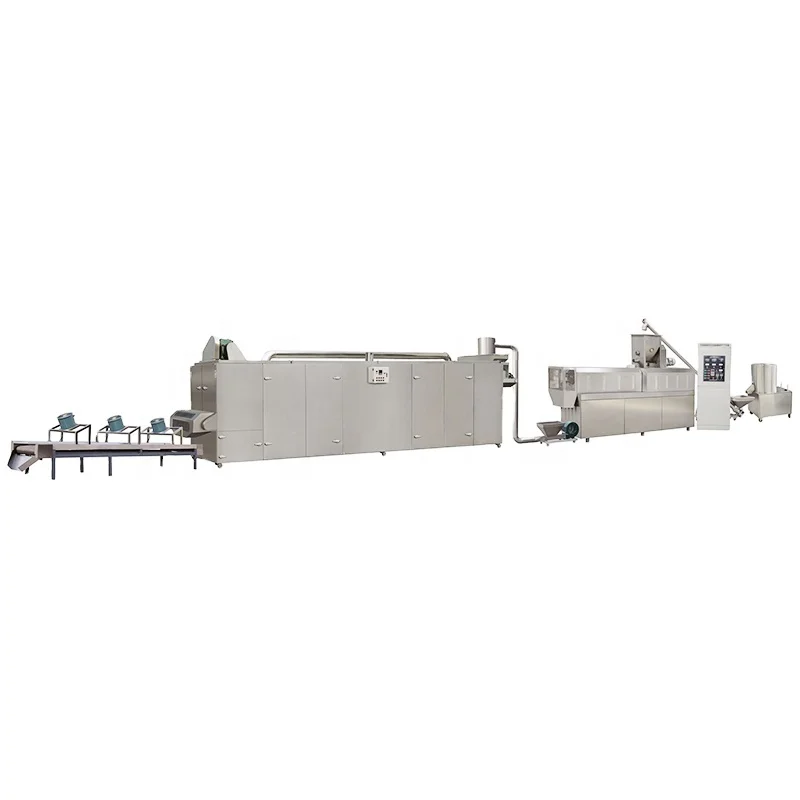

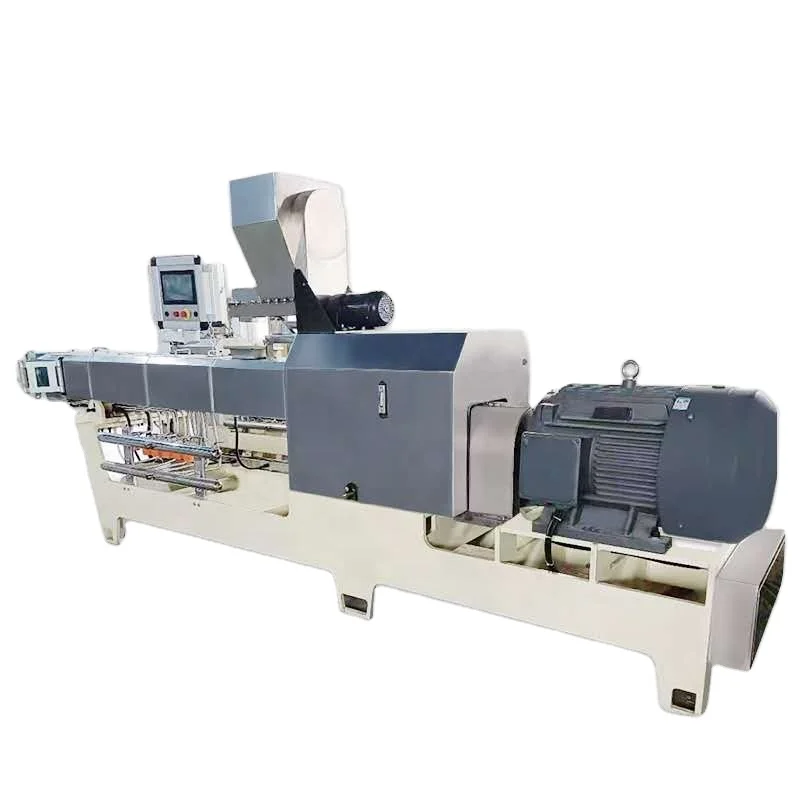
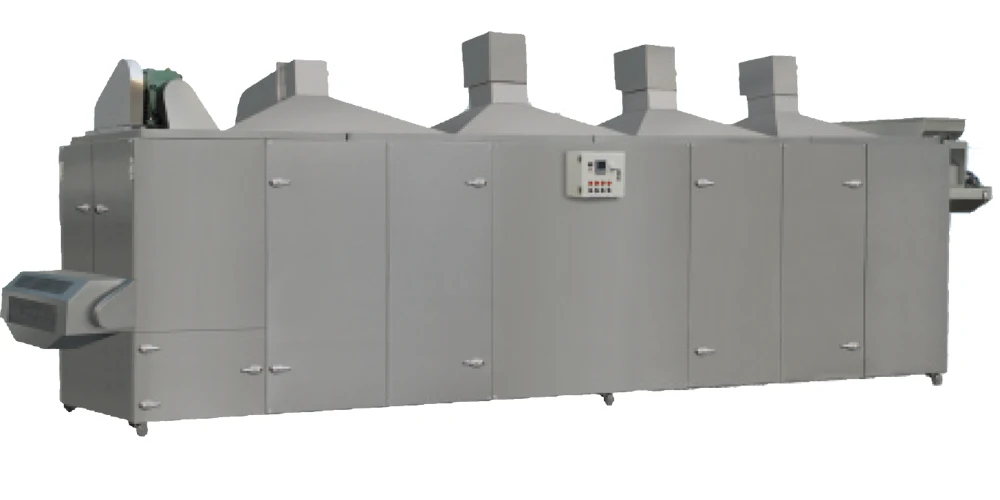


MT65 / MT70 / MT85 Textured Vegetable Protein Production Line, Twin-Screw Extrusion, Stainless Steel Construction — configured for soy and peanut meal formulations across ham, sausage, and canned food applications. Screw configuration and die design are matched to your raw material’s moisture content and target fiber structure, with throughput balanced from mixing through drying and cooling to prevent station-level bottlenecks. Layout, capacity calculation, and trial run reports on your specific formulation are provided before shipment.
Description
Turnkey line throughput matched — every station from powder mixing through high-temperature roasting and cooling is sized to the extruder’s real output on your soybean or peanut meal formulation, not assembled from standalone vendors.
Technical Specifications
| Parameter | Value |
|---|---|
| Product Type | Textured Vegetable Protein (TVP) Production Line |
| Models Available | MT65, MT70, MT85 |
| Extruder Type | Double Screw (Twin-Screw) |
| MT65 Installed Power | 85 kW |
| MT65 Real Power | 65 kW |
| MT65 Output | 150–200 kg/h (basis not stated in source — confirm raw material formulation and moisture content) |
| MT65 Dimension | 18000 × 1300 × 2300 mm |
| MT70 Installed Power | 120 kW |
| MT70 Real Power | 90 kW |
| MT70 Output | 200–300 kg/h (basis not stated in source — confirm raw material formulation and moisture content) |
| MT70 Dimension | 20000 × 1500 × 2400 mm |
| MT85 Installed Power | 195 kW |
| MT85 Real Power | 165 kW |
| MT85 Output | 600–800 kg/h (basis not stated in source — confirm raw material formulation and moisture content) |
| MT85 Dimension | 24000 × 3500 × 4300 mm |
| Extruder Main Motor Power | 30 kW |
| Extruder Actual Power | 30–35 kW |
| Extruder Dimension | 2800 × 830 × 1875 mm |
| Powder Mixer Tank Volume | 150 kg |
| Powder Mixer Rotary Speed | 385 rpm |
| Powder Mixer Mixing Time | 10 min per batch |
| Powder Mixer Power | 4 kW |
| High-temperature Roaster Effective Belt Length | 3.5 m |
| Roaster Far Infrared Heater Power | 3.9 kW × 24 |
| Roaster Belt Motor Power | 0.55 kW |
| Cooling Machine Capacity | 200–300 kg/h (source value — verify against manufacturer catalog) |
| Construction Material | Stainless steel (food-grade contact parts) |
| Process Flow | Raw material preparation → Mixing → Conveying → Extrusion → Conveying → Drying → Cooling → Packing |
| Warranty | 1 year complete warranty |
Application Suitability
| Application | Material or Output |
|---|---|
| Soybean meat for ham and sausage processing | Low-temperature soybean meal, peanut meal |
| Plant-based meat alternatives for canned food | Soy protein isolate blends, defatted soy flour |
| Vegetarian meat for quick-frozen food industry | Peanut meal and soybean meal mixtures |
| Fast-food meat substitute patties and strips | Textured vegetable protein from twin-screw extrusion |
| Fortified protein ingredients for institutional nutrition programs | Blended legume and cereal protein bases |
Why "Rated Capacity" Means Nothing Without Your Raw Material
A textured vegetable protein production line turnkey quotation only holds value when capacity is tied to your specific soybean or peanut meal formulation and moisture content.
I spent two weeks in Santiago rewiring screw elements and recalibrating barrel temperatures after a client swapped in pea protein mid-contract — the fiber structure collapsed and output dropped sharply. [NEED_CITE: protein denaturation behavior varies across legume sources under twin-screw shear]. A textured vegetable protein production line turnkey built on generic assumptions will underperform the moment your actual formulation enters the barrel, and no amount of downstream adjustment compensates for poor extrusion.
Screw Configuration Dictates Fiber Integrity
The twin-screw extruder in this line is configured around the buyer’s raw material and target fiber structure, not a generic build copied from unrelated applications. Barrel temperature profiling, screw element sequencing, and die geometry together determine whether soybean meal develops the elongated muscle-like fibers that downstream customers expect in ham and sausage applications. A textured vegetable protein production line turnkey project succeeds or fails at this stage — everything downstream merely preserves what the extruder creates.
Moisture, Shear, and Protein Denaturation
Low-temperature soybean meal behaves differently under thermal and mechanical shear than peanut meal, and blended formulations introduce their own variables. The extrusion zone must maintain a precise moisture window to achieve proper protein alignment without over-gelatinizing starch residues. [NEED_CITE: twin-screw extrusion parameters for plant protein texturization]. When moisture drifts outside the target band, the extrudate either fractures into crumbs or emerges as a dense, untextured mass — neither outcome is recoverable through drying alone.
Reading the Power and Dimension Data
The MT65 draws 65 kW in real operation against an installed capacity of 85 kW, leaving headroom for startup surges and formulation changes without tripping breakers. The MT85 spans 24 meters in length with a 3.5-meter high-temperature roaster belt, requiring significant floor space and ceiling clearance for ventilation ducting. The powder mixer cycles 150 kg batches at 385 rpm in 10-minute intervals, meaning continuous extrusion depends on staggered mixing schedules or a second mixer running in parallel. Buyers planning a textured vegetable protein production line turnkey installation must reconcile these physical footprints with their facility layout before the line ships.
What Happens When Stations Are Mismatched
A line assembled from separate vendors often has an extruder that outpaces the dryer, forcing operators to throttle output or accept uneven moisture in the finished product. When the cooling station cannot keep pace, packed bags trap residual heat and the textured protein develops off-flavors within days. [NEED_CITE: moisture migration in packaged plant protein products]. These bottlenecks surface only after installation, when the cost of reconfiguration is measured in weeks of lost production.
Why Buyers Source This Line Here
The entire textured vegetable protein production line turnkey package — batching, extrusion, drying, cooling, and packing — comes from a single supplier, so throughput is calculated across every station rather than assumed from individual machine nameplates. Screw configuration and die design are specified to the buyer’s raw material and target fiber structure, not pulled from a catalog of generic builds. An in-house testing workshop runs trial extrusion on the customer’s actual soybean or peanut meal before shipment, revealing formulation issues while adjustments still cost days instead of weeks. Twin-screw expertise spans pet food, aquatic feed, snacks, cereals, starch, and protein applications, meaning screw element libraries cover a wide range of material behaviors. Pre-sales consultation extends through engineer design, on-site installation, commissioning, and ongoing maintenance rather than ending at the factory gate.
Documentation & Verification
- Line layout and capacity calculation matched to your soybean or peanut meal formulation and target output
- Screw and die configuration record specific to your product fiber structure and moisture window
- Trial run report on customer raw material conducted in the testing workshop before shipment
- Electrical schematic with voltage and frequency confirmation for the target market
- Factory test record documenting real power draw and throughput during pre-dispatch validation
- Operation and maintenance manual with wear parts list specific to your extruder configuration
Installation, Commissioning & Support
- MT85 requires 24-meter floor length with clearance for 4.3-meter ceiling height and roaster ventilation ducting
- MT85 installed power of 195 kW demands dedicated circuit with voltage and frequency confirmed before wiring begins
- Extruder ships partially disassembled; barrel sections and screw shafts reassembled and aligned on-site during commissioning
- First production run includes screw speed, barrel temperature, and die pressure calibration against your raw material batch
- Operator training covers moisture adjustment, screw element replacement, and roaster belt tension checks
- Wear parts list for screws and dies provided with recommended reorder intervals based on soybean meal abrasion rates
What We Need From Your Side to Build an Accurate Proposal
Send your raw material specification — soybean meal protein percentage, fat content, and moisture at delivery — along with your target product form and daily production volume. Confirm the voltage, frequency, and control language at your facility so the electrical schematic matches local standards before the line enters production. If you have existing upstream batching or downstream packing equipment, share those details so the line throughput can be calculated around your current infrastructure rather than assuming a greenfield layout.
Frequently Asked Questions
Q: How is line capacity verified against my specific soybean meal or peanut meal formulation?
A: Before shipment, your raw material runs through the extruder in our in-house testing workshop under production conditions. The trial documents actual throughput, fiber structure quality, and moisture levels exiting each station. Capacity figures in the final quotation are then tied to your specific formulation rather than generic benchmarks, so the line you receive performs as documented on your material.
Q: What is the phased installation and commissioning schedule for a complete TVP turnkey project?
A: Installation follows a sequence from heavy equipment positioning through utility connection, starting with the extruder and roaster on prepared foundations. Electrical wiring and control panel integration follow, then mechanical alignment of conveyors and cooling stations. Commissioning begins with dry runs, progresses to wet trials with your raw material, and concludes with sustained production runs where operators train on actual output conditions.
Q: How do you ensure throughput matching between the extruder, dryer, and cooling stations?
A: Each station is selected so its rated capacity exceeds the extruder’s verified output on your formulation, preventing bottlenecks. The high-temperature roaster’s 3.5-meter belt length and far infrared heater array are sized to handle the extrudate volume at target moisture reduction rates. The cooling machine capacity is cross-checked against the roaster discharge rate to prevent product backlog before packing.
Q: Can a trial run be performed on my raw material before the line ships?
A: Yes. Our testing workshop runs your soybean or peanut meal through the configured extruder before the line leaves the factory. The trial produces sample extrudate for your evaluation and generates a report documenting screw speed, barrel temperatures, die pressure, and resulting fiber structure. Any required screw element or die adjustments are made before the equipment is packed for dispatch.
Q: What operator training is included during on-site commissioning?
A: Training covers daily startup and shutdown sequences, moisture monitoring and adjustment at the mixer stage, screw element inspection and replacement procedures, roaster belt speed and temperature management, and cooling conveyor maintenance. Operators practice these tasks during sustained production runs with your raw material under the supervision of our commissioning engineer before handover.
Related products
-
Dry Protein Drawing Equipment – Intelligent Puffing Machine for Cake Protein & Vegetarian Meat
¥65.00 Select options This product has multiple variants. The options may be chosen on the product page -

Customized Vegetarian Meat Production Line for Food Factory
¥9,500.00 Select options This product has multiple variants. The options may be chosen on the product page -
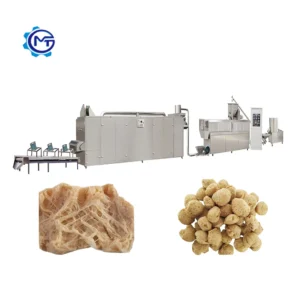
High Productivity New Soy Protein Automated Production Line Meat Substitute Processing Line
¥30.00 Select options This product has multiple variants. The options may be chosen on the product page -
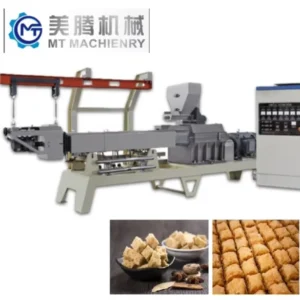
Vegetarian Beef Substitute Making Machine with Twin Screw Extruder
¥9,500.00 Select options This product has multiple variants. The options may be chosen on the product page