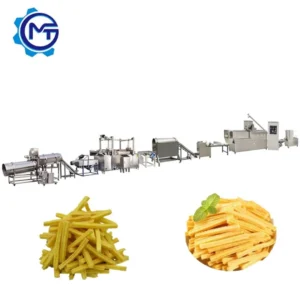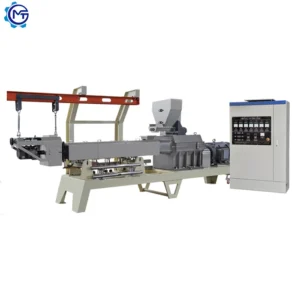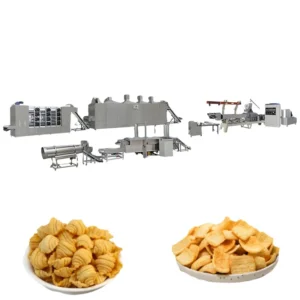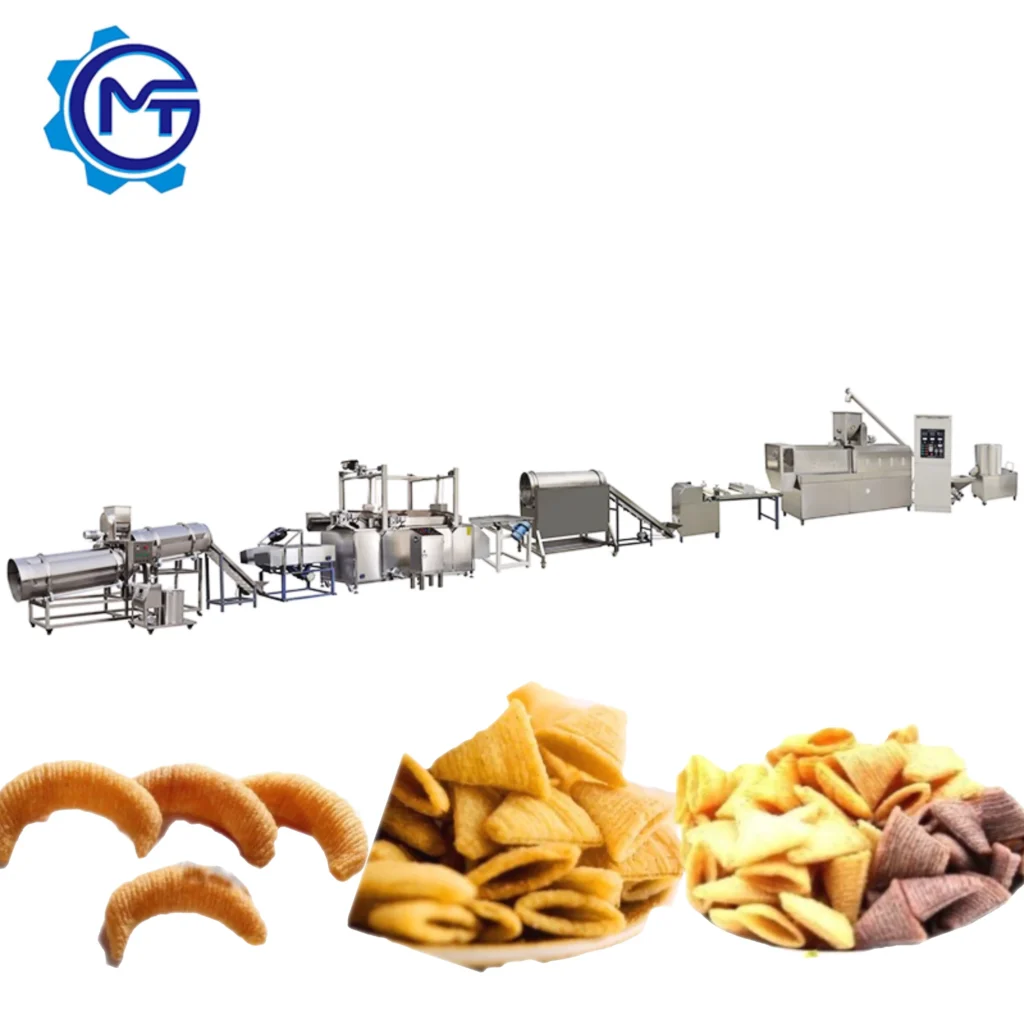


MT100/MT120 Single Screw Extruder Production Line, 50–70 kW, CE/ISO Certified — designed for secondary puffing snack formats including bugles, rice crust, and pani puri.
- High and low pressure screw design with interchangeable dies supports multiple shapes from wheat flour, corn starch, or potato starch
- Multi-energy options (electricity, gas, diesel, steam) adapt to local utility conditions
- Throughput matched across mixing, extrusion, cutting, frying, flavoring, and packing stations
Turnkey project layout, throughput balancing, and in-house trial runs on your raw material de-risk commissioning before shipment.
Description
Integrated throughput matching — every station from mixing to packing is engineered as a single system so the fryer never waits on the extruder and the flavoring drum never starves.
Technical Specifications
| Parameter | Value |
|---|---|
| Product Type | Single Screw Extruder Production Line for Secondary Puffing Snacks |
| Model | MT100/MT120 |
| Extruder Type | Single Screw (high and low pressure screw options) |
| Rated Power | 50–70 kW |
| Voltage & Frequency | Three-phase 380 V / 50 Hz; single-phase 220 V / 50 Hz (configurable to local supply) |
| Output Capacity | 120 kg/h (basis not stated in source — confirm raw material, moisture, and shape) |
| Overall Dimensions (L × W × H) | 12 000–26 000 × 1 200 × 2 200 mm |
| Construction Material | Food-grade stainless steel 201 / 304 |
| Energy Options | Electricity, gas, diesel, or steam |
| Motor & Inverter | Siemens (China-made) or equivalent top-brand motors; Delixi or Delta inverters |
| Die Configuration | Interchangeable dies for screw shell, round tube, square tube, ring, cartoon shapes |
| Process Flow | Mixer → Screw Conveyor → Single Screw Extruder → Pulling & Cutting Machine → Automatic Fryer → Automatic Flavoring Line → Cooling |
| Certification | CE / ISO 9001 |
| Warranty | One year |
Application Suitability
| Application | Material or Output |
|---|---|
| Rice crust and bugles production | Wheat flour, corn starch blends |
| Golgappa / pani puri shells | Wheat flour and potato starch mixes |
| Screw shell and ring snacks | Corn starch with moisture-adjusted feed |
| Cartoon-shaped fried puffed snacks | Multi-grain starch formulations |
| Secondary puffing tubes (round and square) | Potato starch and corn starch blends |
Why the "Nominal Capacity" Number Rarely Survives First Contact with Your Raw Material
The capacity figure on a quotation assumes a specific flour type, moisture content, and die geometry — change any one and the number shifts.
I once watched a turnkey puffing snack production line run flawlessly on standard corn flour during a workshop trial, then stall on a customer’s high-fiber grain blend when we arrived on site. Expansion dropped, die holes clogged, and the rated output became unreachable until we reworked the screw configuration and barrel temperature profile over two weeks. Lines quoted on a single reference material often cannot sustain that throughput once the buyer’s actual formulation enters the hopper [NEED_CITE: raw material variability in extrusion throughput claims].
How Screw Pressure Zones Shape Secondary Puffing Texture
The MT100/MT120 single screw extruder uses distinct high-pressure and low-pressure screw sections to control how starch gelatinises before the die. High-pressure zones build the internal steam needed for expansion, while low-pressure zones manage residence time so the dough does not scorch. Switching between these configurations lets a turnkey puffing snack production line handle dense wheat flour for pani puri and lighter corn starch for bugles on the same platform, simply by swapping screw elements and adjusting feed moisture.
Die Geometry and the Cut-Off Point That Defines Final Shape
Interchangeable dies on this line determine whether the extrudate emerges as a hollow tube, a flat ribbon, or a cartoon outline. The pulling and cutting station downstream must match the die exit speed precisely — too fast and the walls thin out before frying, too slow and the product buckles. This synchronization is why throughput balancing across the extruder and cutter matters more than the extruder’s standalone motor rating [NEED_CITE: extrusion die design and downstream speed matching].
Reading the Spec Sheet Against Your Actual Production Target
The 50–70 kW rated power range covers the difference between running light corn starch at moderate moisture and pushing a heavier wheat-potato blend through a small-diameter die. Energy selection — electricity, gas, diesel, or steam — affects the fryer’s recovery time between batches more than the extruder itself. A gas-fired fryer in a region with cheap LPG will hold oil temperature steadier during continuous runs than an electric element on a constrained grid, directly influencing whether the turnkey puffing snack production line maintains output across a full shift.
What Happens When Stations Are Sized Independently
An extruder rated for a given output means little if the downstream fryer basket cannot cycle fast enough to keep up, or if the flavoring drum is too small to coat the full stream before product temperature drops below the seasoning adhesion threshold. I have seen lines where the fryer became an unintended buffer zone, with semi-finished product piling up on cooling conveyors and absorbing ambient moisture — exactly the condition that ruins crunch [NEED_CITE: throughput imbalance effects in snack processing lines]. Matching every station to a single verified throughput figure, rather than quoting each machine at its own maximum, eliminates this failure mode.
Why a Single Supplier Handles the Bottleneck Question Better
Because the mixing system, extruder, cutting unit, dryer, fryer, flavoring drum, and packing station all come from one source, the throughput calculation is done once across the entire chain. The screw conveyor is sized to feed the single screw extruder at the rate the fryer can accept, and the cooling conveyor is long enough for the product to reach packing temperature before bagging. This integrated approach to a turnkey puffing snack production line removes the finger-pointing that occurs when separate vendors each blame the other’s equipment for a capacity shortfall.
Documentation & Verification
- Line layout drawing showing station spacing matched to the MT100/MT120 throughput calculation
- Trial run report produced on your specific starch blend before the line leaves the workshop
- Screw and die configuration record documenting the pressure zones and die bore used for your shape
- Electrical schematic confirming voltage, frequency, and control language for the destination country
- CE declaration of conformity covering the full assembled line, not individual machines only
Installation, Commissioning & Support
- Foundation plan accounts for the 12 000–26 000 mm line length and fryer load-bearing requirements
- Dedicated circuit sizing based on the 50–70 kW extruder draw plus fryer and dryer heating elements
- Line arrives in modular sections for reassembly; alignment checks run before first powered extrusion
- First-run parameter setting covers barrel temperatures, screw speed, and fryer oil recovery timing
- Operator training includes die changeover procedure for switching between screw shell and ring shapes
- Wear parts list covers screws, dies, and cutter blades with recommended replacement intervals
What to Include in Your First Technical Inquiry
Provide the exact starch or flour formulation you intend to run, including typical moisture content at the mixer discharge. Specify the target product shapes from the die catalog and the daily output you need across an eight-hour or twelve-hour shift. Confirm the local voltage and frequency at your facility, along with the preferred energy source for the fryer and dryer, so the turnkey puffing snack production line is configured correctly before production begins.
Frequently Asked Questions
Q: How is the 120 kg/h capacity verified, and what conditions apply?
A: That figure originates from a reference run and must be confirmed against your specific raw material, moisture percentage, and die shape. We conduct a trial in the testing workshop using your actual flour or starch blend, then document the achievable throughput in the trial run report before the line ships.
Q: How are screw and die configurations chosen for a specific shape?
A: The high- and low-pressure screw sections are arranged to match the gelatinisation behavior of your starch blend. Die bore and land length are selected to produce the wall thickness your target shape requires, then validated during the in-house trial so adjustments happen before installation, not after.
Q: What electrical details are confirmed before shipment?
A: Voltage, frequency, phase configuration, and control panel language are verified against the destination site’s supply and operator preference. An electrical schematic reflecting these choices is included in the documentation package, preventing wiring mismatches that would otherwise delay commissioning.
Q: How is throughput balanced between extruder, fryer, and flavoring stations?
A: Each station is sized to the same verified line output rather than its individual maximum. The fryer basket cycle time, flavoring drum volume, and cooling conveyor length are all calculated from the extruder’s confirmed throughput on your material, so no single station creates a bottleneck.
Q: What does the in-house trial run cover before delivery?
A: The trial runs your raw material through the full process — mixing, extrusion, cutting, frying, and flavoring — to confirm expansion ratio, shape integrity, and seasoning adhesion. Results are recorded in a trial report that becomes the baseline for on-site commissioning parameters.
Related products
-
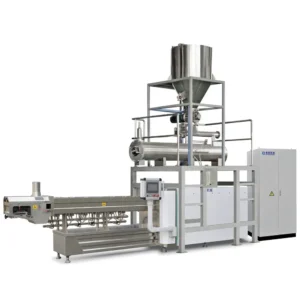
New Automatic 150-200kg/h Nimko Fried Pasta Snacks & Kurkure Making Machine Food Grade Stainless Steel High Productivity
¥8,585.00 Select options This product has multiple variants. The options may be chosen on the product page -
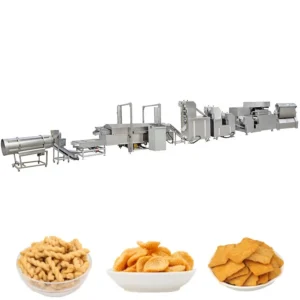
Frying Crispy 3D Corn Bugles Pellets Fried Chips Snacks Food Machine Production Line Bugles Making Extruder
¥100.00 Select options This product has multiple variants. The options may be chosen on the product page -
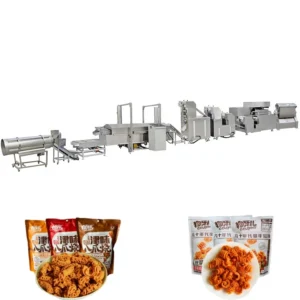
Puffed Octopus Snack Processing Line – Full-Automatic Fried Octopus Production Machinery
¥65.00 Select options This product has multiple variants. The options may be chosen on the product page -
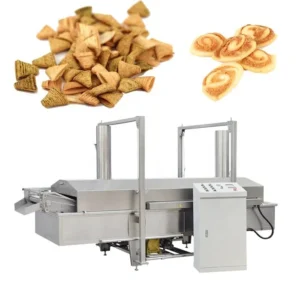
Double Screw Extruder Corn Flour Puffs Snack Nacho Chips Tortilla Doritos Making Machine Savory Snack Production Line
¥50.00 Select options This product has multiple variants. The options may be chosen on the product page