

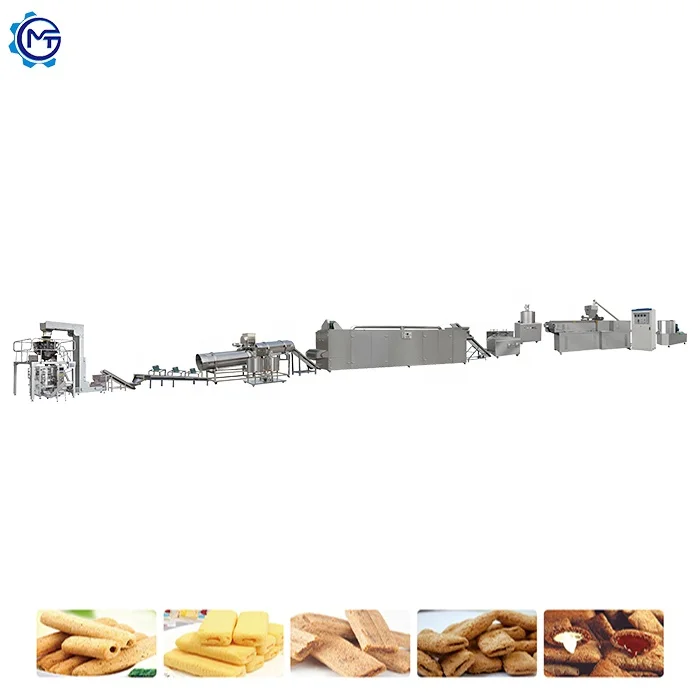
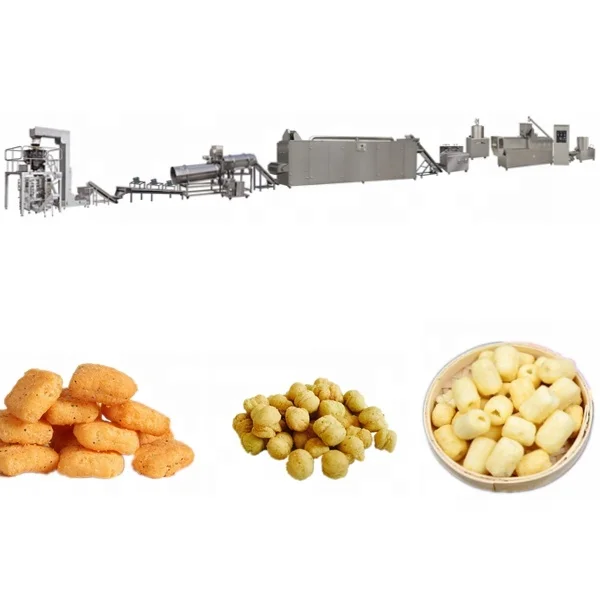
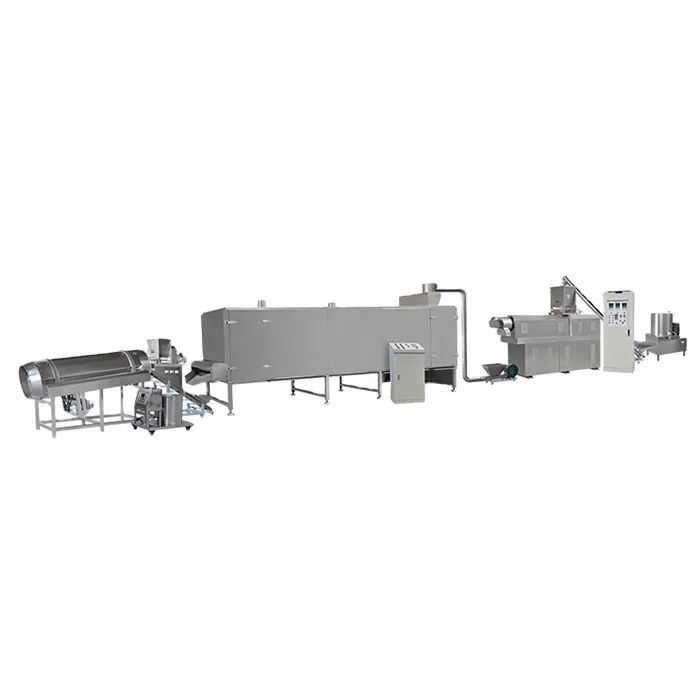

MT70 / MT85 / MT75 Twin Screw Puffed Corn Snack Extrusion Line, 130-220 kW Installed Power, Interchangeable Die System — engineered as a complete turnkey project from batching through extrusion, drying, coating to packing.
- Twin-screw configuration and die geometry specified to your raw material and target puff density, with throughput balanced across every station to eliminate bottlenecks.
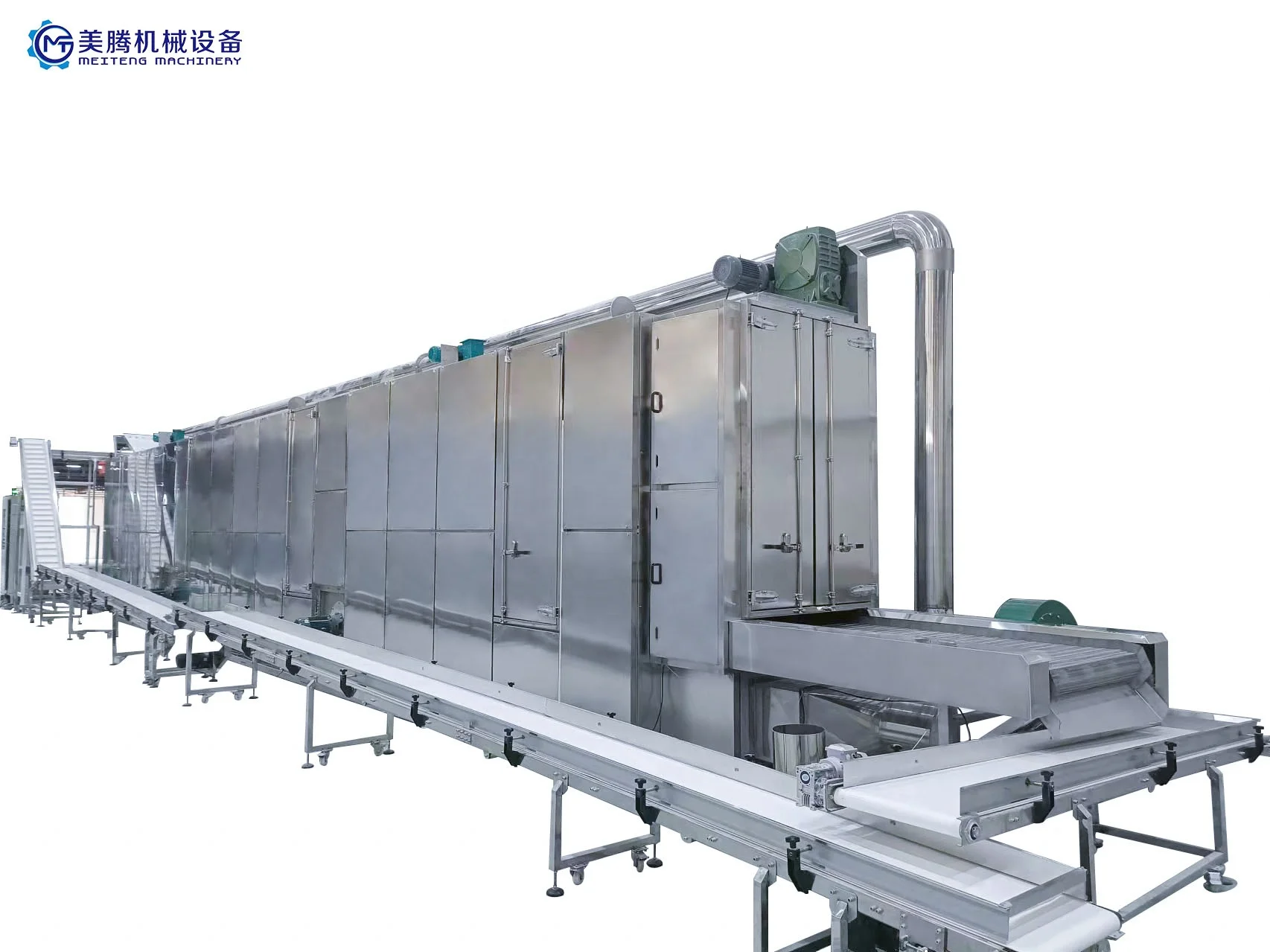
- Dryer heating by gas or electric, coating drum with sugar-melting tumble and spraying nozzle for uniform flavor coverage.
- In-house trial runs on your actual raw material confirm output and product specification before shipment, supported by full line layout design and on-site commissioning.
Description
Turnkey Line Layout — throughput verified from batching through extrusion, drying, coating, and packing using your actual raw material before the puffed corn snack extrusion production line turnkey ships.
Technical Specifications
| Parameter | Value |
|---|---|
| Product Type | Twin Screw Puffed Corn Snack Extrusion Line |
| Model Options | MT70 / MT85 / MT75 |
| Screw Type | Twin Screw |
| Installed Power | MT70 — 130 kW; MT85 — 180 kW; MT75 — 220 kW |
| Power Consumption | MT70 — 95 kW; MT85 — 120 kW; MT75 — 130 kW |
| Output Capacity | MT70 — 100–120 kg/hr (basis to be confirmed); MT85 — 200–300 kg/hr (basis to be confirmed); MT75 — 300–500 kg/hr (basis to be confirmed) |
| Overall Dimensions (L×W×H) | MT70 — 21 × 1.5 × 2.2 m; MT85 — 25 × 1.5 × 2.2 m; MT75 — 28 × 1.5 × 2.2 m |
| Die Configuration | Interchangeable moulds: ball, tube, stick, ring, fruit loop, star, wheel, flower, heart |
| Line Stations | Mixing → Extruding → Drying → Coating/Flavoring → Cooling → Packing |
| Dryer Heating Source | Gas or Electric (selectable) |
| Coating System | Double tumble for sugar melting, elevator, coating drum, spraying nozzle |
| Control System | To be confirmed (PLC / MCC options available) |
| Voltage & Frequency | Confirmed per buyer local supply before production |
Application Suitability
| Application | Material or Output |
|---|---|
| Cheese ball and ring snack production | Corn, rice, wheat flour blends at controlled moisture |
| Fruit loop and star-shape cereal snacks | Oat, barley, and multi-grain formulations |
| Tube and stick format puffed snacks | Corn grits and rice flour with flavor coating |
| Heart and wheel shape novelty snacks | Blended grain bases with sugar or savory coating |
| Scale-up from pilot to commercial volume | Progression across MT70, MT85, MT75 capacity tiers |
What "Nominal Capacity" Really Means for Your Puffed Corn Snack Extrusion Production Line Turnkey
A capacity number without raw material context is just a guess.
When I first quoted a puffed snack line to a buyer in the Middle East, the spec sheet said the extruder would run at its rated throughput. What the sheet did not say was that the number was based on a standard corn grit formulation at a specific moisture level. The buyer’s actual recipe was high in fiber, which changed the expansion behavior entirely. The product came out dense, the dryer could not keep up, and the whole line bottlenecked at the drying station. That experience reshaped how I approach every puffed corn snack extrusion production line turnkey project now: before any number goes into a proposal, the buyer’s raw material runs through our testing workshop [NEED_CITE: importance of raw material trial runs in extrusion projects].
Screw and Die Matching to Your Recipe
The twin-screw configuration on the MT70, MT85, and MT75 is selected based on the buyer’s target snack geometry and raw material composition. Screw pitch, flight depth, and compression ratio are adjusted to control shear and residence time inside the barrel. Die inserts then shape the expanded product — from a simple cheese ball to a multi-loop fruit ring. Getting both the screw profile and the die geometry right on the first run prevents the trial-and-error phase that delays commissioning on a puffed corn snack extrusion production line turnkey installation.
Dryer and Coating Station Throughput Alignment
An extruder running at full output means nothing if the dryer downstream cannot handle the moisture load. Each line layout we build pairs the dryer belt length and heating capacity — gas or electric — to the extruder’s actual discharge rate on your recipe. The coating station follows the same logic: the double tumble system, elevator feed rate, and spraying nozzle coverage are sized so flavor application keeps pace without product pile-up [NEED_CITE: throughput balancing across extrusion line stations].
What the Power and Dimension Numbers Mean on the Floor
The installed power ranges from 130 kW on the MT70 to 220 kW on the MT75, but the running consumption sits lower — 95 kW to 130 kW respectively — because the main drive motor does not operate at full load continuously. Line lengths stretch from 21 meters to 28 meters, so ceiling height and floor space must be confirmed before layout finalization. The interchangeable die system means one extruder can produce nine different shapes, but each shape change requires a die swap and a brief process re-stabilization period. Understanding these parameters prevents surprises during installation and helps the buyer plan utility hookups and shift schedules accurately.
The Hidden Cost of Skipping Line Integration
A buyer who sources the extruder from one vendor, the dryer from another, and the coating drum from a third often discovers the throughput mismatch only after all three arrive on site. The extruder pushes product faster than the dryer can remove moisture, or the coating drum tumbles too slowly and creates a backlog. These are not equipment defects — they are integration failures. When every station on a puffed corn snack extrusion production line turnkey project comes from one source, the throughput at each node is calculated against the others, and the bottleneck is resolved on paper before the first machine is built [NEED_CITE: integration risks in multi-vendor extrusion lines].
Why Procure This Line Here
Complete line engineering from batching through packing under one supplier means throughput at every station is matched rather than assembled from mismatched independent purchases. Screw configuration and die design are specified to your raw material and target shape, not copied from a generic build sheet. Our in-house testing workshop runs your actual formulation before shipment, so product density, expansion, and coating adhesion are confirmed in advance. Twin-screw expertise spans puffed snacks, cereals, pet food, and aquatic feed, giving cross-application insight that single-category suppliers cannot match. Pre-sales layout consultation, on-site installation, commissioning, and ongoing wear-part support keep the line running long after the first production shift.
Documentation & Verification
- Line layout and capacity calculation matched to your factory footprint and recipe
- Screw and die configuration record specific to your target snack shape and density
- Trial run report on your raw material confirming output before shipment
- Electrical schematic with voltage and frequency confirmed for your destination country
- Factory test record documenting every station’s performance prior to dispatch
- Operation and maintenance manual with wear parts list included
Installation, Commissioning & Support
- Floor space from 21 m to 28 m length requires confirmed ceiling height of at least 2.2 m clearance
- Power supply must match confirmed voltage and frequency before the MT70/MT85/MT75 motor is wired
- Line arrives in modular sections for staged assembly aligned to your utility hookup schedule
- First-run parameter setting covers screw speed, barrel temperature profile, and die pressure
- Operator training addresses die changeover, coating drum adjustment, and dryer temperature tuning
- Wear parts list includes screws, dies, and spraying nozzles with recommended replacement intervals
What We Need to Build Your Line
To prepare an accurate puffed corn snack extrusion production line turnkey proposal, share your raw material composition and moisture content, the snack shapes you plan to produce, and your target hourly output. We also need your factory floor dimensions, available ceiling height, local voltage and frequency, and preferred control language. If you have existing upstream mixing or downstream packing equipment, let us know so the new line integrates cleanly with what is already in place.
Frequently Asked Questions
Q: How is actual line capacity verified against my raw material before shipment?
A: We run your exact formulation through the extruder in our in-house testing workshop. The trial run measures actual throughput, expansion ratio, and product density. A written report accompanies shipment so you know what to expect on day one of production, not after weeks of on-site guessing.
Q: How do you match dryer and coating station throughput to the extruder output?
A: Dryer belt length, heating source selection, and coating drum speed are calculated against the extruder’s confirmed discharge rate on your specific recipe. This prevents product backlog at any station and keeps the puffed corn snack extrusion production line turnkey running continuously without manual intervention.
Q: What screw and die configuration do you recommend for my target snack shape and density?
A: Screw pitch and compression ratio are chosen based on your flour blend and moisture level. Die inserts are matched to the desired shape — ball, tube, ring, star, or any of the nine available geometries. The configuration record is documented and included in your shipment documentation package.
Q: Can the line layout be adapted to my factory floor dimensions and utility hookups?
A: Yes. Line length ranges from 21 to 28 meters depending on the model, and we draft a layout drawing based on your floor plan. Utility connection points for power, gas, and ventilation are positioned to match your existing infrastructure before production begins.
Q: What commissioning, operator training, and spare wear-parts support is included?
A: On-site installation covers mechanical assembly, electrical connection, and first-run parameter tuning. Operators are trained on die changeover, coating system adjustment, and routine maintenance. A wear parts list with screws, dies, and nozzles ensures replacements are available when first needed.
Related products
-

Automatic Rice Crispies Extruder Machine/Chocolate Corn Flakes Extrusion Plant/wheat Flaking Snacks Production Line
¥8,500.00 Select options This product has multiple variants. The options may be chosen on the product page -

Automatic Puffed Food Snack Machine Electric Corn Puffs Snacks Making Machinery New Condition Flavorful Puff Snack Production
¥7,550.00 Select options This product has multiple variants. The options may be chosen on the product page -

New Puffed Snack Food Machine Production Line Corn Flake Puff Corn Making Machine Twin Screw Extruder 100-500kg/h Capacity Food
¥8,500.00 Select options This product has multiple variants. The options may be chosen on the product page -

Automatic Corn Crisps Extruder Production Machine for Maize Chips and Corn Sticks New Condition
¥8,000.00 Select options This product has multiple variants. The options may be chosen on the product page


