

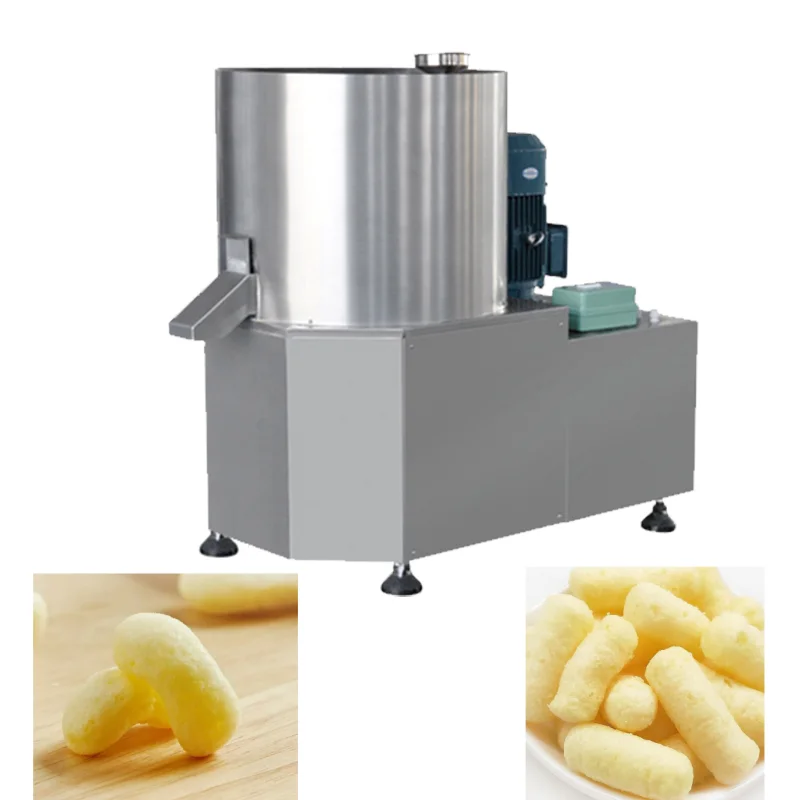
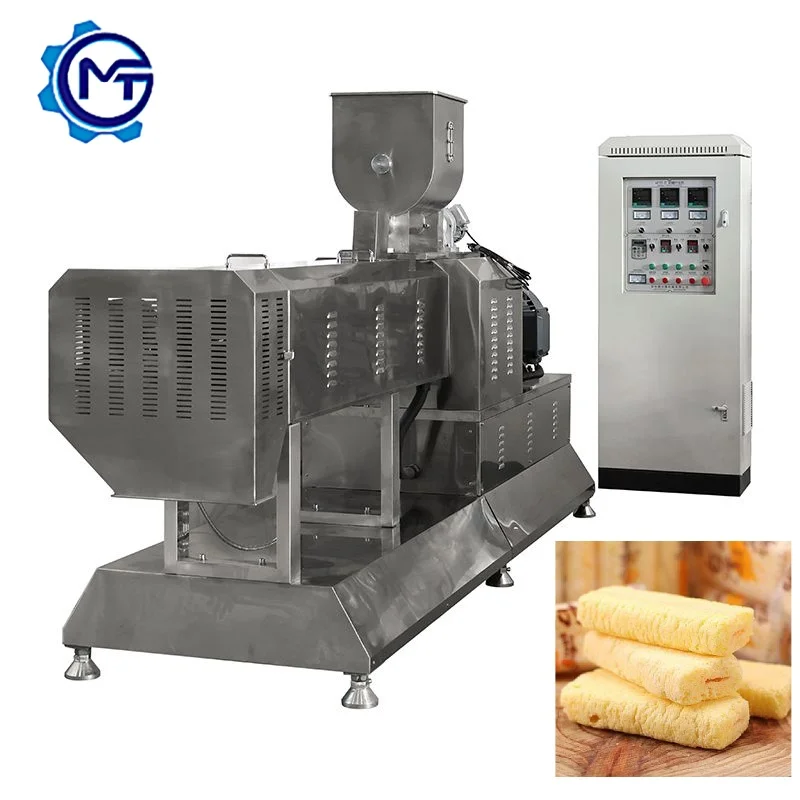
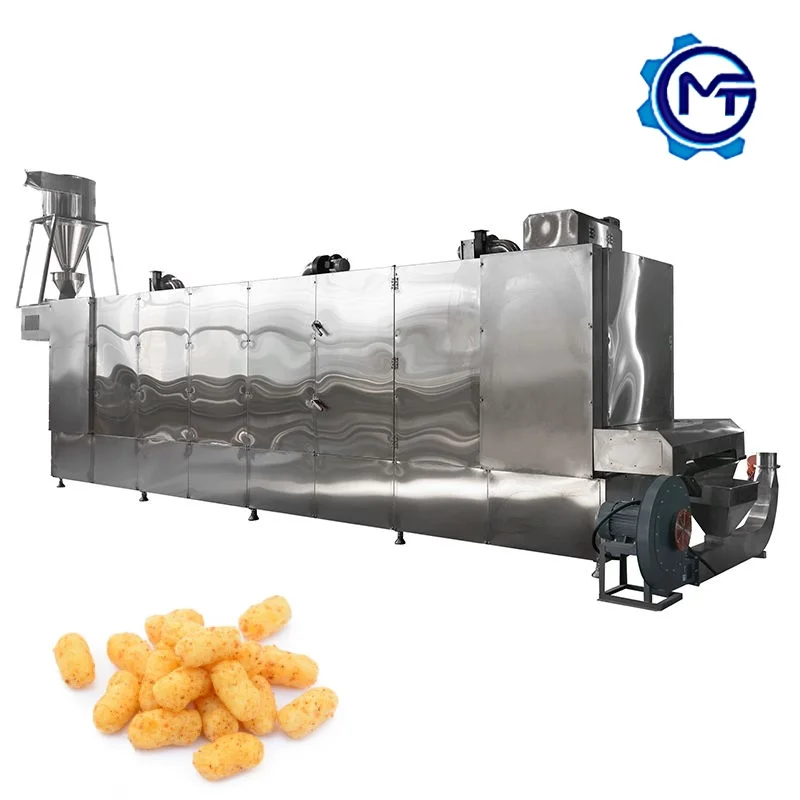
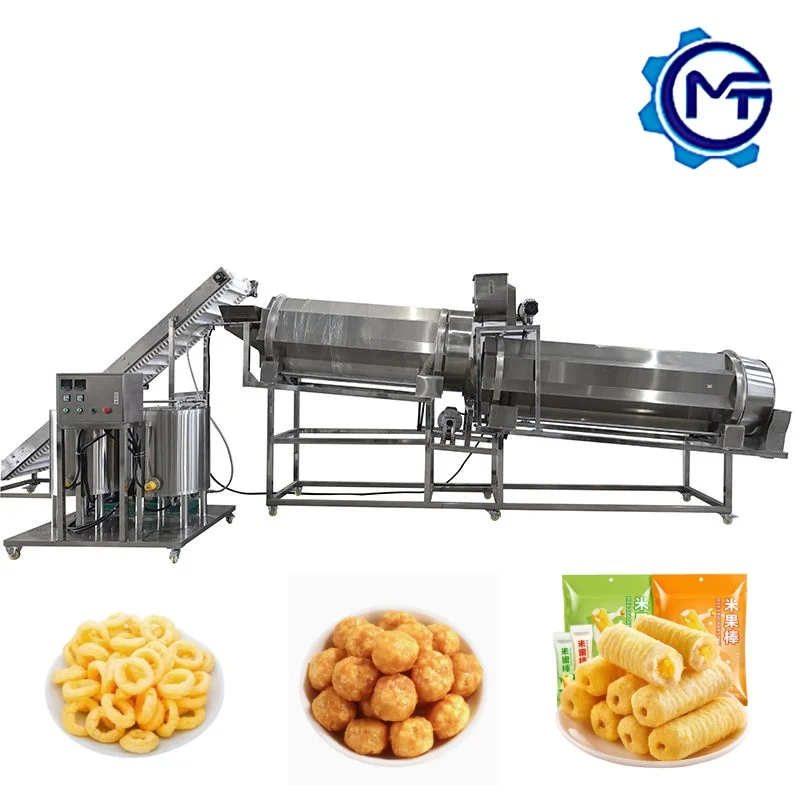

MT65 Twin Screw Puffed Snack Food Extrusion Line, 120–150 kg/h, PLC Control — complete turnkey solution from batching to packing with matched throughput across every station.
- Twin-screw extrusion with interchangeable dies for cheese balls, rings, sticks, loops, stars and core-filled variants
- Screw configuration and die design specified to your flour blend, moisture content and target product density
- Dryer heating source (electric, steam or gas) matched to local utility conditions
Trial run on your raw material in our testing workshop before shipment ensures product development starts on day one of installation.
Description
Throughput-Matched Station Design — Every station from batching to packing is calculated against your actual flour blend and target shape, preventing bottlenecks that leave extruders or dryers running below capacity.
Technical Specifications
| Parameter | Value |
|---|---|
| Product Type | Twin Screw Puffed Snack Food Extrusion Line |
| Available Models | MT65 / MT70 / MT85 / MT100 |
| Screw Configuration | Twin-screw |
| Installed Power | 130 kW (MT65); 180 kW (MT70); 220 kW (MT85); 240 kW (MT100) |
| Real Consumption | 95 kW (MT65); 120 kW (MT70); 130 kW (MT85); 160 kW (MT100) |
| Output Capacity | 120–150 kg/h (MT65); 200–300 kg/h (MT70); 300–500 kg/h (MT85); 600–800 kg/h (MT100) (basis not stated in source — confirm raw material, moisture and die shape) |
| Control System | Frequency speed controlling system; automated PLC/MCC available per client profile |
| Die Options | Interchangeable dies for cheese ball, tube, stick, ring, fruit loop, star, wheel, flower, heart shapes |
| Line Stations | Material preparation → Batching → Extruding → Drying → Coating/Flavoring → Cooling → Packing → Stacking |
| Dryer Heating Source | Electric / Steam / Gas options |
| Flavoring System | Double drum flavoring line with sugar melting, spraying nozzle, elevator |
| Packing Machine | Automatic weighing, sealing, marking, coding, bag filling |
| Assembly State | Turnkey complete line |
| Warranty | 1 year free warranty |
| Delivery Time | 20 working days for extruder line; ~35 working days if packing and stacking machines included (source value — verify against manufacturer schedule) |
Application Suitability
| Application | Material or Output |
|---|---|
| Ring and loop snacks | Corn flour, rice flour, wheat flour blends |
| Cheese balls and spherical puffs | Corn grits, oat flour with moisture adjustment |
| Core-filled snack variants | Wheat and rice base with cream or chocolate center filling |
| Stick and tube formats | Barley, corn and multi-grain flour mixtures |
| Custom 2D/3D shapes | Proprietary flour blends matched to die geometry |
What "Rated Capacity" Actually Means for Your Snack Line
A puffed snack food extrusion line turnkey project only holds its quoted throughput when every station is matched to your specific flour blend, moisture content and die geometry.
Lines built on generic capacity tables often stall because the dryer cannot keep pace with the extruder on a high-moisture dough, or the flavoring drums create a backlog when the product requires extended coating time [NEED_CITE: twin-screw extrusion throughput matching principles]. I have walked into workshops where the extruder was running at half speed simply because the downstream cooling conveyor was never specified for the actual product density. When you evaluate a puffed snack food extrusion line turnkey proposal, the capacity number should come with a material specification sheet, not just a model brochure.
Station-by-Station Throughput Calculation
A turnkey puffed snack food extrusion line must balance output across eight distinct processing stages. If the extruder pushes product faster than the dryer can reduce moisture to the target level, the entire line backs up and product quality degrades. The dryer length, heating source selection and air flow rate are calculated against the specific moisture reduction required by your flour blend.
Die Geometry and Product Density Control
The interchangeable die system allows producers to switch between rings, balls, loops, stars and custom shapes without replacing the screw assembly. Each die geometry demands a specific screw configuration and barrel temperature profile to achieve the correct expansion ratio [NEED_CITE: die design and starch gelatinisation in twin-screw extrusion]. Core-filled variants require an additional filling station synchronized with the extruder output and cutter timing.
Power Consumption and Heating Source Selection
The difference between installed power and real consumption reflects the actual energy draw during steady-state production across the MT65 to MT100 range. The dryer heating source — electric, steam or gas — must align with local utility availability and cost structures. Facilities in regions with unreliable grid power often specify gas-fired dryers to maintain consistent drying temperatures and avoid product moisture variation during voltage fluctuations.
Reading the Specifications Beyond the Model Number
The twin-screw configuration across all models handles a wider range of flour blends and moisture levels than single-screw alternatives, particularly when processing high-fat or high-protein recipes. Frequency speed control allows operators to adjust screw RPM in real time, compensating for raw material batch variation without stopping the line. The automated PLC and MCC control options provide recipe storage and repeatability, which matters when running multiple SKUs across different die shapes on the same line. The real consumption figures indicate actual operating cost rather than peak motor draw, which affects your facility’s electrical infrastructure planning [NEED_CITE: industrial electrical load calculation for food processing plants].
The Cost of Underspecifying Downstream Equipment
When a snack line is quoted based only on extruder capacity, the dryer, flavoring drums and cooling conveyor often cannot handle peak output. I have seen producers forced to run their extruder at reduced speed because the double drum flavoring system was specified for a lower throughput, creating a permanent bottleneck. Mismatched stations mean the line never reaches its designed capacity, and the capital investment in the extruder is partially wasted. These problems surface only after installation, when the cost of adding or replacing equipment has multiplied [NEED_CITE: food processing line bottleneck analysis].
Why This Line Is Configured as a Single Project
The line layout and capacity calculation starts with your raw material sample and target product specification, not a standard catalog configuration. Screw configuration and die design are specified to match your flour blend’s starch content and the expansion ratio your market expects. The in-house testing workshop runs your actual raw material before shipment, producing a trial run report that confirms output and product quality. Pre-sales consultation extends through on-site installation, commissioning and operator training, so the line is running to specification before the engineering team leaves. Electrical schematics and voltage confirmation happen before production begins, eliminating commissioning delays caused by incorrect motor wiring or control panel language.
Documentation & Verification
- Line layout and capacity calculation showing throughput matched between all eight stations
- Screw and die configuration record tied to your specific flour blend and target product shape
- Electrical schematic with voltage, frequency and control language confirmed before production
- Trial run report on your raw material documenting output rate and product density
- Factory test record with photographic evidence of line running under load before dispatch
- CE declaration of conformity and ISO certificate for customs and regulatory clearance
Installation, Commissioning & Support
- Foundation and floor space planning based on the complete eight-station line footprint
- Electrical supply specification matching the confirmed voltage, frequency and real consumption load
- Assembly sequence for turnkey delivery with all stations arriving as a coordinated shipment
- First-run commissioning with screw speed, barrel temperature and dryer settings calibrated to your material
- Operator training covering die changes, recipe adjustments and emergency stop procedures
- Wear parts inventory list for screws, dies and cutter blades with recommended replacement intervals
What We Need to Configure Your Line
To specify the correct model and station configuration, provide your flour blend composition, target moisture content and the product shapes you intend to run. Share your facility’s available voltage, frequency and whether you prefer electric, steam or gas dryer heating. If you are integrating this line with existing upstream mixing or downstream packing equipment, send the interface specifications so the line throughput is matched at every connection point.
Frequently Asked Questions
Q: How is line capacity verified on my actual raw material and die shape?
A: We run a trial in the testing workshop using your flour blend and target die configuration. The trial run report documents actual output rate, product density and expansion ratio. This confirms the line holds its rated capacity on your specific material rather than a generic test recipe, and the results are shared before shipment.
Q: How are extruder, dryer and flavoring stations matched for throughput?
A: Each station is calculated based on the extruder’s output on your material. Dryer length and heating capacity are sized for the moisture reduction your product requires. The double drum flavoring system and cooling conveyor are specified to handle peak output without creating a backlog at any point in the line.
Q: What voltage, frequency and control language are confirmed before build?
A: We confirm your facility’s electrical supply specifications and the preferred control panel language during the proposal stage. The electrical schematic reflects these requirements before production begins, so the PLC interface, motor wiring and safety circuits match your local standards and operator requirements when the line arrives.
Q: Is a trial run done on my raw material before shipment?
A: Yes. Your raw material is processed through the extruder and supporting stations in the testing workshop. The trial verifies screw configuration, die performance, drying time and flavoring coverage. You receive a trial run report with output data and product samples before approving shipment.
Q: What installation, commissioning and operator training are included on site?
A: Engineers supervise unpacking, station placement and utility connections according to the line layout. Commissioning includes running your material through the complete line and adjusting parameters to match the trial run results. Operator training covers daily startup, die changes, recipe adjustments and wear part replacement procedures.
Related products
-

Automatic Corn Flake Processing Line Corn Coco Pops Breakfast Cereals Snacks Making Machinery
¥7,500.00 Select options This product has multiple variants. The options may be chosen on the product page -

Corn Puff Processing Line with Mixer Fryer Baking Oven Automatic High Productivity Grain Products Snack Making Machine
¥8,300.00 Select options This product has multiple variants. The options may be chosen on the product page -

Hot Sale Corn Snack Extruder Puffed Snacks Production Machine Corn Puffs Making Machine
¥20,000.00 Select options This product has multiple variants. The options may be chosen on the product page -

Full Automatic Crispy Maize Chocos Corn Flakes Breakfast Cereals Processing Production Line Industrial Equipment
¥1,000.00 Select options This product has multiple variants. The options may be chosen on the product page


