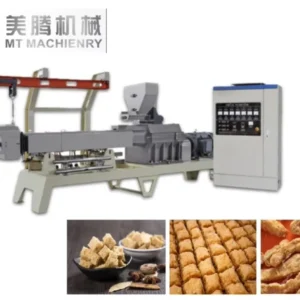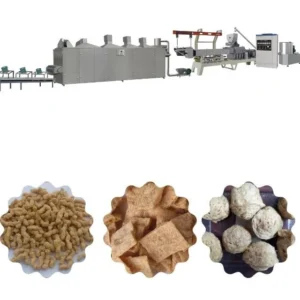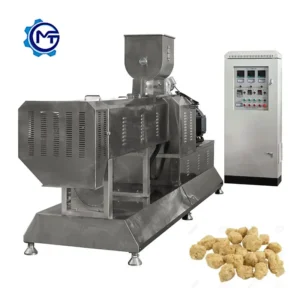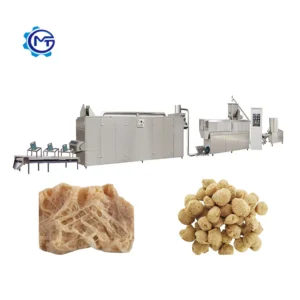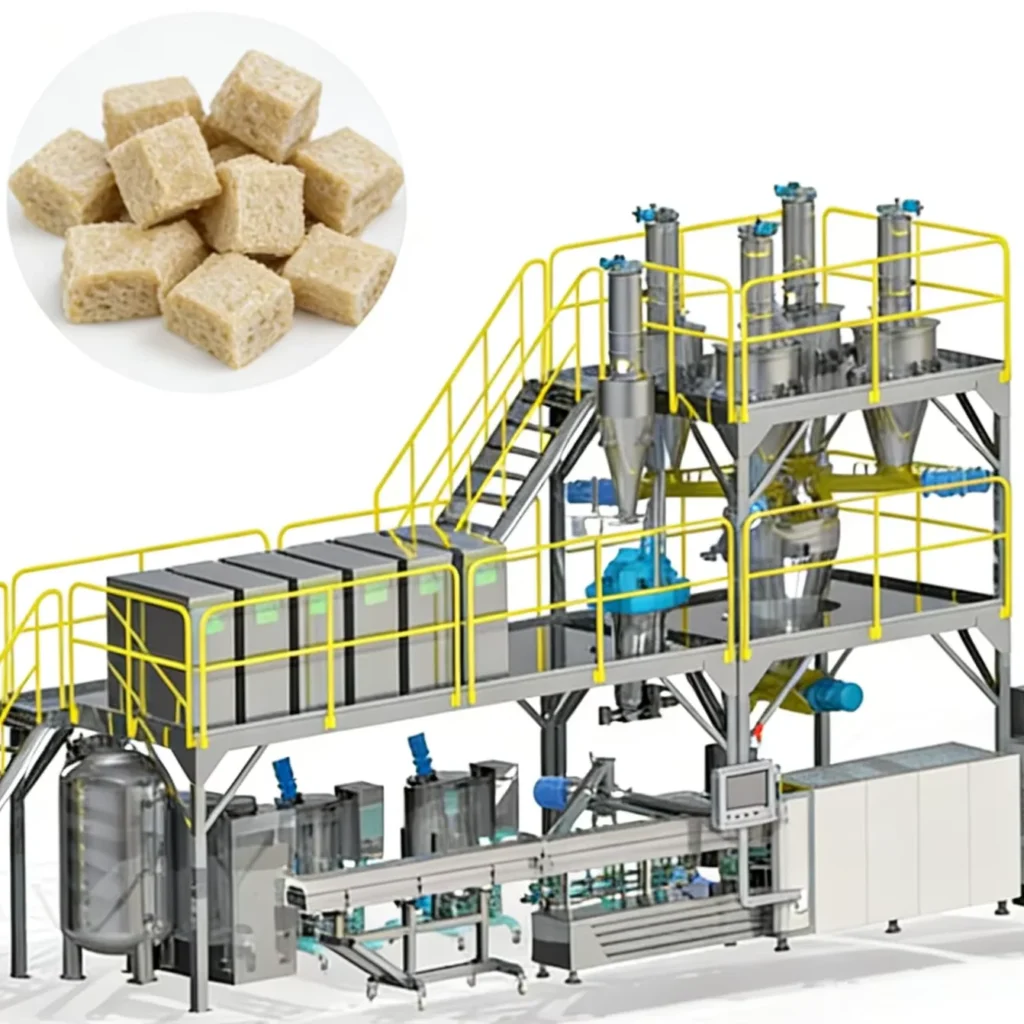
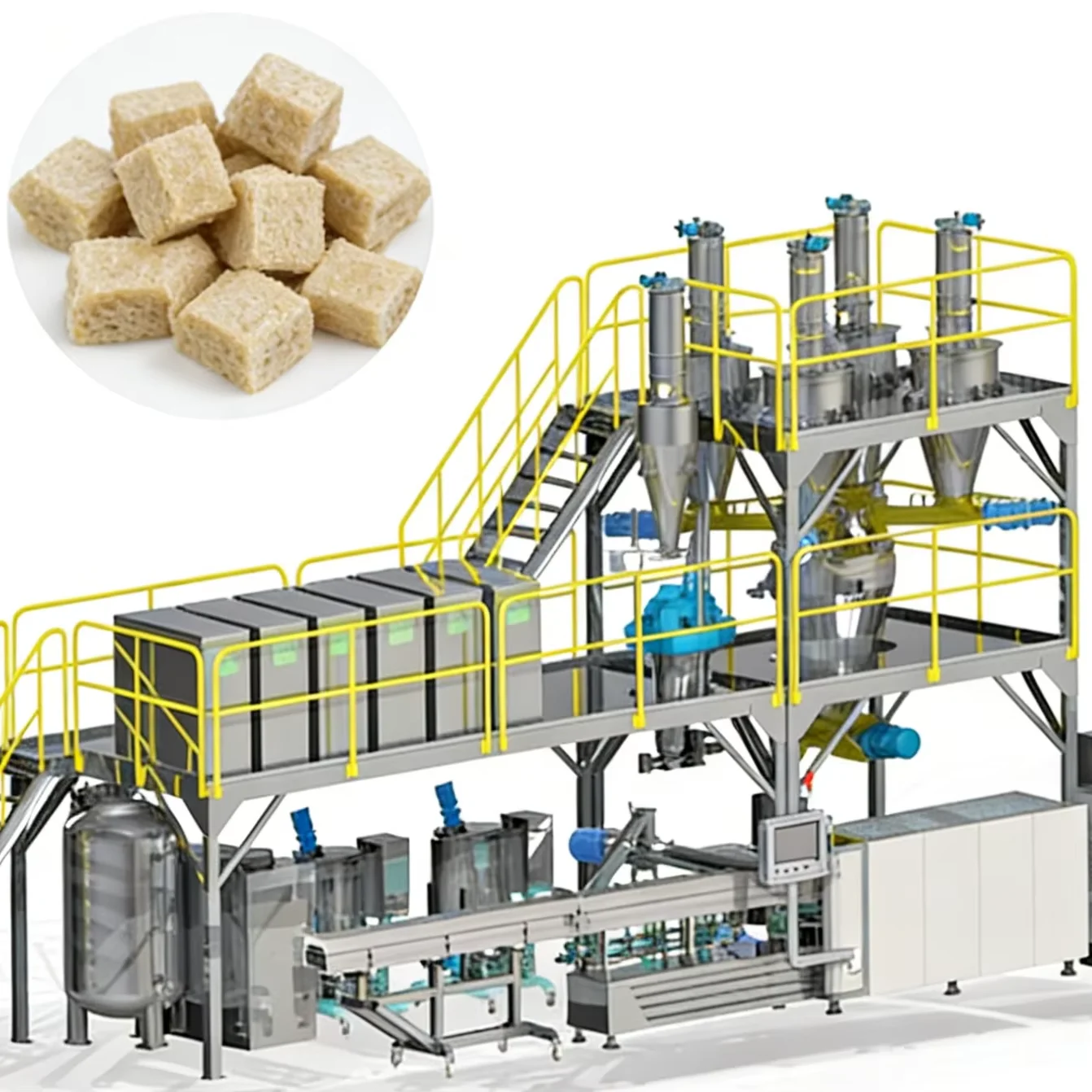
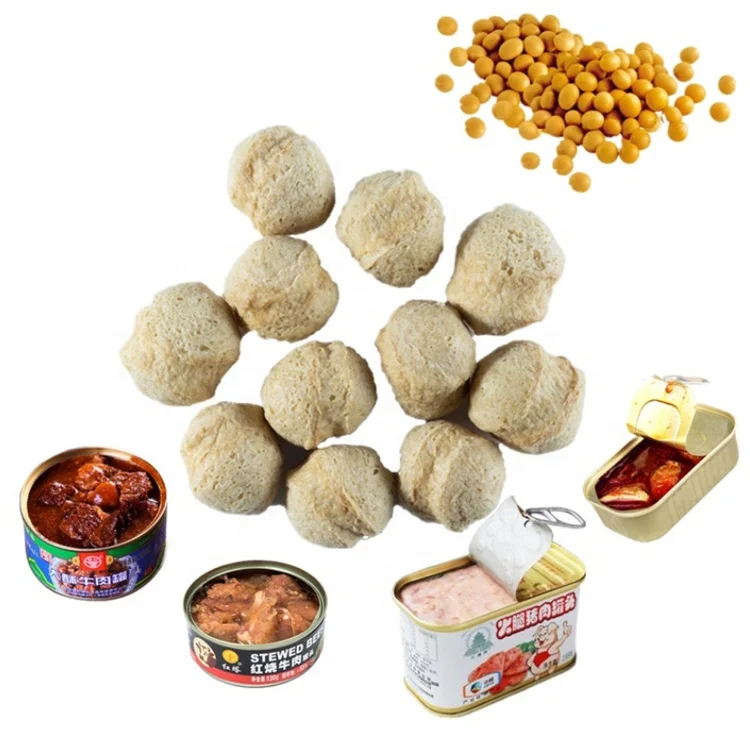
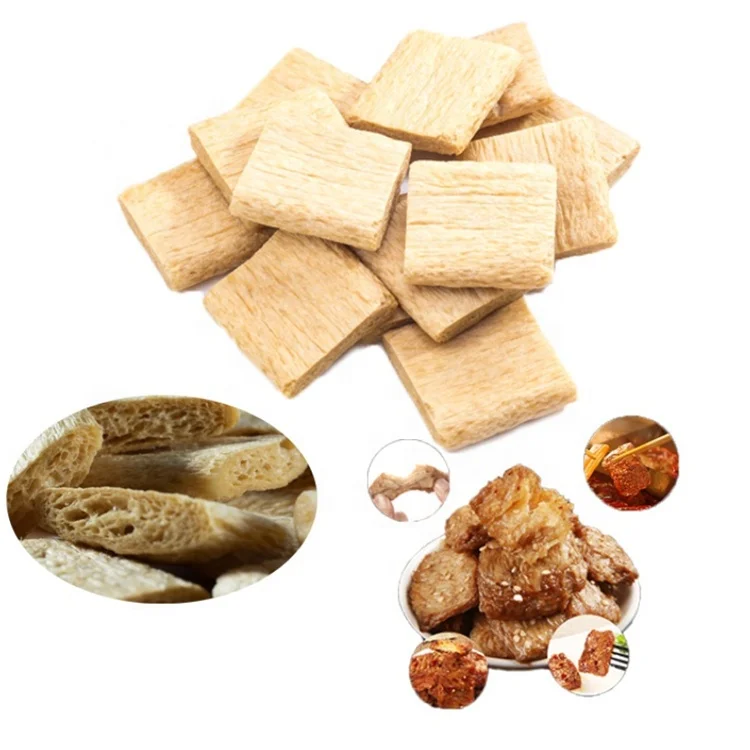

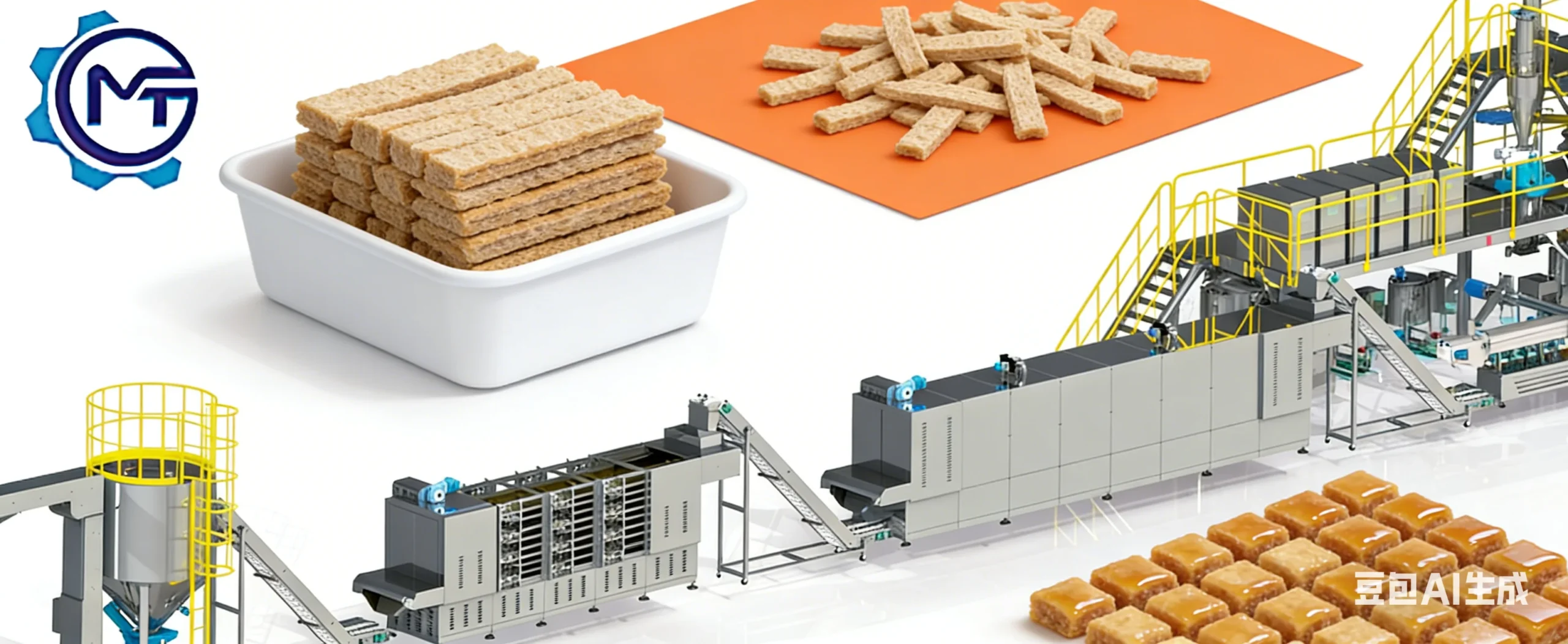
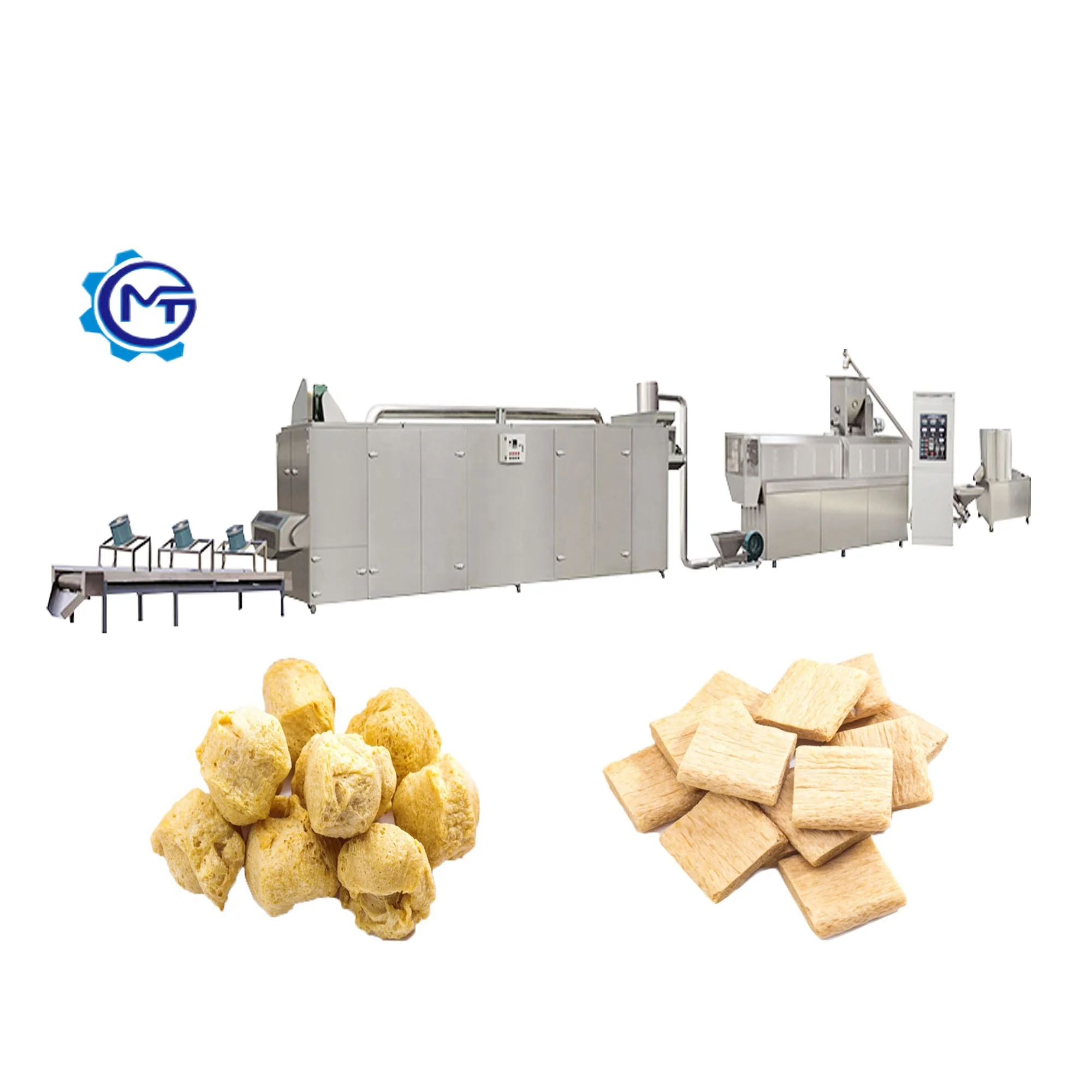
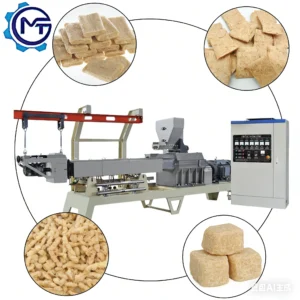
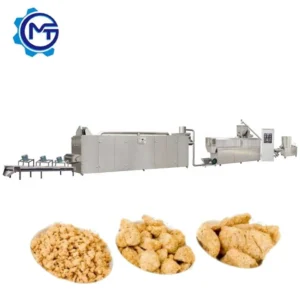
MT65, MT70, MT75, MT85 TVP Extrusion Production Line, Twin Screw, Multi-layer Dryer — complete texturized vegetable protein line from batching through extrusion to cooling, with throughput matched across every station. Screw configuration and die design are specified to your raw material and target TVP density, ensuring consistent fibre structure from soya nuggets to chunks.
- Models MT65 through MT85 with installed power from 84 kW to 210 kW
- Multi-layer dryer with adjustable temperature and round-trip chain drive for uniform moisture removal
- Interchangeable die moulds for varied product shapes on one extruder platform
Pre-shipment trial runs on your actual defatted soya flour are conducted in our in-house testing workshop, confirming product texture and output before installation.
Description
Integrated Line Balancing — Every station from mixer to cooling is sized to hold the extruder’s rated throughput without creating a bottleneck on your actual protein formulation.
Technical Specifications
| Parameter | Value |
|---|---|
| Product Type | Texturized Vegetable Protein (TVP) Extrusion Production Line |
| Models Available | MT65, MT70, MT75, MT85 |
| Extruder Screw Type | Twin screw |
| Screw Length | 1050 mm or 1520 mm (model dependent) |
| Main Motor Power | 22 kW / 30 kW / 45 kW (model dependent) |
| Installed Power | 84 kW (MT65) / 160 kW (MT70) / 190 kW (MT75) / 210 kW (MT85) |
| Power Consumption | 59 kW (MT65) / 120 kW (MT70) / 140 kW (MT75) / 140 kW (MT85) |
| Output Capacity | 100–150 kg/h (MT65, basis not stated in source); 150–200 kg/h (MT70/MT75, basis not stated in source); 250–300 kg/h (MT85, basis not stated in source) |
| Overall Dimensions | Up to 45000 × 1500 × 3500 mm (MT85) |
| Heating Power | 10 kW / 14 kW (model dependent) |
| Feeding Motor Power | 0.75 kW |
| Rotary Cutting Motor Power | 0.75 kW |
| Mixer Type | Vertical mixing machine with stainless steel 304 mixing ruler |
| Mixer Power Options | 4 kW / 7.5 kW / 15 kW |
| Dryer Type | Multi-layer, double pitch roller chain drive, round-trip drying |
| Dryer Heating Options | Fuel, gas, or electricity |
| Line Sequence | Mixer → Screw Conveyor → Twin Screw Extruder → Air Conveyor → Multi-layer Dryer → Cooling Machine |
| Die Configuration | Interchangeable moulds for nuggets, chunks, and varied shapes |
| Standards | CE |
Application Suitability
| Application | Material or Output |
|---|---|
| Soya nugget and soya chunk production | Defatted soya flour, low-temperature soya flakes |
| Plant-based meat analogue manufacturing | Texturized vegetable protein for patties, strips, and ground-meat substitutes |
| Meat substitute ingredients for frozen food | TVP chunks and granules formulated for deep-frozen applications |
| Vegetarian snack and fast-food protein | Extruded TVP pieces shaped for breading, frying, or seasoning |
| Turnkey vegetarian protein facility projects | Full line from raw material batching through extrusion, drying, and cooling |
Why "Rated Capacity" Fails When the Protein Source Changes
A TVP extrusion production line turnkey quoted at a nominal output figure means very little if the screw configuration and barrel profile were set for a different protein base than yours.
I learned this the hard way a couple of years ago. We sent a plant-based meat line to a Middle East customer configured around standard defatted soya flour parameters. Their actual formulation ran a high proportion of pea protein. When we arrived on site for commissioning, the extrudate came out sticky and the chunks fell apart on the dryer belt. We spent two weeks reworking the screw element combination and temperature zones before the product held its fibrous structure. Since then, I will not let a line ship without a trial run on the buyer’s actual raw material in our testing workshop [NEED_CITE: importance of pre-shipment trial runs for protein extrusion]. The rated capacity on paper only becomes real capacity when it is validated on your specific flour blend, moisture level, and target density.
Matching Extruder Output to Dryer Residence Time
The twin screw extruder generates moist, expanded TVP that must lose a precise amount of water to lock in its fibrous texture. If the multi-layer dryer is undersized relative to extruder output, chunks exit too wet, clump during cooling, and spoil in storage. Oversizing the dryer wastes floor space and energy. On this TVP extrusion production line turnkey, each model tier pairs the extruder barrel volume with a dryer belt length and heating capacity calculated for the specific moisture removal load, so the line runs continuously without material backing up at any station.
Screw Configuration Dictates the Protein Fibre You Can Sell
The fibrous, meat-like bite of TVP comes from how the twin screw elements shear, mix, and align the protein molecules under heat and pressure. A screw setup designed for soya chunks will not produce the same strand structure when switched to a nugget formulation or a pea-protein blend. The interchangeable die moulds on this line let you change the external shape — nuggets, chunks, or granules — but the internal texture depends entirely on the screw element arrangement and barrel temperature profile. Our configuration record documents the exact element sequence matched to your target product, and we adjust it during the pre-shipment trial if the texture does not meet your specification [NEED_CITE: twin-screw element configuration for texturized protein].
Reading the Power and Dimension Figures
The installed power across the four models ranges from 84 kW on the MT65 to 210 kW on the MT85, but actual consumption sits lower — 59 kW to 140 kW respectively — because heaters cycle and motors rarely draw full rated current at steady state. The overall length reaches 45 metres on the MT85, which means your facility needs a clear run with adequate service access on both sides. The main motor steps from 22 kW to 45 kW across the range, directly governing how much mechanical energy the screws can deliver per kilogram of protein flour. Higher motor power allows longer screw assemblies — up to 1520 mm — giving the material more residence time for complete protein texturization. The mixer power options of 4 kW, 7.5 kW, and 15 kW correspond to batch capacities that must align with the extruder’s feed rate; an undersized mixer forces the extruder to idle between batches.
The Cost of Skipping the Voltage Conversation
Voltage, frequency, and control language sound like paperwork details until commissioning day. A line wired for 380 V / 50 Hz dropped into a 440 V / 60 Hz facility will either trip breakers or run motors outside their thermal rating, shortening bearing and winding life. Control panels labelled in a language the local operators cannot read lead to parameter errors during recipe changes. We confirm electrical schematics, supply voltage, and HMI language before production begins so the TVP extrusion production line turnkey powers up correctly the first time [NEED_CITE: electrical standards for food processing machinery exports].
Why Source the Entire Line from One Build
Every station on this line — vertical mixer, screw conveyor, twin screw extruder, air conveyor, multi-layer dryer, cooling machine — is specified and built under a single project scope. Throughput is calculated end-to-end rather than assembled from separate vendor quotes that may not align. The screw and die configuration is matched to your raw material and target texture during a factory trial run before dispatch. Electrical schematics and voltage requirements are locked in before fabrication, not improvised at installation. On-site commissioning covers parameter tuning, operator training, and a wear-parts handover so your team can run independently from day one. Documentation travels with the machine, including the trial run report on your specific protein formulation [NEED_CITE: turnkey project documentation standards for food extrusion lines].
Documentation & Verification
- Line layout drawing with station-by-station throughput calculation for your TVP output target
- Screw element arrangement and die mould record matched to your protein formulation
- Trial run report on your raw material produced in the testing workshop before shipment
- Electrical schematic with confirmed voltage, frequency, and control language
- CE declaration of conformity covering the complete extrusion line assembly
- Operation and maintenance manual with wear-parts replacement intervals
Installation, Commissioning & Support
- Foundation plan accounts for the line’s full length up to 45 metres and dryer weight distribution
- Dedicated power circuit sized to the model’s installed power rating up to 210 kW
- Modular station assembly allows phased positioning within facilities with limited overhead clearance
- First-run parameter tuning covers barrel temperature zones, screw speed, and dryer belt timing
- Operator training addresses recipe changeover procedures and die mould swap sequences
- Wear parts list includes screw elements, die plates, and mixer ruler blades with reorder references
What We Need to Configure Your Line
Send us the protein base you plan to run — defatted soya flour, pea protein, or a blend — along with your target product shape and daily output goal. We also need your facility’s available floor length, ceiling height, and local supply voltage and frequency. If you can ship a sample of your raw material, we will run a trial in our testing workshop and include the results with the proposal so you can see the actual texture and throughput before committing to the build.
Frequently Asked Questions
Q: How is throughput balanced across every station to prevent bottlenecks?
A: Each station is sized against the extruder’s output on your specific formulation. Mixer batch capacity, conveyor transfer rate, dryer belt length, and cooling airflow are all calculated from the same throughput figure so material flows continuously without queuing at any point.
Q: Can we send our raw material for a trial run before shipment?
A: Yes. We run your defatted soya flour, soya flakes, or alternative protein blend through the extruder in our testing workshop. The trial run report documents screw speed, temperature profile, die selection, and resulting product texture, giving you verified data before the line ships.
Q: How do you confirm voltage and control language before production?
A: During the specification stage we collect your site’s supply voltage, frequency, and preferred HMI language. The electrical schematic is updated and signed off before fabrication so motors, heaters, and the control panel arrive configured for your facility.
Q: How is the screw configuration selected for our target TVP shape and density?
A: Screw element arrangement and barrel temperature zones are matched to your protein source and target fibre structure. The trial run validates texture and density; if adjustments are needed, we modify the element sequence and re-test before finalizing the configuration record.
Q: What does on-site commissioning include?
A: Our team handles mechanical assembly, electrical connection verification, parameter tuning on your raw material, and operator training covering recipe changeover, die swaps, and daily maintenance. A wear-parts list with reorder references is handed over at project close.
Related products
-
Meat Taste Textured Soybean Protein Processing Machine Vegetable Protein Soy Meat Making Machine
¥8,650.00 Select options This product has multiple variants. The options may be chosen on the product page -
Soybean Protein Making Machine Automatic Soy Chunk Production Line
¥30.00 Select options This product has multiple variants. The options may be chosen on the product page -
High Moisture Vegetarian Meat Extrusion Machine
¥9,500.00 Select options This product has multiple variants. The options may be chosen on the product page -
New Pea and Soybean Protein Production Line Equipment with Mechanical Extruder Food Grade Stainless Steel High Productivity
¥65.00 Select options This product has multiple variants. The options may be chosen on the product page