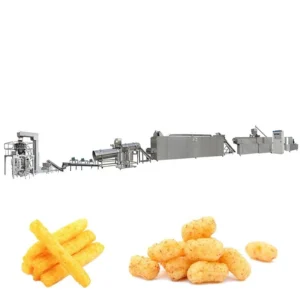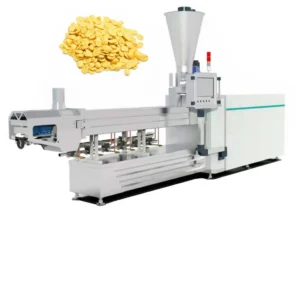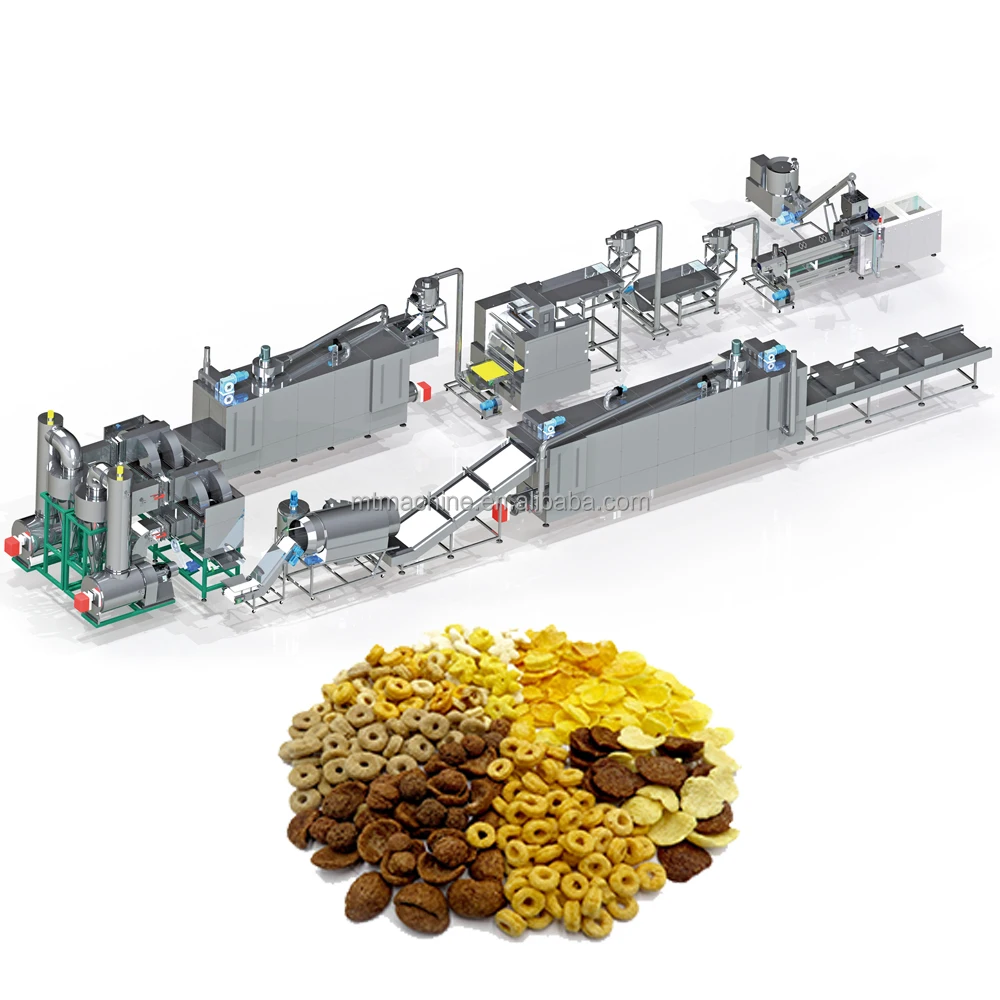
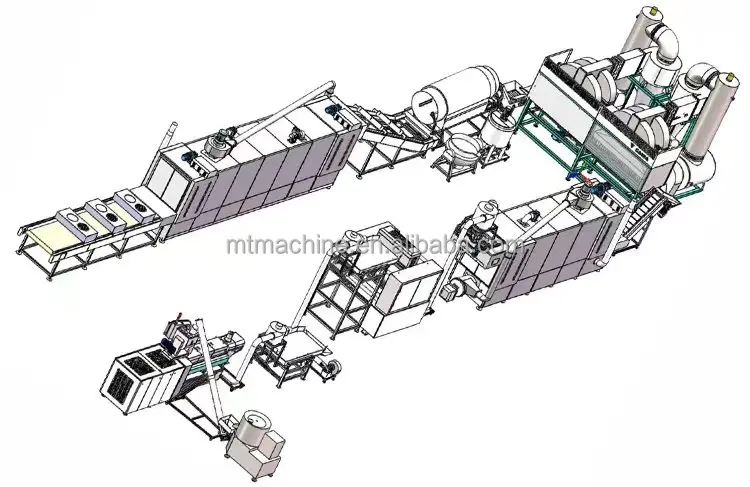
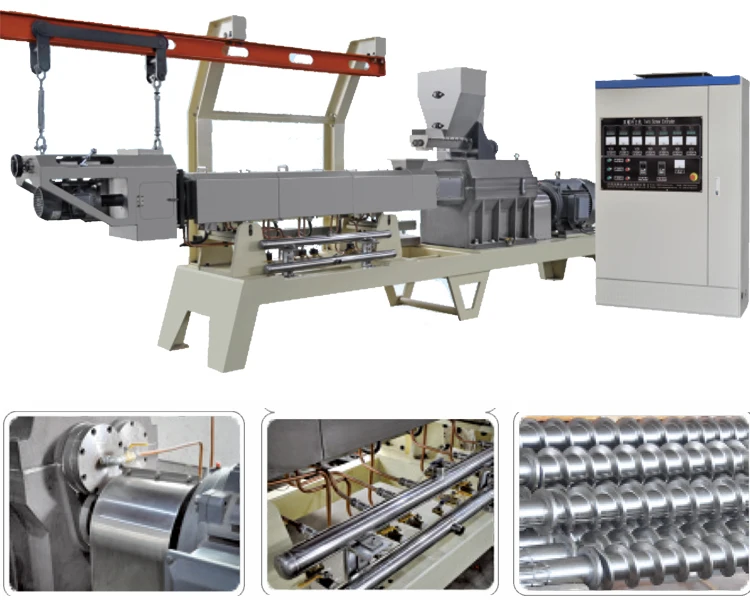
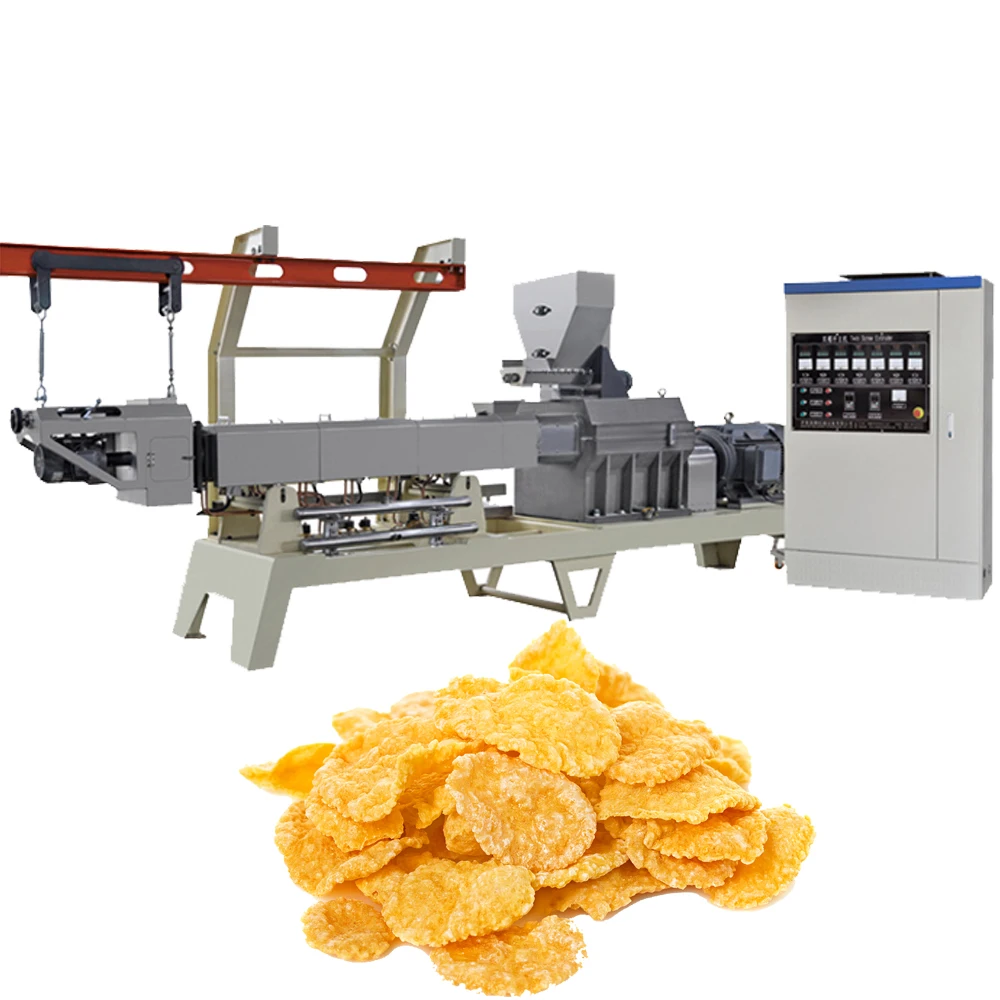
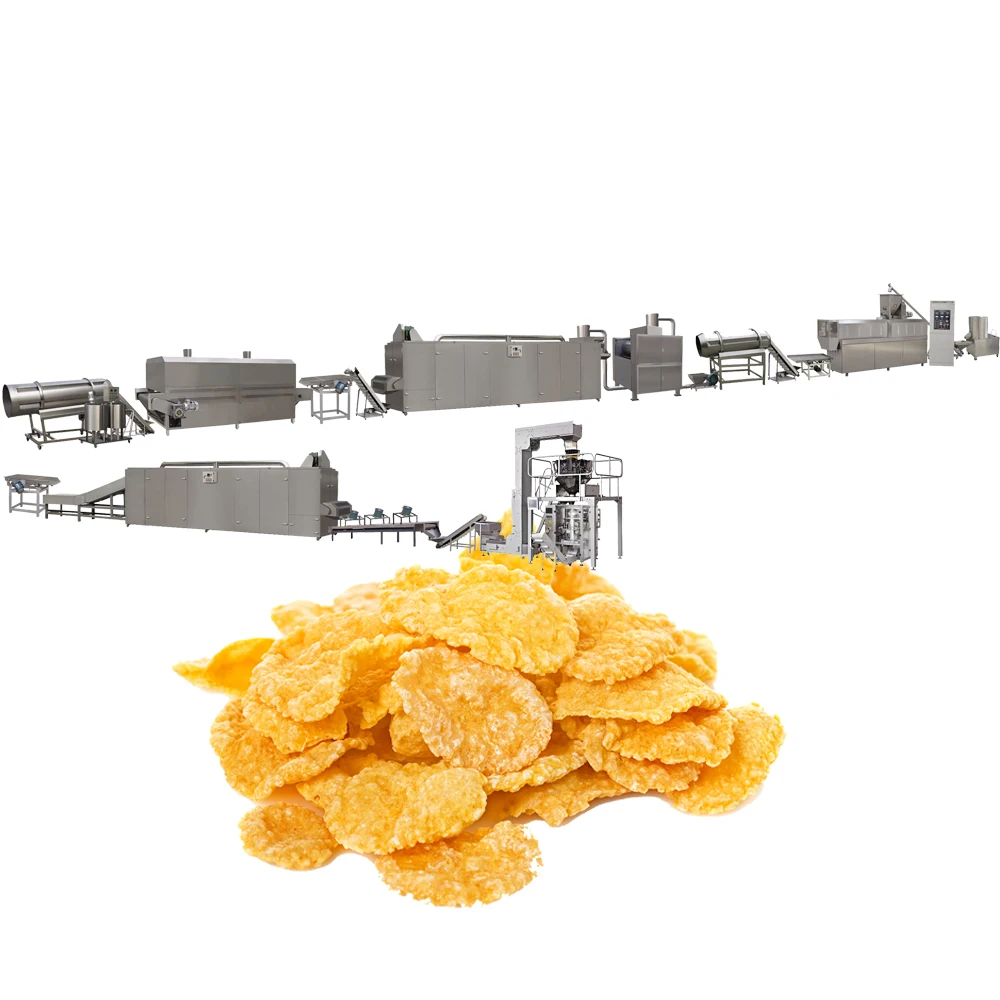

MT-75 Twin Screw Extruder Corn Flakes Production Line, 200-300 kg/hr, PLC Control, Hydraulic Flaking System — complete turnkey line from mixing through extrusion, flaking, hot air roasting to packing. Screw configuration and die design are matched to your raw material and target flake density, with hydraulic double-roller flaking and infrared temperature control ensuring consistent thickness. Hot air roasting oven delivers uniform surface bubbling and crispness with cyclone dust removal.
- Line layout and capacity calculation with throughput matched across every station
- Trial run on your actual raw material before shipment
- Electrical schematic with voltage and frequency confirmed for your market
Description
Throughput Matching by Design — every station from the mixer to the packing conveyor is sized against the extruder’s actual output on your grain recipe, so the corn flakes production line turnkey you receive runs without bottlenecks from day one.
Technical Specifications
| Parameter | Value |
|---|---|
| Model | MT-75 |
| Product Type | Twin Screw Extruder Corn Flakes Production Line |
| Screw Configuration | Twin-screw, material-specific profile |
| Output Capacity | 200-300 kg/hr (basis not stated in source — confirm raw material / moisture content) |
| Voltage Options | 220V / 380V, configurable to site supply |
| Flaking System | Hydraulic double-roller, PLC-controlled, infrared temperature monitoring |
| Roasting Oven | Vibrating pan, cyclone dust removal, dual circulating fans |
| Coating System | Double tumble sugar melter, elevator, spray nozzle coating drum |
| Heating Source (Dryer) | Gas or Electric, selectable |
| Control System | PLC automation with MCC integration |
| Core Components Warranty | 1 Year (gearbox covered) |
| Assembly State | Complete turnkey line, factory-tested before shipment |
Application Suitability
| Application | Material or Output |
|---|---|
| Corn flakes production | Degermed corn grits, maize flour blends |
| Wheat and barley flakes | Whole or pearled wheat, rolled barley grain |
| Rice and oat flakes | Broken rice, dehulled oat groats |
| Sugar-coated breakfast cereal | Any base flake with sugar, honey or malt syrup coating |
| Fortified cereal manufacturing | Grain blends with added vitamin and mineral premix |
What "Nominal Capacity" Leaves Out on a Corn Flakes Line
A rated output figure means nothing if the flaking station and roasting oven cannot absorb what the extruder actually produces on your grain.
I watched a breakfast cereal project stall for a full week because the extruder was quoted at a nominal throughput tested on soft wheat, but the buyer’s local corn variety had a much higher amylose content. The dough came out too stiff, the flakes cracked during pressing, and the roasting oven could not keep up with the altered moisture profile. The corn flakes production line turnkey had to be re-parameterised from scratch [NEED_CITE: grain amylose variability affecting extrusion behaviour]. That delay cost more than any price difference between suppliers. When throughput across stations is not verified against your actual raw material before the machines leave the factory, the bottleneck simply moves downstream and hides until commissioning.
Screw Profile and Die Geometry for Flake Consistency
Flake texture starts inside the extruder barrel. The twin-screw configuration on the MT-75 allows operators to adjust screw element sequencing — mixing intensity, residence time, and shear profile — so the cooked dough exits with the exact gelatinisation degree your corn variety requires. Die geometry then determines strand cross-section before the flaking rollers take over. A die designed for a generic recipe will produce strands that flatten unevenly, giving you thin edges that over-roast and thick centres that stay chewy.
Why the Roasting Oven Must Match Extruder Moisture Output
The vibrating pan roasting oven uses high-temperature spray tubes and two separate circulating fans to drive surface bubbling and final crispness. But its effectiveness depends entirely on the moisture content entering from the dryer upstream. If the extruder is running a wetter dough than the dryer was sized for, flakes enter the oven carrying excess moisture, the surface cannot blister properly, and you end up with a dense, hard product [NEED_CITE: moisture-temperature interaction in cereal roasting]. This is why the corn flakes production line turnkey must have its dryer and oven capacities calculated together, not sourced independently.
Reading the Specs That Matter for Breakfast Cereal Quality
The hydraulic double-roller flaking machinery uses separate motors for each roller, allowing differential speed adjustment that controls flake thickness within tight tolerances — critical when your market expects a specific bowl-life and crunch duration. Infrared sensor temperature control on the rollers prevents surface scorching during high-speed runs. The cyclone dust removal in the roasting oven is not just a housekeeping feature; it pulls fine particulate away before it can carbonise and deposit bitter notes on the flakes. Gas or electric heating selection affects your utility planning and per-shift energy cost, so this choice should be locked in before the line layout is finalised [NEED_CITE: industrial gas versus electric heating efficiency for cereal processing]. The PLC control system ties these stations together so that recipe changes — say, switching from corn to oat flakes — can be executed as a stored parameter set rather than a manual recalibration at every machine.
The Hidden Cost of Mismatched Station Throughput
When an extruder is paired with an undersized flaking unit, operators slow the entire front end to match the slower station. Output drops, but the buyer still paid for the higher capacity. Worse, the dough sits longer in the extruder barrel, over-gelatinising and producing a sticky mass that fouls the die. I have seen this force a full barrel clean-out every few hours, turning what should be continuous production into a batch-and-stop operation [NEED_CITE: consequences of extruder-flaker throughput mismatch in cereal lines]. The sugar coating drum presents a similar trap: if tumble speed and spray rate are not calibrated to upstream output, flakes either receive an uneven glaze or clump together, generating waste that never reaches the packing station.
Why Procurement Through This Channel Works
Every station in the corn flakes production line turnkey is configured under a single engineering scope, meaning throughput calculations run across the entire chain rather than per machine. The screw and die set is specified to the buyer’s raw material, not copied from a catalogue build. A trial run using your actual grain is conducted in the testing workshop before shipment, so texture and density are confirmed before you commit to commissioning. Electrical schematics are drawn with your local voltage and frequency validated in advance [NEED_CITE: export machinery voltage and frequency confirmation practices]. Post-installation, operator training covers recipe storage and changeover on the PLC, not just basic start-stop procedures.
Documentation & Verification
- Line layout drawing with station-by-station throughput balance for your target flake output
- Screw element sequence and die specification record matched to your grain recipe
- Trial run report documenting flake density and moisture on your supplied raw material
- Electrical schematic confirming voltage, frequency, and control language for your facility
- CE declaration of conformity and ISO certificate for customs and regulatory clearance
- Operation manual with PLC recipe parameter tables and preventive maintenance intervals
Installation, Commissioning & Support
- Foundation load calculations for the MT-75 extruder and hydraulic flaking unit placement
- Dedicated circuit planning for 380V extruder drive and roasting oven heating elements
- Modular shipment with on-site mechanical and electrical assembly sequence provided
- First-run parameter tuning covering screw speed, roller gap, and oven temperature profiles
- PLC recipe programming for corn, wheat, and oat flake changeovers during commissioning week
- Wear parts list covering screw elements, die inserts, and roller surfaces with reorder intervals
What We Need to Move Your Inquiry Forward
Share your primary grain type and any secondary grains in your recipe, along with target daily output and shift pattern. Include your workshop dimensions and ceiling height so we can draft the line layout. Confirm the local voltage supply and frequency, plus your preferred control language for the PLC interface.
Frequently Asked Questions
Q: How is line capacity verified on my specific raw material and recipe?
A: Before shipment, your grain is run through the extruder and downstream stations in the testing workshop. Flake density, moisture at each stage, and final texture are recorded in a trial run report. Capacity figures in the quotation reflect what the line produced on your actual material, not a generic benchmark.
Q: What is the phased installation and commissioning schedule for a complete line?
A: Mechanical assembly of the MT-75 extruder, flaking unit, dryer, and roasting oven typically spans the first week. Electrical connections and PLC integration follow. The second week covers dry runs, parameter tuning on your grain, and operator training on recipe storage and changeover procedures.
Q: How do you ensure throughput matching between extruder, flaking, and roasting stations?
A: Each station is sized using mass-balance calculations that account for moisture loss at drying and roasting stages. The flaking rollers and roasting oven are specified to absorb the extruder’s actual output on your recipe, preventing the bottleneck that occurs when stations are sourced from separate vendors.
Q: How are utility requirements planned for the full line layout?
A: Steam demand for conditioning, gas or electric load for the dryer and roasting oven, and compressed air for the PLC-controlled actuators are mapped in the layout drawing. This allows your facility team to confirm utility availability before the line arrives on site.
Related products
-
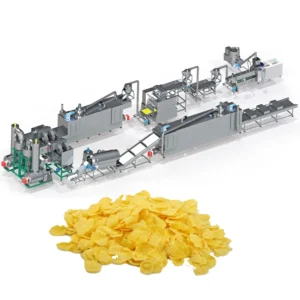
New High Efficiency Electric Corn Flakes Production & Manufacturing Machine
¥7,500.00 Select options This product has multiple variants. The options may be chosen on the product page -
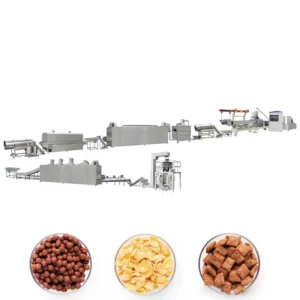
1000 Lbs Automatic Corn Flakes Production Line Mixer Breakfast Cereal Corn Flakes Production Line
¥45,000.00 Select options This product has multiple variants. The options may be chosen on the product page -
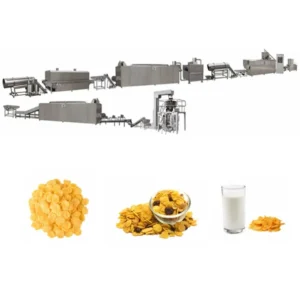
Cereals Corn Flakes with Sugar Corn Flakes Extrusion Food Machine Breakfast Cereal Production Line
¥23,000.00 Select options This product has multiple variants. The options may be chosen on the product page -

200kg/h Breakfast Cereal Extruder Making Machine Hot Sale Corn Flake Production Line
¥30,000.00 Select options This product has multiple variants. The options may be chosen on the product page