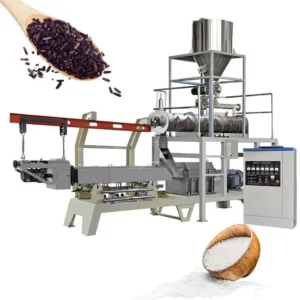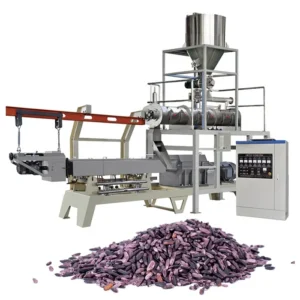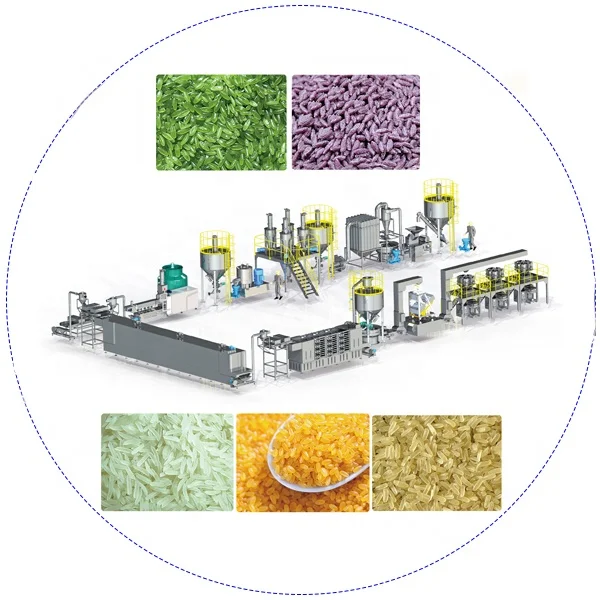

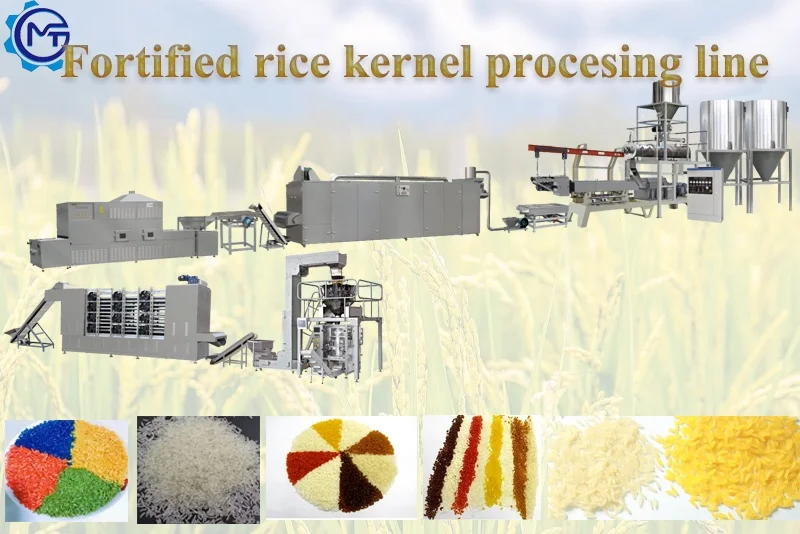


MT65 / MT70 / MT85 / MT75 / MT95 Fortified Rice Processing Line, Twin-Screw Extrusion, PLC Control — engineered as a complete turnkey project from batching through extrusion, drying, roasting and packing, with throughput matched at every station to prevent bottlenecks on your grain and micronutrient formulation.
- Screw configuration and die design specified to the buyer’s raw material and target kernel density
- Frequency-controlled extruder drive and dryer mesh belt for flexible production rate adjustment
- Circulation drying with uniform moisture across fortified rice kernels
In-house testing workshop validates your actual raw material before shipment, ensuring the line performs as specified from day one.
Description
Matched Throughput Stations — Every mixing, extruding, drying and packing unit in this line is sized against your actual grain and micronutrient formulation, so one station never starves or floods another.
Technical Specifications
| Parameter | Value |
|---|---|
| Product Type | Fortified Rice Processing Line |
| Line Stations | Mixing → Extruding → Vibrating → Low Temperature Drying → Cooling → High Temperature Roasting → Cooling → Packing |
| Extruder Type | Twin Screw |
| Screw Material | Special wear-resistant alloy |
| Feeding System | Single or double screw feeding (selected according to material) |
| Control System | Frequency speed controlling, automatic lubricating and cooling |
| Dryer Heating Source | Electric or gas |
| Dryer Process | Circulation drying, frequency motor controls mesh belt speed |
| Model MT65 Installed Power | 85 kW |
| Model MT65 Power Consumption | 60 kW |
| Model MT65 Output Capacity | 80–100 kg/h (basis not stated in source — confirm raw material formulation and moisture content) |
| Model MT65 Overall Dimensions | 28 × 1.2 × 2.2 m |
| Model MT70 Installed Power | 120 kW |
| Model MT70 Power Consumption | 85 kW |
| Model MT70 Output Capacity | 100–120 kg/h (basis not stated in source — confirm raw material formulation and moisture content) |
| Model MT70 Overall Dimensions | 30 × 1.5 × 2.2 m |
| Model MT85 Installed Power | 235 kW |
| Model MT85 Power Consumption | 165 kW |
| Model MT85 Output Capacity | 200–300 kg/h (basis not stated in source — confirm raw material formulation and moisture content) |
| Model MT85 Overall Dimensions | 34 × 3.5 × 4.3 m |
| Model MT75 Installed Power | 180 kW |
| Model MT75 Power Consumption | 135 kW |
| Model MT75 Output Capacity | 300–500 kg/h (basis not stated in source — confirm raw material formulation and moisture content) |
| Model MT75 Overall Dimensions | 32 × 3.5 × 4.3 m |
| Model MT95 Installed Power | 260 kW |
| Model MT95 Power Consumption | 195 kW |
| Model MT95 Output Capacity | 800–1000 kg/h (basis not stated in source — confirm raw material formulation and moisture content) |
| Model MT95 Overall Dimensions | 36 × 3.5 × 4.3 m |
| Standards | CE, ISO |
Application Suitability
| Application | Material or Output |
|---|---|
| Government nutritional programmes | Fortified rice kernels with precise vitamin and mineral dosing |
| Grain reprocessing plants | Artificial rice from broken rice, rice bran, and starch |
| Fortified staple food exporters | Enriched kernels from corn, millet, wheat, oats, buckwheat, and beans |
What "300 kg/h Output" Leaves Out About a Fortified Rice Processing Line Turnkey
Capacity numbers on paper mean nothing until the extruder, dryer, and roaster all hold that rate on your exact grain blend.
I once watched a buyer discover on commissioning day that his extruder could push 300 kg/h on plain rice flour, but once whey protein and a micronutrient premix entered the barrel, the starch gelatinisation window shifted and throughput dropped noticeably. The dryer, sized for the higher rate, then ran half-empty and wasted energy. A turnkey project only stays turnkey when every station is calculated against the formulation you will actually run [NEED_CITE: starch gelatinisation behaviour under protein-enriched extrusion conditions].
Barrel and Screw Geometry for Grain-Micronutrient Blends
A fortified rice processing line turnkey succeeds or fails at the screw. The twin-screw configuration here is specified to the buyer’s grain base and micronutrient ratio, meaning pitch, flight depth, and kneading block arrangement are chosen so that starch reaches the correct gelatinisation degree without degrading heat-sensitive vitamins.
Dryer Sizing Against Extruder Throughput
The circulation dryer uses a frequency-controlled mesh belt, allowing belt speed to track the extruder output rate. When a batch contains added fat or protein, moisture release slows, and belt speed must decrease to hold uniform kernel moisture before the high-temperature roaster.
Low-Temperature and High-Temperature Stages Explained
Low-temperature drying removes surface and free moisture gently so the kernel skin does not case-harden. The subsequent high-temperature roasting stage then develops the characteristic cooked-rice aroma and sets final hardness. Skipping either stage produces kernels that crack during storage or fail the bite-test panels expect [NEED_CITE: two-stage drying protocol for extruded rice kernels].
Reading the Specification Table for Your Project
Installed power ranges from 85 kW on the MT65 to 260 kW on the MT95, reflecting the combined draw of extruder drive, feeder, and dryer heating. The larger MT85, MT75, and MT95 models carry wider dimensions (34–36 m line length, up to 4.3 m height) that demand proportionally larger workshop clearance. Selecting the correct model depends on confirming your daily target against the formulation you will actually feed into the hopper.
The Hidden Cost of an Unmatched Dryer
Buyers often size the extruder first and treat the dryer as an afterthought. When dryer capacity lags, wet kernels queue on the conveyor, surface moisture rises, and downstream packing receives product outside specification. In one project I saw, the entire line stopped twice a shift because the roaster inlet moisture sensor tripped the interlock.
Why Source the Full Line From One Supplier
Throughput matching across every station is calculated before production begins, not patched on site. The screw and die configuration is recorded against your grain formulation, so re-orders stay consistent. An in-house testing workshop runs your actual raw material before shipment, catching gelatinisation or density issues early. Voltage, frequency, and control language are confirmed against the destination site before wiring starts. Installation engineers remain through commissioning and operator training, so the first production week is not a learning curve.
Documentation & Verification
- Line layout showing station-by-station throughput calculation for your grain blend
- Screw and die configuration record matched to your micronutrient premix ratio
- Trial run report using your actual raw material before dispatch
- Electrical schematic confirming voltage and frequency at destination
- CE declaration of conformity and ISO certificate
- Operation and maintenance manual with wear parts list
Installation, Commissioning & Support
- Foundation plan aligned to the 28–36 m line length and up to 4.3 m headroom requirement
- Dedicated circuit sized for the model’s installed power draw, up to 260 kW
- Station modules shipped in sequence for phased assembly on site
- First-run parameter log covering screw speed, barrel zones, and dryer belt frequency
- Operator training on formulation changeover and die cleaning
- Wear parts list covering screws, dies, and dryer belt sections
What to Include With Your Inquiry
Send your base grain type, micronutrient premix ratio, and target daily output so the line layout can be calculated station by station. Specify workshop floor dimensions, ceiling height, and the local voltage and frequency standard so electrical panels and motor ratings are set before production. Indicate whether you can ship a sample of your raw material for an in-house trial run.
Frequently Asked Questions
Q: How is line capacity verified on my specific grain formulation?
A: We run your actual base grain and micronutrient blend through the extruder in our testing workshop, record screw speed, barrel temperatures, and output rate, and issue a trial run report. Capacity figures in the final quotation reference that specific formulation rather than a generic starch baseline.
Q: How do you match throughput between extruder, dryer, and packing?
A: Each station’s rated rate is calculated from the extruder’s confirmed output on your formulation. Dryer belt speed, roaster residence time, and packing scale intervals are then set so no station accumulates or starves material during continuous operation.
Q: What voltage and control language options are confirmed before production?
A: We confirm local voltage, frequency, and preferred HMI language during the specification stage. The electrical schematic is issued for approval before wiring begins, avoiding rewiring delays during on-site commissioning.
Q: Can I send raw material for a trial run before shipment?
A: Yes. We encourage buyers to ship a representative sample of their grain base and premix. The trial run validates screw configuration, die selection, and drying parameters, and the results are documented in a report shared before the line is crated.
Q: What does the phased installation schedule look like?
A: Station modules arrive in sequence aligned to your floor preparation timeline. Mechanical assembly, electrical termination, and wet commissioning are scheduled as distinct phases, with operator training running parallel to the first production trials.
Related products
-
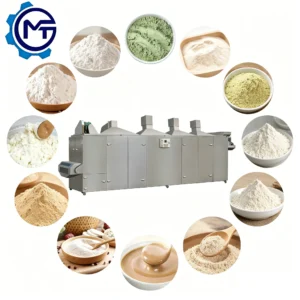
Small Scale MT Brand Automatic Baby Food Nutrition Powder Rice Flour Making Machine with 500kg/h Production Capacity PLC Control
¥9,500.00 Add to cart -

Hygienic Stainless Steel Infant Rice Powder Processing Line Automatic 500kg/h Capacity PLC Controlled
¥9,500.00 Add to cart -
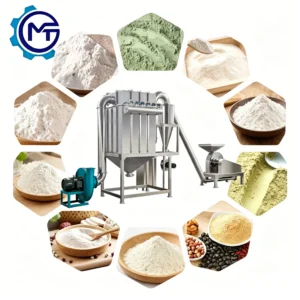
Compact Automatic Baby Cereal Nutrition Powder Production Line with 500kg/h Capacity and PLC Control
¥9,500.00 Add to cart -
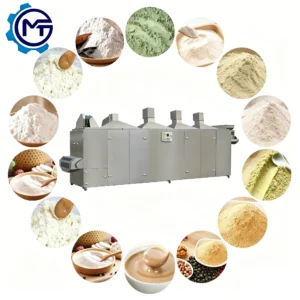
Full Automatic Complete Baby Food Nutrition Powder Porridge Processing Production Line for Infant Nutrition Factory
¥9,500.00 Add to cart