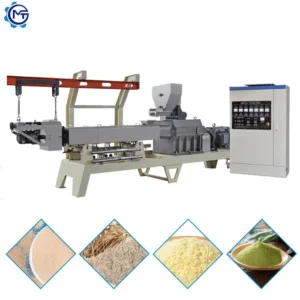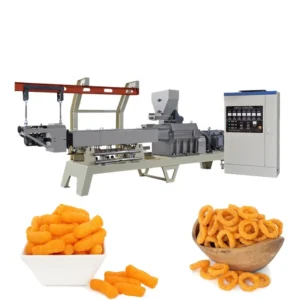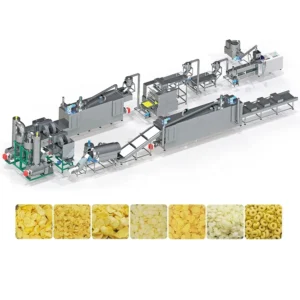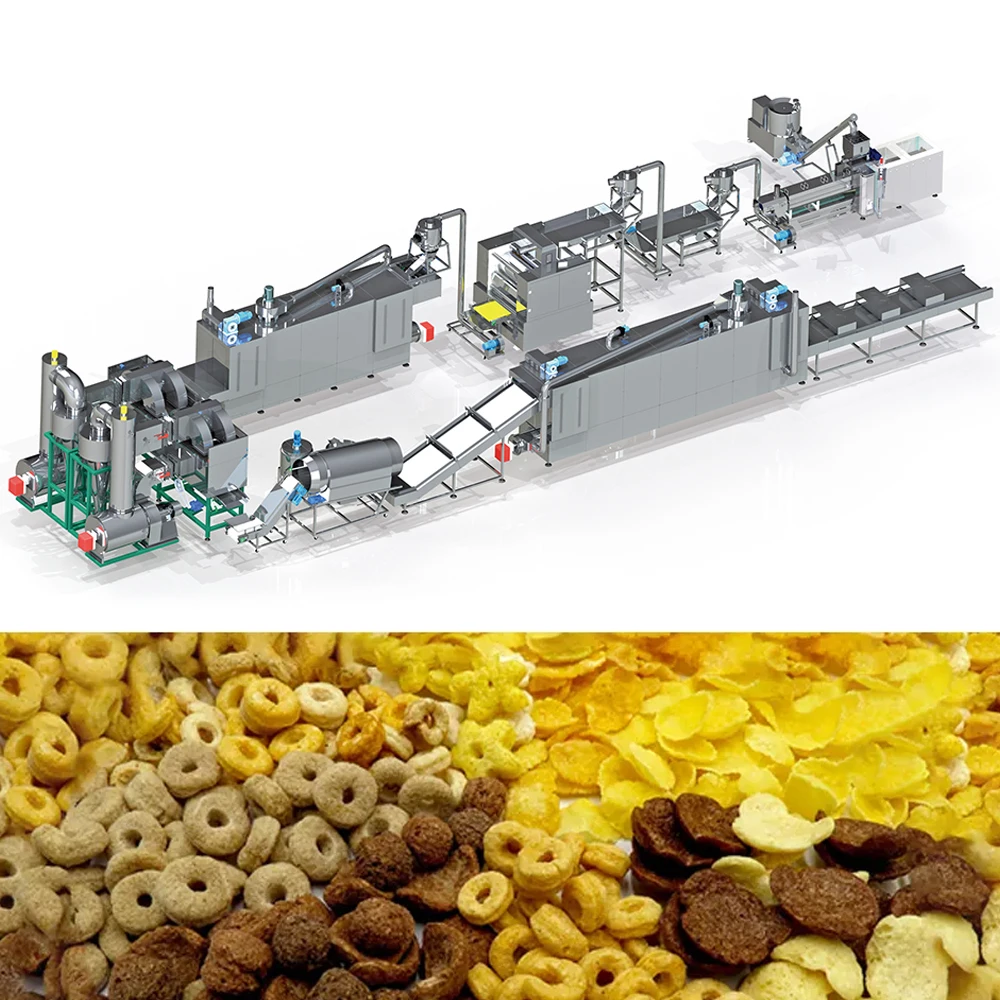
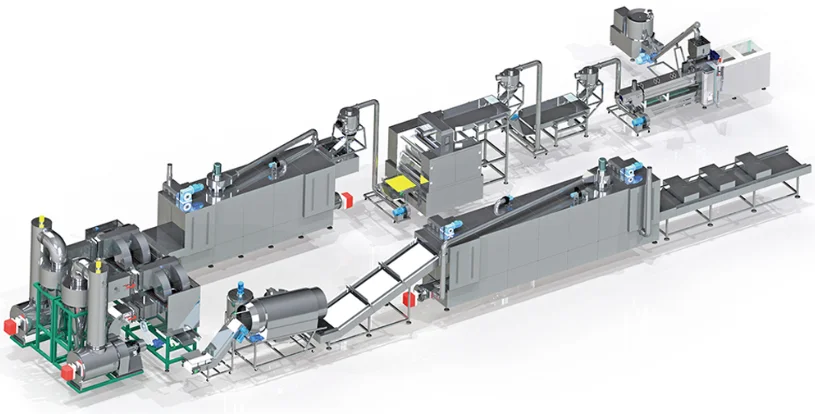


MT70 Corn Flakes Breakfast Cereal Production Line, Twin-Screw, PLC Control — configured for corn, rice, wheat, oat and barley formulations with screw and die geometry matched to target flake density and expansion.
- Hydraulic double-roller flaking with infrared temperature control
- Hot air roasting with dual circulating fans and cyclone dust removal
- Coating station sized to extruder output for natural or sugar-coated flakes
Every station throughput is calculated against your raw material before shipment, with trial runs completed in our testing workshop to verify capacity and product specification.
Description
Complete Turnkey Configuration — Every station from raw material batching to final packing is throughput-matched under one supplier, eliminating the bottleneck risk that arises when assembling a corn flakes line from separate vendors.
Technical Specifications
| Parameter | Value |
|---|---|
| Product Type | Corn Flakes Breakfast Cereal Production Line |
| Model | MT70 |
| Installed Power | 160 kW |
| Power Consumption | 120 kW |
| Capacity | 150–200 kg/h (basis to be confirmed against raw material formulation and moisture content) |
| Overall Dimensions | 41 × 1.5 × 2.2 m |
| Extruder Type | Twin Screw |
| Control System | PLC (flaking machinery); MCC and PLC control (complete line) |
| Flaking Machinery Features | Hydraulic double-roller system; double motors for separate roller driving; infrared sensor temperature pipe control |
| Dryer Heating Source | Gas / Electric |
| Roasting Oven | Hot air roasting; conciliation burner; two separate circulating fans; cyclone dust removal device |
| Coating System | Double tumble for sugar melting; elevator; coating drum; spraying nozzle |
| Production Procedure | Mixing → Extruding → Flaking → Drying → Hot Air Roasting → Sugar Spraying → Sugar Coating → Drying → Cooling → Packing |
| Raw Materials | Corn, rice, wheat, oat, barley powder |
| Final Products | Natural corn flakes; coated corn flakes; shaped cereals (ball, tube, ring, fruit loop, star, wheel) |
| Voltage Options | Customized (commonly 415V 50/60Hz, 440V 50/60Hz, 220V 60Hz) |
| Standards | CE, ISO |
Application Suitability
| Application | Material or Output |
|---|---|
| Traditional Corn Flakes | Yellow or white corn grits, steam-cooked and flaked for breakfast cereal |
| Sugar-Coated Cereal Flakes | Corn or rice base with sugar syrup glazing in the coating drum |
| Shaped Breakfast Cereal | Rings, stars, and fruit loops via die and mould adjustment on the extruder |
| Multi-Grain Flakes | Blends of wheat, oat, and barley powder processed through the same extrusion platform |
What "Nominal Capacity" Leaves Out for Corn Flake Lines
A line rated for a specific output on standard yellow corn often fails to hold that throughput when the buyer switches to a local white corn or multi-grain formulation.
I spent five days in Mexico re-tuning a line because the original setup used parameters for yellow corn while the client ran local white corn. The resulting flakes came out too thick and hard for the flaking rollers to flatten. We had to rebuild the moisture profile in the cooking zone and adjust the shear combination in the extruder to get the correct texture. This is a common failure point. Buyers often commit to a corn flakes breakfast cereal production line turnkey project based on a brochure number, only to find the extruder, flaking mill, and roasting oven cannot sustain that rate on their specific raw material [NEED_CITE: impact of starch gelatinisation on extruder throughput].
Extrusion Shear and Moisture Control
The twin-screw extruder on the MT70 is configured to match the specific starch gelatinisation requirements of the buyer’s cereal formulation. Screw configuration and die design are not generic builds; they are specified to the raw material’s amylose content and the target flake density. This ensures the dough exiting the barrel has the correct plasticity for the downstream flaking rollers, preventing the dough sheet from tearing or sticking. A corn flakes breakfast cereal production line turnkey setup relies entirely on this precise moisture and shear balance to achieve the signature blistered surface after roasting.
Throughput Matching Across the Drying and Roasting Stages
A frequent bottleneck occurs when the extruder output exceeds the capacity of the drying and roasting stages. The MT70 line includes a hot air roasting oven equipped with two separate circulating fans and a cyclone dust removal device to handle the required moisture extraction rate. If the roasting oven cannot remove surface moisture fast enough, the flakes will not achieve the necessary crispness or the characteristic surface blisters. The entire corn flakes breakfast cereal production line turnkey layout is calculated so that the dwell time in the dryer and roaster aligns with the extruder and flaking machinery output, preventing wet product from backing up the line [NEED_CITE: thermal dynamics in cereal roasting ovens].
Decoding the MT70 Power and Control Architecture
The 160 kW installed power rating on the MT70 reflects the combined load of the extruder main drive, the hydraulic flaking rollers, and the drying and roasting heaters. The PLC-controlled flaking machinery uses a hydraulic system to maintain consistent pressure between the double rollers, which is critical for achieving uniform flake thickness. Infrared sensor temperature control on the flaking stage prevents the dough sheet from cooling too much before being pressed, which would otherwise cause cracking. Furthermore, the voltage is customized to the buyer’s facility—commonly 415V or 440V—ensuring the motor drives and heating elements operate within the correct frequency range to avoid premature burnout.
The Hidden Cost of Ignoring Voltage and Utility Planning
Specifying a corn flakes breakfast cereal production line turnkey project without confirming local voltage, frequency, and control language often delays commissioning by several weeks. If the facility runs on 220V 60Hz but the equipment arrives wired for 380V 50Hz, the extruder motor will run at the wrong speed, altering the shear rate and ruining the flake texture. Additionally, control panels programmed in a language the operators cannot read lead to parameter errors during the critical start-up phase. These utility mismatches are a primary cause of delayed production starts [NEED_CITE: electrical compatibility standards in international machinery exports].
Why Source This Line from a Single Contractor
Managing a single supplier for the entire line, from batching to packing, ensures that every station is throughput-matched rather than assembled from disparate vendors. The MT70 comes with a dedicated in-house testing workshop where trial runs are conducted on the buyer’s actual raw material before shipment. This process validates the screw configuration and die design against the specific cereal formulation, providing a trial run report that confirms the target flake density and throughput. Furthermore, the complete documentation package—including the line layout and capacity calculation—supports phased installation and utility planning for the contractor.
Documentation & Verification
- Line layout and capacity calculation mapped to your factory footprint and target output.
- Trial run report on your actual raw material conducted before shipment.
- Screw and die configuration record specific to your cereal formulation.
- Electrical schematic with voltage, frequency, and control language confirmed.
- Operation and maintenance manual for the hydraulic flaking and PLC systems.
Installation, Commissioning & Support
- Foundation planning for the 41-meter line layout and heavy flaking machinery anchors.
- Verification of incoming 160 kW power supply against the customized voltage configuration.
- Calibration of the hydraulic double-roller pressure and infrared sensor temperature control.
- Operator training on the PLC interface for managing the hot air roasting parameters.
- Provision of spare wear parts lists for extruder screws and dies.
Preparing Your Project Brief
To initiate a layout proposal, provide your specific raw material formulation, including moisture content and grain type, alongside your target daily output. Specify the local voltage and frequency, as well as the preferred language for the PLC and MCC control interface. Indicate whether the final product requires the sugar-coating station and if your facility has space constraints that require a customized footprint for the drying and roasting ovens.
Frequently Asked Questions
Q: How is line capacity verified against my specific cereal formulation before I commit?
A: We conduct trial runs in our in-house testing workshop using your actual raw material. This process validates the extruder screw configuration, moisture profile, and flaking pressure to confirm the achievable throughput and flake density before the equipment is shipped.
Q: How do you match throughput between the extruder, flaking rollers, and roasting oven?
A: The entire corn flakes breakfast cereal production line turnkey layout is calculated so that the dwell time in the dryer and roaster aligns with the extruder output. This prevents bottlenecks where wet product backs up or the roasting oven fails to achieve the required surface blistering.
Q: What voltage, frequency, and control language options are confirmed before production?
A: Voltage is customized to your facility requirements, commonly 415V 50/60Hz, 440V 50/60Hz, or 220V 60Hz. The PLC and MCC control interfaces are programmed in the operator’s preferred language to ensure accurate parameter management during commissioning.
Q: Can the line produce both natural and sugar-coated corn flakes?
A: Yes, the line includes a dedicated coating system with a double tumble for sugar melting, a coating drum, and a spraying nozzle. The coating station is sized relative to the extruder output to ensure full coverage without slowing down the upstream flaking process.
Related products
-
Sweet Corn Flakes Maize Breakfast Cereal Full-automatic Food Grade Stainless Steel Heat Exchanger Mixer Fryer Processing Line
¥8,000.00 Add to cart -
Corn Flake Making Machine Corn Puffs Making Machine Snack Food Production Line
Price range: ¥500.00 through ¥1,200.00 Select options This product has multiple variants. The options may be chosen on the product page -

Best Price Corn Flakes Making Machine Breakfast Cereals Processing Line with Motor As Core Component
¥19,000.00 Select options This product has multiple variants. The options may be chosen on the product page -

Corn Flakes Production Line Breakfast Cereal Production Machine Line Corn Flake Making Machinery
¥59,800.00 Select options This product has multiple variants. The options may be chosen on the product page