

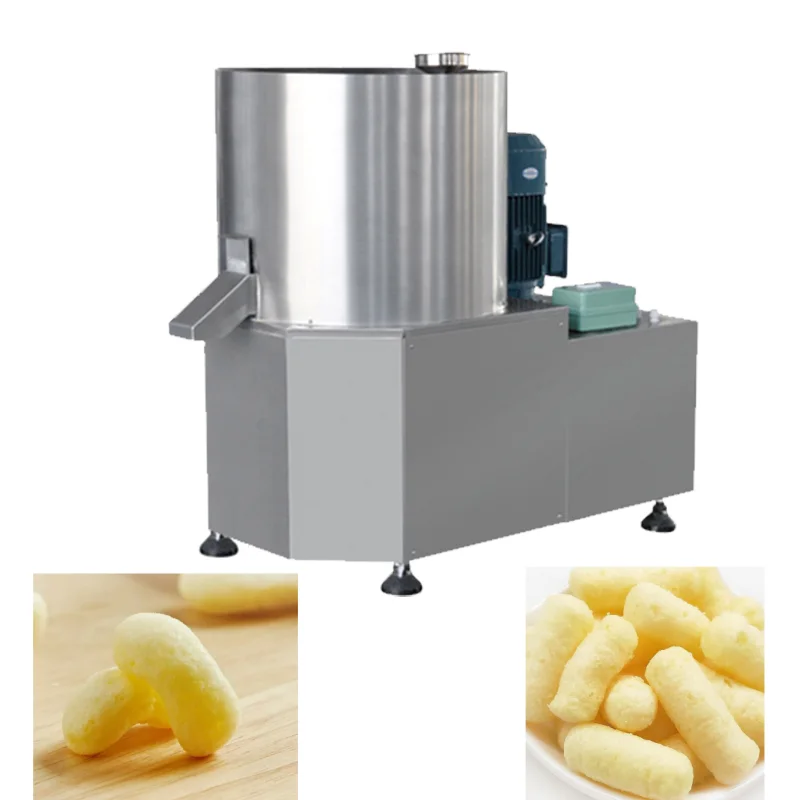
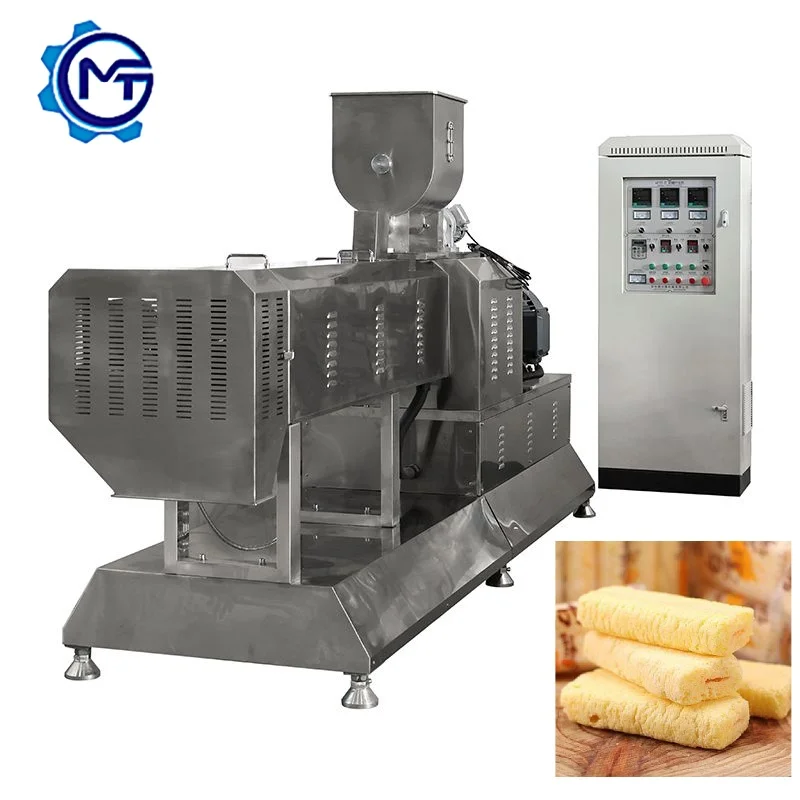
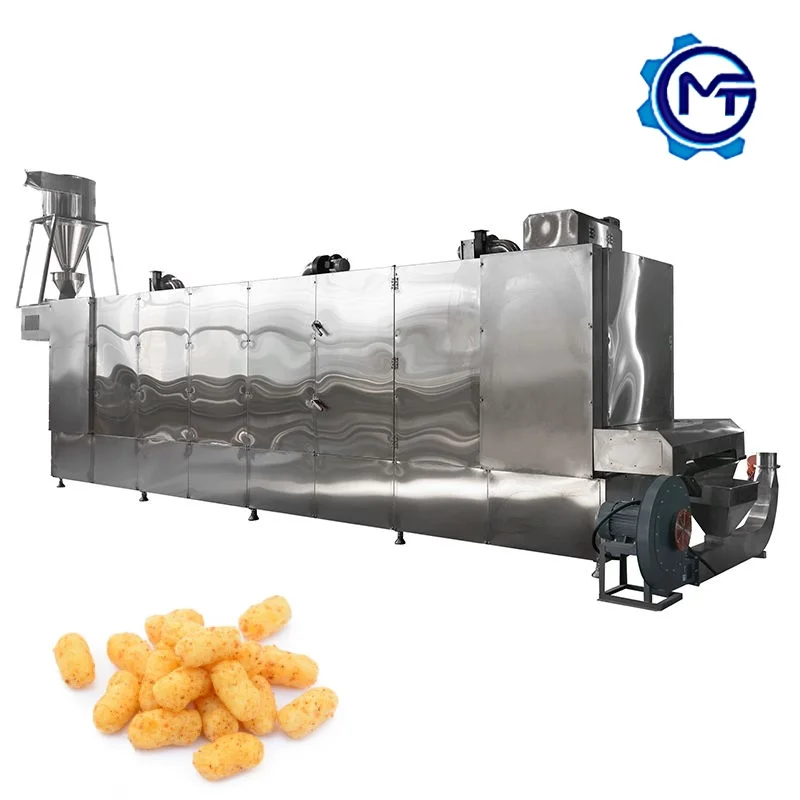
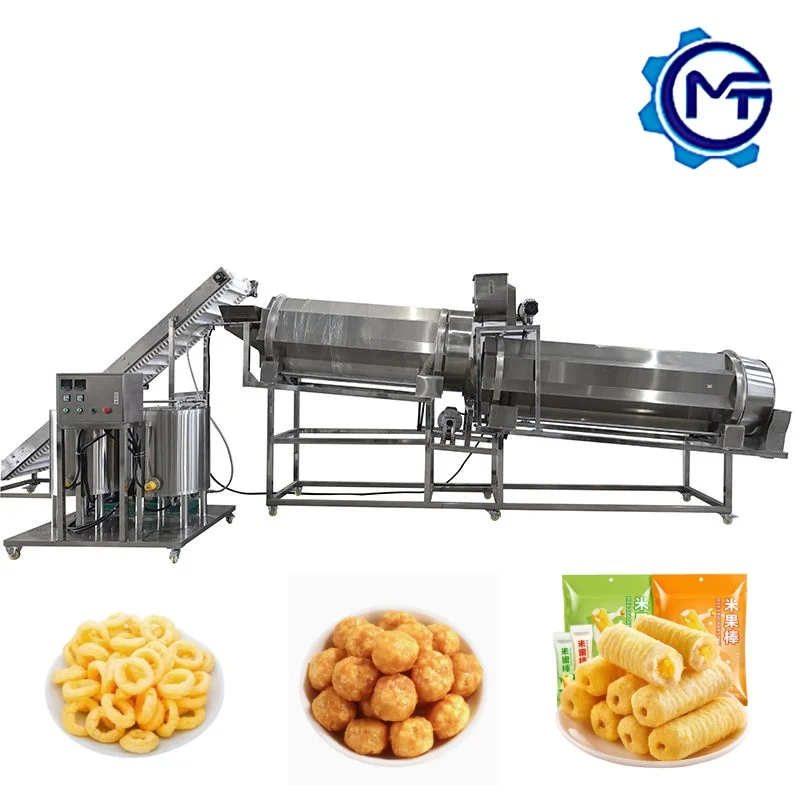

MT65 / MT70 / MT85 / MT100 Twin Screw Puffed Corn Snack Extrusion Line, 130–240 kW Installed Power, CE Certified — engineered as a complete turnkey project from batching through packing, with throughput matched at every station to prevent bottlenecks.
- Twin-screw extrusion with frequency speed control and automatic lubrication ensures stable continuous output across corn, rice, wheat, and oat formulations
- Interchangeable die system produces multiple geometries — balls, tubes, sticks, rings, loops, stars — from one extruder, with optional core-filling station
- Dryer heating configurable to electric, steam, or gas based on site utility; double drum flavoring line with sugar melting and precision spraying
Every line undergoes factory trial runs on the buyer’s actual raw material before shipment, with screw configuration and die design documented to the target product specification.
Description
Precision-Engineered Line Matching — Every station from mixing to packing is throughput-balanced and trial-run on your actual corn formulation before the line leaves our workshop.
Technical Specifications
| Parameter | Value |
|---|---|
| Product Type | Twin Screw Puffed Corn Snack Extrusion Line |
| Available Models | MT65 / MT70 / MT85 / MT100 |
| Screw Configuration | Twin-screw, interchangeable |
| Installed Power | MT65: 130 kW / MT70: 180 kW / MT85: 220 kW / MT100: 240 kW |
| Real Consumption | MT65: 95 kW / MT70: 120 kW / MT85: 130 kW / MT100: 160 kW |
| Output Capacity | MT65: 120–150 kg/h (basis to be confirmed); MT70: 200–300 kg/h (basis to be confirmed); MT85: 300–500 kg/h (basis to be confirmed); MT100: 600–800 kg/h (basis to be confirmed) |
| Raw Materials | Corn, rice, wheat, oat, barley flour |
| Die Configuration | Interchangeable dies: cheese ball, tube, stick, ring, fruit loop, star, wheel, flower, heart |
| Control System | Frequency speed controlling system, automatic lubricating and cooling |
| Dryer Heating Source | Electric, steam, or gas (configurable) |
| Flavoring System | Double drum with sugar melting, spraying nozzle, and elevator |
| Packing System | Automatic weighing, sealing, marking, coding; bag filling and fully automatic options |
| Optional Station | Core filling machine and cutting machine for core-filled snacks |
| Certification | CE |
| Warranty | 1 year |
Application Suitability
| Application | Material or Output |
|---|---|
| Puffed corn snack production | Corn flour and corn grits at varying moisture levels |
| Multi-shape extruded snacks | Rice, wheat, oat, and barley flour blends |
| Core-filled puff snacks | Grain-based shells with cream or chocolate filling |
| Breakfast cereal formats | Rings, loops, and balls from corn or mixed grain formulations |
| Fortified snack pellets | Grain flour with added vitamin and mineral premixes |
Why the Capacity Number on a Quote Is Not Enough for a Puffed Corn Snack Extrusion Line Turnkey
A rated output figure without raw material context is a guess, not a guarantee.
I have stood in a Middle Eastern snack factory watching a brand-new extrusion line struggle at barely more than half its quoted throughput. The problem was not the extruder itself — it was that the screw configuration and barrel temperature profile had been set for standard corn grits, while the local corn flour had a different particle size and moisture behaviour. The dryer sat half-empty. The flavoring drums ran with gaps between batches. That situation is avoidable when the supplier tests on the buyer’s actual formulation before shipping [NEED_CITE: raw material variability in corn flour across different regions and harvest seasons]. A properly configured puffed corn snack extrusion line turnkey project accounts for these variables at the trial stage, not during commissioning on your factory floor.
Screw Configuration and Die Selection Against Your Formulation
The twin-screw extruder at the heart of this line allows operators to adjust screw element sequencing to control shear intensity and residence time inside the barrel. Corn flour behaves differently from corn grits during gelatinisation — finer particles absorb moisture faster and can compact if the screw pitch is not matched accordingly. Interchangeable dies then shape the expanded product into the target geometry, from simple balls and tubes to more complex rings and flower shapes. Each die opening creates a specific expansion ratio and surface texture that affects how the snack picks up coating downstream.
Thermal Management Across Extrusion and Drying Stages
Barrel temperature zones work together with the frequency speed control system to maintain consistent starch gelatinisation throughout a production run. Once the extrudate leaves the die and expands, it enters the dryer where residual moisture must be reduced evenly to achieve the crunch the market expects. The dryer heating source — electric, steam, or gas — is selected based on the utility infrastructure available at your plant site. Gas-fired dryers are common where natural gas is inexpensive, while electric units suit facilities where steam boilers are not yet installed [NEED_CITE: industrial dryer energy source selection criteria for food processing facilities].
Power Draw, Line Stations, and Throughput Balancing
The installed power across models ranges from 130 kW on the MT65 to 240 kW on the MT100, with real consumption running noticeably lower during steady-state operation. What matters for line planning is that every downstream station — drying, double drum flavoring, cooling, and packing — must handle the extruder’s actual output without becoming a bottleneck. The double drum flavoring line includes a sugar melting system and precision spraying nozzle to apply seasoning uniformly at whatever rate the extruder delivers. The packing station offers automatic weighing and sealing, configurable between semi-automatic bag filling and fully automatic packing depending on your labour planning and shift structure.
What Happens When Line Stations Are Not Balanced
An extruder running at full output while the dryer cannot keep up forces the operator to slow the entire line down, or worse, to push wet product into packaging where it goes stale within days. I have seen coating drums overflow because the flavoring system was sized for a lower throughput than the extruder was actually delivering. These mismatches do not show up on a quotation that lists each machine independently. They surface during the first week of production, when the shift supervisor is trying to hit targets [NEED_CITE: production line bottleneck diagnosis in snack food manufacturing].
Why This Line Is Sourced as a Single Project
Every station from the batching system through the extruder, dryer, flavoring drums, cooler, and packing line is supplied by one manufacturer, so throughput calculations are done across the entire sequence rather than per machine. Screw and die configurations are documented against your target product shape and density before production starts. The line undergoes a factory trial run using your actual raw material, and the results are recorded before the equipment is crated. Electrical schematics and voltage specifications are confirmed against your local grid standard before fabrication begins. On-site installation follows a phased schedule with commissioning and operator training included in the project scope.
Documentation & Verification
- Line layout drawing with station-by-station throughput calculation for your target product
- Screw and die configuration record matched to your corn formulation and snack geometry
- Factory trial run report produced on your raw material before dispatch
- Electrical schematic with confirmed voltage, frequency, and control language
- CE declaration of conformity and ISO certificate for customs and compliance filing
- Operation and maintenance manual with illustrated wear parts list
Installation, Commissioning & Support
- Foundation and floor space plan sized to the specific model configuration from MT65 to MT100
- Dedicated power circuit specification matching the extruder’s real consumption up to 160 kW
- Partial disassembly for shipping with reassembly sequence documented for your installation crew
- First-run parameter setting covering barrel temperatures, screw speed, and dryer retention time
- Operator training on die changeover, automatic lubrication system, and frequency speed controls
- Wear parts list covering screws, dies, and cutting blades with recommended replacement intervals
What We Need to Configure Your Line
To move from inquiry to line proposal, share the specific grain flour or blend you intend to process, your target daily output across how many shifts, and the ceiling height and floor area available in your production hall. We also need your local voltage and frequency standard, the preferred dryer heating source, and whether the packing station should be semi-automatic or fully automatic. If you can send a sample of your raw material, we will run a trial in our testing workshop and base the screw configuration and capacity calculation on those results.
Frequently Asked Questions
Q: How is line capacity verified on the buyer’s actual raw material before shipment?
A: We run a trial in our testing workshop using your specific corn flour or grain blend. Screw configuration, barrel temperatures, and die selection are adjusted until the extrudate meets your target density and shape. A written trial run report documents the actual output rate, product appearance, and moisture readings before the line is cleared for shipment.
Q: How are throughput rates matched between extruder, dryer, flavoring, and packing stations?
A: Each downstream station is sized based on the extruder’s verified output from the trial run, not on a generic catalogue figure. The dryer belt length, flavoring drum volume, and packing speed are all calculated to handle continuous flow without accumulation gaps or material backlog at any point.
Q: What is the phased installation and commissioning schedule for a complete line?
A: Equipment is delivered in stages matching the physical sequence from batching to packing. Mechanical installation comes first, followed by electrical connection and control system verification. Commissioning runs begin with the extruder alone, then progressively integrate the dryer, flavoring system, cooler, and packing station, with operator training conducted on the fully integrated line.
Q: How are voltage, frequency, and control language confirmed before production begins?
A: During the quotation phase, we request your local electrical standard and control interface language preference. These are locked into the electrical schematic and motor specification before fabrication. The control system labels and PLC interface are set accordingly so that your operators can run the line from day one without translation delays.
Q: What spare wear parts are included and how is long-term supply ensured?
A: Each line ships with a wear parts list identifying screws, dies, cutting blades, and spray nozzles. A recommended initial spare set is included or quoted alongside the line. Replacement parts remain available for order using the documented screw and die configuration record, ensuring consistency across production batches over the life of the equipment.
Related products
-

Automatic Puff Corn Snack Stick Production Line Equipment New Condition Machines
¥100.00 Select options This product has multiple variants. The options may be chosen on the product page -

Full Automatic Crispy Maize Chocos Corn Flakes Breakfast Cereals Processing Production Line Industrial Equipment
¥1,000.00 Select options This product has multiple variants. The options may be chosen on the product page -

Fully automatic puff snack processing line
¥8,500.00 Select options This product has multiple variants. The options may be chosen on the product page -

Puff Corn Extruder Machine Puffed Core Filled Snack Food Production Line Machine
¥8,500.00 Select options This product has multiple variants. The options may be chosen on the product page


