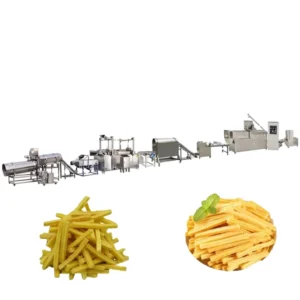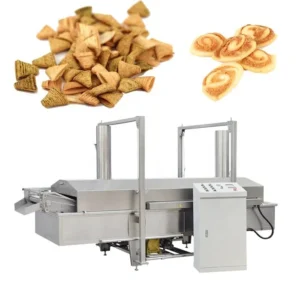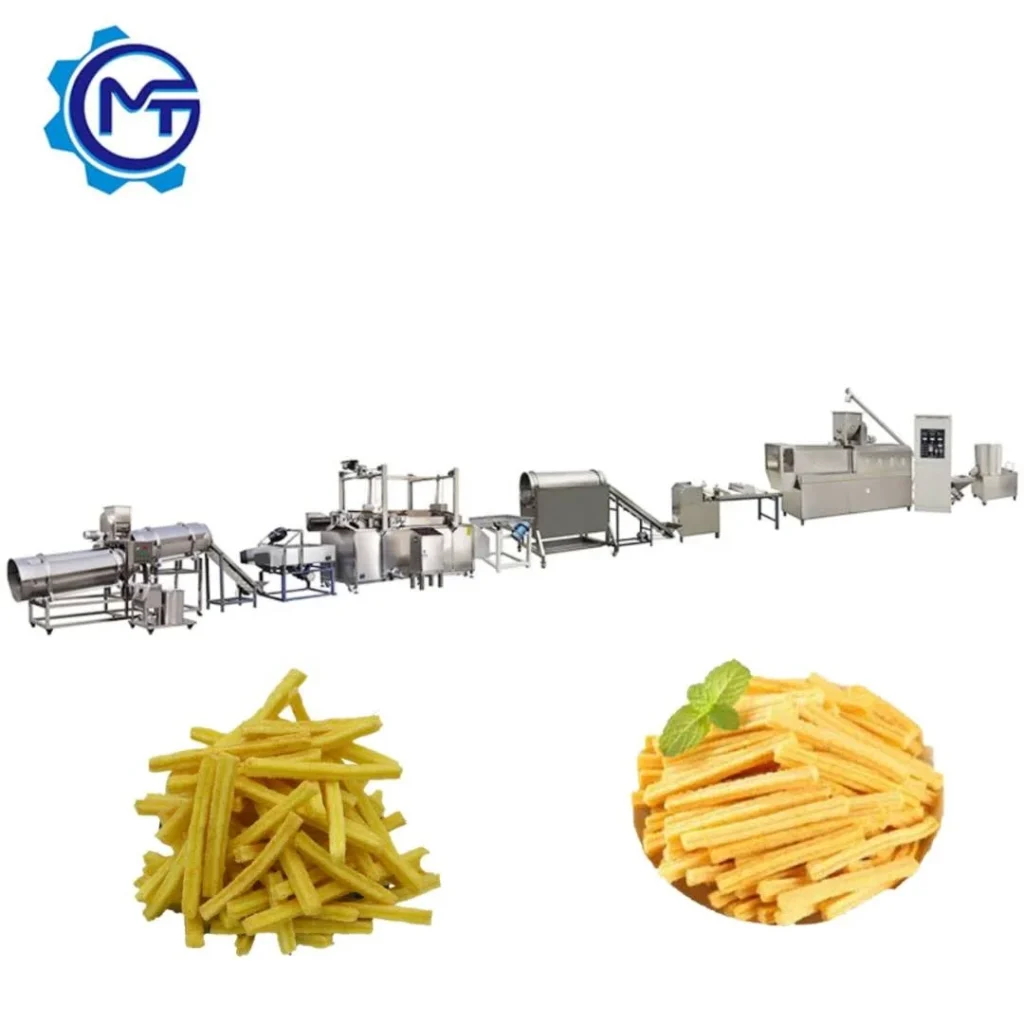
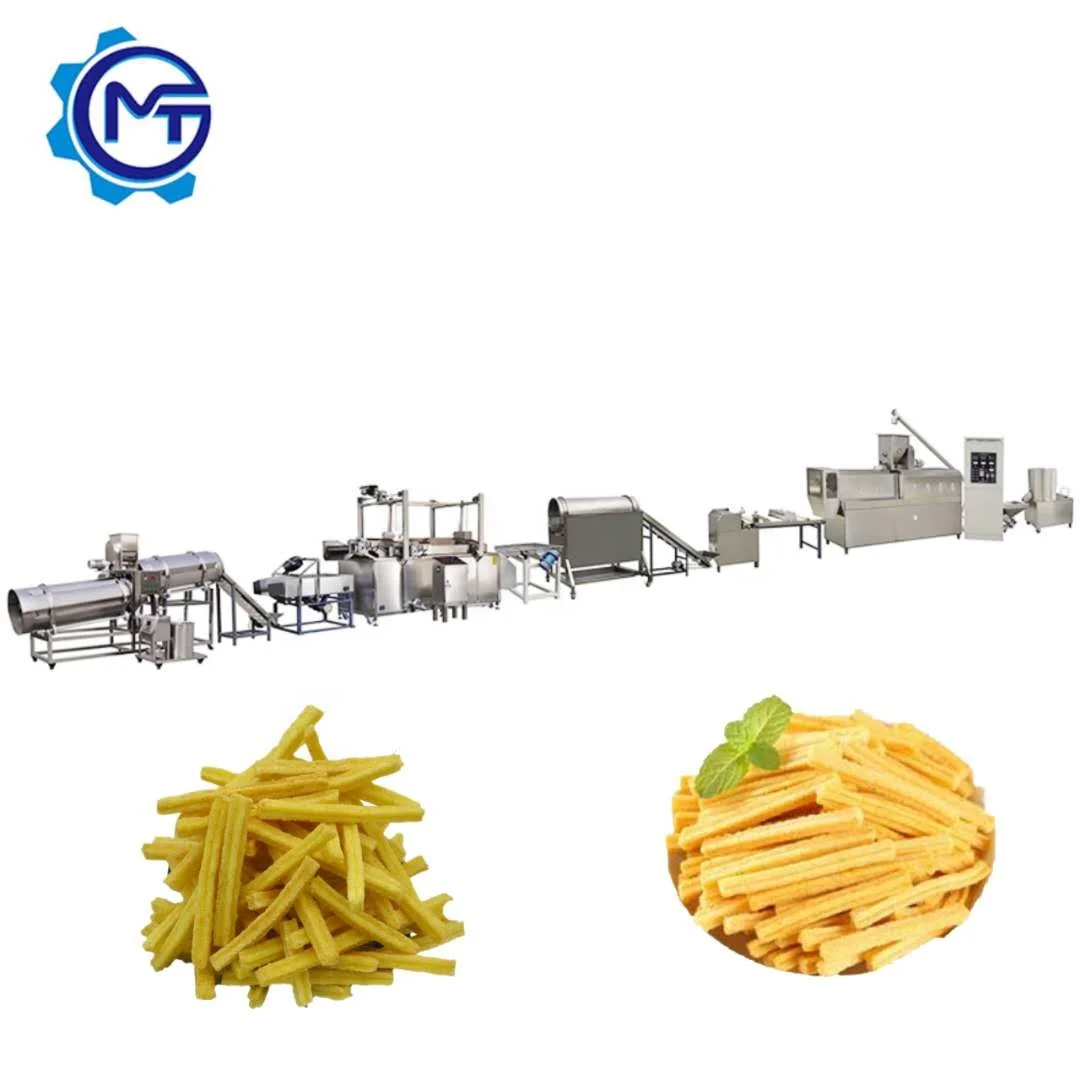
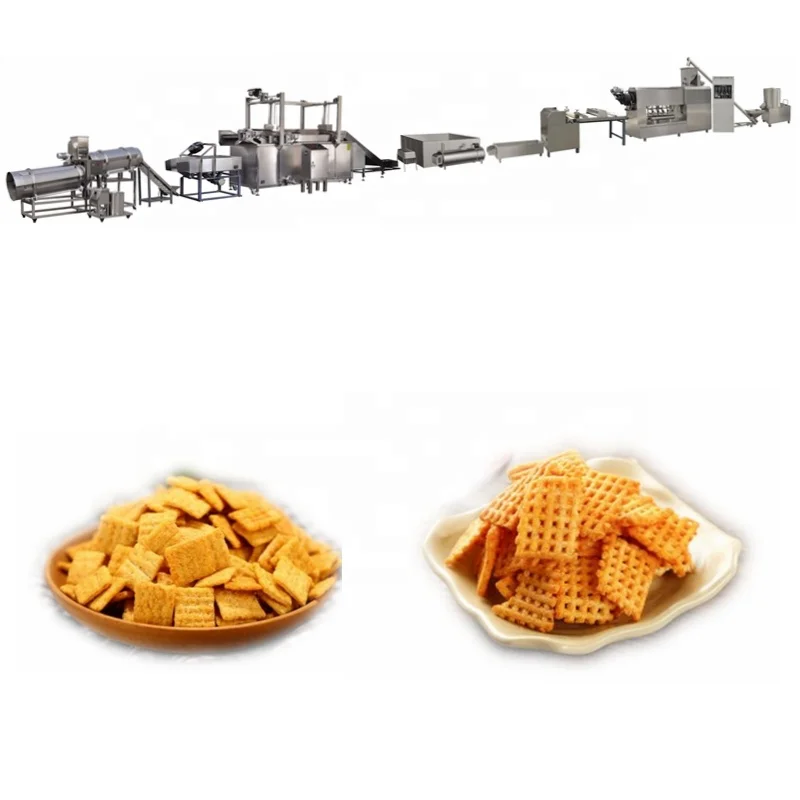
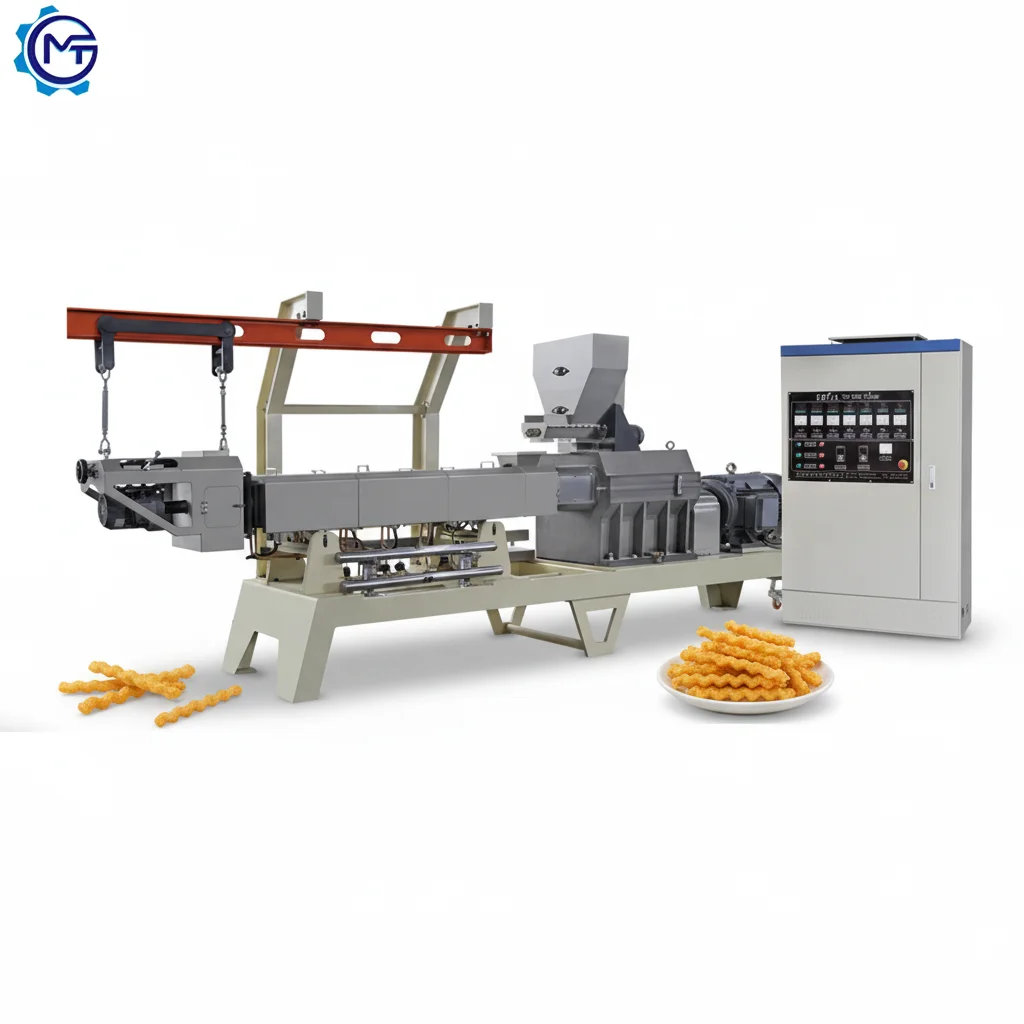


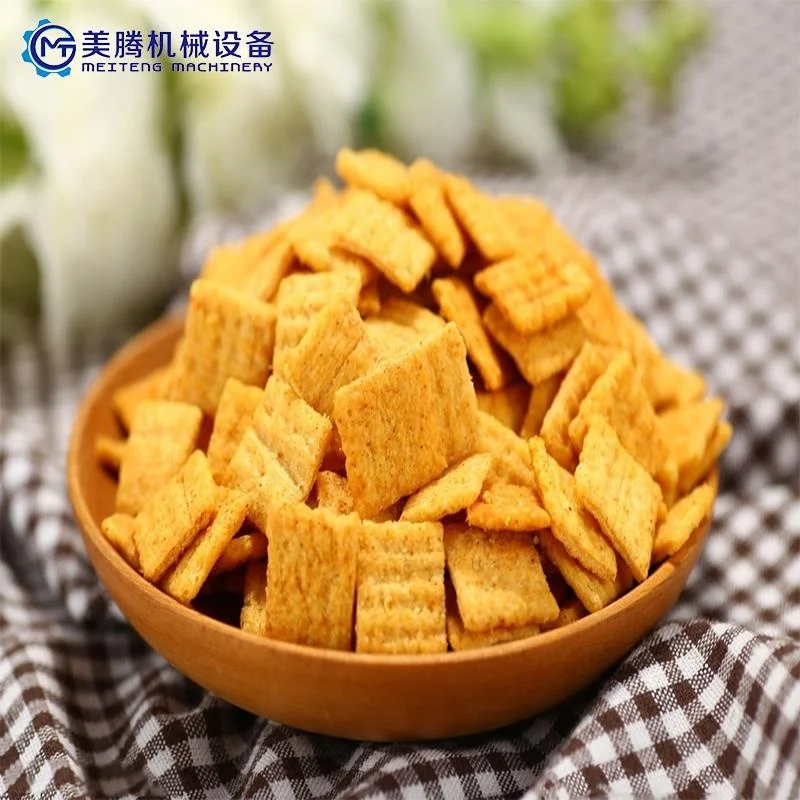
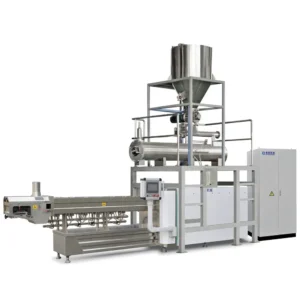
MT100/MT120 Single Screw Extrusion Production Line for Fried Rice Cracker, 50–70 kW, 380V/50Hz — configured for secondary puffing snacks from wheat flour, corn starch, and potato starch.
- Die and screw setup matched to target shape — screw shell, tube, ring, or cartoon forms from one line
- Frying, drying, and flavoring stations throughput-matched to extruder output to prevent bottlenecks
- Electrical system with Siemens-equivalent motors and Delixi/Delta inverters
Trial runs on your actual raw material are completed in our testing workshop before shipment, with full documentation of screw configuration, capacity, and electrical schematics confirmed to your local voltage standard.
Description
Matched Throughput Stations — every segment from the single-screw extruder through the fryer and flavoring drum is capacity-balanced under one line layout, so the 120 kg/h extrusion rate (basis not stated in source) never stalls waiting on downstream equipment.
Technical Specifications
| Parameter | Value |
|---|---|
| Model | MT100 / MT120 |
| Product Type | Single Screw Extrusion Production Line for Fried Rice Cracker & Millet Rice Crust |
| Extruder Type | Single screw extruder |
| Output Capacity | 120 kg/h (basis not stated in source — confirm raw material / moisture / product format) |
| Installed Power | 50–70 kW (electric heating approx. 100 kW; gas/diesel approx. 50–60 kW) |
| Voltage & Frequency | Three phase 380 V / 50 Hz; Single phase 220 V / 50 Hz (customizable to local voltage) |
| Overall Dimensions (L×W×H) | 12,000–26,000 × 1,200 × 2,200 mm |
| Contact Material | Food grade stainless steel 201 / 304 |
| Energy Options | Electricity / gas / diesel / steam |
| Motors | Siemens (China-made) or top Chinese brand |
| Inverters | Delixi or Delta |
| Process Flow | Mixer → Screw conveyor → Single screw extruder → Pulling and cutting machine → Automatic fryer → Automatic flavoring line → Cooling → Packing |
| Certification | CE / ISO 9001 |
| Warranty | One year warranty and lifetime technical guidance |
Application Suitability
| Application | Material or Output |
|---|---|
| Fried rice cracker production | Wheat flour, corn starch, potato starch blends |
| Millet rice crust (salad bar style) | Millet flour combined with starch bases |
| Golgappa / pani puri shells | Wheat and starch dough formulations |
| Secondary puffed snack shapes | Screw shell, round tube, square tube, ring, cartoon shapes via interchangeable dies |
Why "120 kg/h" Means Nothing Without Your Raw Material
A capacity figure detached from the actual flour or starch blend is the single largest source of post-installation disappointment on any fried rice cracker extrusion production line turnkey project.
I once watched a line ship with beautiful trial results on standard rice flour, only for the buyer to switch to a proprietary multigrain blend on arrival — expansion collapsed, and the fried output came out dense enough to crack a tooth. Two weeks of remote screw-configuration and moisture tuning followed before the line ran acceptably. That episode changed how every project starts here: the buyer’s actual raw material goes into our testing workshop first [NEED_CITE: importance of raw material trial runs in extrusion projects]. Output numbers on paper mean little when the starch gelatinisation behaviour of your specific blend has not been verified under real barrel temperatures and die pressure.
Barrel and Screw Geometry That Dictates Product Texture
The single-screw extruder on this line uses a configurable screw profile and barrel temperature zoning to control how thoroughly the starch component gelatinises before the dough exits the die. For a fried rice cracker extrusion production line turnkey installation, the screw compression ratio directly governs the dough density entering the fryer — too low and the cracker absorbs excess oil; too high and it fractures during cutting. The pulling-and-cutting station downstream must match the extruder’s linear output speed so that each piece enters the fryer at a consistent moisture level, preventing batch-to-batch texture variation that buyers notice on the first bite.
Die Interchangeability and Shape Changeover
Multiple die sets allow the same extruder to produce screw shells, tubes, rings, and cartoon shapes without swapping the entire barrel assembly. On a millet rice crust run, the die opening diameter and land length determine wall thickness, which in turn sets the fry time needed for full expansion. Changeover between shapes involves loosening the die clamp, sliding in the new plate, and re-setting the cutter timing — a process the operator can complete during a normal shift break. This flexibility matters for producers supplying several snack formats to different regional markets from one fried rice cracker extrusion production line turnkey setup [NEED_CITE: die changeover practices in single-screw snack extrusion].
Power, Voltage, and What the Electrical Panel Actually Contains
The line draws 50–70 kW under gas or diesel heating for the fryer and dryer sections, rising to roughly 100 kW when electric heating is specified. Siemens or equivalent motors drive the extruder main shaft and conveyor, while Delixi or Delta inverters regulate screw speed and cutting frequency. Before production begins, the electrical schematic is reviewed with the buyer to confirm voltage and frequency — a 380 V / 50 Hz panel shipped to a 440 V / 60 Hz market will trip breakers on day one. Control language on the inverter displays is set to the operator’s working language so that fault codes can be read without a translator on the floor.
The Bottleneck That Separate-Vendor Lines Create
When the extruder, fryer, and flavoring drum arrive from three different suppliers, nobody takes ownership of the throughput gap between them. The extruder may push dough faster than the fryer can handle, forcing the operator to idle the screw and lose batch consistency. Or the flavoring drum may be undersized, leaving seasoned product waiting in a cooling conveyor where it absorbs ambient moisture and goes stale before packing. These mismatches surface only after installation, when return shipping is no longer an option [NEED_CITE: throughput mismatch risks in multi-vendor snack lines]. A single-supplier layout document showing station-by-station capacity alignment prevents this before metal is cut.
Why This Line Ships With the Answers Buyers Usually Chase Later
Every station from the mixer to the packing conveyor is specified under one layout, so throughput is matched rather than guessed. The screw configuration and die set are recorded against the buyer’s target shape and raw material before the extruder leaves the workshop. An in-house trial run on the buyer’s actual flour or starch blend generates a written report confirming expansion behaviour and fry response. Electrical schematics carry the buyer’s confirmed voltage, frequency, and control language before the panel is wired. Food-grade stainless steel 201 or 304 contact surfaces are documented with material certificates, so the line meets hygiene audit requirements from the first production day.
Documentation & Verification
- Line layout showing matched throughput between extruder, fryer, and flavoring stations
- Trial run report on buyer’s actual flour or starch blend before dispatch
- Screw and die configuration record for the specified snack shape
- Electrical schematic with confirmed voltage, frequency, and panel language
- CE declaration of conformity and ISO 9001 certificate
- Wear parts list covering screws, dies, and cutting blades
Installation, Commissioning & Support
- Foundation plan based on the 12,000–26,000 mm line length and local floor-load limits
- Dedicated circuit sized for the 50–100 kW total load depending on energy option selected
- On-site assembly of extruder, fryer, and conveyor modules with alignment verification
- First-run parameter setting for barrel temperature, screw speed, and fry time on buyer’s material
- Operator training covering die changeover, inverter fault codes, and daily sanitation steps
- Spare screw, die, and blade set shipped with the line for initial replacement cycles
What We Need to Quote Accurately
Send the exact flour, starch, or multigrain blend you intend to run, along with the target snack shape and daily output goal. Include your workshop’s available voltage and frequency so the electrical panel is built correctly from the start. If you have existing upstream mixers or downstream packing equipment, share their throughput rates so the new line integrates without creating a new bottleneck.
Frequently Asked Questions
Q: How is line output verified on my raw material before the machine ships?
A: Your actual flour or starch blend is run through the single-screw extruder in our in-house testing workshop. We record expansion rate, cutting behaviour, and fry response, then issue a trial report confirming achievable throughput on that specific formulation before the line is cleared for dispatch.
Q: Which voltage and frequency options are available for my market?
A: The standard panel is 380 V three-phase / 50 Hz, but the electrical schematic is customised to your local supply — including 440 V / 60 Hz or other regional standards. Inverter display language is also set to match your operators before the panel leaves the factory.
Q: How are the extruder, fryer, and flavoring stations balanced to prevent bottlenecks?
A: Each station’s throughput is calculated against the extruder’s output on your confirmed raw material. The fryer belt speed, oil volume, and flavoring drum diameter are all sized so product flows continuously without queuing or idle gaps between stages.
Q: What does on-site commissioning include once the line arrives?
A: Engineers assemble and align every module, set barrel temperature zones and screw speed for your material, run the fryer to stable oil temperature, and train operators on die changeover, fault-code reading, and daily cleaning routines before handover.
Q: Which spare wear parts come with the line and how are replacements handled?
A: The initial shipment includes a spare screw set, matching die plates, and cutting blades. A wear parts list with part numbers is provided so replacements can be ordered directly, and lifetime technical guidance covers wear-schedule recommendations for your production volume.
Related products
-
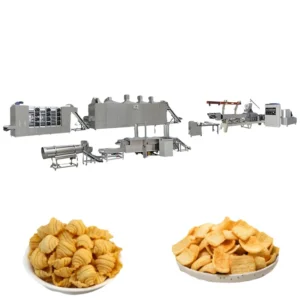
Hot Selling Full Automatic Fried Dough Wheat Flour Bugles Snacks Frying Machine Fried Puffed Food Bugles Snack Production Line
¥7,349.41 Select options This product has multiple variants. The options may be chosen on the product page -
New Automatic 150-200kg/h Nimko Fried Pasta Snacks & Kurkure Making Machine Food Grade Stainless Steel High Productivity
¥8,585.00 Select options This product has multiple variants. The options may be chosen on the product page -
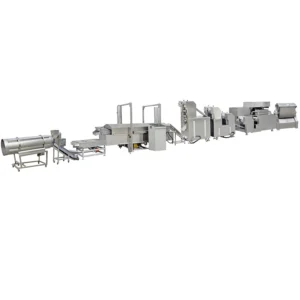
New Doritos Chips Frying Equipment Machine Automatic Tortilla Corn Chips Making Line Portable High Productivity
¥100.00 Select options This product has multiple variants. The options may be chosen on the product page -
Orion TURTLE CHIPS Snack Puffing Machinery Internet Celebrity Puffed Four-layer Crispy Production Line
¥65.00 Select options This product has multiple variants. The options may be chosen on the product page