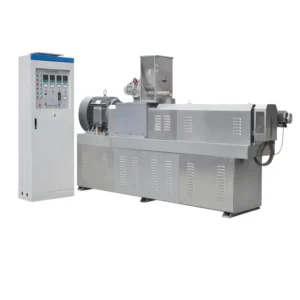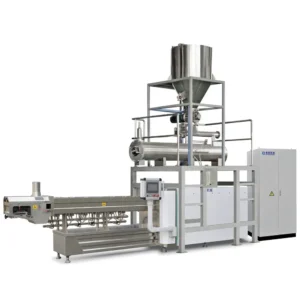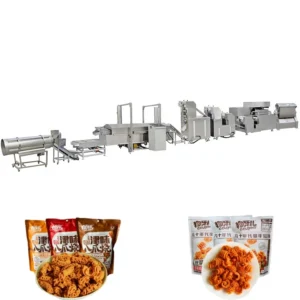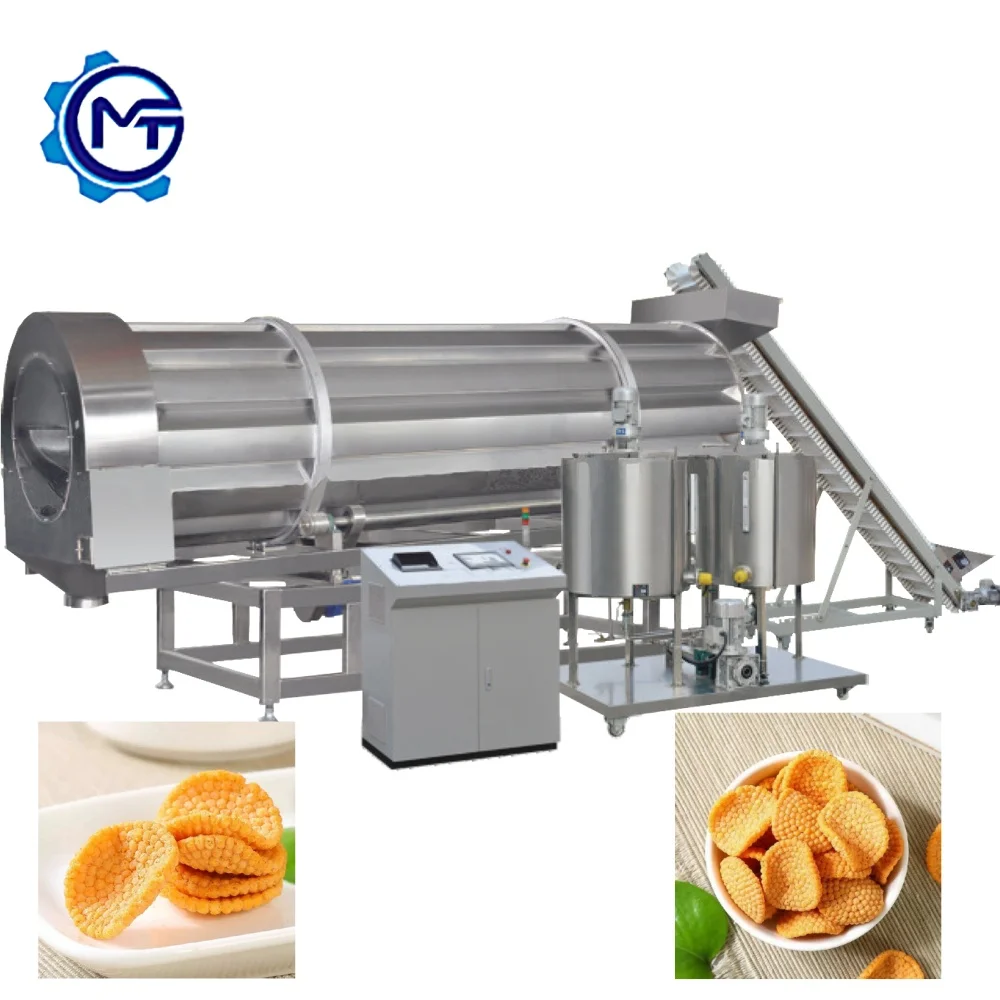


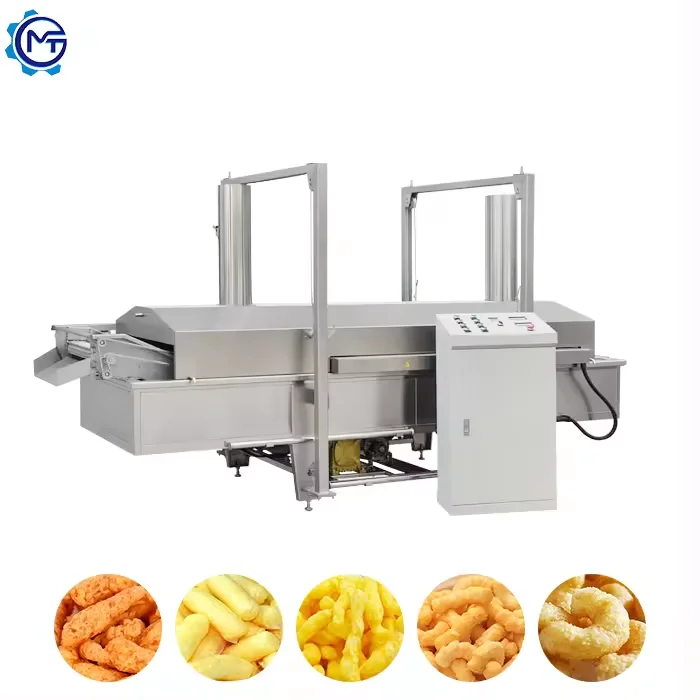

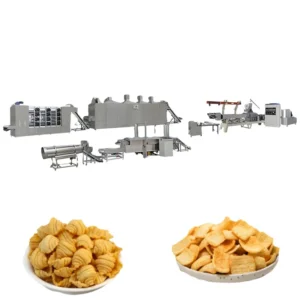
Fried Snack Food Processing Line, 380V 50Hz, PLC Control, 304 Stainless Steel — configured for rice crust chips, bugles, and pizza rolls with matched throughput from extrusion through continuous frying. The double-layer mesh belt and stepless speed regulation ensure uniform frying across varying product densities, while continuous oil filtration extends service life. Delivered with line layout, capacity calculation, and in-house trial run report before shipment.
- Complete turnkey project from batching to packing under one supplier
- Screw and die configuration matched to each fried snack format
- On-site installation, commissioning, and operator training included
Description
End-to-End Line Integration — Throughput from extrusion through frying is calculated station by station, so a 320 L oil capacity fryer holds pace with the extruder output on rice crust and bugle formats.
Technical Specifications
| Parameter | Value |
|---|---|
| Product Type | Fried Snack Food Processing Line |
| Power Source | Electric / Gas |
| Voltage & Frequency | 380V / 50Hz (configurable for target market) |
| Fryer Heating Tube Power | 60 kW |
| Control System | PLC |
| Overall Dimensions (L×W×H) | 6700 × 2200 × 1200 mm |
| Net Weight | 2000 kg |
| Output Capacity | 100–1000 kg/h (basis not stated in source — confirm raw material type, moisture content, and product format) |
| Oil Capacity | 320 L |
| Heating Method | Electricity Heating / Gas Heating |
| Material | Food-grade 304 Stainless Steel |
| Frying Belt | Upper and lower double-layer mesh belt with frequency conversion stepless speed regulation |
| Oil Filtration | Continuous circulation filtration system |
| Lifting System | Automatic lifting of upper hood and mesh belt for cleaning |
| Slag Discharge | Bottom-mounted automatic residue discharge system |
| Core Components Warranty | 1 Year |
| Standards | CE, ISO |
Application Suitability
| Application | Material or Output |
|---|---|
| Rice crust chips | Rice flour, starch blends, and grain-based dough sheets |
| Bugles and cone-shaped snacks | Corn grits, corn flour, and maize-based formulations |
| Pizza rolls and filled snacks | Wheat flour dough with savory filling compounds |
| Puffed-then-fried pellet snacks | Potato starch, tapioca, and modified starch pellets |
What "1000 kg per Hour" Leaves Out on a Fried Snack Line
Capacity numbers printed on a brochure assume a specific raw material, moisture level, and product geometry — change one variable and the real output shifts.
I watched a buyer in the Gulf region spec a fried snack food processing line turnkey based on a catalog figure tied to standard corn grits. On arrival, the local maize had higher moisture and a different starch profile. The extruder pushed dough through, but the fryer could not keep pace because the product density was wrong, and the belt speed had to drop. The line ran, but at a fraction of the promised throughput [NEED_CITE: raw material moisture impact on extrusion throughput]. Asking for the trial run report on your actual flour blend — not the factory standard — is the single step that prevents this mismatch.
Matching Extruder Output to Fryer Residence Time
A fried snack food processing line turnkey only performs when every station agrees on the same mass flow rate. The PLC-controlled extruder sets the output rhythm, but the double-layer mesh belt fryer must hold that volume for the exact seconds each product format requires. Rice crust chips need a shorter fry than dense pizza roll dough, and the frequency conversion stepless speed regulation on the belt lets operators dial in that difference without stopping the line.
Oil Management as a Throughput Variable
Frying oil degrades faster when residue accumulates, and degraded oil forces slower belt speeds to avoid burnt product. The continuous circulation filtration system on this line pulls particulate out during production, which means the oil stays within usable parameters for longer stretches between full changes. This is not a minor maintenance detail — it directly governs whether the line holds its rated pace through a full shift or drifts into unplanned downtime [NEED_CITE: edible oil degradation and frying consistency].
Reading the Spec Sheet Against Your Actual Recipe
The 60 kW fryer heating tube power is sized to bring 320 L of oil to frying temperature and hold it there under continuous product load. If your recipe calls for a lower frying temperature or a higher moisture dough, the thermal demand changes. The 380V / 50Hz electrical supply is standard for many export markets, but confirming voltage and frequency with the local grid before production avoids commissioning delays. Gas heating is available as an alternative where electricity costs make resistance heating impractical. The food-grade 304 stainless steel construction across all contact surfaces meets the hygiene requirements most food safety auditors expect to see documented.
The Cost of Undersized Supporting Stations
When a line is assembled from separate vendors, the extruder may be rated for a certain output while the dryer or fryer is a size smaller. The result is product stacking up between stations, operators manually throttling the extruder down, and a facility that never reaches the throughput the buyer paid for. I have seen fried snack food processing line turnkey installations where the fryer belt ran empty half the time because the upstream dryer could not deliver product fast enough [NEED_CITE: throughput bottleneck in multi-vendor food lines]. A single-supplier layout where every station is calculated against the same output target eliminates that gap.
Why Source the Entire Line From One Build
The line layout and capacity calculation are prepared before any metal is cut, so the extruder, dryer, and fryer are matched on paper first. Screw configuration and die design are specified to the buyer’s raw material and target product format — whether that is rice crust, bugles, or pizza rolls — rather than copied from a generic build. The in-house testing workshop runs trial production on the customer’s actual raw material before shipment, which means product development happens in Jinan, not on the buyer’s factory floor during commissioning. Pre-sales consultation carries through to on-site installation, operator training, and ongoing maintenance support, so the same engineering team that designed the line is responsible for making it run.
Documentation & Verification
- Line layout and capacity calculation confirming throughput match from batching through frying
- Screw and die configuration record matched to your specific snack format
- Trial run report on your actual raw material conducted before dispatch
- Electrical schematic with voltage and frequency confirmed to your local grid
- Machinery test report and video outgoing inspection provided before shipment
Installation, Commissioning & Support
- Floor plan review against the 6700 × 2200 × 1200 mm fryer footprint and upstream station spacing
- Dedicated electrical circuit sized for 60 kW fryer heating load plus extruder motor draw
- Automatic lifting hood and mesh belt demonstrated during commissioning for cleaning access
- PLC interface language and parameters set to operator preference during on-site startup
- Wear parts list covering screws, dies, and mesh belts supplied with first shipment
- Preventive maintenance schedule aligned to oil filtration system and residue discharge intervals
What to Include in Your Inquiry
Provide the exact raw material formulation you intend to run — including flour type, moisture percentage, and any inclusion particles — so the screw and die configuration can be matched before quotation. Specify your local voltage, frequency, and preferred control language to avoid rewiring or reprogramming on arrival. Confirm whether gas or electric heating suits your facility utility plan, and indicate the product formats you want to produce so the line layout accounts for die changes and fryer belt speed ranges.
Frequently Asked Questions
Q: How is line throughput verified across extrusion, drying, and frying stations?
A: A capacity calculation document maps mass flow at every station before production begins. The in-house testing workshop then runs your actual raw material through the configured extruder and fryer, generating a trial report that confirms real-world output against the layout specification.
Q: What voltage, frequency, and control language options are confirmed before shipment?
A: The electrical schematic is prepared with your local grid specifications — the standard 380V / 50Hz is configurable. PLC interface language is set to your operator preference during the specification confirmation stage, so the control panel reads correctly from day one of commissioning.
Q: Can the line produce multiple fried snack formats on one extruder?
A: Yes. Screw configuration and die design are changed to shift between rice crust chips, bugles, and pizza rolls. The fryer belt speed adjusts via frequency conversion to match each format’s required residence time, so multiple products run on the same line without hardware replacement.
Q: What does on-site installation and operator training include?
A: Engineers position each station per the approved layout, connect utilities, and run the first production batches with your team. Training covers PLC operation, fryer temperature and belt speed adjustment, oil filtration maintenance, and the automatic residue discharge system.
Q: How are spare wear parts supplied after the first production run?
A: A wear parts list — covering screws, dies, and mesh belts — ships with the line. Replacement parts are manufactured to the same configuration records, and orders are fulfilled against those records to ensure fit and performance match the original build.
Related products
-
Doritos Chips Making Extruder Fried Corn Bugles Crispy Chips Process Machine Frying Salad Sticks Pellet Snacks Production Line
¥100.00 Select options This product has multiple variants. The options may be chosen on the product page -
Fried Bugles Chips Production Line Fried Doritos Tortilla Snack Food Extruder
¥100.00 Select options This product has multiple variants. The options may be chosen on the product page -
Orion TURTLE CHIPS Snack Puffing Machinery Internet Celebrity Puffed Four-layer Crispy Production Line
¥65.00 Select options This product has multiple variants. The options may be chosen on the product page -
Automatic Fried Crispy Bugles Snacks Food Making Machines Wheat Flour Sala Food Extruder
¥100.00 Select options This product has multiple variants. The options may be chosen on the product page