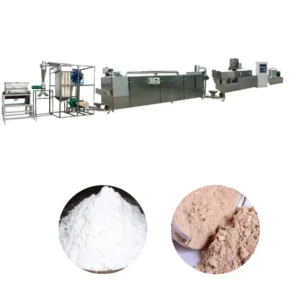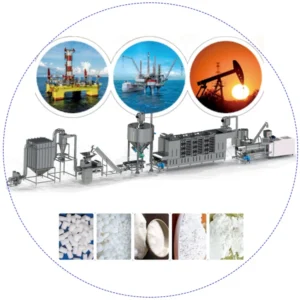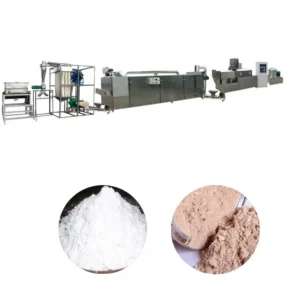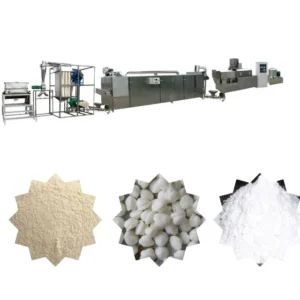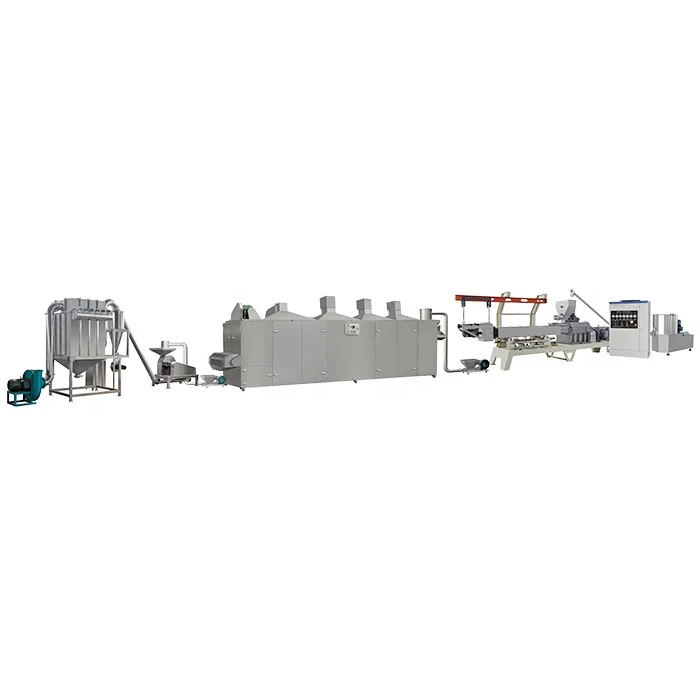


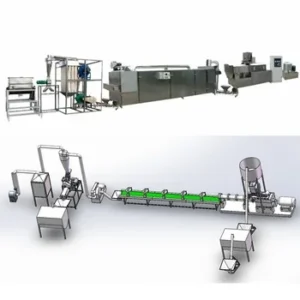
MT70 Modified Starch Extrusion Production Line, Twin-Screw, 30 kW Main Motor — engineered for consistent gelatinisation across potato, cassava, and corn starch sources.
- Screw configuration and die design matched to your raw material and target modification degree
- PLC and MCC control with integrated barrel cooling for precise temperature and shear management
- 5-layer dryer with inverter speed control matched to extruder output
Turnkey line from batching to packing under one supplier, with in-house trial runs on your starch source confirming real throughput before shipment.
Description
Line throughput matched end-to-end — a modified starch processing line turnkey solution from batching through extrusion to packing, engineered so every station holds the same rate without bottlenecks.
Technical Specifications
| Parameter | Value |
|---|---|
| Product Type | Modified Starch Extrusion Production Line |
| Model | MT70 |
| Screw Type | Twin-screw |
| Screw Diameter | 70 mm |
| Screw Length | 1520 mm |
| Screw Material | 38CrMoAl |
| Main Motor Power | 30 kW |
| Installed Power | 160 kW |
| Power Consumption | 120 kW |
| Output Capacity | 150-200 kg/h (basis to be confirmed) |
| Overall Dimensions | 41000×1500×2200 mm |
| Voltage & Frequency | 380V 50Hz Three Phase (configurable) |
| Control System | Available with PLC or MCC control |
| Barrel Cooling | Integrated cooling system for temperature control |
| Heating Ring | 7×2 kW (14 kW total) |
| Feeding Power | 0.75 kW |
| Cutting Power | 0.75 kW |
| Oil Pump Power | 0.37 kW |
| Mixer Capacity | 20-30 kg/time (basis to be confirmed) |
| Dryer Type | 5-layer baking oven, gas or diesel fired |
| Dryer Dimensions | 5.0×1.2×2.3 m |
| Dryer Power | 3 kW |
| Dryer Speed Control | Inverter |
| Contact Material | Food-grade stainless steel (201SS / 304SS) |
| Fuel Options | Gas / Diesel / Electricity / Steam |
| Warranty | 1 year complete, life-time maintenance |
Application Suitability
| Application | Material or Output |
|---|---|
| Food-grade modified starch | Potato, cassava, and corn starch raw materials |
| Pregelatinised starch for industrial use | Textile, paper making, and building material sectors |
| Functional ingredient starch | Casting, oil drilling, and fortified food production |
What Nominal Capacity Figures Leave Out on Starch Lines
The rated output on a modified starch processing line turnkey only holds when the upstream mixer and downstream dryer are sized to the same mass flow.
Buyers often see a capacity figure quoted for the extruder alone, without confirming whether the batching station can feed it continuously or whether the dryer can remove moisture at the same rate. On one cassava starch project I worked on, the extruder ran fine for twenty minutes, then the five-layer oven fell behind and the whole line backed up. Starch gelatinisation demands tight moisture control, and when any single station drifts from the matched rate, the product viscosity and gelling properties shift outside specification [NEED_CITE: starch gelatinisation parameters and residence time dependencies]. That kind of mismatch does not show up in a brochure — it appears on the factory floor during the first production week.
Screw Configuration Specified to Your Starch Source
Different starch sources behave very differently under shear and heat. Potato starch gelatinises at a lower temperature than corn starch, while cassava starch carries its own moisture profile and granule size. The twin-screw configuration — including screw element arrangement, compression ratio, and die aperture — must be set to match the raw material entering the barrel. A generic screw build copied from a snack application will either under-process the starch or over-shear it, producing inconsistent modification degrees batch after batch.
Barrel Temperature and Shear Control for Consistent Modification
Modified starch quality depends on how uniformly the material moves through the barrel’s temperature zones. The integrated barrel cooling system on this line keeps each zone within a narrow band, preventing hot spots that cause partial degradation. The seven heating rings, rated at 14 kW total, work with the cooling circuits to maintain the thermal profile required for your target modification. When temperature drifts even a few degrees, the starch’s water-binding capacity and paste clarity change — properties that downstream food or industrial users measure precisely.
Reading the Specifications That Matter Most
The 30 kW main motor provides the torque needed to push viscous starch through the barrel at sustained rates. Starch melts are notably thicker than snack doughs, so motor headroom matters for long-run stability. The 38CrMoAl screw material resists the abrasive wear that raw starch granules cause over thousands of operating hours, extending the interval between screw replacements. The inverter-controlled dryer speed allows operators to adjust belt travel time to match the moisture content leaving the extruder, rather than being locked into a fixed drying cycle. Voltage is configurable across 380V/50Hz, 380V/60Hz, 415V/60Hz, and 220V/60Hz — a detail that must be confirmed before production starts, because rewiring after arrival adds weeks to commissioning [NEED_CITE: voltage and frequency standards by export market].
The Cost of Undersized Upstream and Downstream Stations
When a buyer sources the extruder from one supplier and the mixer or dryer from another, nobody takes responsibility for the throughput gap between them. I have walked into plants where a properly specified twin-screw extruder sat idle because the mixer could only prepare half the batch weight per cycle, forcing the extruder to run intermittent starts and stops. That pattern destroys screw life and produces unevenly modified starch. The same problem appears downstream: a dryer that cannot handle the extruder’s moisture load forces operators to slow the screw speed, which changes shear rate and shifts the entire modification profile [NEED_CITE: effects of intermittent extruder operation on screw wear and product consistency].
Why Source the Full Line From One Supplier
Every station on this modified starch processing line turnkey system — mixer, screw conveyor, twin-screw extruder, five-layer dryer, pulse grinder, and packing — is configured so the mass flow through each one matches the others. The screw and die configuration is documented against your specific starch source and target modification degree before the extruder enters production. A trial run using your raw material takes place in the testing workshop, producing a report that confirms actual throughput and product quality before the line ships. Electrical schematics are prepared with your facility’s confirmed voltage, frequency, and control language, so the cabinet is wired correctly the first time. CE and ISO certifications cover the full line rather than individual machines, simplifying your import and compliance process [NEED_CITE: CE machinery directive requirements for complete processing lines].
Documentation & Verification
- Line layout and capacity calculation showing throughput matching across mixer, extruder, dryer, and grinder
- Screw and die configuration record tied to your potato, cassava, or corn starch source
- Trial run report on your raw material produced in-house before shipment
- Electrical schematic with voltage, frequency, and control language confirmed for your facility
- Factory test record and operation manual covering all line stations
Installation, Commissioning & Support
- Foundation plan based on the 41000×1500×2200 mm overall footprint and station spacing
- Power supply confirmation for 160 kW installed capacity with dedicated circuit requirements
- On-site assembly guidance covering screw conveyor alignment and dryer duct connections
- First-run parameter setting for barrel zones, screw speed, and dryer inverter timing
- Operator training on PLC or MCC interface, including alarm response procedures
- Wear parts list covering 38CrMoAl screws, die plates, and cutter blades with reorder intervals
What to Share With Your Inquiry
To configure this line accurately, provide the starch source you plan to process — potato, cassava, or corn — along with the target modification type and any viscosity or gelling specifications your end users require. Share your facility’s voltage and frequency, plus the available floor space and ceiling height for the 41-meter line layout. If you have existing upstream batching or downstream packing equipment, describe it so the new line can integrate without throughput gaps.
Frequently Asked Questions
Q: How is line capacity verified against my specific starch raw material and target modification?
A: Before shipment, your raw material runs through the extruder in the in-house testing workshop. The trial produces a documented report showing actual output rate, modification quality, and moisture content at the dryer exit. This confirms the line holds your required specification rather than relying on a generic capacity figure.
Q: What screw and die configuration is matched to potato, cassava, or corn starch sources?
A: Each starch source has a different gelatinisation temperature, granule size, and moisture behaviour. The screw element sequence, compression ratio, and die aperture are set specifically for your material. The configuration record ships with the line so replacements match the original build exactly.
Q: How is dryer and grinder capacity matched to extruder throughput to prevent bottlenecks?
A: The five-layer dryer and pulse grinder are sized so their maximum handling rate equals or exceeds the extruder output. The dryer’s inverter speed control lets operators fine-tune residence time to the actual moisture leaving the barrel, keeping the full line running at one steady rate.
Q: What voltage, frequency, and control language options are confirmed before production?
A: Voltage is configurable across 380V/50Hz, 380V/60Hz, 415V/60Hz, and 220V/60Hz. The PLC or MCC interface language is set to your operators’ preference. All electrical details are confirmed and documented in the schematic before the cabinet is wired, avoiding rewiring delays during commissioning.
Q: What trial runs and documentation are provided before shipment?
A: The testing workshop runs your starch through the full extruder and produces a trial report covering throughput, product quality, and screw configuration. You also receive the line layout, capacity calculation, electrical schematic, factory test record, and a complete operation and maintenance manual.
Related products
-
Twin-Screw Extrusion Line for Modified Starch. Producing Pregelatinized Adhesive & Food Grade Powder
¥65.00 Select options This product has multiple variants. The options may be chosen on the product page -
Automatic Industrial Adhesive Starch Modification Production Line – Pre-Gelatinization Extrusion Equipment
¥65.00 Select options This product has multiple variants. The options may be chosen on the product page -
Cassava Corn Potato Flour Starch Production Line – Industrial Pregelatinized & Modified Extrusion Machinery
¥65.00 Select options This product has multiple variants. The options may be chosen on the product page -
2025 New Design Modified Starch Big Capacity Industrial Use Food Additives Core Components Motor Bearing
¥50.00 Select options This product has multiple variants. The options may be chosen on the product page