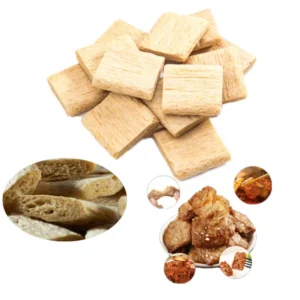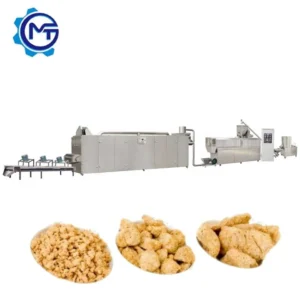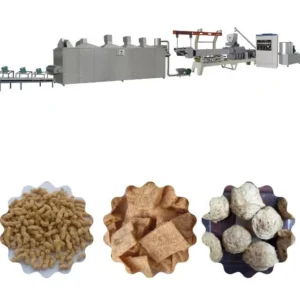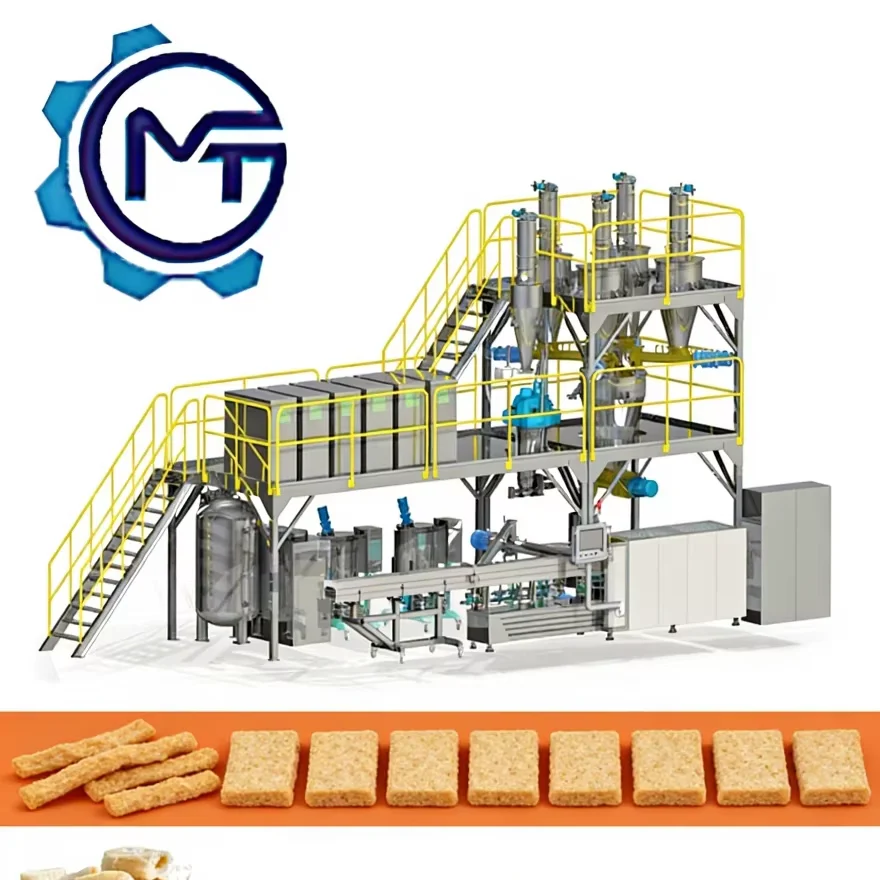
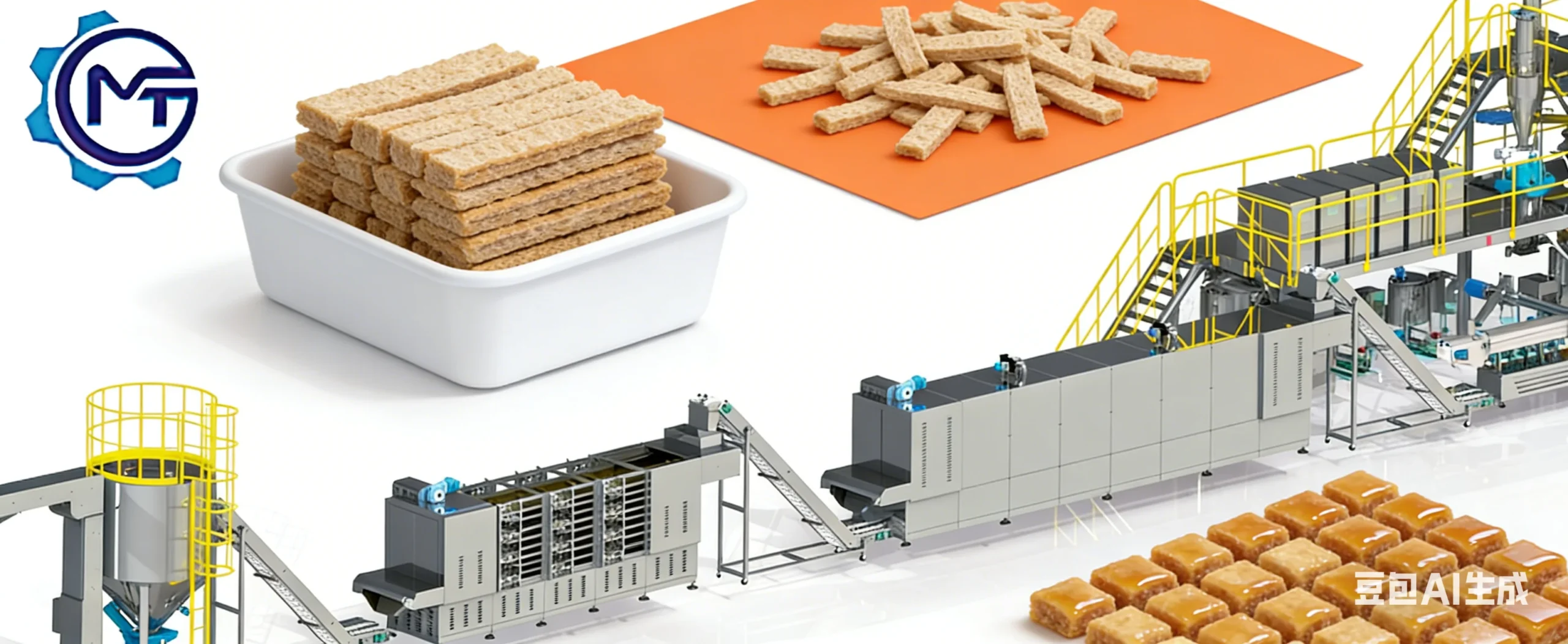
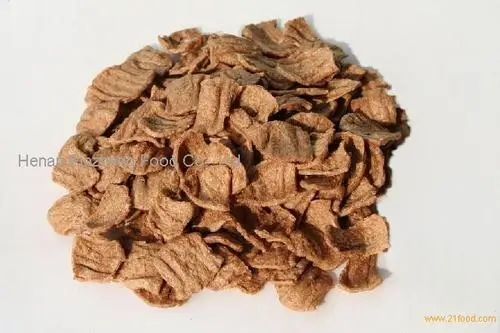

MT65 Twin Screw Texturized Vegetable Protein (TVP) Extrusion Line, 84 kW Installed Power, Multi-layer Dryer — engineered for soy protein meat analogue production from mixing through cooling.
Screw configuration and interchangeable die design are matched to defatted soy flour formulations and target fibre structure, controlling expansion and density across nugget or chunk formats. Multi-station throughput is balanced so extruder output aligns with dryer residence time and cooling capacity.
- Trial runs on buyer’s raw material executed in-house before shipment, with full configuration record provided
- Line layout, utility planning and capacity calculation delivered as one integrated turnkey project scope
- CE and ISO certified documentation package with electrical schematic and voltage confirmation included7898
Description
Integrated Line Engineering — every station from batching to cooling is sized against your actual soy formulation, so throughput stays balanced rather than bottlenecked at the dryer or extruder.
Technical Specifications
| Parameter | Value |
|---|---|
| Product Type | Twin Screw Texturized Vegetable Protein (TVP) Extrusion Line |
| Model | MT65 / MT70 / MT75 / MT85 |
| Screw Type | Twin Screw |
| Installed Power | 84 kW (MT65) / 160 kW (MT70) / 190 kW (MT75) / 210 kW (MT85) |
| Power Consumption | 59 kW (MT65) / 120 kW (MT70) / 140 kW (MT75) / 140 kW (MT85) |
| Output Capacity | 100–150 kg/h (MT65) / 150–200 kg/h (MT70) / 150–200 kg/h (MT75) / 250–300 kg/h (MT85) (basis to be confirmed — depends on raw material formulation, moisture content, and target format such as nuggets, chunks, or mince) |
| Main Motor Power | 22 kW / 30 kW / 45 kW |
| Screw Length | 1050 mm / 1520 mm |
| Heating Power | 10 kW / 14 kW |
| Line Stations | Mixer → Screw Conveyor → Twin Screw Extruder → Air Conveyor → Multi-layer Dryer → Cooling Machine |
| Mixer Type | Vertical ribbon/paddle mixer, food-grade stainless steel 304 contact parts |
| Dryer Configuration | Multi-layer, selectable fuel (electric / gas / thermal oil), double-pitch roller chain drive |
| Overall Dimensions | 40000×1200×2200 mm (MT65) to 45000×1500×3500 mm (MT85) |
| Standards | CE certified (since 2014), ISO certified |
Application Suitability
| Application | Material or Output |
|---|---|
| TVP / TSP production | Defatted soy flour, low-temperature soy flakes |
| Soy nuggets and chunks | Meat analogue, ready meal, and deep-frozen food ingredient supply |
| High-protein vegetarian blocks and slices | Vegan meat substitute retail and food-service formats |
| Optional cereal and snack formats | Reconfigured screw elements and dies for expanded product range |
What "Nominal Capacity" Leaves Out About Soy Protein Lines
A TVP extrusion production line turnkey must be validated against your actual defatted soy flour blend, not a generic catalogue figure.
When a line is quoted at a round number, that figure almost always comes from a standard test material under ideal lab conditions. On a plant based meat processing line, the real variable is your raw material: protein content, particle size, residual oil, and moisture all shift how the dough behaves inside the barrel. I once watched a Middle East installation stall because the screw set was copied from a wheat-gluten recipe while the customer was running pure defatted soy meal — the fibre structure collapsed and the nuggets came out dense and crumbly. Five days of on-site reconfiguration followed. That kind of delay is avoidable when the TVP extrusion production line turnkey is trialled on the buyer’s own raw material before the machines ever leave the factory [NEED_CITE: raw material variability impact on twin-screw extrusion output].
Screw Configuration as the Fibre-Structure Lever
The twin-screw arrangement on this line is not a fixed build. Screw elements — kneading blocks, reverse-flight sections, and conveying segments — are assembled in a sequence matched to your target fibre alignment. Soy protein requires a specific shear profile to unfold and cross-link into the layered, meat-like texture that end users expect from nuggets and chunks. The screw length options (1050 mm and 1520 mm) give room to adjust residence time and shear intensity, which directly shape how well the protein matrix forms before the die.
Matching Dryer Residence Time to Extruder Output
The multi-layer dryer is not an afterthought. On a TVP extrusion production line turnkey, the extruder pushes out a continuous stream of high-moisture protein pieces that must drop to a stable shelf-ready moisture level without case-hardening the surface. The selectable fuel options — electric, gas, or thermal oil — let the dryer be tuned to local utility costs and available infrastructure. Drying temperature and belt speed together set residence time, and that must track exactly with whatever the extruder is producing per hour. A mismatch here means either soggy product reaching the cooling station or a dryer idling while it waits for upstream output.
Reading the Specs Against Your Production Target
The installed power range from 84 kW on the MT65 up to 210 kW on the MT85 reflects the thermal and mechanical energy needed as barrel diameter and throughput scale up. The main motor options (22 kW, 30 kW, 45 kW) govern screw torque — critical when pushing viscous soy dough through restrictive die apertures. Power consumption figures sit noticeably below installed capacity because heating zones cycle on and off through PID control rather than running flat-out. The line dimensions stretch from 40 metres to 45 metres in length, which dictates the floor space and utility routing your facility must accommodate before installation begins [NEED_CITE: industrial food extrusion line floor space and utility planning requirements].
The Hidden Cost of Skipping Throughput Balancing
When an extruder is sourced from one vendor and a dryer from another, nobody owns the gap between them. The extruder may push more volume than the dryer can handle, forcing the operator to slow the screw speed and sacrifice output. Or the dryer may overshoot, baking the nuggets past the texture specification the market expects. I have seen installations where the cooling machine was undersized for the actual line speed, so warm, moisture-laden product went straight into packaging — leading to condensation, mould complaints, and shelf-life failures within weeks of commissioning. These problems compound because each vendor blames the other’s equipment [NEED_CITE: throughput mismatch consequences in multi-vendor food processing lines].
Why This Line Is Scoped as One Project
The entire TVP extrusion production line turnkey comes from a single supplier, meaning throughput is calculated station by station before any steel is cut. The mixer capacity is matched to extruder feed rate. The air conveyor volume matches extruder discharge. The dryer belt width and length track the moisture load coming in. Screw configuration and die design are specified against your raw material formulation and target product format — nuggets, chunks, or mince — not pulled from a generic library. An in-house testing workshop runs your actual soy flour or soy flake blend through the extruder before shipment, so fibre structure and density are confirmed in advance. Electrical schematics, voltage, frequency, and control language are locked down during the engineering phase, not discovered during commissioning.
Documentation & Verification
- Line layout drawing showing throughput balance from mixer through cooling station
- Screw and die configuration record tied to your soy formulation and target nugget density
- Trial run report executed on your raw material in the testing workshop before dispatch
- Electrical schematic with voltage, frequency, and control language confirmation
- CE declaration of conformity and ISO certificate package included with shipment
- Operation and maintenance manual with wear parts list specific to your screw configuration
Installation, Commissioning & Support
- Foundation and floor space planning based on line dimensions up to 45000×1500×3500 mm
- Power supply routing for installed loads up to 210 kW with dedicated circuit planning
- Assembled station delivery with on-site alignment of extruder, dryer, and cooling conveyor
- First-run parameter setting including barrel zone temperatures and screw speed ramp-up
- Operator training covering screw element changeover and die swap procedures
- Wear parts list covering screws, dies, and mixer blades with recommended reorder intervals
What We Need to Scope Your Line
To configure a TVP extrusion production line turnkey that actually holds its rated output, we need your raw material specification — protein content, particle size, and moisture level of the soy flour or flakes you plan to run. Tell us the target product format (nuggets, chunks, or mince) and the hourly throughput you need to hit. Share your facility’s available floor length, ceiling height, local voltage and frequency, and preferred control language. If you have upstream batching or downstream packaging equipment already in place, let us know so the line interfaces are designed around them.
Frequently Asked Questions
Q: How is the line capacity verified against my specific soy flour formulation?
A: We run your actual raw material through the extruder in our testing workshop before shipment. The trial records output rate, fibre structure, and nugget density against your specification. If the formulation needs adjustment, screw configuration and moisture levels are tuned during the trial — not after installation on your factory floor.
Q: How do you match dryer and cooling capacity to extruder output?
A: Each station is sized against the extruder’s verified throughput on your material. The multi-layer dryer’s belt speed, temperature zones, and residence time are calculated to bring the extruded pieces to target moisture. The cooling machine is then matched to the dryer discharge rate so no bottleneck forms downstream.
Q: What screw configuration do you recommend for my raw material?
A: The screw element sequence — kneading blocks, conveying segments, and reverse-flight sections — is assembled based on your soy flour protein content, particle size, and the fibre structure your market expects. The die aperture and shape are chosen together with the screw build to produce the target nugget or chunk format.
Q: Can I run a trial on my own raw material before the line ships?
A: Yes. Our in-house testing workshop is set up for full trial runs on customer-supplied raw material. You receive a trial report documenting output rate, product texture, moisture content, and the exact screw and die configuration used. This report ships with the line as the baseline for commissioning.
Q: What is included in the turnkey project scope?
A: The scope covers line layout, throughput calculation across every station, utility planning, electrical schematic with voltage and control language confirmation, factory trial, shipment, on-site installation, commissioning, operator training, wear parts list, and ongoing maintenance support — all under one supplier responsibility.
Related products
-
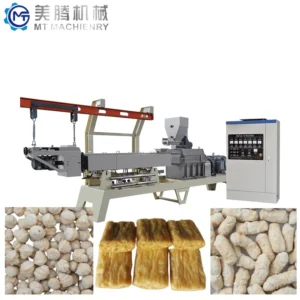
Small Multifunctional Textured Soy Protein Machine – Soy Protein Production Line – Vegetarian Meat Processing Equipment
¥65.00 Select options This product has multiple variants. The options may be chosen on the product page -
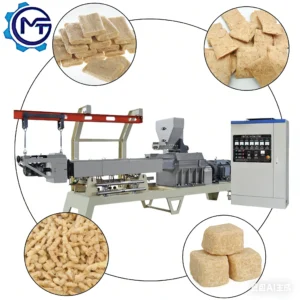
Automatic Vegetarian Meat Production Line with Twin Screw Extruder
¥9,500.00 Select options This product has multiple variants. The options may be chosen on the product page -
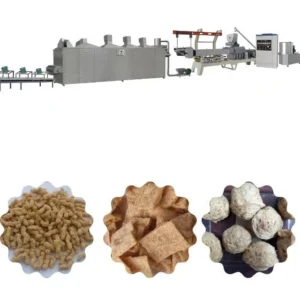
Vegetable Meat Making Machine Textured Soybean Protein Maker
¥30.00 Select options This product has multiple variants. The options may be chosen on the product page -
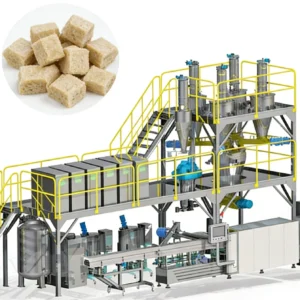
CE Certified Vegetarian Meat Processing Machine
¥9,500.00 Select options This product has multiple variants. The options may be chosen on the product page