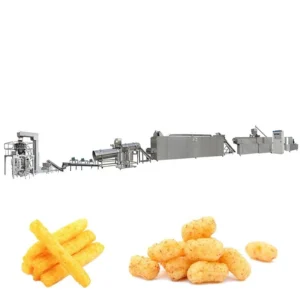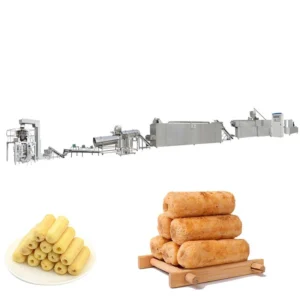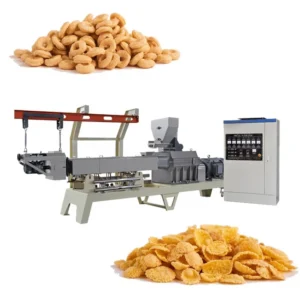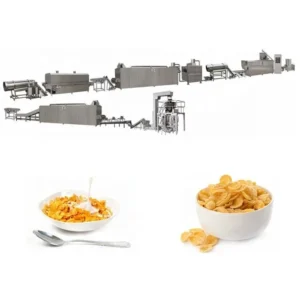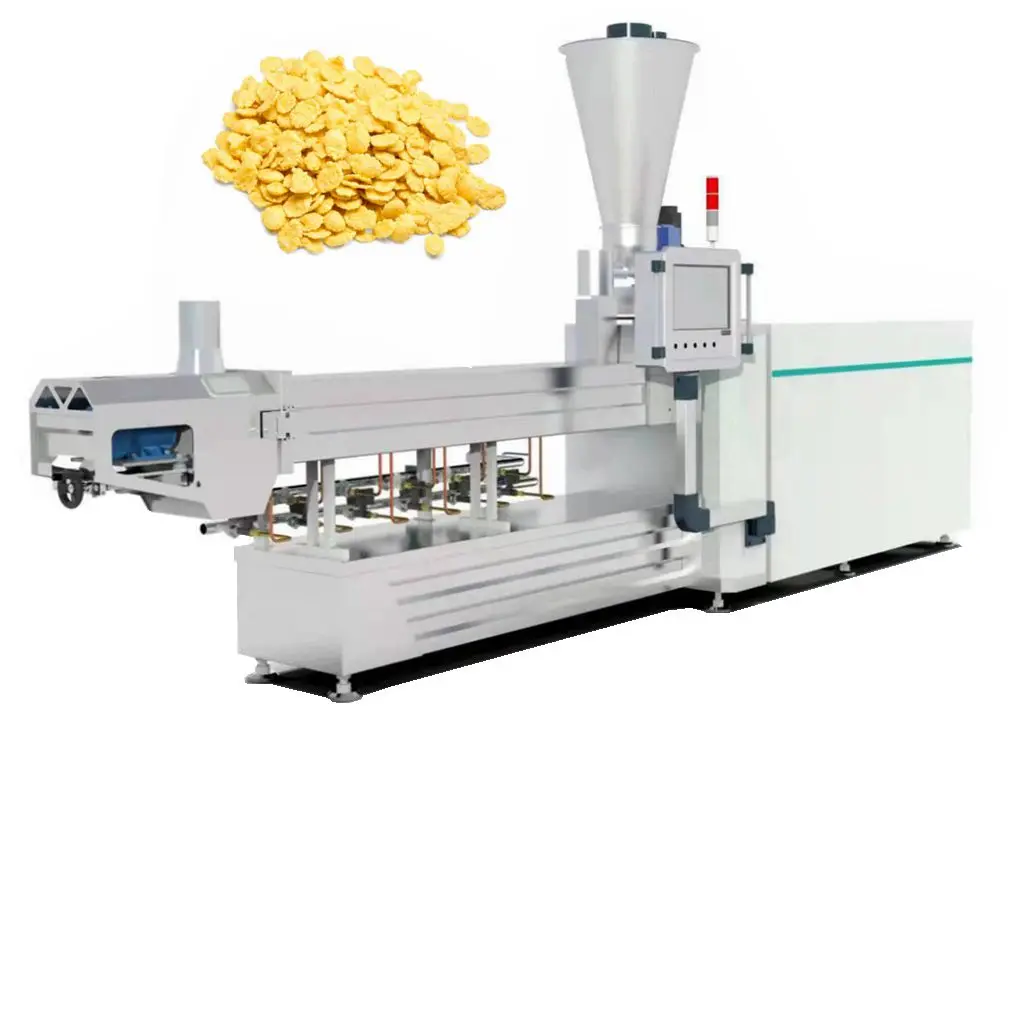


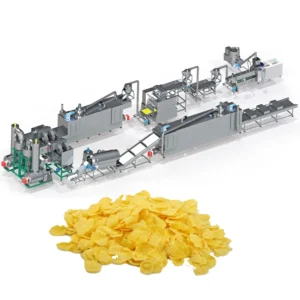
MT-65 / MT-70 / MT-85 / MT-75 Corn Flakes Production Line, Twin-Screw Extruder, PLC Control — complete turnkey layout from batching to packing with throughput-matched stations.
- Twin-screw extrusion with 3D-designed screw configuration and die matched to your corn, rice, or wheat grits blend for consistent flake density and texture
- Multi-layer dryer and hot air roaster up to 400 °C sized to extruder output, eliminating bottlenecks across drying, coating, and cooling
- Flaking station with water-cooled cast iron rollers and adjustable gap for precise thickness control
Single-supplier line with in-house trial runs on your raw material before shipment, ensuring output verification and screw configuration matched to your target product specification.
Description
Complete Throughput Matching — Every station from batching to packing is engineered to hold the same hourly output, preventing the dryer or coater from choking a line quoted only on extruder speed.
Technical Specifications
| Parameter | Value |
|---|---|
| Product Type | Corn Flakes Production Line |
| Extruder Type | Twin Screw |
| Model Options | MT-65 / MT-70 / MT-85 / MT-75 |
| Output Capacity (MT-65) | 120-150 kg/h (basis not stated in source — confirm raw material and moisture content) |
| Output Capacity (MT-70) | 200-250 kg/h (basis not stated in source — confirm raw material and moisture content) |
| Output Capacity (MT-85) | 300-400 kg/h (basis not stated in source — confirm raw material and moisture content) |
| Output Capacity (MT-75) | 400-500 kg/h (basis not stated in source — confirm raw material and moisture content) |
| Installed Power (MT-65) | 84 kW |
| Real Power (MT-65) | 59 kW |
| Installed Power (MT-70) | 132 kW |
| Real Power (MT-70) | 92 kW |
| Installed Power (MT-85) | 239 kW |
| Real Power (MT-85) | 167 kW |
| Installed Power (MT-75) | 186 kW |
| Real Power (MT-75) | 140 kW |
| Overall Dimensions (MT-65) | 21000 × 1200 × 2200 mm |
| Overall Dimensions (MT-70) | 23000 × 1500 × 2200 mm |
| Overall Dimensions (MT-85) | 28000 × 3500 × 4300 mm |
| Overall Dimensions (MT-75) | 24000 × 1500 × 2800 mm |
| Control System | PLC with real-time data storage, monitoring, alarm and reminder functions |
| Flaking Machine Roller Material | Cast iron (shaft: 45# steel, frame: carbon steel) |
| Flaking Machine Cooling | Water cooling system, adjustable roller gap |
| Hot Air Roaster Max Temperature | Up to 400 °C |
| Hot Air Roaster Heating Source | Electric or gas |
| Dryer Heating Method | Electric or gas |
| Dryer Layers | Three, five, or seven |
| Dryer Capacity | 100-500 kg/h |
| Packing Machine | Combination head weigher vertical automatic packing machine (models 420, 520, 620, 720) |
| Sugar Spraying System Total Power | 28.75 kW |
| Sugar Spraying System Roller Size | Ø600 × 2700 mm |
| Standards | CE, ISO certified |
Application Suitability
| Application | Material or Output |
|---|---|
| Plain corn flakes for breakfast cereal packaging | Corn grits or corn flour |
| Sugar-coated and honey-glazed flakes | Corn, rice, wheat, oat flour blends |
| Multi-format cereals (loops, rings, balls, stars) | Corn, rice, millet, wheat, oat, barley powder |
| Cocoa flakes and chocolate-coated cereal pieces | Corn and rice flour with cocoa powder |
| Fortified breakfast cereals for nutrition programmes | Multi-grain blends with vitamin premix |
What "Nominal Capacity" Leaves Out on a Corn Flakes Production Line Turnkey
A rated output means nothing if the dryer and coating drum cannot keep pace with the extruder.
I spent years on the buying side of breakfast cereal projects, and one failure pattern repeated itself: the extruder was quoted at a certain throughput, but the downstream dryer was sized for a different number. When the line ran, wet flakes piled up before the dryer entrance, sticking together and losing the crisp texture the market expected. The corn flakes production line turnkey was technically "complete," but throughput was never balanced across stations. That mismatch is not a commissioning problem — it is a design problem that should have been caught before the equipment left the workshop. [NEED_CITE: dryer and extruder throughput matching principles in cereal processing]
Layout Planning That Starts With the Slowest Station
A corn flakes production line turnkey is only as fast as its most constrained station. On this line, the layout begins by identifying whether the dryer, the flaking unit, or the cooling conveyor will set the pace for a given recipe. Once the bottleneck is mapped, every upstream and downstream station is sized to match. The PLC control system stores real-time production data at every point, so operators can see exactly where material accumulates and adjust belt speeds or drying times before a backlog becomes scrap.
Trial Runs Before the Line Ships
Most extrusion lines are tested on standard corn grits at the factory, then shipped. When the buyer’s actual raw material arrives — perhaps an oat-rich blend with higher fat content or a fortified premix with different starch behaviour — the extrusion parameters shift. This line includes in-house trial runs on the buyer’s own recipe before dispatch. The screw configuration, barrel temperature profile, and die design are adjusted during that test so the machine arrives already tuned to the target flake density and texture. [NEED_CITE: starch gelatinisation behaviour differences across cereal grain types]
Reading the Specs That Matter for Flake Quality
The twin-screw extruder on this line is designed using 3D software with analogue simulation, which determines screw pitch, barrel zone count, and die geometry before metal is cut. For corn flakes, the critical parameter is the degree of starch gelatinisation inside the barrel — too little and the flake cracks on the roller, too much and it turns gummy. The water-cooled cast iron flaking rollers maintain a consistent surface temperature during continuous operation, and the adjustable roller gap lets operators dial in flake thickness down to fine tolerances. The hot air roaster reaches up to 400 °C with a high-pressure blower, giving the instant puffing that creates the characteristic blistered surface. Multi-layer dryer options — three, five, or seven layers — let the line handle both plain flakes and sugar-coated variants by adjusting belt residence time without changing the dryer footprint.
The Hidden Cost of Skipping Throughput Verification
When a corn flakes line is assembled from separate vendors, each supplier guarantees their own machine in isolation. The extruder vendor confirms output at the die. The dryer vendor confirms evaporation rate. Nobody confirms that wet, sugar-coated flakes require a longer drying cycle than plain flakes, and that the original dryer capacity was calculated on plain product. The result is a line that runs at full speed for the first week, then drops to partial throughput once the sugar coating system is engaged. Buyers end up adding a second dryer or accepting lower daily output — both costly corrections that a single-supplier layout would have prevented. [NEED_CITE: sugar coating impact on drying time in cereal production]
Why Source the Entire Line From One Supplier
Every station on this line — mixer, screw conveyor, twin-screw extruder, air conveyor, dryer, hoister, flavoring drum, oil sprayer, cooling machine, and packing machine — is specified under a single engineering responsibility. The flaking machine uses cast iron rollers with 45# steel shafts matched to the extruder output, not a generic catalogue pick. The hot air roaster is available in electric or gas heating, selected based on the buyer’s facility utility plan. The PLC system stores batch records with alarm functions, giving traceability for fortified cereal programmes. Trial runs on the buyer’s actual corn, oat, or multi-grain blend are completed in the Jinan testing workshop before crating. Voltage, frequency, and control language are confirmed on the electrical schematic before production starts, so commissioning is not delayed by a mismatched motor or an unreadable HMI.
Documentation & Verification
- Line layout showing throughput match between extruder, flaking unit, dryer, and packing station
- Trial run report on buyer’s own corn or multi-grain recipe before shipment
- Screw and die configuration record matched to target flake density and texture
- Electrical schematic with confirmed voltage, frequency, and PLC language
- CE declaration of conformity and ISO certificate included with shipping documents
- Wear parts list covering screws, dies, and flaking roller consumables
Installation, Commissioning & Support
- Floor plan and utility layout provided for the full line footprint up to 28000 × 3500 mm
- Electrical connection plan specifying dedicated circuits for installed power up to 239 kW
- Extruder barrel zones and flaking roller water cooling loop tested before site handover
- PLC commissioning with real-time data storage, alarm setup, and operator language configuration
- On-site operator training covering screw changeover, die adjustment, and dryer belt speed tuning
- Spare screws, dies, and flaking roller parts supplied with the initial shipment
What to Include in Your Inquiry
To size a corn flakes production line turnkey accurately, share your raw material blend (corn, oat, wheat, or multi-grain), the target flake format (plain, sugar-coated, or multi-shape), and your daily production target. Confirm the available voltage and frequency at your facility, the preferred PLC display language, and whether your workshop has gas supply for the roaster and dryer or requires all-electric heating. If you can send a sample of your raw material, a trial run can be arranged before the line is finalized. [NEED_CITE: export machinery voltage and frequency standards by destination market]
Frequently Asked Questions
Q: How is output capacity verified on my specific raw material blend?
A: We conduct trial runs in our testing workshop using your actual corn, oat, wheat, or multi-grain recipe. The screw configuration, barrel temperature, and die design are adjusted during that test. You receive a trial run report documenting the achieved throughput and flake quality before the line ships, so there are no surprises at commissioning.
Q: What voltage, frequency, and PLC language will be configured?
A: Voltage and frequency are confirmed on the electrical schematic before production begins, matched to your facility’s supply. The PLC interface language is set to your operator preference. This prevents the common delay where a machine arrives with a motor rated for the wrong supply or a display the local team cannot read.
Q: How do you prevent dryer bottlenecks when running sugar-coated flakes?
A: Sugar-coated flakes retain more moisture and require longer drying residence time than plain flakes. The dryer on this line is available in three, five, or seven layer configurations, and belt speed is adjustable. During the layout phase, drying capacity is calculated for your heaviest coating recipe, not just plain product.
Q: Can I do a trial run before the line ships?
A: Yes. The in-house testing workshop runs your raw material through the extruder, flaking unit, and roaster to confirm flake texture, density, and blister formation. Screw and die adjustments are made during this test so the line arrives pre-tuned to your recipe rather than requiring weeks of on-site experimentation.
Q: What does the installation and commissioning process look like?
A: Engineers arrive on site for phased installation covering foundation alignment, utility connections, and station-by-station commissioning. The PLC system is calibrated with your production parameters, and operators are trained on screw changeover, roller gap adjustment, and dryer tuning. Spare wear parts are delivered with the initial shipment.
Related products
-
Complete Corn Flakes Production Line Breakfast Cereal Processing Machine Core Motor Component Cornflakes Processing Equipment
¥19,000.00 Select options This product has multiple variants. The options may be chosen on the product page -
Automatic Commercial Breakfast Wheat Circle Corn Flake Production Line
¥65,000.00 Add to cart -
Corn Flake Making Machine Corn Puffs Making Machine Snack Food Production Line
Price range: ¥500.00 through ¥1,200.00 Select options This product has multiple variants. The options may be chosen on the product page -
New High Efficiency Electric Corn Flakes Production & Manufacturing Machine
¥7,500.00 Select options This product has multiple variants. The options may be chosen on the product page