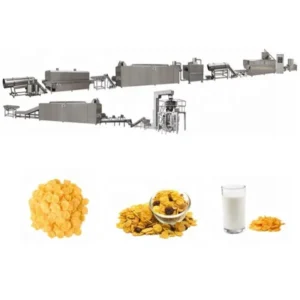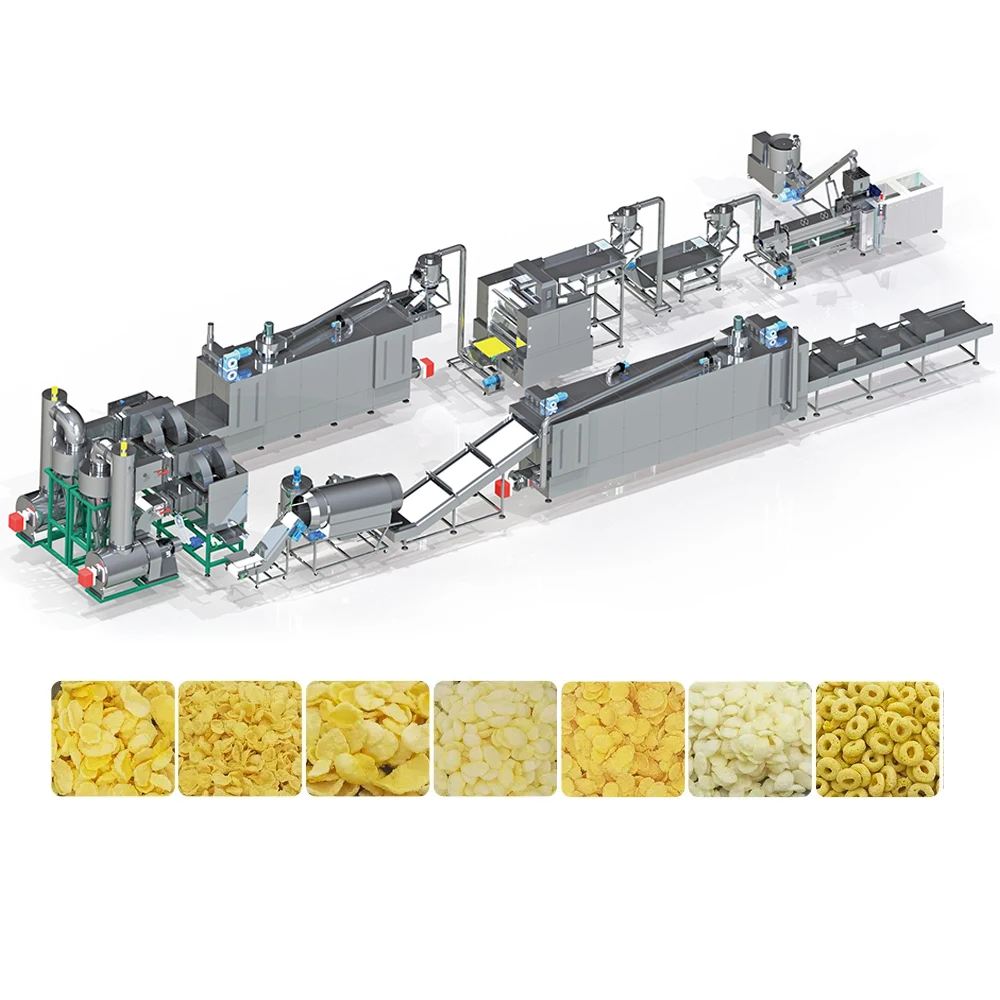
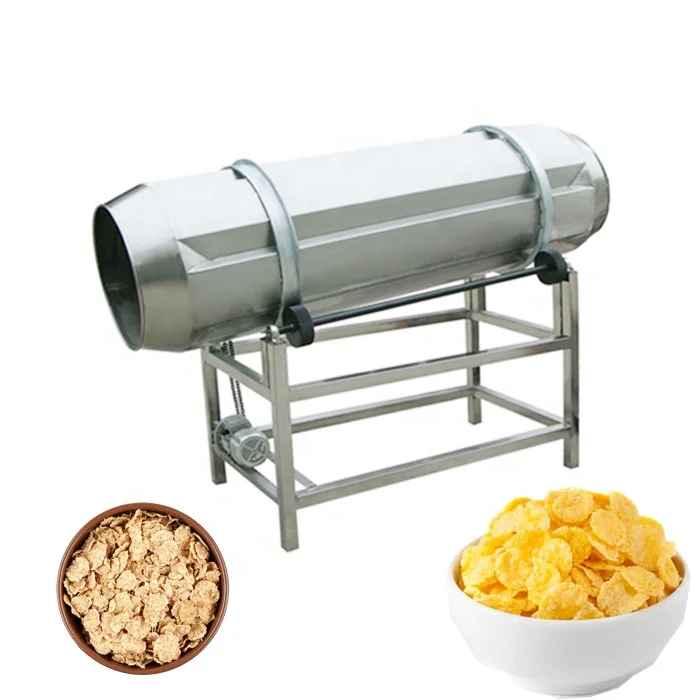
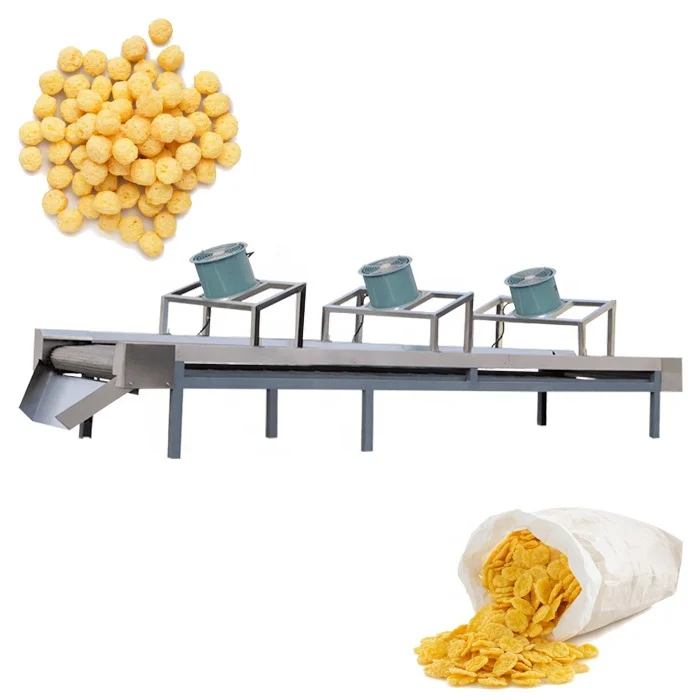
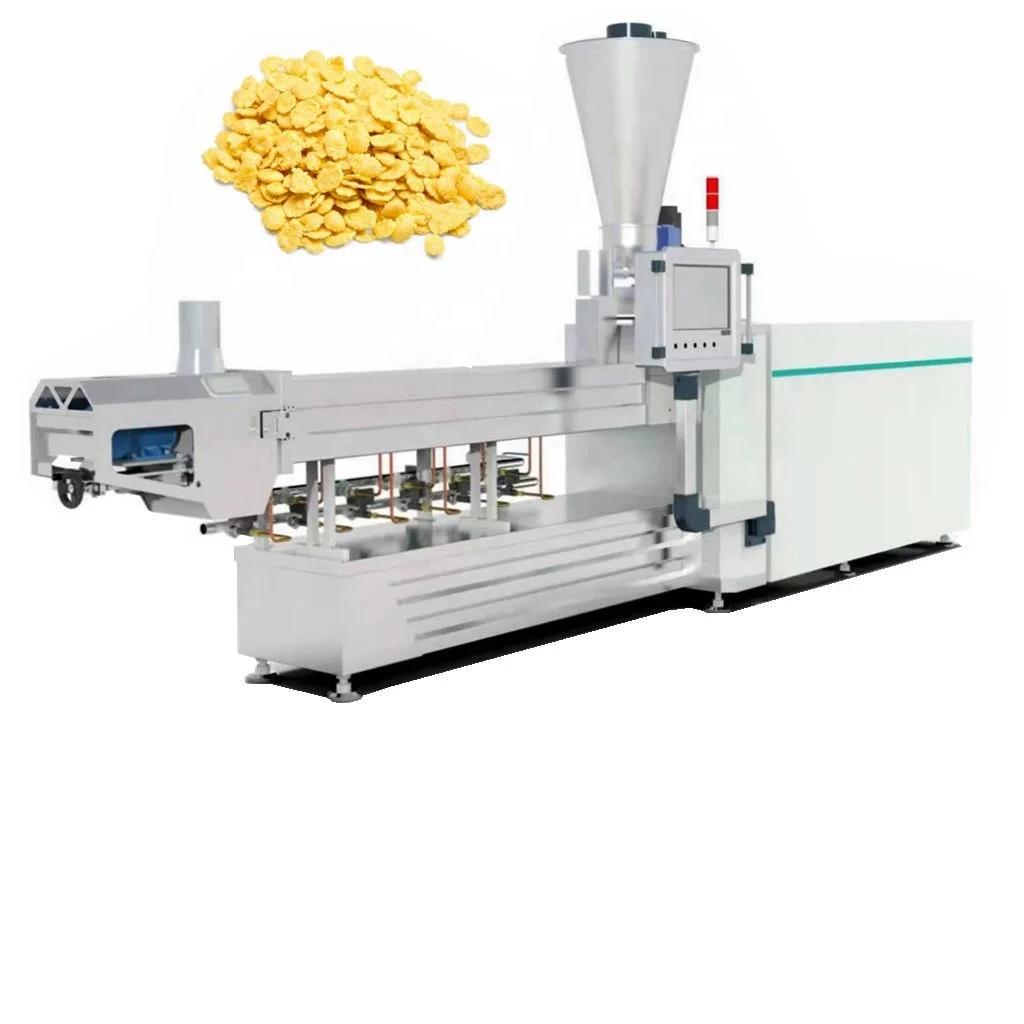

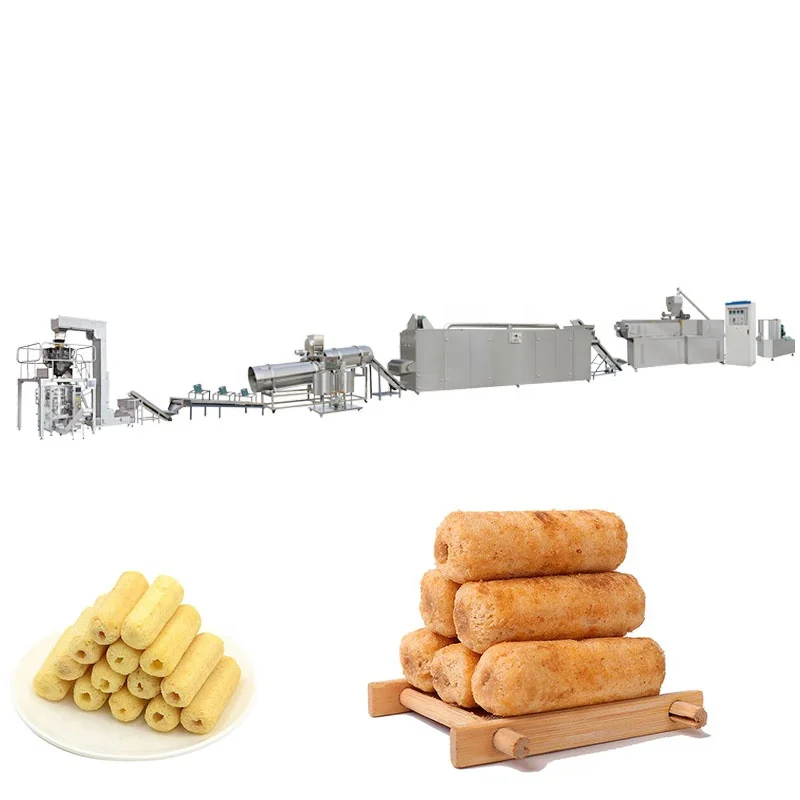
MT75 Breakfast Cereal Corn Flake Production Line, Twin-Screw Extruder, PLC Control — complete turnkey layout from mixing through extrusion, flaking, drying, roasting, and packing, with throughput matched across every station to eliminate single-vendor bottlenecks.
- Screw configuration and die design specified to your raw material and target flake density
- Hydraulic double-roller flaking with infrared temperature monitoring for consistent thickness
- Hot air roasting with dual circulating fans and cyclone dust removal
Trial runs on your actual formulation in our testing workshop before shipment ensure the line performs to spec from day one.
Description
Integrated Line Engineering — Every station from mixing to packing is throughput-matched under a single project scope, eliminating the hand-off gaps that arise when sourcing breakfast cereal and corn flake equipment from separate vendors.
Technical Specifications
| Parameter | Value |
|---|---|
| Product Type | Breakfast Cereal Corn Flake Production Line |
| Model Options | MT70 / MT75 / MT85 |
| Installed Power | MT70 160 kW / MT75 210 kW / MT85 190 kW |
| Power Consumption | MT70 120 kW / MT75 150 kW / MT85 140 kW |
| Output Capacity | MT70 150–200 kg/h (basis to be confirmed); MT75 300–500 kg/h (basis to be confirmed); MT85 300–400 kg/h (basis to be confirmed) |
| Overall Dimensions (L×W×H) | MT70 41 × 1.5 × 2.2 m / MT75 45 × 1.5 × 3.5 m / MT85 43 × 1.5 × 3.2 m |
| Extruder Screw Type | Twin-screw |
| Control System | PLC control; MCC available across line |
| Flaking Machinery | Hydraulic double-roller system, infrared temperature monitoring |
| Dryer Heating Source | Gas or Electric |
| Roasting Oven | Hot air roasting, dual circulating fans, conciliation burner, cyclone dust removal |
| Coating System | Double tumble for sugar melting, elevator, coating drum, spraying nozzle |
| Certifications | CE (since 2014), ISO |
Application Suitability
| Application | Material or Output |
|---|---|
| Natural corn flake production | Corn powder as primary base material |
| Sugar-coated corn flake production | Corn powder base with sugar coating stage |
| Shaped breakfast cereal formats | Rice, wheat, oat, or barley powder using die changes for rings, balls, stars, fruit loops |
| Multi-grain cereal expansion | Blends of corn, wheat, rice, oat, barley powder |
Why "Nominal Capacity" Misleads Cereal Buyers
The most expensive mistake in a breakfast cereal corn flake production line turnkey purchase is trusting an extruder nameplate number that was never tested against your actual recipe. Capacity is meaningless unless it references your raw material, moisture level, and target flake density.
I have walked into plants in Latin America where the extruder was rated for a certain throughput on paper, but the actual corn formulation required different moisture conditioning and screw shear. The line ran, but output sat well below the quoted figure, and the dryer downstream was oversized for what actually came through — a bottleneck created by mismatched expectations rather than bad equipment [NEED_CITE: common causes of throughput shortfall in extruded cereal lines]. The fix is not a bigger motor; it is a trial run on the buyer’s specific formulation before the line leaves the factory.
Throughput Matching Across Every Station
A breakfast cereal corn flake production line turnkey project fails or succeeds on whether each station can handle what the previous one delivers. The extruder may push product at a given rate, but if the flaking rollers cannot keep up, material backs up and moisture changes before pressing. If the hot air roaster has insufficient residence time, the flakes leave with uneven blistering and residual moisture that shortens shelf life.
Our layout process calculates throughput at every transfer point — extruder to flaking, flaking to dryer, dryer to roaster, roaster to coating drum — so that no single station constrains the whole line. This is the difference between buying machines and buying a production system.
Phased Installation and Utility Planning
Corn flake lines occupy substantial floor space — the MT75 layout extends up to 45 meters in length with a 3.5-meter height profile. Utility connections for steam, compressed air, gas supply for the roaster, and electrical circuits for the PLC cabinets must be planned before the concrete is poured. [NEED_CITE: industrial utility planning standards for food processing facilities]
We sequence installation by station: base extruder and flaking machinery first, then dryer and roaster, then coating and cooling. Each phase has its own utility sign-off before the next station is connected. This prevents the situation where a line is mechanically complete but cannot run because the gas line to the roaster was never sized for the burner load.
Reading the Specs That Actually Matter
The twin-screw extruder is the core of any corn flake line, and its screw configuration determines how the starch in your corn or wheat flour gelatinises under heat and shear. The MT75 extruder uses screws made with wear-resistant technology and includes automatic lubricating and cooling — features that maintain consistent barrel temperature across long production runs.
The flaking machinery uses a hydraulic system driving two separate motors, one per roller, with temperature monitored by an infrared sensor. This setup controls flake thickness, which directly affects how the flakes behave in the roaster. Too thick, and the interior stays doughy; too thin, and the flakes shatter during coating.
The hot air roaster uses a conciliation burner with two separate circulating fans and a cyclone dust removal device. Uniform air distribution is what produces the characteristic surface blistering on a corn flake — a visual cue that consumers associate with proper toasting and crunch.
The Cost of Skipping Configuration Verification
When a line ships with generic screw and die settings, the extruder may produce pellets that are too dense or too porous for your target flake. The flaking rollers then either crush the material or fail to compress it into a coherent sheet. I have seen plants run for weeks on the wrong configuration, blaming the raw material supplier, before anyone thought to check the screw pitch and die aperture against the actual recipe [NEED_CITE: impact of screw configuration on extrudate density in cereal processing].
The same applies to voltage and control language. A PLC cabinet built for a different market’s electrical standard will not simply underperform — it may refuse to start, or worse, damage the drive motors. Confirming frequency, voltage, and HMI language before production avoids commissioning delays that can stretch into weeks.
Why This Project Scope Works
Line layout and capacity calculations are documented per station, not just for the extruder in isolation. The MT70, MT75, and MT85 models each have a defined power envelope and footprint, and the supporting equipment is matched to those parameters.
An in-house testing workshop runs your raw material before shipment, producing a trial run report that documents actual output, flake thickness, and roasting behaviour on your formulation. Screw and die configuration is recorded for your specific product and provided as part of the documentation package.
The roasting oven, flaking machinery, and coating system are all sourced under the same project scope, meaning warranty and service responsibility sits with one supplier rather than being disputed across multiple vendors.
Documentation & Verification
- Line layout with throughput calculations matched across all stations
- Trial run report on customer’s specific raw material formulation
- Screw and die configuration record for target flake density
- Electrical schematic with voltage, frequency, and control language confirmed
- Wear parts list with spare screw and die availability at first replacement
Installation, Commissioning & Support
- Foundation plan provided for 41–45 meter line length with 2.2–3.5 meter height clearance
- Dedicated electrical circuits sized for MT75 210 kW installed power and PLC cabinet load
- Gas line sizing specified for hot air roaster conciliation burner before installation
- Hydraulic system commissioning on flaking machinery with infrared calibration on-site
- Operator training covering PLC interface, screw change procedures, and roller gap adjustment
- Wear parts inventory established with replacement schedule for screws and dies
What to Include in Your Inquiry
To scope a breakfast cereal corn flake production line turnkey project accurately, we need your target product format (natural flakes, sugar-coated, or shaped cereals), the primary raw material and its moisture content, your daily production target, and your factory’s available floor space and ceiling height. Confirm your local voltage and frequency standard, and whether the PLC interface should be in a specific language. If you can send a sample of your raw material, we schedule a trial run in our testing workshop before finalising the line configuration.
Frequently Asked Questions
Q: How is line capacity verified against my specific raw material and recipe?
A: We run your actual corn, wheat, or multi-grain formulation through our in-house testing workshop before shipment. The trial documents extruder throughput, flake thickness, and roasting behaviour on your material. Capacity figures in the final proposal reference this trial data, not generic nameplate ratings.
Q: What does the turnkey project scope include beyond the machines themselves?
A: The scope covers line layout design matched to your factory dimensions, utility planning for electrical, gas, steam, and compressed air, a phased installation schedule, commissioning with parameter tuning on your recipe, and operator training. All stations are sourced and warranted under one project contract.
Q: How do you ensure throughput is matched between stations?
A: Each station — extruder, flaking machinery, dryer, roaster, coating drum, cooler — is selected based on calculated transfer rates from the previous station. The layout document shows throughput at every hand-off point so no single machine constrains the line below the target output.
Q: Can I test my raw material before committing to the full line?
A: Yes. Send a sample of your formulation to our testing workshop. We run it on the extruder and flaking machinery, document the results in a trial report, and use that data to finalise screw configuration, die selection, and roasting parameters before production begins.
Q: How are electrical standards and control language confirmed before production?
A: During the specification phase, we confirm your local voltage, frequency, and preferred PLC interface language. These are locked into the electrical schematic before manufacturing starts, preventing commissioning delays caused by mismatched drive motors or untranslated HMI screens.
Related products
-

Corn Flakes Production Line Breakfast Cereal Production Machine Line Corn Flake Making Machinery
¥59,800.00 Select options This product has multiple variants. The options may be chosen on the product page -
Corn Flake Making Machine Corn Puffs Making Machine Snack Food Production Line
Price range: ¥500.00 through ¥1,200.00 Select options This product has multiple variants. The options may be chosen on the product page -
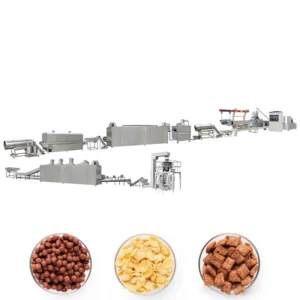
Kelloggs Corn Flakes Breakfast Cereal Normal Making Machine Breakfast Cereal Extruder Production Line
¥30,000.00 Select options This product has multiple variants. The options may be chosen on the product page -
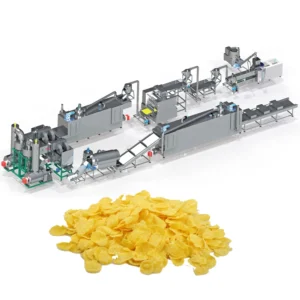
Intelligent Corn Flakes Production Line Twin Screw Extruder to Make Corn Flakes amd Morning Cereals
¥30.00 Select options This product has multiple variants. The options may be chosen on the product page