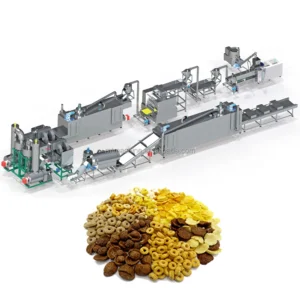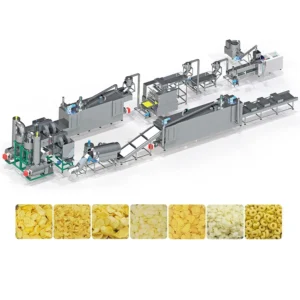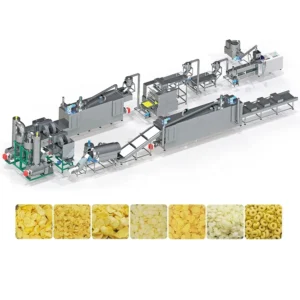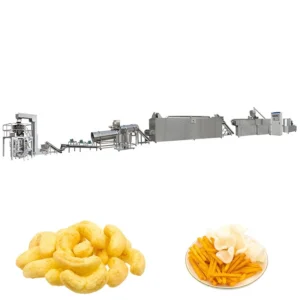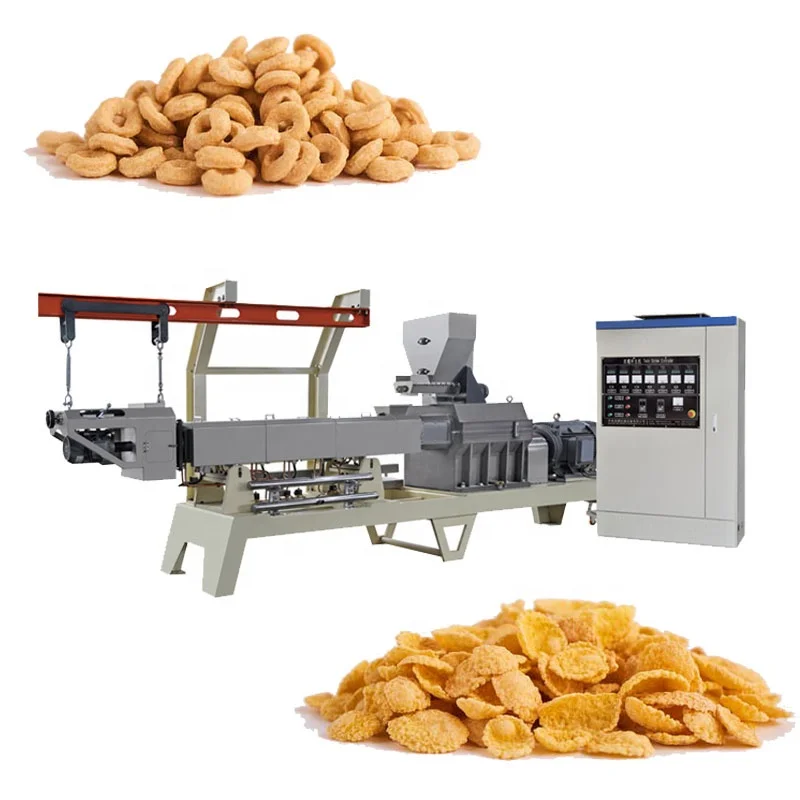


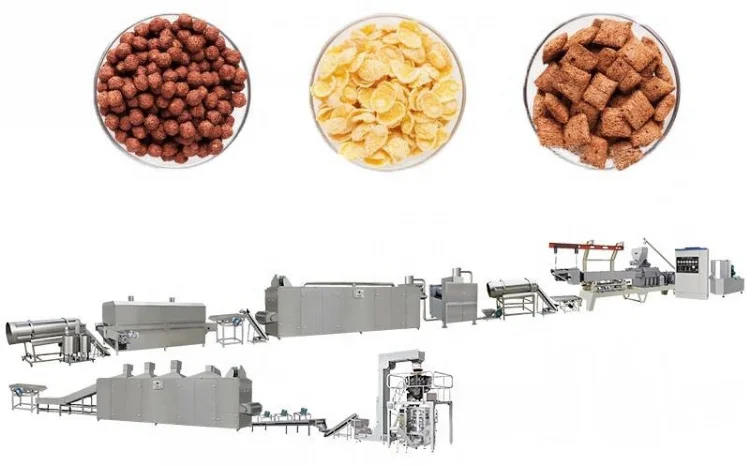

MT-65processing line Corn Flakes Breakfast Cereal Production Line, Twin-Screw Extruder, PLC & MCC Control — configured as a complete turnkey project from batching through extrusion, flaking, baking, coating and packing.
- Line stations are throughput-matched so the extruder, flaking press, gas-fired oven and packing unit hold the same target output without bottlenecking
- Co-rotating twin-screw extruder with sectional screw modules, configurable for your cereal blend’s gelatinisation and cooking profile
- Screw configuration and die design specified to the buyer’s raw material and target flake density
Trial runs on customer raw material are completed in the testing workshop before shipment, with full documentation including line layout, capacity calculation and electrical schematics provided.
Description
Throughput-Matched Line Design — Every station from batching to packing is sized against your actual cereal formulation, so no single unit bottlenecks the corn flakes production line turnkey output.
Technical Specifications
| Parameter | Value |
|---|---|
| Product Type | Corn Flakes Breakfast Cereal Production Line |
| Screw Type | Twin-screw, co-rotating sectional modules |
| Available Models | MT-65, MT-70, MT-85, MT-75 |
| Output Capacity (MT-65) | 120–150 kg/h (basis not stated in source — confirm raw material, moisture, pellet size) |
| Output Capacity (MT-70) | 200–250 kg/h (basis not stated in source — confirm raw material, moisture, pellet size) |
| Output Capacity (MT-85) | 300–400 kg/h (basis not stated in source — confirm raw material, moisture, pellet size) |
| Output Capacity (MT-75) | 400–500 kg/h (basis not stated in source — confirm raw material, moisture, pellet size) |
| Installed Power (MT-65) | 84 kW |
| Real Power (MT-65) | 59 kW |
| Installed Power (MT-70) | 132 kW |
| Real Power (MT-70) | 92 kW |
| Installed Power (MT-85) | 239 kW |
| Real Power (MT-85) | 167 kW |
| Installed Power (MT-75) | 186 kW |
| Real Power (MT-75) | 140 kW |
| Flaking Press Roller Size | 510 × 310 × 1050 mm |
| Flaking Press Power | 16.12 kW |
| High-Temperature Oven Dimensions | 4.5 × 1.4 × 1.8 m |
| Oven Heating Method | Gas-fired, both-side baking system |
| Control System | PLC and MCC |
| Certification | CE |
| Assembly State | Complete turnkey line |
Application Suitability
| Application | Material or Output |
|---|---|
| Traditional corn flakes production | Corn grits or corn flour |
| Multi-grain breakfast cereal manufacturing | Rice, millets, wheat, oat, barley blends in powder or grits form |
| Fortified breakfast cereal lines | Cereal base with added vitamin and mineral premix |
| Flaked and toasted cereal products | Various grain formulations requiring gelatinisation, pressing and baking |
Why Nominal Capacity Figures Mislead Cereal Line Buyers
A quoted kg/h number means nothing until it is validated on your specific grain blend at your target moisture.
I spent years on the assembly floor before moving into technical sales, and the pattern repeats itself: a buyer receives a line quoted at a nominal throughput, installs it, and discovers the extruder cannot sustain that rate on their local corn variety. The fat content differs, the starch behaviour shifts, and the flakes come off the press too dense or too fragile. Downstream, the oven cannot keep up or the coating drum overflows. Each station was specified in isolation rather than as a connected system. [NEED_CITE: common causes of throughput shortfall in cereal extrusion lines]
How Line Sequencing Affects Flake Integrity
A corn flakes production line turnkey project lives or dies on the transitions between stations. After the twin-screw extruder gelatinises the cereal mass, the cooked pellets travel through an air conveyor into a dryer that must reduce moisture to a narrow window before the flaking press can do its work. If the dryer is undersized, wet pellets reach the rollers and smear rather than flatten. If the hoister between the dryer and the press runs too fast, pellets pile up and cool unevenly, producing a mix of thick and thin flakes that bake at different rates.
Matching Oven Capacity to Upstream Throughput
The gas-fired high-temperature oven with both-side baking measures 4.5 metres in length, which provides a specific residence time for a given belt load. Push more flakes through than the oven was sized for and the toast colour falls short, moisture stays too high, and shelf life suffers. Pull them through too slowly and you get over-browned, brittle flakes that shatter during packing. The oven, the flaking press and the extruder must all agree on the same kg/h target, calculated against your actual grain formulation. [NEED_CITE: oven residence time requirements for toasted corn flakes]
Reading the Specification Sheet Beyond the Headline Numbers
The twin-screw extruder uses co-rotating sectional screw modules, meaning the screw profile can be rearranged to suit different cereal blends. A high-corn formulation may need a longer cooking zone with specific kneading blocks, while a multi-grain mix with oat or barley might require additional de-gassing sections to prevent bubble formation in the pellet. The installed power across the model range — from 84 kW on the MT-65 to 239 kW on the MT-85 — reflects the torque needed for different throughputs, but real power consumption sits noticeably lower, which matters for your transformer sizing and running cost projections. The flaking press draws 16.12 kW on its own, and its roller gap directly governs flake thickness: too thin and the flakes burn in the oven; too thick and they remain doughy at the centre. The PLC and MCC control system coordinates these variables from a single interface, keeping batch-to-batch density consistent when operators change over between recipes.
The Hidden Cost of Mismatched Station Sizing
When a flaking press or dryer is specified without reference to upstream throughput, the consequences show up within the first production week. Operators compensate by slowing the extruder, which changes the residence time inside the barrel and alters the degree of starch gelatinisation. The flakes then toast differently, flavouring adherence drops in the coating drum, and the packing station receives product outside specification. I have seen entire first batches scrapped because one station was pulled from a catalogue without recalculating the line balance. [NEED_CITE: impact of line imbalance on cereal product quality]
Why Sourcing the Full Line From One Supplier Matters Here
Every station — mixer, screw conveyor, twin-screw extruder, air conveyor, dryer, hoister, flaking press, high-temperature oven, flavouring drum with oil sprayer, cooling machine and packing machine — is configured as a single project rather than assembled from separate vendors. Screw configuration and die design are specified to the buyer’s raw material, not copied from a generic build. An in-house testing workshop runs trial production on your actual corn or cereal blend before the line ships, so screw profile, press gap and oven temperature are validated in advance. Pre-sales layout design covers utility planning, phased installation and commissioning scheduling, reducing the gap between delivery and first saleable output.
Documentation & Verification
- Line layout and capacity calculation showing throughput match at every station
- Screw and die configuration record specified to your cereal formulation
- Trial run report on your raw material completed before shipment
- Electrical schematic with voltage, frequency and PLC language confirmation
- CE declaration of conformity and factory test record
- Operation manual with wear parts list and packing photographs
Installation, Commissioning & Support
- Foundation plan accounts for the MT-85 line spanning up to 28 metres in length
- Dedicated power circuit sized for the combined installed load of your selected model
- Flaking press and oven arrive as separate modules requiring on-site alignment
- First production run includes parameter tuning for your local grain formulation
- Operator training covers PLC recipe management and screw module changeover
- Wear parts list includes spare screw elements, dies and flaking roller segments
What We Need to Configure Your Line
To size a corn flakes production line turnkey project accurately, share your target cereal formulation including grain type and flour-to-grits ratio, your daily output requirement, and the available floor space with ceiling height in your production hall. Confirm your local voltage and frequency, the preferred PLC display language, and whether you need the line to integrate with existing upstream mixing or downstream packing equipment. If your raw material differs significantly from standard corn grits, a trial run in the testing workshop is recommended before finalising the screw and die configuration.
Frequently Asked Questions
Q: How is line capacity verified on my specific corn or cereal formulation?
A: Before shipment, your raw material is run through the twin-screw extruder in the testing workshop. Screw configuration, die selection, flaking press gap and oven temperature are adjusted until the flakes meet target density and toast colour. A trial run report documenting these parameters is provided so the same settings transfer directly to your plant during commissioning.
Q: How do you prevent one station from bottlenecking the rest of the line?
A: Each station is sized during the layout phase based on the agreed throughput. The extruder output, dryer residence time, flaking press feed rate and oven belt speed are calculated together rather than specified independently. This matching is documented in the capacity calculation so every unit holds the target kg/h without forcing upstream or downstream equipment to slow down.
Q: What does phased installation and operator training look like?
A: The line arrives in modules — extruder, dryer, flaking press, oven, coating and cooling sections — and is installed in sequence starting from the mixer end. Commissioning engineers set parameters station by station, then run a full-line production test. Operator training covers PLC recipe entry, screw module changeover, roller gap adjustment and daily maintenance routines specific to your model.
Q: How are voltage and control language confirmed before shipping?
A: During the specification stage, you provide your plant supply voltage, frequency and preferred PLC display language. These are recorded in the electrical schematic and confirmed before production begins, so the MCC panels and HMI arrive ready for your local electricians and operators without rewiring or reprogramming delays on site.
Q: Which spare wear parts are included and what is the lead time for replacements?
A: The initial shipment includes a wear parts list covering screw elements, die inserts and flaking roller segments. These are packed with the line so first replacements are on hand when needed. Subsequent orders are processed through the factory with standard production lead times, and the configuration record ensures exact part matching for your screw profile and die geometry.
Related products
-
Sweet Corn Flakes Maize Breakfast Cereal Full-automatic Food Grade Stainless Steel Heat Exchanger Mixer Fryer Processing Line
¥8,000.00 Add to cart -
Kelloggs Corn Flakes Breakfast Cereal Normal Making Machine Breakfast Cereal Extruder Production Line
¥30,000.00 Select options This product has multiple variants. The options may be chosen on the product page -
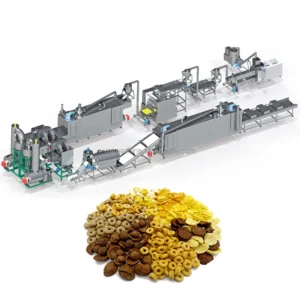
Stainless Steel Honey Small Corn Flake Breakfast Cereal Flakes Maker Making Machine Production Plant
¥30,000.00 Add to cart -
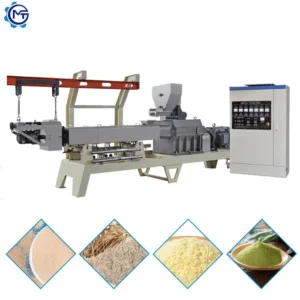
New Technical Automatic Cereal Nutritional Powder Instant Porridge Baby Food Making Machine
¥10,000.00 Select options This product has multiple variants. The options may be chosen on the product page