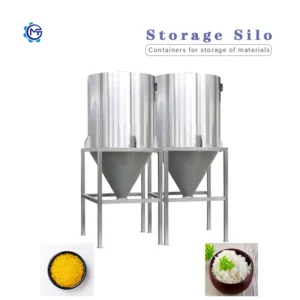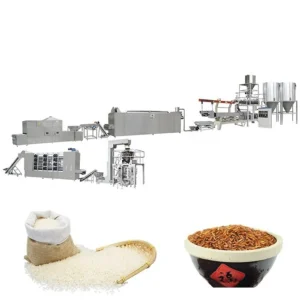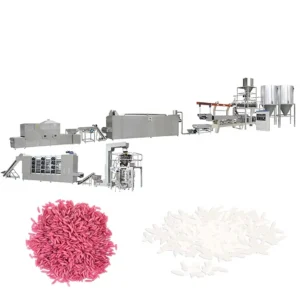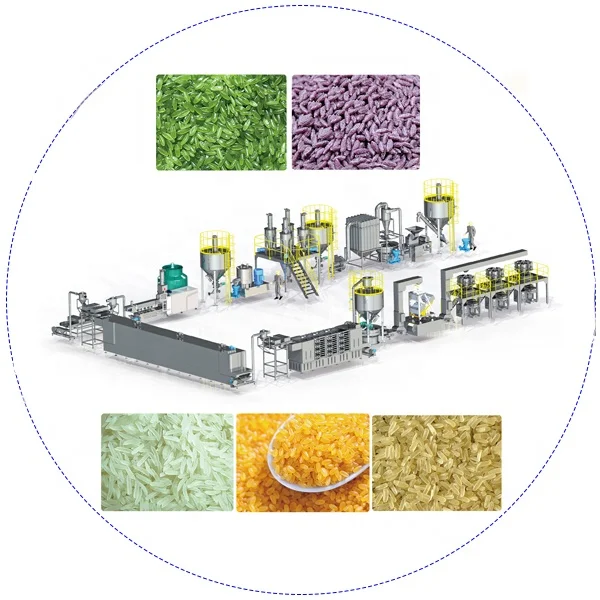


MT65 / MT70 / MT85 / MT75 / MT95 Fortified Artificial Rice Processing Line, Twin-Screw, PLC Control — engineered as a complete turnkey project from batching through extrusion, drying, roasting, and packing.
- Screw configuration and die design specified to your raw material formulation and target kernel density
- Throughput matched across every station to prevent dryer or packing bottlenecks
- Frequency speed control with automatic lubrication for stable long-duration runs
Trial runs on your actual raw material are completed in our in-house testing workshop before shipment, with full documentation provided.
Description
Precision-Matched Throughput — Every station from batching to packing is engineered as a single system so that extruder output, dryer residence time, and cooling capacity align with your specific rice formulation rather than generic benchmarks.
Technical Specifications
| Parameter | Value |
|---|---|
| Product Type | Fortified Artificial Rice Processing Line |
| Model | MT65 / MT70 / MT85 / MT75 / MT95 |
| Screw Type | Twin-screw |
| Feeding System | Single or double screw feeding system optional based on material |
| Capacity (MT65) | 80-100 kg/h (basis to be confirmed with raw material formulation and moisture content) |
| Capacity (MT70) | 100-120 kg/h (basis to be confirmed with raw material formulation and moisture content) |
| Capacity (MT85) | 200-300 kg/h (basis to be confirmed with raw material formulation and moisture content) |
| Capacity (MT75) | 300-500 kg/h (basis to be confirmed with raw material formulation and moisture content) |
| Capacity (MT95) | 800-1000 kg/h (basis to be confirmed with raw material formulation and moisture content) |
| Installed Power (MT65) | 85 kW |
| Installed Power (MT70) | 120 kW |
| Installed Power (MT85) | 235 kW |
| Installed Power (MT75) | 180 kW |
| Installed Power (MT95) | 260 kW |
| Power Consumption (MT65) | 60 kW |
| Power Consumption (MT70) | 85 kW |
| Power Consumption (MT85) | 165 kW |
| Power Consumption (MT75) | 135 kW |
| Power Consumption (MT95) | 195 kW |
| Overall Dimensions (MT65) | 28 × 1.2 × 2.2 m |
| Overall Dimensions (MT70) | 30 × 1.5 × 2.2 m |
| Overall Dimensions (MT85) | 34 × 3.5 × 4.3 m |
| Overall Dimensions (MT75) | 32 × 3.5 × 4.3 m |
| Overall Dimensions (MT95) | 36 × 3.5 × 4.3 m |
| Control System | Frequency speed control with high automation |
| Lubrication | Automatic lubricating and cooling system |
| Heating Source (Dryer) | Electric or gas |
| Dryer Feature | Circulation drying process, frequency motor controls mesh belt speed |
| Line Stations | Mixing → Extruding → Vibrating → Low temperature drying → Cooling → High temperature roasting → Cooling → Packing |
| Basic Materials | Broken rice, rice, corn, millet, wheat, oats, buckwheat, bean, starch, vitamin and mineral additives |
| Final Products | Artificial rice, fortified rice kernels |
| Assembly State | Complete line (turnkey solution available) |
| Voltage & Frequency | Customized to customer’s local voltage (to be verified before production) |
| Standards | CE (since 2014), ISO certified |
Application Suitability
| Application | Material or Output |
|---|---|
| Fortified rice for government nutrition programmes | Broken rice and rice bran blended with vitamin and mineral premix |
| High-value rice kernels from milling by-products | Broken rice, rice flour, and starch reconstituted into whole-grain-shaped kernels |
| Multigrain nutritional rice | Corn, millet, wheat, oats, and buckwheat combined with legume starch |
| Infant and weaning rice cereal base | Rice and bean flour with controlled gelatinisation for digestibility |
| Artificial rice for food aid and emergency supply | Corn and wheat with shelf-stable moisture content and uniform kernel density |
Why the Dryer Is Where Fortified Rice Lines Actually Fail
Matching extruder throughput to dryer residence time is what separates a line that hits its quoted output from one that quietly drops half its capacity on the floor.
I have watched a fortified rice installation where the extruder ran at full speed but the dryer could not pull enough moisture from the kernels before they reached the cooling belt. The result was a pile of sticky, misshapen kernels that cracked during roasting. Nobody noticed the mismatch until commissioning week, and by then the buyer had already shipped raw material to the site [NEED_CITE: dryer and extruder throughput matching in cereal processing lines]. When you evaluate a Fortified Artificial Rice Processing Line turnkey proposal, the dryer specification deserves the same scrutiny you give the extruder motor rating.
Screw Configuration That Fits Your Grain Blend, Not a Catalogue Default
The twin-screw extruder in this Fortified Artificial Rice Processing Line turnkey system is configured after reviewing your exact raw material ratios. Broken rice behaves differently from millet or buckwheat under shear — starch gelatinisation temperature, fibre content, and particle size all shift the screw profile needed to produce a smooth, intact kernel. A screw combination designed for pure rice flour will tear through a high-fibre oat blend, leaving rough surfaces and inconsistent expansion.
Die Geometry and Kernel Density Control
The die plate determines the cross-section of every kernel that exits the barrel. For fortified rice, the target is a dense, unexpanded grain that survives roasting and cooking without disintegrating. Die hole diameter, land length, and face-cut knife speed must be calculated together. Too short a land, and kernels exit before internal pressure stabilises; too long, and throughput drops while barrel pressure climbs toward the safety limit [NEED_CITE: die land length and pressure relationship in pasta and rice extrusion].
What the Power and Dimension Figures Mean on the Floor
Installed power across the range spans from 85 kW on the MT65 to 260 kW on the MT95, but actual consumption sits roughly 25 percent lower under normal load — the difference comes from the frequency speed control adjusting motor draw to real-time barrel resistance. The MT85 and larger models occupy a 3.5-metre-wide footprint, which means your facility needs clear access on both sides for maintenance and screw extraction. The automatic lubricating and cooling system runs independently of the main drive, keeping barrel zones within tolerance during extended shifts without manual intervention. Choosing between electric and gas heating for the dryer changes not just the utility hookup but also the ventilation and exhaust ducting your building must accommodate.
The Cost of Ignoring Voltage Until the Crate Arrives
A factory in Southeast Asia received an extruder wired for 380 V / 50 Hz while their grid ran at 440 V / 60 Hz. The motor overheated within the first hour, and the frequency inverter faulted out repeatedly [NEED_CITE: voltage and frequency standards by export market]. The buyer lost two weeks waiting for replacement contactors and a correctly rated transformer. Confirming voltage, phase configuration, and control language before the machine enters production prevents this kind of commissioning stall and the cascade of delays it triggers downstream.
Why Source the Entire Line from One Engineering Scope
When the Fortified Artificial Rice Processing Line turnkey project is designed as a single package, every station is sized against the same throughput target. The mixing batch cycle feeds the extruder hopper at a rate the twin-screw can absorb; the vibrating screen removes fines before they enter the dryer; the circulation dryer holds kernels for the exact residence time your moisture specification demands; the roasting stage reaches surface colour without splitting the kernel interior. This eliminates the finger-pointing that happens when five different vendors each blame the others for a bottleneck. Screw and die records are kept on file so replacement wear parts match the original configuration. Trial runs on your actual raw material take place in the testing workshop before the line ships, so formulation adjustments happen at the factory, not on your floor during commissioning. Electrical schematics and a confirmed voltage record travel with the machine, giving your local electrician a clear wiring reference.
Documentation & Verification
- Line layout drawing with throughput calculation for each station matched to your target output
- Screw and die configuration record tied to your specific grain blend and kernel density
- Trial run report on your raw material conducted in the testing workshop before dispatch
- Electrical schematic with voltage, frequency, and control language confirmed for your site
- CE declaration of conformity and ISO certificate for customs and regulatory submission
- Operation and maintenance manual with wear parts list and replacement intervals
Installation, Commissioning & Support
- Foundation plan showing load points for the MT85 and larger models requiring a level concrete pad across the 34–36 m line length
- Dedicated power circuit sized to the installed power of your selected model, with breaker ratings confirmed before energisation
- Modular station assembly with bolted connections allowing sectional installation in facilities with limited overhead clearance
- First-run parameter setting covering barrel temperature profile, screw speed, and dryer mesh belt frequency to match your formulation
- Operator training on screen-based controls, lubrication system checks, and die changeover procedure
- Wear parts kit including spare screw elements and die plates shipped with the line to cover initial production months
What We Need to Move Forward
Share your raw material recipe — including the percentage of broken rice, starch binders, and any vitamin premix — along with your target kernel size and daily output goal. Let us know your site voltage and frequency, the language your operators prefer on the control interface, and whether your facility has existing upstream milling or downstream packing equipment that the line must integrate with. If a trial run on your material would help confirm kernel integrity, we can schedule that before the quotation is finalised.
Frequently Asked Questions
Q: How is line capacity verified against my specific raw material formulation and moisture content?
A: We run your actual blend through the extruder in our testing workshop, recording barrel pressure, screw speed, and moisture at the die face. The trial run report documents kernel shape, density, and surface finish. Only after you approve these results do we lock the screw configuration and finalise the line capacity figure for your contract.
Q: What is included in the turnkey scope — does the line cover every station from batching to packing?
A: Yes. The scope includes the mixing and batching system, twin-screw extruder, vibrating screen, low-temperature circulation dryer, cooling conveyor, high-temperature roasting unit, second cooling stage, and packing station. Throughput at each station is calculated against the same target so no single unit becomes a bottleneck.
Q: How are voltage, frequency, and control language confirmed before production begins?
A: During the proposal stage we request your site utility data sheet. Electrical schematics are then drawn to your exact voltage and phase. Control panel labels and HMI language are set to your preference. These records are included in the documentation package shipped with the line.
Q: Can a trial run be performed on my raw material before shipment, and what does the report cover?
A: We conduct the trial using your supplied raw material and record screw combination, barrel temperature zones, die selection, moisture content at each stage, and final kernel appearance. You receive the report for review and sign-off before the line is crated for dispatch.
Q: What is the phased installation and commissioning schedule, and is operator training included?
A: Installation proceeds station by station following the layout drawing, with electrical and utility connections verified at each phase. Commissioning covers dry runs, wet runs with your material, and parameter fine-tuning. Operator training on controls, maintenance routines, and die changeover is delivered on site before the engineering team departs.
Related products
-
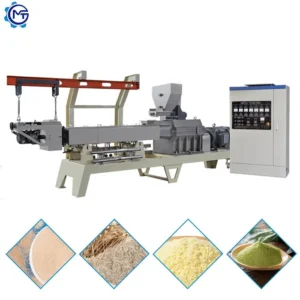
High Productivity New Condition Safe Healthy and Nutritious Baby Food Meal Replacement Powder Production Line
¥30.00 Select options This product has multiple variants. The options may be chosen on the product page -

Industrial Automatic 500kg/h Baby Cereal Nutrition Powder Extruder Manufacturing Process Line
¥8,238.27 Add to cart -
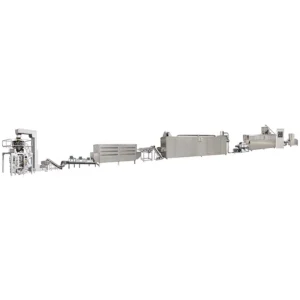
High Productivity New Condition Nutritious Baby Food Meal Replacement Powder Production Line
¥30.00 Select options This product has multiple variants. The options may be chosen on the product page -
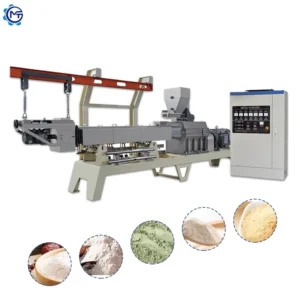
CE cerelac Instant Baby Food Porridge Making Machine Production Line
¥35,000.00 Select options This product has multiple variants. The options may be chosen on the product page