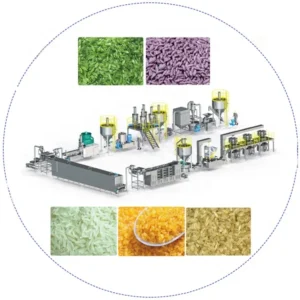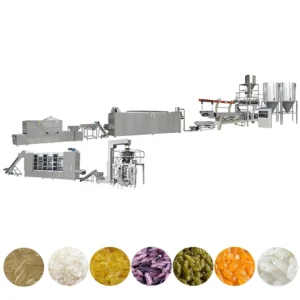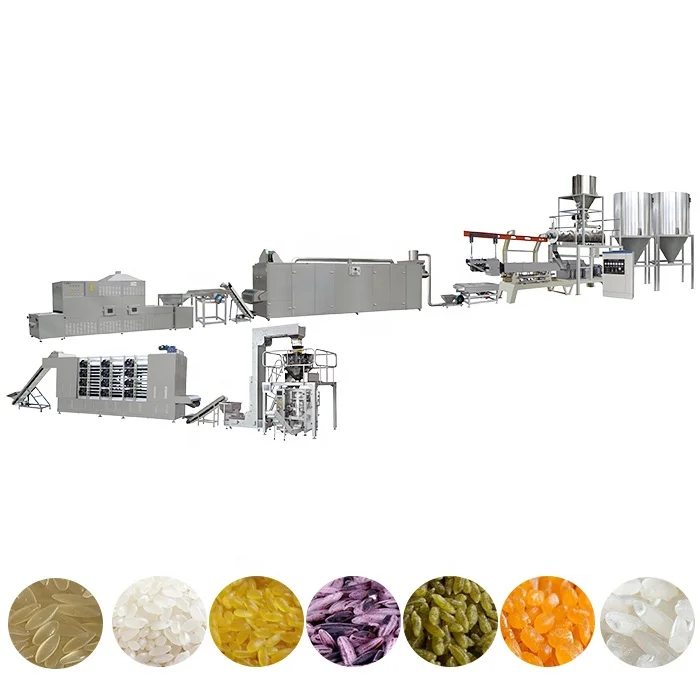
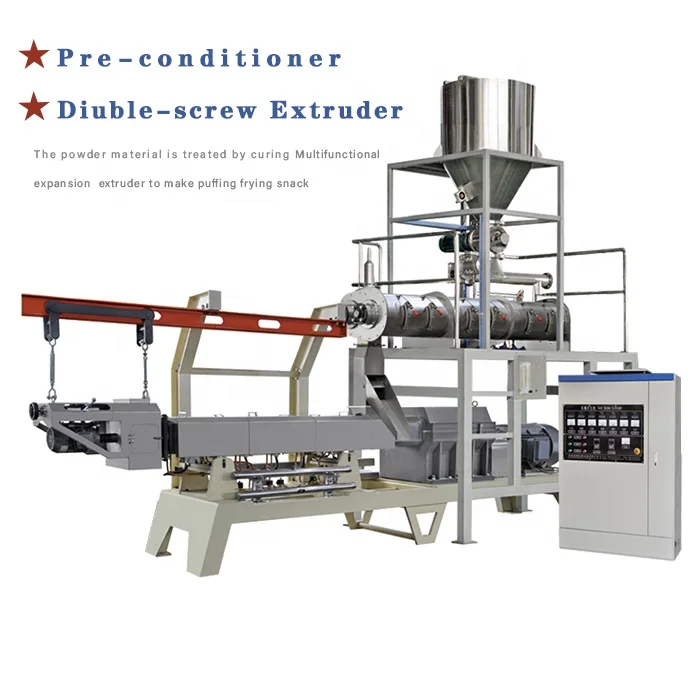
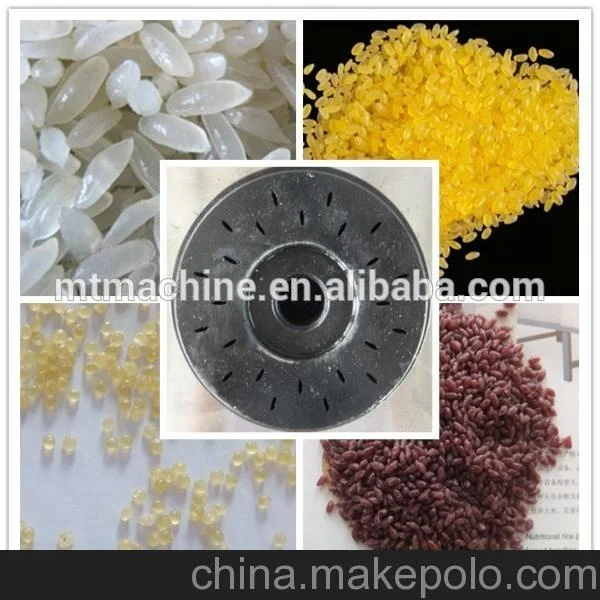
MT65 Fortified Rice Extrusion Production Line, Twin-Screw, PLC & MCC Control — engineered for consistent kernel density and nutritional retention across grain blends.
- Screw configuration and die design specified to your raw material and target product
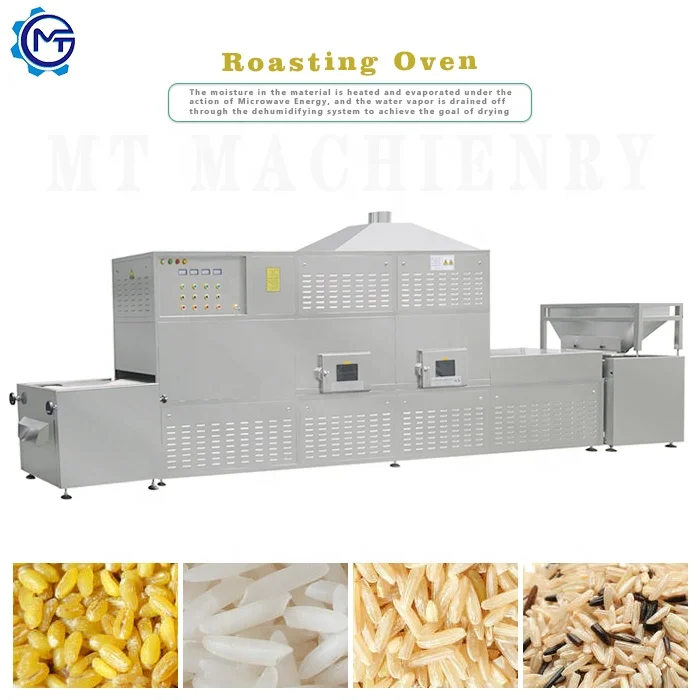
- Multi-stage drying and roasting with frequency speed regulation for uniform throughput
- Line stations throughput-matched from mixing through packing under one supplier
Trial runs on your actual raw material are completed in our testing workshop before shipment, with a full report confirming output and kernel specification.
Description
Integrated Throughput Matching — every station from batching to packing is sized against the extruder’s verified output, preventing dryer or roaster bottlenecks on your actual grain blend.
Technical Specifications
| Parameter | Value |
|---|---|
| Product Type | Fortified Rice Extrusion Production Line |
| Available Models | MT65, MT70, MT85, MT75, MT95 |
| Extruder Type | Twin-screw |
| Rated Power | MT65: 85 kW; MT70: 120 kW; MT85: 235 kW; MT75: 180 kW; MT95: 260 kW |
| Power Consumption | MT65: 60 kW; MT70: 85 kW; MT85: 165 kW; MT75: 135 kW; MT95: 195 kW |
| Output Capacity | MT65: 80–100 kg/h; MT70: 100–120 kg/h; MT85: 200–300 kg/h; MT75: 300–500 kg/h; MT95: 800–1000 kg/h (basis not stated in source — confirm raw material and moisture) |
| Overall Dimensions (L×W×H) | MT65: 28 × 1.2 × 2.2 m; MT70: 30 × 1.5 × 2.2 m; MT85: 34 × 3.5 × 4.3 m; MT75: 32 × 3.5 × 4.3 m; MT95: 36 × 3.5 × 4.3 m |
| Control System | PLC and MCC with frequency speed control, automatic lubricating and cooling |
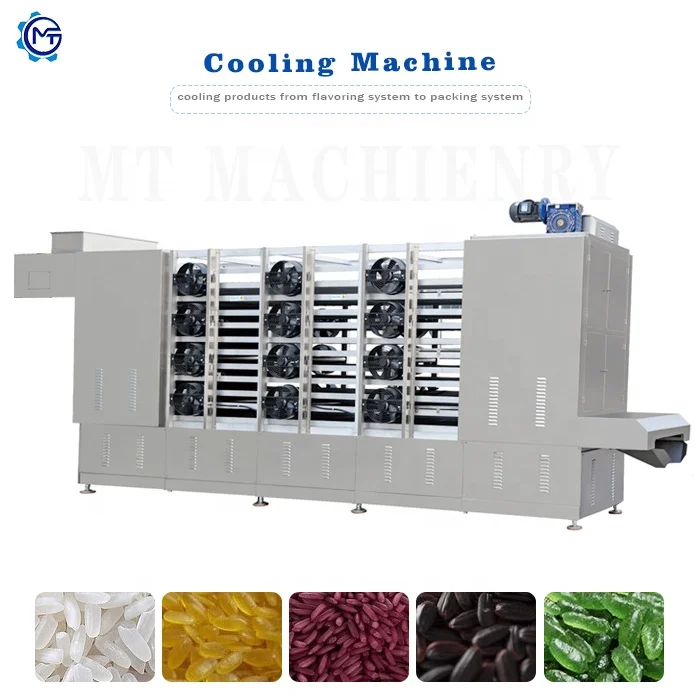
| Processing Stages | Mixing → Extruding → Vibrating → Low-temperature drying → Cooling → High-temperature roasting → Cooling → Packing |
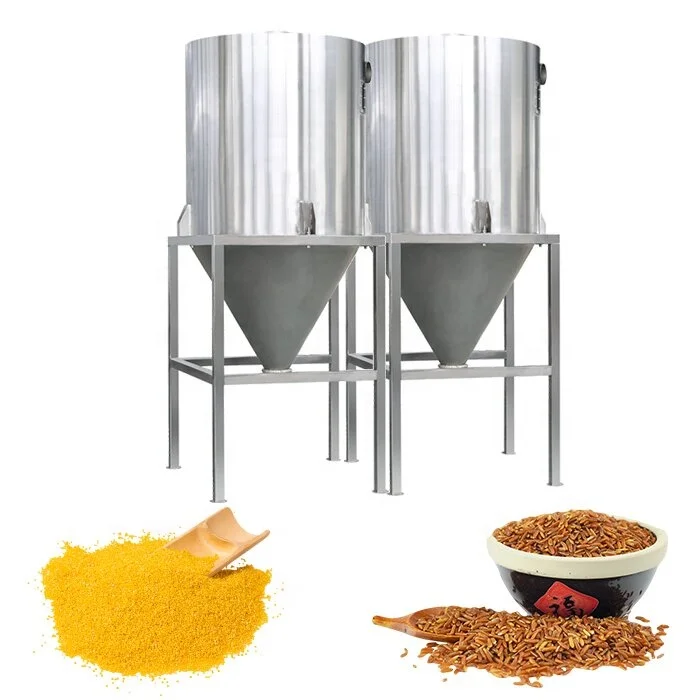
| Basic Materials | Broken rice, rice, corn, millet, wheat, oats, buckwheat, bean, starch; vitamins and minerals as additive |
| Drying Oven Heating Source | Electric or gas |
| Drying Method | Circulation drying with frequency motor-controlled mesh belt speed |
| Standards | CE, ISO |
Application Suitability
| Application | Material or Output |
|---|---|
| Fortified and artificial rice kernels | Broken rice and rice flour blended with vitamin and mineral premixes |
| Nutritional rice enrichment programs | Grain-based formulations carrying added micro-nutrients for public health distribution |
| Couscous production | Wheat, corn, or millet semolina processed into uniform granules |
| Broken rice valorization | Rice mill by-products converted into high-nutritional food-grade kernels |
| Fortified infant and weaning food bases | Pre-cooked grain and starch blends for downstream nutritional powder processing |
What a Nominal Capacity Figure Leaves Out About Your Grain Blend
A rated output number means nothing until it is tested against your exact raw material at your operating moisture.
I remember standing in a workshop in West Africa watching a fortified rice line choke on locally milled broken rice flour. The machine was rated for a specific throughput, but the customer’s grain had a different starch profile and particle size than the test material used at the factory. Extrusion成型 rates dropped badly, and the line spent hours producing cracked kernels and fines instead of intact rice-shaped pieces. We spent three days reconfiguring the screw elements and adjusting die clearances before production stabilized [NEED_CITE: raw material variability in extrusion processing]. A fortified rice extrusion production line turnkey project only delivers when every parameter is locked to what you will actually feed into the hopper.
Screw Configuration Matched to Your Starch Chemistry
Twin-screw extrusion relies on the interplay between screw element geometry, barrel temperature zones, and residence time to gelatinize starch and shape the kernel. Different grain sources — broken rice, corn, buckwheat, bean flour — each demand a distinct screw profile. A high-amylose rice blend requires more shear and a longer conditioning section than a waxy corn base. The die aperture and land length then determine whether the extrudate expands into a dense, rice-like kernel or puffs into something the market will not accept. Getting this wrong at the specification stage means living with the consequences for the entire lifespan of the line.
Multi-Stage Drying That Preserves Kernel Integrity
The drying and roasting sequence on this fortified rice extrusion production line turnkey setup follows a deliberate thermal path: low-temperature drying first removes surface moisture without case-hardening the kernel, a cooling stage equalizes internal temperature, and then high-temperature roasting develops the final texture and shelf stability. Skipping or shortening the cooling phase between drying and roasting causes stress fractures inside the kernel, which show up as breakage during packing and transport. Frequency-controlled mesh belt speed on the circulation dryer lets operators fine-tune residence time to match the specific moisture curve of their formulation [NEED_CITE: multi-stage drying principles for extruded grain products].
Reading the Power and Dimension Data
The rated power across the five extruder models spans from 85 kW on the MT65 to 260 kW on the MT95, and actual power consumption sits at roughly 70 to 75 percent of rated figures depending on formulation load. Overall line length ranges from 28 meters for the smallest configuration to 36 meters for the MT95 setup, which means floor planning must account for the full processing sequence including both cooling conveyors and the packing station. The PLC and MCC control system with frequency speed regulation across the extruder and drying oven ensures that throughput adjustments at one station propagate to the others, keeping material flow balanced. The twin-screw design handles a broad viscosity range, which matters when you shift between a pure rice formulation and one loaded with mineral premix that changes the melt behavior inside the barrel.
The Hidden Cost of Mismatched Station Capacity
When the extruder output exceeds what the dryer can handle at the required residence time, kernels pile up on the mesh belt and exit with uneven moisture content. Some arrive at the roasting stage too wet, others too dry. The result is a finished product with inconsistent texture and a shelf life that varies bag to bag. Similarly, if the cooling conveyor between roasting and packing is undersized, residual heat continues to cook the kernels inside the packaging, leading to condensation and spoilage [NEED_CITE: throughput imbalance consequences in food extrusion lines]. These are not problems you discover during a factory acceptance test — they emerge weeks into production when the customer starts returning product.
Why This Line Is Configured as One Integrated Project
The entire processing sequence from mixing through packing is supplied and sized by a single source, which means throughput calculations account for every transfer point rather than assuming each vendor has matched their equipment correctly. Screw configuration and die design are specified to the buyer’s raw material and target kernel density before production begins. An in-house testing workshop runs trial batches on the customer’s actual grain blend before the line ships, catching formulation issues early rather than during on-site commissioning. Electrical schematics are prepared with the target market’s voltage and frequency confirmed, and control language is set to match the operating team. Documentation covers the full chain: line layout, capacity calculation, screw and die configuration records, trial run reports, and operation manuals [NEED_CITE: turnkey food extrusion project documentation standards].
Documentation & Verification
- Line layout and capacity calculation specific to your grain blend and target kernel output
- Screw and die configuration record matched to your raw material trial results
- Trial run report produced on your actual broken rice or grain formulation before dispatch
- Electrical schematic with confirmed voltage, frequency, and control language for your facility
- CE declaration of conformity and ISO certificate for the complete line
- Operation and maintenance manual with wear parts list for extruder screws and dies
Installation, Commissioning & Support
- Floor plan and utility routing based on the specific model footprint, up to 36 meters line length
- Dedicated power circuit sized to the extruder’s rated power, from 85 kW to 260 kW depending on model selected
- Equipment arrives in modular sections for phased assembly matching your facility readiness
- On-site commissioning includes screw configuration verification and drying curve calibration on your material
- Operator training covers PLC interface navigation, frequency speed adjustment, and die changeover procedures
- Wear parts inventory includes replacement screw elements and dies specific to your kernel specification
What to Prepare Before Requesting a Quotation
To configure a fortified rice extrusion production line turnkey project accurately, we need to understand your production environment. Share the specific grain types and any vitamin or mineral premix formulations you plan to process, along with your target daily output and the moisture content of your incoming material. Confirm the available voltage, frequency, and phase at your facility, and the preferred control language for the operating team. If you have existing upstream milling or downstream packing equipment, provide the interface specifications so the line can be integrated without material handling gaps.
Frequently Asked Questions
Q: How is line capacity verified against my specific raw material blend and moisture content?
A: Before shipment, your grain blend is run through the extruder in our testing workshop using the configured screw and die setup. The trial run produces a report documenting actual throughput, kernel formation rate, and moisture at each stage. This data becomes the baseline for your commissioning parameters.
Q: How do you match throughput between extruder, dryer, and roasting stations to avoid bottlenecks?
A: Each station is sized based on the extruder’s verified output on your material. The drying oven belt speed and roasting chamber capacity are calculated to handle the full extruder output with the required residence time, so material never accumulates between stages.
Q: What voltage, frequency, and control language options are confirmed before production?
A: During the specification phase, we confirm your facility’s electrical supply — voltage, frequency, and phase — and prepare the electrical schematic accordingly. The PLC and MCC interface language is set to match your operating team’s requirements before the control cabinets are built.
Q: Can I send my raw material for a trial run before shipment, and what does the report cover?
A: Yes. Send a representative sample of your grain blend with premix. The trial run tests extrusion behavior, kernel shape, and drying response. The report includes throughput data, screw configuration used, die specification, and product samples for your evaluation.
Q: What is the phased installation and commissioning schedule for a complete turnkey line?
A: Installation follows a sequenced plan based on your facility readiness. The extruder and dryer are positioned first, then conveying and cooling sections are connected. Commissioning progresses station by station, starting with extruder calibration on your material, then drying curve tuning, and finally full-line continuous run testing.
Related products
-

High Precision Automatic 500kg/h Baby Food Nutrition Powder Rice Extrusion Processing Line
¥8,238.27 Add to cart -
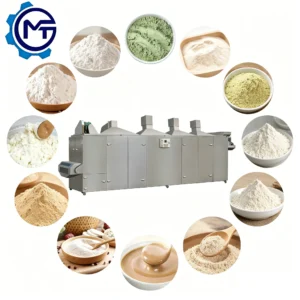
Small Scale MT Brand Automatic Baby Food Nutrition Powder Rice Flour Making Machine with 500kg/h Production Capacity PLC Control
¥9,500.00 Add to cart -
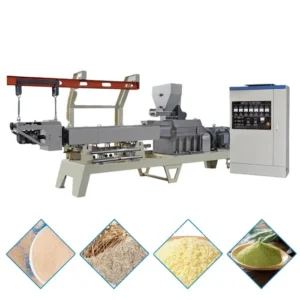
Industrial Instant Corn Paste Production Line Nutritional Powder Processing Equipment Meal Replacement Nutrition Powder Machine
¥65.00 Select options This product has multiple variants. The options may be chosen on the product page -
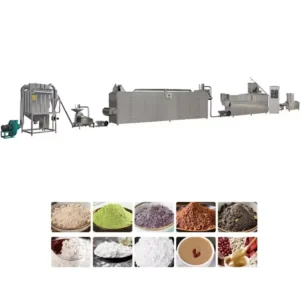
Healthy Baby Food Production Line Nutritional Powder Equipment for Baby Food Supplements for Flour Processing Machinery
¥8,500.00 Select options This product has multiple variants. The options may be chosen on the product page