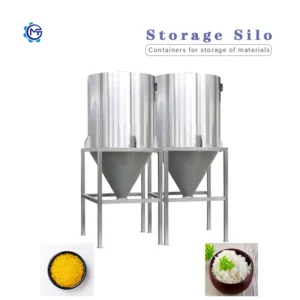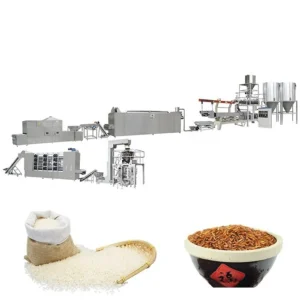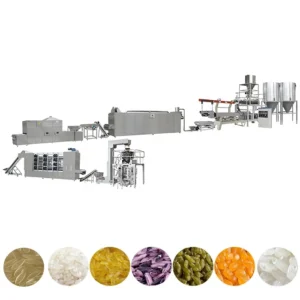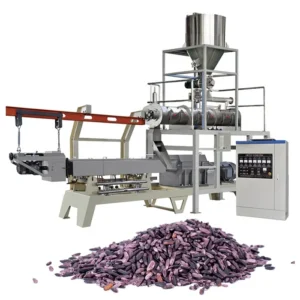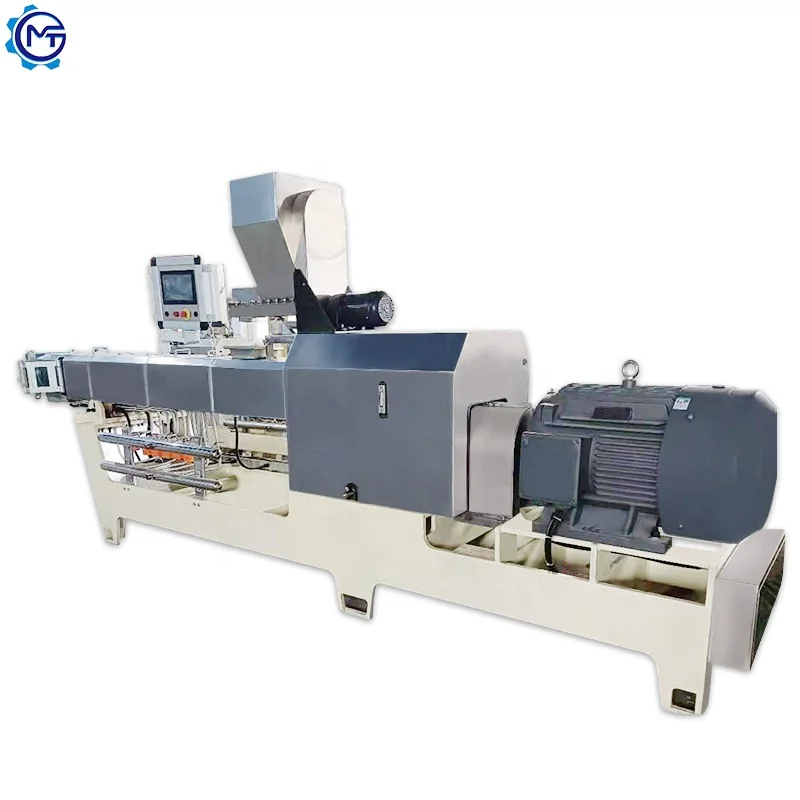


MT65 Fortified Rice Processing Line, Twin-Screw Extruder, 85 kW Installed Power — complete turnkey layout from batching to packing.
- Screw configuration and die design matched to your raw material blend and target kernel density
- Multi-stage drying and roasting sequence controls moisture differential for consistent texture
- Frequency-controlled motor speed across extruder and dryer for flexible throughput adjustment
Validated through in-house trial runs on your formulation before shipment, with full line throughput matching across every station to prevent bottlenecks.
Description
Throughput-matched turnkey line — every station from batching to packing is calculated against your actual raw material blend, not catalog numbers.
Technical Specifications
| Parameter | Value |
|---|---|
| Model | MT65 / MT70 / MT85 / MT75 / MT95 |
| Product Type | Fortified Rice Processing Line |
| Screw Configuration | Twin-screw extruder |
| Installed Power Range | 85 kW (MT65) to 260 kW (MT95) |
| Power Consumption Range | 60 kW (MT65) to 195 kW (MT95) |
| Output Capacity | 80–1000 kg/h (basis not stated in source — confirm raw material and moisture) |
| Overall Dimensions Range | 28 × 1.2 × 2.2 m (MT65) to 36 × 3.5 × 4.3 m (MT95) |
| Control System | Frequency speed controlling with high automation |
| Drying Oven Heating Source | Electric or gas |
| Material Compatibility | Broken rice, rice, corn, millet, wheat, oats, buckwheat, bean, starch, vitamin and mineral blends |
| Assembly State | Complete turnkey processing line |
| Compliance | CE (source value — verify against manufacturer catalog) |
Application Suitability
| Application Scenario | Material Input or Output |
|---|---|
| Nutritional programme supply | Vitamin- and mineral-fortified rice kernels for food aid and public health distribution |
| Rice mill by-product conversion | Broken rice and rice bran processed into high-value artificial rice kernels |
| Multi-grain extruded rice production | Corn, millet, wheat, oats, buckwheat and bean blended with starch for artificial rice |
| Micro-nutrient solidification | Trace element integration into rice-based kernels with controlled gelatinisation |
| Turnkey project deployment | Full production facility build-out from raw material intake to final packing |
Why the "Nominal Capacity" Trap Wrecks Fortified Rice Projects
A Fortified Rice Processing Line turnkey quoted on paper capacity routinely underperforms once your specific vitamin premix and starch blend hit the barrel. Actual throughput depends entirely on raw material moisture, fibre content and the exact micro-nutrient load in your formulation. I spent two weeks on a site in Southeast Asia watching a line struggle because the buyer’s rice bran ratio was twice what the seller assumed during quoting. The extruder kept stalling, the drying curve never stabilised, and the kernel density drifted outside the nutrition programme spec [NEED_CITE: common causes of extruder throughput loss in starch-based formulations]. When throughput is stated without a raw material basis, it is a number that belongs to a different factory running a different recipe.
Screw Configuration Matched to Starch Gelatinisation
The twin-screw extruder in this Fortified Rice Processing Line turnkey allows screw element rearrangement to control shear, residence time and melt temperature inside the barrel. Fortified rice demands a precise gelatinisation window: too little shear and the vitamin premix fails to bind into the starch matrix; too much shear and the kernel fractures during drying. Each screw configuration is documented against the buyer’s raw material formulation before the machine leaves the workshop.
Multi-Stage Moisture Control Through Drying and Roasting
The production sequence moves through low-temperature drying, cooling, high-temperature roasting and a final cooling stage. This staged approach controls the moisture gradient between the kernel surface and its core. A single-pass high-temperature dryer would case-harden the outside while trapping moisture inside, causing the kernel to crack or collapse during storage [NEED_CITE: moisture gradient effects on extruded rice kernel structural integrity]. Frequency-controlled mesh-belt speed lets the operator tune residence time in each zone independently.
Reading the Power and Dimension Data
The installed power spans from 85 kW on the MT65 to 260 kW on the MT95, reflecting the drive torque required for increasingly viscous starch-protein blends at higher throughputs. Power consumption figures — 60 kW for the MT65 up to 195 kW for the MT95 — represent typical operating draw under load, which determines the transformer sizing and dedicated circuit requirements at your facility. The dimensional range from 28 m to 36 m in line length dictates the minimum workshop bay length needed for a straight-through layout, and the 4.3 m height on the larger models requires clear overhead space for dryer exhaust ducting and maintenance access. The twin-screw design across all models means the same barrel-opening and screw-pull procedures apply regardless of which capacity tier you select, simplifying operator training across a mixed fleet.
The Hidden Cost of Mismatched Station Throughput
When the extruder, dryer, roaster and packing station are sourced from separate vendors, one station always becomes the bottleneck. The extruder pushes product faster than the dryer can stabilise, or the roaster finishes kernels quicker than the packing line can weigh and seal. Operators then throttle the extruder back, running it below its designed screw fill ratio, which degrades gelatinisation consistency batch after batch [NEED_CITE: throughput mismatch consequences in multi-vendor food processing lines]. The result is a line that never reaches its paid-for output and produces kernels with variable texture across a single shift.
Why This Line Is Specified as One System
Every station in this Fortified Rice Processing Line turnkey is sized so that the mixer batch cycle, the extruder output rate, the dryer belt speed and the packing head weight align without intermediate buffer storage. The screw and die configuration is documented against your specific raw material before production begins, not copied from a generic build. An in-house testing workshop runs your actual formulation on the extruder before shipment, so product development happens on the machine that will run it, not on a lab-scale prototype. Electrical schematics confirm voltage, frequency and control language matched to your site’s utility supply before the control panel is wired. Pre-sales engineering covers layout, utility planning and phased installation scheduling through to operator training.
Documentation & Verification
- Line layout and capacity calculation confirming throughput match from mixer to packer
- Trial run report on your specific raw material blend conducted before shipment
- Screw and die configuration record tied to your formulation and target kernel density
- Electrical schematic with voltage, frequency and control language confirmation for your market
- Factory test record documenting all station run-in parameters before dispatch
- Operation and maintenance manual with wear parts list and replacement intervals
Installation, Commissioning & Support
- MT95 line requires a 36 m bay with 4.3 m clearance for dryer exhaust routing
- MT65 draws 60 kW operating load requiring a dedicated circuit with appropriate breaker sizing
- Frequency-controlled extruder and dryer motors allow on-site speed tuning during commissioning
- Twin-screw barrel segments are individually replaceable without full barrel removal
- Operator training covers screw configuration changes for different raw material blends
- Spare screws and dies shipped with initial order to cover first replacement cycle
What We Need to Specify Your Line
To configure this Fortified Rice Processing Line turnkey for your project, share your raw material formulation including the exact vitamin and mineral premix ratio, your target kernel dimensions and density, and the daily output requirement. We also need your workshop floor dimensions with ceiling height, and the local voltage and frequency standard so the control panel and heating elements are built to match.
Frequently Asked Questions
Q: How is the line capacity verified against my specific raw material formulation?
A: Your raw material blend, including vitamin and mineral ratios, is run on the twin-screw extruder in our in-house testing workshop before shipment. The trial run report documents actual throughput, kernel density and gelatinisation degree so you see real output data — not a catalog number — before the machine leaves the factory.
Q: What does phased installation look like for a complete turnkey project?
A: Installation follows a sequenced schedule starting with floor preparation and utility rough-in, then station-by-station mechanical assembly from mixer through packer. Electrical commissioning runs in parallel once stations are positioned, and the full-line wet test with your raw material happens only after every station passes individual dry-run checks.
Q: How is throughput matched between the extruder, dryer, roaster and packing station?
A: Each station is calculated against the extruder output rate for your specific formulation. The dryer belt speed, roaster residence time and packing head cycle are set so no station accumulates or starves product, eliminating the bottleneck that occurs when equipment is assembled from separate vendors.
Q: What voltage and control configurations are confirmed before production begins?
A: The electrical schematic is reviewed with you before the control panel is wired, confirming voltage, frequency, plug type and control language. This prevents the common situation where a machine arrives on site and the local electrician discovers an incompatible supply requirement.
Q: How are spare wear parts supplied and when is the first replacement due?
A: A wear parts list with recommended replacement intervals ships with the documentation package. Initial spare screws and dies are included so you have replacements on hand when the first change-out is due, avoiding unplanned downtime while waiting for international shipment.
Related products
-

High Precision Automatic 500kg/h Baby Food Nutrition Powder Rice Extrusion Processing Line
¥9,500.00 Add to cart -
CE cerelac Instant Baby Food Porridge Making Machine Production Line
¥35,000.00 Select options This product has multiple variants. The options may be chosen on the product page -

Compact Automatic Baby Cereal Nutrition Powder Production Line with 500kg/h Capacity and PLC Control
¥9,500.00 Add to cart -
Healthy Baby Food Production Line Nutritional Powder Equipment for Baby Food Supplements for Flour Processing Machinery
¥8,500.00 Select options This product has multiple variants. The options may be chosen on the product page