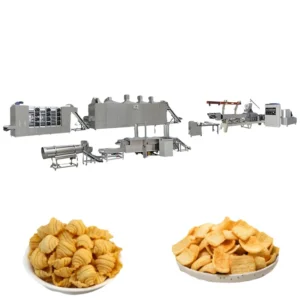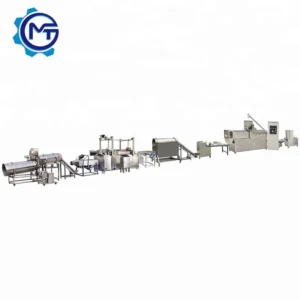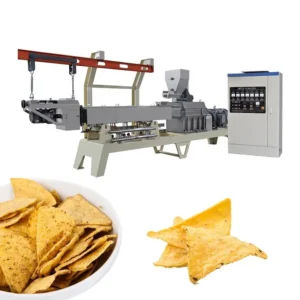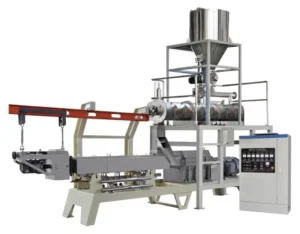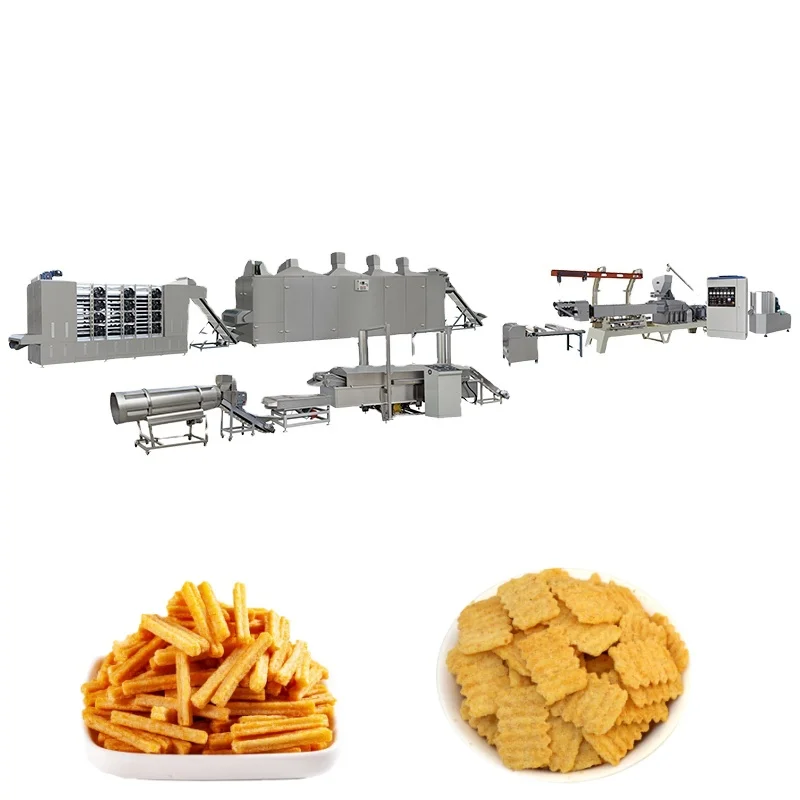


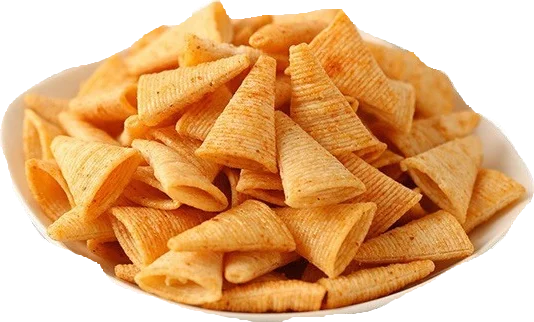
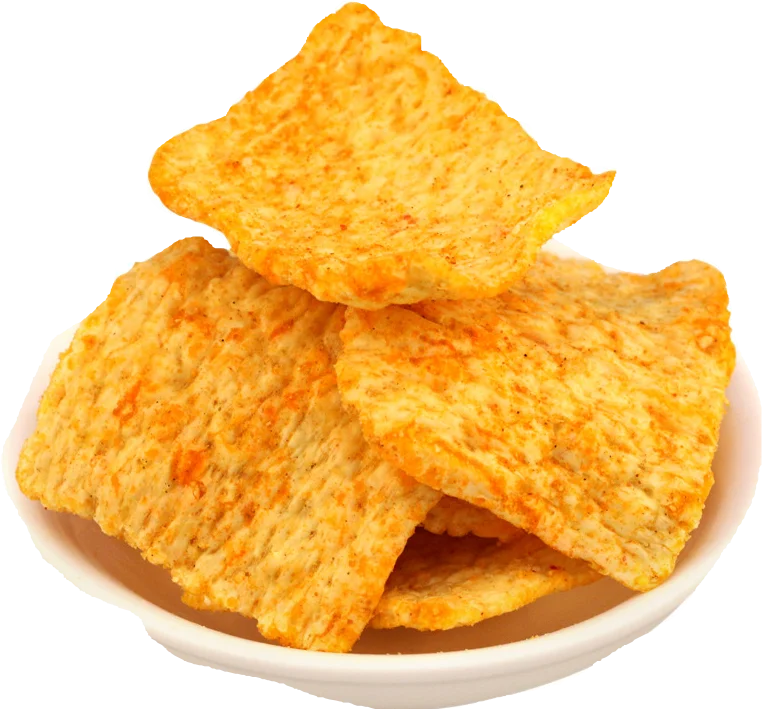

MT-65 / MT-70 / MT-85 / MT-75 / MT-95 Fried Snack Food Extrusion Production Line, Twin-Screw, PLC & MCC Control — engineered as a complete turnkey project from batching to packing.
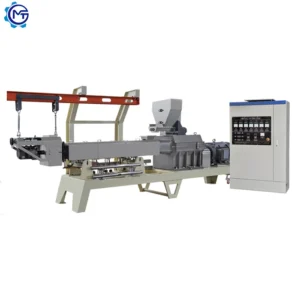
- Co-rotating twin-screw extruder with sectional modules ensures precise starch gelatinisation and expansion control across corn, wheat, and potato formulations
- Every station — mixer, extruder, dryer, fryer, seasoning — throughput-matched to eliminate bottlenecks
- Fryer features 600 mm stainless steel belt with automatic temperature regulation
- Voltage, frequency, and control language confirmed before production
Each line undergoes an in-house trial run on your raw material before shipment, with full layout design, screw configuration records, and electrical schematics delivered as part of the project package.
Description
Integrated Turnkey Line Delivery — Every station from batching to packing is throughput-matched and validated on your raw material in our testing workshop before the fried snack food extrusion production line turnkey leaves the factory.
Technical Specifications
| Parameter | Value |
|---|---|
| Product Type | Fried Snack Food Extrusion Production Line |
| Model Range | MT-65 / MT-70 / MT-85 / MT-75 / MT-95 |
| Screw Type | Twin-screw, co-rotating sectional modules |
| Main Motor Power | 100 kW (MT-65) / 130 kW (MT-70) / 180 kW (MT-85) / 185 kW (MT-75) / 280 kW (MT-95) |
| Output Capacity (MT-65) | 120–150 kg/h (basis not stated in source — confirm raw material formulation and moisture) |
| Output Capacity (MT-70) | 200–250 kg/h (basis not stated in source — confirm raw material formulation and moisture) |
| Output Capacity (MT-85) | 300–500 kg/h (basis not stated in source — confirm raw material formulation and moisture) |
| Output Capacity (MT-75) | 400–500 kg/h (basis not stated in source — confirm raw material formulation and moisture) |
| Output Capacity (MT-95) | 800–1000 kg/h (basis not stated in source — confirm raw material formulation and moisture) |
| Mixer Power | 4 kW / 7.5 kW / 15 kW (matched to line model) |
| Cutting Machine Power | 1.47 kW |
| Fryer Belt Width | 600 mm stainless steel mesh belt |
| Fryer Heating Options | Electricity / Fuel / Gas |
| Drying Heating Options | Gas / Electric / Diesel |
| Voltage & Frequency | Customizable (e.g., 3ph 380V 50Hz, 3ph 415V 60Hz) |
| Control System | PLC and MCC |
| Overall Dimensions (MT-65) | 22000×1200×2200 mm |
| Overall Dimensions (MT-70) | 24000×1500×2200 mm |
| Key Features | Automatic fryer temperature control, adjustable belt speed, roller feeding, modular screw configuration |
| Certification | CE, ISO |
Application Suitability
| Application | Material or Output |
|---|---|
| Fried pellet snack production | Corn powder, wheat flour, potato starch blends for 3D pellet chips |
| Tortilla and corn chip lines | Corn flour and masa-based formulations for flat and ribbed chips |
| Shaped fried extruded snacks | Potato powder and starch mixes for bugles, shells, and wavy formats |
| Expanded snack formats | Corn and wheat blends for pillow, tube, and screw shapes |
| Seasoned ready-to-pack chips | Extruded and fried pieces requiring post-fry flavouring drum application |
What "Nominal Capacity" Hides From Your Project Budget
A capacity figure without a raw material basis is a guess, not a guarantee.
I have spent nights on factory floors in Southeast Asia watching extruders choke on formulations the supplier never tested. When a client in Vietnam ran a corn chip line with a starch blend the quotation ignored, the expansion collapsed and we spent days reconfiguring screw modules. A fried snack food extrusion production line turnkey must be validated on the exact flour ratios, moisture levels, and starch content you will actually run. Otherwise the extruder starves the dryer, the fryer runs empty, and your commissioning schedule slips by weeks [NEED_CITE: raw material variability impact on extrusion throughput].
Screw Module Configuration for Starch Gelatinisation Control
The co-rotating twin-screw extruder uses sectional modules that can be rearranged along the barrel to control shear, residence time, and temperature profile. For corn-based formulations requiring full gelatinisation before the die, a longer compression zone ensures the starch matrix fully hydrates. Potato starch blends, which gel at lower temperatures, need a shorter compression section to prevent over-shearing and breakdown of the expanded structure. This modular approach means the fried snack food extrusion production line turnkey is configured to your specific recipe rather than a generic build.
Die Geometry and Post-Extrusion Shape Retention
The die plate determines not just the cross-section of the extrudate but also how the product behaves through the dryer and fryer. Thin-wall die geometries for bugles and shells require precise moisture control at the extruder exit; too wet and the shape collapses in the fryer oil, too dry and the product cracks during conveying. Square sheet rib chips and diamond chips need uniform thickness from the die to ensure consistent frying across the 600 mm belt width. The die design is matched to both the raw material behaviour and the target product specification your market expects [NEED_CITE: extrusion die design principles for snack food forming].
Why Motor Power and L/D Ratio Matter for Your Output
The motor power range from 100 kW to 280 kW across the model series reflects different barrel lengths and screw diameters, which directly govern how much material can be processed per revolution. A higher L/D ratio provides more barrel volume for mixing and cooking, which is critical when running formulations with multiple starch sources that require thorough blending before expansion. The PLC control system monitors barrel temperature zones and screw speed to maintain batch consistency, which becomes essential when producing seasoned chips where uniform shape and density affect how flavouring adheres in the seasoning drum.
The Hidden Cost of Mismatched Station Throughput
When the extruder output exceeds the dryer capacity, semi-finished product accumulates on the conveyor, losing moisture unevenly and creating density variation that shows up as inconsistent colour after frying. An undersized fryer forces the belt speed down, increasing oil absorption beyond specification and altering the crunch profile your brand promises. These imbalances are invisible in a quotation that lists each machine independently without showing the throughput calculation that links them [NEED_CITE: production line bottleneck analysis in food processing].
Why This Line Configuration Fits Your Project
The line layout and capacity calculation document maps every station to your workshop footprint and target throughput before production begins. The in-house testing workshop runs your actual raw material through the extruder and documents the screw configuration, die selection, and process parameters before the equipment ships. Voltage, frequency, and control language are confirmed against your facility specifications so the MCC cabinet arrives ready to connect. Spare wear parts including screw modules and die plates are packed with the initial shipment, preventing downtime when the first replacement cycle arrives.
Documentation & Verification
- Line layout and capacity calculation matched to your workshop dimensions and target hourly output
- Trial run report on your supplied raw material documenting screw configuration and process parameters
- Electrical schematic with voltage, frequency, and control language confirmed to your facility standard
- Screw and die configuration record specifying module arrangement and die geometry for your product shape
- Factory test record showing all stations running in sequence before crating
- CE declaration of conformity and ISO certificate in electronic edition for customs clearance
Installation, Commissioning & Support
- Foundation plan showing load points for the 22–30 metre line footprint and utility connection positions
- Dedicated circuit requirements for the main extruder motor up to 280 kW and fryer heating elements
- Modular station assembly with mechanical and electrical connections completed on-site by the installation team
- First-run parameter setting using your raw material with screw speed, barrel temperature, and fryer belt speed logged
- Operator training covering PLC interface navigation, screw module changeover, and daily cleaning procedures
- Wear parts inventory review with reorder schedule for screw segments, die plates, and fryer belt sections
What We Need to Size Your Line Correctly
To prepare a layout proposal that holds up through commissioning, we need your target product format with dimensional specifications, the raw material formulation including starch ratios and moisture content, and your daily production target in kilograms of finished product. Please also confirm your facility voltage and frequency, the available floor area with ceiling height clearance for the dryer exhaust, and whether you require integration with existing upstream batching or downstream packing equipment.
Frequently Asked Questions
Q: How is line capacity verified against my specific raw material formulation before shipment?
A: Your raw material is run through the twin-screw extruder in our testing workshop using the proposed screw configuration and die. The trial run report documents the actual output rate, expansion ratio, and product density achieved on your formulation, so the capacity figure in your quotation reflects your recipe rather than a generic corn flour baseline.
Q: What is the phased installation and commissioning schedule for a complete fried snack line?
A: The installation team arrives with the equipment and sequences station assembly from the mixer through to the packing interface. Mechanical alignment and utility connections are completed first, followed by cold runs of each station. Hot commissioning then runs your raw material through the full line, with parameter adjustments logged until product specification is met consistently.
Q: How do you ensure throughput matching between extruder, dryer, and fryer stations?
A: Each station is sized based on the extruder output calculated from your raw material and target product format. The dryer belt length and heating capacity are matched to remove the required moisture before frying, and the fryer belt width and oil volume are specified to handle the product load without temperature drop or belt speed reduction.
Q: Can voltage, frequency, and control language be configured for my target market?
A: The electrical schematic is prepared after confirming your facility supply, with options including 380V 50Hz, 415V 60Hz, and 220V 60Hz three-phase configurations. The PLC interface and MCC labels are produced in your specified language, and all motor nameplates and documentation match the confirmed standard before the line ships.
Q: What operator training and wear parts support is included with the turnkey project?
A: On-site training covers daily operation, screw module changeover for different product shapes, and routine maintenance intervals for each station. A wear parts list identifies screw segments, die plates, and fryer belt sections with recommended replacement cycles, and a reserve stock is included with the initial shipment to cover the first maintenance intervals.
Related products
-
Industrial Wheat Flour Snacks Processing Equipment – Stainless Steel Fried Food Production Line
¥65.00 Select options This product has multiple variants. The options may be chosen on the product page -
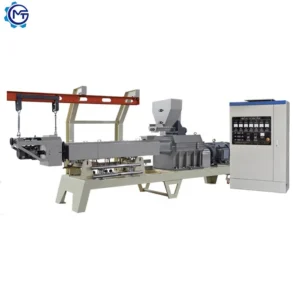
Industrial Fully Automatic Stainless Steel Deep Fried Line – Snack Factory Miscellaneous Grains Special Processing Equipment
¥65.00 Select options This product has multiple variants. The options may be chosen on the product page -
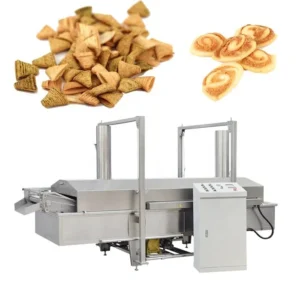
Double Screw Extruder Corn Flour Puffs Snack Nacho Chips Tortilla Doritos Making Machine Savory Snack Production Line
¥50.00 Select options This product has multiple variants. The options may be chosen on the product page -
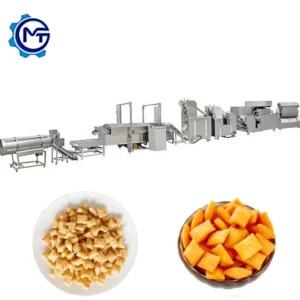
Hot Selling Full Automatic Fried Dough Wheat Flour Bugles Snacks Frying Machine Fried Puffed Food Bugles Snack Production Line
¥7,349.41 Select options This product has multiple variants. The options may be chosen on the product page