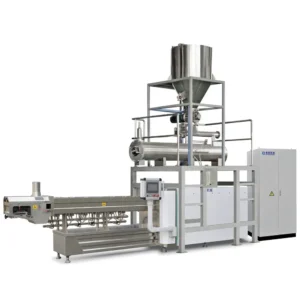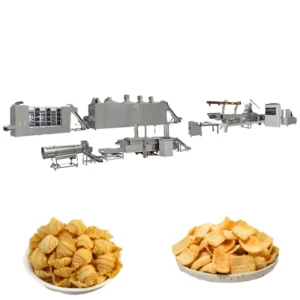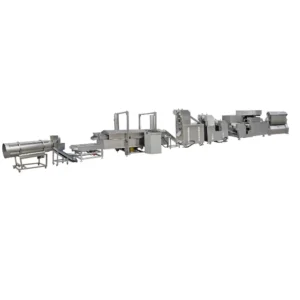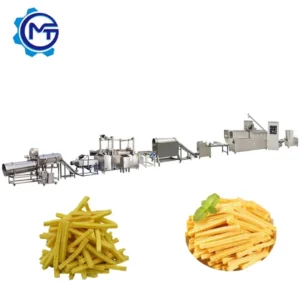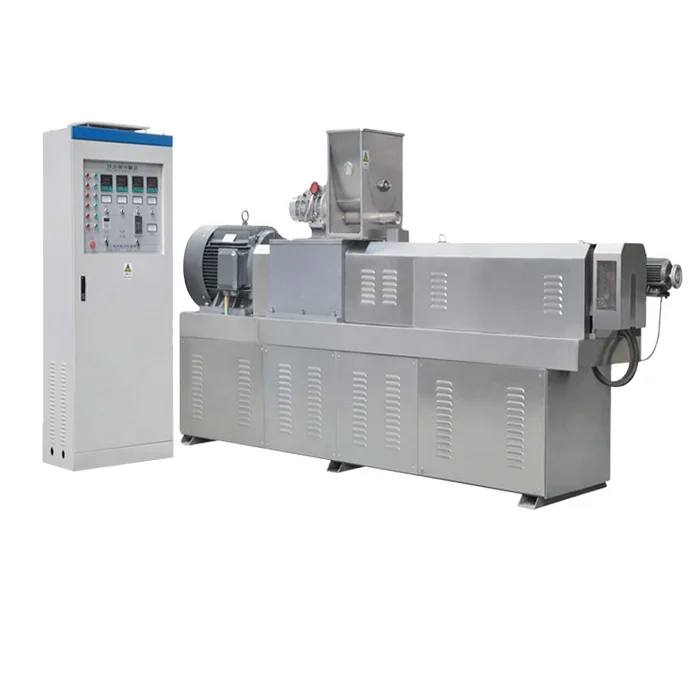


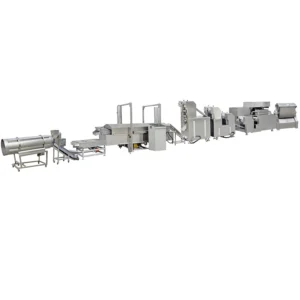
MT65 / MT70 / MT85 / MT75 / MT95 Fried Snack Processing Line, Twin-Screw Extrusion, PLC Control — configured as one turnkey project with every station throughput-matched to eliminate bottlenecks. Screw configuration and die design are specified to your raw material and target product shape, producing bugles, tortilla chips, rice crust and shaped crisps consistently. Mixer output, extruder capacity, fryer temperature range (0–260 °C) and flavoring drum speed are calculated together for stable line performance.
- In-house trial runs on your raw material validate product development before shipment
- CE and ISO certified construction with food-grade stainless steel contact surfaces
- Complete documentation including layout, electrical schematics and wear parts list provided
Description
Integrated throughput engineering — Every station in this fried snack processing line turnkey project is capacity-matched against your raw material and target shape, so the fryer never waits on the extruder and the flavoring drum never chokes the dryer.
Technical Specifications
| Parameter | Value |
|---|---|
| Product Type | Fried Snack Processing Line (Bugles / Crisp Chips Extrusion Line) |
| Model Options | MT65 / MT70 / MT85 / MT75 / MT95 |
| Extruder Type | Double Screw Extruder (Twin-screw) |
| Installed Power Range | MT65: 142 kW | MT70: 185 kW | MT85: 240 kW | MT75: 245 kW | MT95: 370 kW |
| Actual Power Consumption | MT65: 100 kW | MT70: 130 kW | MT85: 180 kW | MT75: 185 kW | MT95: 280 kW |
| Output Capacity | MT65: 120–150 kg/h | MT70: 200–250 kg/h | MT85: 300–500 kg/h | MT75: 400–500 kg/h | MT95: 800–1000 kg/h (basis not stated in source — confirm raw material type, moisture content, and product shape) |
| Overall Line Dimensions | MT65: 22000×1200×2200 mm | MT70: 24000×1500×2400 mm | MT85: 26000×1500×2300 mm | MT75: 26000×1500×2800 mm | MT95: 30000×1500×2800 mm |
| Powder Mixer Tank Volume | 150 kg per batch |
| Powder Mixer Mixing Time | 10 min per batch |
| Powder Mixer Rotary Speed | 385 rpm |
| Fryer Temperature Range | 0–260 °C |
| Fryer Dimensions | 4500×1350×2350 mm |
| Flavor Line Dimensions | 3000×1650×1800 mm |
| Control System | PLC and MCC control |
| Construction Material | Food-grade stainless steel (product-contact surfaces) |
| Product Shapes Available | Bugles, crisp corners, small fish crisps, golden corners, small gourds, ducks, Christmas trees, triangles |
| Processing Method | Extrusion → Frying → Seasoning → Drying (non-fried option also available) |
| Warranty | 1 year complete warranty with lifetime maintenance service |
| Certification | CE, ISO |
Application Suitability
| Application | Material or Output |
|---|---|
| Bugles and crisp corners production | Corn flour, corn grits, rice flour blends at controlled moisture |
| Tortilla chip and corn chip extrusion | Corn-based dough with fat content verified per local supply |
| Rice crust and puffed crisp snacks | Rice flour, wheat flour, or composite grain blends |
| Shaped 3D snack crisps (fish, gourds, triangles) | Starch-rich flour mixtures with die-specific configuration |
| Non-fried puffed snack variants | Same raw material base with drying replacing the frying stage |
Why "Rated Capacity" Means Nothing Without the Raw Material Story
The number on the nameplate only holds up if somebody actually ran your flour through the screws before shipping.
I spent two weeks in a plant outside Guadalajara debugging a fried snack line that was supposed to run 300 kg/h of bugles. The extruder was rated for it — on paper. But the local corn flour carried higher fat than the standard test material, and the dough lubricated the barrel walls enough to drop shear and kill expansion coming out of the die. The fryer had nothing to do. Workers stood around watching under-puffed shells absorb oil and go soft. The whole fried snack processing line turnkey package sat idle while we swapped screw elements and re-profiled the barrel heating zones.
That failure was not a capacity problem. It was a throughput-matching problem that started with somebody quoting a number without asking what the buyer was actually going to pour into the hopper [NEED_CITE: raw material variability in corn-based snack extrusion]. When you evaluate a line, the question is not what the extruder can push in an hour under ideal conditions — it is whether the mixer batch cycle, the extruder screw speed, the fryer belt dwell time, and the flavoring drum rotation all agree on the same hourly throughput for your specific recipe.
Throughput Matching Across Every Station in the Line
A fried snack processing line turnkey project only works when no single station sets the pace while the others wait. The powder mixer on this line cycles a 150 kg batch every 10 minutes at 385 rpm, which means the extruder downstream must be configured to consume at a rate that keeps the mixer from either flooding or starving. The fryer, operating across a 0–260 °C range with a 4500 mm belt length, must hold product for the exact dwell time that achieves the target crispness without backing up the seasoning drum after it.
Each of the five line models — from MT65 to MT95 — is configured as a single project, not assembled from a catalogue of independent machines. The layout drawing you receive before production shows every conveyor length, every buffer hopper, and every station throughput calculated against the same target output.
Commissioning as a Phased Project, Not a Plug-and-Play Event
Installing a complete frying and extrusion line involves utility planning that goes well beyond plugging in the main motor. The MT95 configuration draws up to 370 kW installed, which means dedicated switchgear, cable sizing for the actual run length inside your facility, and coordination with the local transformer capacity [NEED_CITE: industrial electrical supply requirements for food extrusion lines]. The PLC and MCC control panels need to communicate across every station, and the control language on the HMI must match what your operators actually read.
Phased commissioning starts with dry-running the extruder and mixer without product, then introducing raw material at reduced feed rate, then ramping to target throughput only after the fryer temperature profile and flavoring drum speed have been dialed in against real output quality.
Reading the Specs That Actually Matter for Your Product
The twin-screw extruder is the heart of the line, and its screw configuration determines everything that happens downstream. Screw element arrangement — the ratio of conveying elements to kneading blocks to reverse-flight sections — controls residence time, shear intensity, and the degree of starch gelatinisation inside the barrel. A bugle shape needs a specific die geometry and enough internal dough elasticity to hold its curved form through the fryer; a flat triangle needs a different moisture profile and die land length. The specs list multiple product shapes, but achieving each one depends on the screw and die record that gets written for your flour.
The fryer’s 0–260 °C range is wide, but the useful operating window for any given snack is narrow — typically a band of roughly 15–20 °C where oil absorption, surface colour, and moisture removal all fall within specification. Belt speed through the fryer oil determines dwell time, and that speed must be locked to the extruder output rate so that product enters the oil at a consistent density and moisture level.
The Hidden Cost of Skipping the Trial Run
I have watched a line in Colombia burn through three days of raw material before anybody could get the seasoning to stick properly. The flavoring drum was sized for a different product density, and the oil-misted seasoning powder clumped on contact with shells that were still carrying too much surface oil from the fryer. The drum was not wrong for the line — it was wrong for the product that line was actually making that week [NEED_CITE: seasoning adhesion challenges in fried snack production].
When stations are sourced from separate vendors, nobody takes responsibility for the interfaces. The extruder supplier says the die is correct for the shape. The fryer supplier says the belt speed is adjustable. The seasoning supplier says the drum works with any fried product. But nobody ran the complete sequence on your corn flour, at your target moisture, through your fryer oil, into your flavoring drum, and measured what came out the other end.
What Single-Supplier Project Delivery Actually Changes
Every station on this fried snack processing line turnkey package is specified under one layout drawing and one set of throughput calculations, so the mixer batch size, extruder screw speed, fryer belt length, and flavoring drum volume are all solving for the same hourly output number. The in-house testing workshop runs your actual raw material before the line ships, meaning the screw configuration and die selection are validated against your flour — not copied from a generic build file. PLC and MCC control panels are wired and tested as one system before crating, reducing on-site electrical commissioning time. Food-grade stainless steel contact surfaces are maintained across every station from the mixer bowl through the fryer basket to the flavoring drum interior. The documentation package arrives with the line, not weeks later by email, so your maintenance team has the wear parts list and electrical schematics on day one.
Documentation & Verification
- Line layout drawing with throughput calculations matched to your raw material and target shape
- Trial run report from in-house testing workshop using your supplied flour sample
- Screw configuration and die design record specific to your product shape
- Electrical schematic with voltage, frequency, and control language confirmed for your market
- Wear parts list covering screws, dies, and fryer belt sections with first-cycle replacements identified
- CE declaration of conformity and ISO certificate included in shipping documentation
Installation, Commissioning & Support
- Line footprint requires up to 30 m length clearance depending on model, with level concrete floor and drainage near fryer station
- Electrical supply must match confirmed voltage and frequency; MT95 draws up to 280 kW actual and needs dedicated breaker sizing
- Extruder barrel heating zones and fryer temperature controllers calibrated on-site against ambient workshop conditions
- First production run supervised with screw speed, fryer dwell time, and flavoring drum rotation set to trial-run parameters
- Operators trained on PLC interface in confirmed language, including alarm response and daily shutdown sequence
- Spare screw elements, die plates, and fryer belt links shipped with line for first replacement cycle
What We Need to Configure Your Line
To size the right model and match every station to your production target, we need to know the raw material you plan to run — including flour type, typical fat content, and supply source — along with the product shape you are launching first. Share your workshop length and ceiling height so the layout accounts for the full line footprint plus maintenance access. Confirm your local voltage, frequency, and the language your operators need on the control screen. If you can send a sample of your flour to the testing workshop before we finalize the screw configuration, the trial run will validate product quality before the line leaves the factory.
Frequently Asked Questions
Q: How is line throughput verified against my raw material before shipment?
A: Your flour sample runs through the extruder in the in-house testing workshop with the screw configuration and die selected for your target shape. The trial run report documents expansion rate, product density, and fryer behaviour so the line configuration is validated against your actual material before it ships.
Q: How do you prevent the fryer or flavoring drum from bottlenecking extruder output?
A: Every station is capacity-calculated against the same target throughput during the layout phase. The fryer belt speed, drum rotation rate, and dryer residence time are all set relative to the extruder output for your specific product shape and moisture level.
Q: What electrical and control details are confirmed before production starts?
A: Voltage, frequency, plug type, and HMI control language are confirmed in writing and reflected in the electrical schematic before the control panels are wired. This prevents commissioning delays caused by mismatched supply or unreadable interface text.
Q: What does on-site commissioning include beyond basic installation?
A: Commissioning covers phased startup — dry run, reduced-feed test, then full throughput ramp — with fryer temperature profiling and flavoring drum calibration. Operators receive hands-on training on the PLC interface, daily startup and shutdown, and basic screw and die changeover.
Q: How are screw elements and dies specified rather than copied from a standard build?
A: The screw configuration record is written for your raw material and target shape based on trial run results. Kneading block placement, reverse-flight sections, and die land geometry are documented so the build matches your product rather than a generic template.
Related products
-
Hot Selling Full Automatic Fried Dough Wheat Flour Bugles Snacks Frying Machine Fried Puffed Food Bugles Snack Production Line
¥7,349.41 Select options This product has multiple variants. The options may be chosen on the product page -
Automatic Fried Crispy Bugles Snacks Food Making Machines Wheat Flour Sala Food Extruder
¥100.00 Select options This product has multiple variants. The options may be chosen on the product page -
Puffed Octopus Snack Processing Line – Full-Automatic Fried Octopus Production Machinery
¥65.00 Select options This product has multiple variants. The options may be chosen on the product page -
Orion TURTLE CHIPS Snack Puffing Machinery Internet Celebrity Puffed Four-layer Crispy Production Line
¥65.00 Select options This product has multiple variants. The options may be chosen on the product page