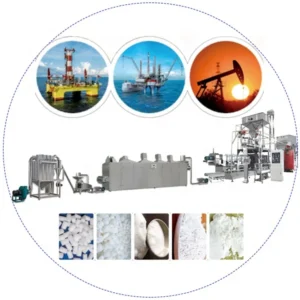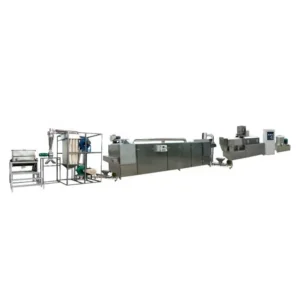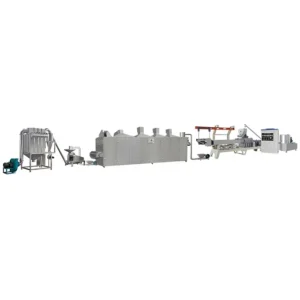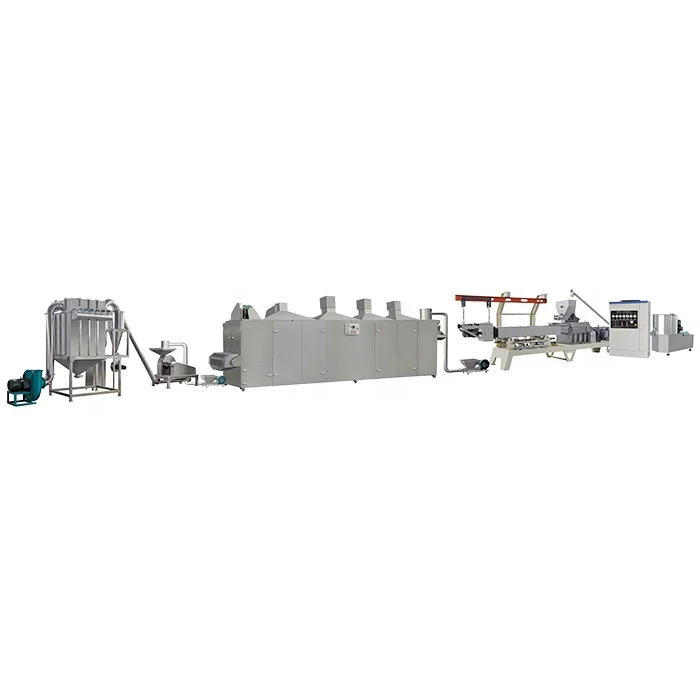


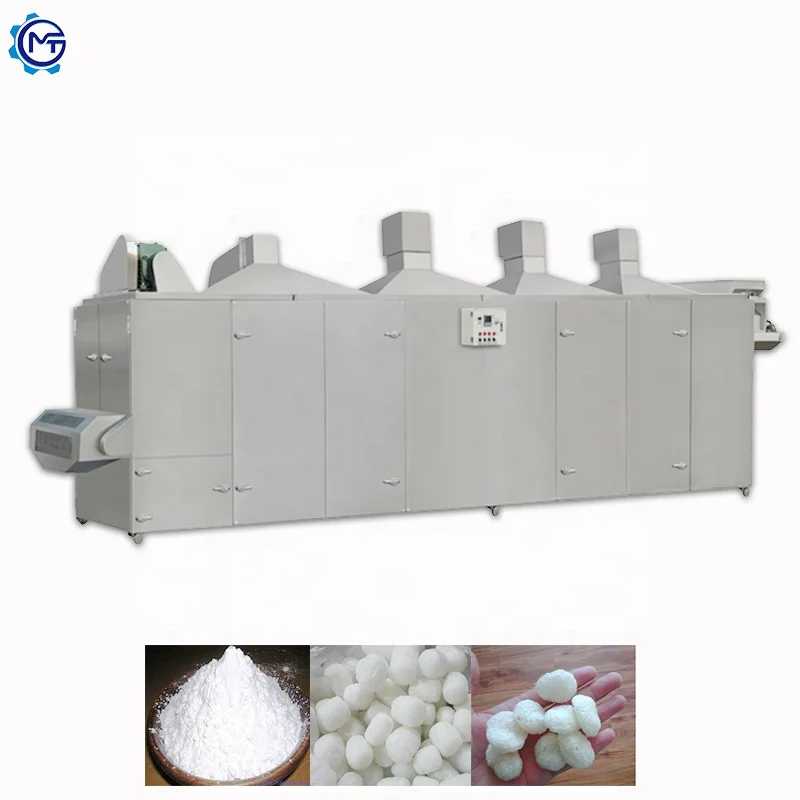

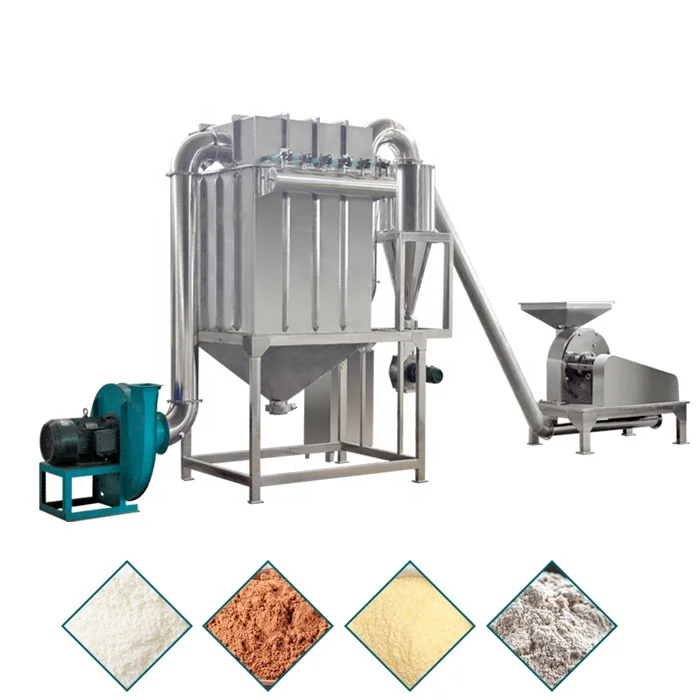
MT70 / MT85 / MT75 Modified Starch Extrusion Production Line, Twin-Screw, 150–500 kg/h, PLC Control — configured for E1422, pregelatinised and cross-linked starch grades with screw and die design matched to your raw material.
- Barrel cooling and 38CrMoAl screws ensure precise gelatinisation and modification control across moisture and shear profiles.
- 5-layer dryer with inverter speed control and pulse grinder with cyclone discharge maintain uniform particle size at full throughput.
Line layout, capacity calculation and trial run on your feedstock completed in our testing workshop before shipment, with voltage and control language confirmed to your facility.
Description
Screw Configuration Matched to Starch Grade — trial runs on your raw material in the testing workshop confirm extrusion stability before the line ships.
Technical Specifications
| Parameter | Value |
|---|---|
| Product Type | Modified Starch Extrusion Production Line |
| Available Models | MT70 / MT85 / MT75 |
| Extruder Screw Type | Twin-screw |
| Screw Material | 38CrMoAl |
| Screw Diameter (MT70) | 70 mm |
| Screw Length (MT70) | 1520 mm |
| Main Motor Power (MT70) | 30 kW |
| Installed Power | MT70 — 160 kW; MT85 — 190 kW; MT75 — 210 kW |
| Power Consumption | MT70 — 120 kW; MT85 — 140 kW; MT75 — 150 kW |
| Output Capacity | MT70 — 150–200 kg/h (basis not stated in source); MT85 — 300–400 kg/h (basis not stated in source); MT75 — 300–500 kg/h (basis not stated in source) |
| Overall Dimensions (L×W×H) | MT70 — 41000×1500×2200 mm; MT85 — 43000×1500×3200 mm; MT75 — 45000×1500×3500 mm |
| Barrel Temperature Control | Integrated cooling system |
| Voltage & Frequency | 380V 50Hz Three Phase (configurable to target market) |
| Mixer Batch Capacity Options | 20–30 kg / 70–80 kg / 170–180 kg per batch |
| Mixer Power Options | 4 kW / 7.5 kW / 15 kW |
| Dryer Type | 5-layer baking oven |
| Dryer Heating Source | Gas or diesel (configurable) |
| Dryer Speed Control | Inverter-driven |
| Dryer Dimensions | 5000×1200×2300 mm |
| Control System | PLC and MCC control |
| Certification | CE, ISO |
| Warranty | 1 year complete warranty, life-time maintenance service |
Application Suitability
| Application | Material or Output |
|---|---|
| Food-grade modified starch (E1422, acetylated distarch adipate) | Native corn, potato, tapioca starch feedstock for sauce, bakery and confectionery thickeners |
| Pregelatinised starch for nutrition programmes | Instant-dissolve starch powders for fortified food and infant formula blending |
| Industrial modified starch | Cross-linked and stabilized starch for textile sizing, paper coating and building material additives |
| Binder and stabilizer grades | Emulsifier-grade starch powders for processed meat, dairy and pet food manufacturing |
Why "Rated Capacity" Means Nothing Without the Raw Material Context
A capacity figure is only valid when tied to the specific starch feedstock, moisture content and target modification grade you will actually run.
Many modified starch lines are quoted on a nominal throughput that assumes ideal corn starch at a specific moisture level. When the buyer switches to tapioca or potato starch, or when the incoming moisture varies by a few percentage points, the extruder output drops and the downstream dryer cannot keep up. This mismatch is rarely discovered until the line is installed and running production, at which point the cost of re-engineering is substantial [NEED_CITE: extrusion throughput dependency on raw material moisture and composition]. Every modified starch production line turnkey project we configure starts with a trial run on your actual feedstock so that capacity, gelatinisation degree and final powder specification are verified before the equipment leaves the factory.
Barrel Cooling and Screw Geometry Define the Modification Reaction
The twin-screw extruder in this modified starch production line turnkey system uses 38CrMoAl screws with an integrated barrel cooling circuit. Modified starch reactions — acetylation, cross-linking, oxidation — are temperature-sensitive. The cooling system removes excess shear heat from the barrel zones, keeping the reaction window within the range that produces the target viscosity and stability profile. Screw elements can be arranged to vary residence time and shear intensity across the barrel length, which is essential when switching between E1422 acetylated distarch adipate and pregelatinised starch grades.
Throughput Matching Between Extruder, Dryer and Grinder
A frequent failure point in starch processing lines is a bottleneck at the dryer or grinder station. The 5-layer baking oven with inverter speed control is sized so that its drying capacity tracks the extruder output across the available model range. Gas or diesel heating provides the thermal input needed for uniform moisture reduction on high-throughput batches. The pulse grinder downstream uses cyclone discharge and a dust collector to maintain consistent particle size without material loss [NEED_CITE: particle size consistency in modified starch powder production]. This station-to-station matching means the line runs at the extruder rate without material backing up at any intermediate point.
Reading the Specs Against Your Production Target
The screw diameter of 70 mm on the MT70 and the corresponding dimensions on the MT85 and MT75 define the shear zone volume and, together with screw speed, the mechanical energy input per kilogram of starch. Longer screw length increases residence time, which matters for cross-linked grades that require extended reaction time inside the barrel. The main motor power range from 30 kW upward reflects the torque available to drive viscous starch dough through the die plate. Mixer batch capacity options from 20–30 kg up to 170–180 kg per batch allow the batching station to feed the extruder continuously without dead time between mixes, which is critical for maintaining a steady extrusion rate and consistent product quality.
What Happens When Voltage and Control Language Are an Afterthought
A modified starch line arriving at a facility with the wrong voltage or a control interface in an unfamiliar language faces weeks of delay before commissioning can begin. Rewinding motors or replacing transformers on site is expensive and risks damaging the PLC and MCC panels. The electrical schematic and voltage confirmation step in our sales process exists specifically to prevent this [NEED_CITE: industrial equipment voltage and frequency mismatches in export markets]. Control language is confirmed at the same stage so operators can read alarms and set parameters from day one.
Why Buyers Source This Line From a Single Supplier
Screw and die configuration is specified to your starch feedstock and target modification grade rather than copied from a generic build. Throughput is calculated across every station — mixer, extruder, dryer, grinder, packing — so no single unit bottlenecks the line. Trial production on your raw material runs in the in-house testing workshop before shipment, producing a documented trial run report. Pre-sales consultation, on-site installation, commissioning and operator training are handled by the same engineering team that configured the line, so accountability sits with one supplier from inquiry through ongoing maintenance.
Documentation & Verification
- Line layout and capacity calculation with throughput matched across mixer, extruder, dryer, grinder and packing stations
- Trial run report on your starch feedstock produced in the testing workshop before shipment
- Screw and die configuration record specified to your target modified starch grade
- Electrical schematic with voltage, frequency and control language confirmed to your facility
- CE declaration of conformity and ISO certificate included with shipment documentation
Installation, Commissioning & Support
- Foundation and floor space planning based on line dimensions up to 45000×1500×3500 mm
- Dedicated electrical circuit sized to installed power up to 210 kW with confirmed voltage and frequency
- Modular station delivery with on-site assembly, alignment and belt tensioning
- First-run commissioning with screw speed, barrel temperature and dryer inverter parameters set to your starch grade
- Operator training on PLC interface, barrel cooling adjustment and grinder classifier settings
- Wear parts list covering screws, dies, grinder blades and heating rings with replacement supply terms
What We Need to Configure Your Line
To size the extruder, dryer and grinder correctly, share the native starch type you will process (corn, tapioca, potato or other), the target modification grade such as E1422 or pregelatinised, and your required daily output. Confirm the voltage and frequency available at your facility, the preferred control language, and whether you can send a raw material sample for a pre-shipment trial run in our testing workshop.
Frequently Asked Questions
Q: How is line capacity verified on my specific raw material before shipment?
A: We run a trial production using your starch feedstock in our in-house testing workshop. The extruder output, gelatinisation degree and final powder moisture are measured and documented in a trial run report. This confirms the line delivers the specified capacity on your actual material before any equipment leaves the factory.
Q: How do you match dryer and grinder throughput to extruder output?
A: The 5-layer dryer capacity and pulse grinder feed rate are calculated against the extruder model selected. Inverter speed control on the dryer and auger feeder speed on the grinder are set during commissioning so material flows through every station without accumulation or starvation.
Q: Can the line produce multiple modified starch grades?
A: Yes. Screw element arrangement and die configuration can be changed to shift between grades such as E1422 acetylated distarch adipate, pregelatinised starch and cross-linked variants. The barrel cooling system and PLC recipe storage support repeatable switching between production runs.
Q: What voltage and control language options are confirmed before production?
A: Voltage, frequency and phase are confirmed to match your facility supply before the electrical schematic is finalized. The PLC and MCC control interface language is specified at the same stage so operators can read all parameters, alarms and maintenance prompts in their working language from commissioning day.
Q: What spare wear parts are included and how are replacements supplied?
A: The initial shipment includes a wear parts set covering screws, dies, grinder rotor blades and heating rings. A full wear parts list with part numbers is provided in the documentation package, and replacements are supplied directly from the factory on order.
Related products
-
Twin-Screw Extrusion Line for Modified Starch. Producing Pregelatinized Adhesive & Food Grade Powder
¥65.00 Select options This product has multiple variants. The options may be chosen on the product page -
Automatic Deep Processing Machine – Food Grade Modified & Pregelatinized Starch Manufacturing Line
¥65.00 Select options This product has multiple variants. The options may be chosen on the product page -
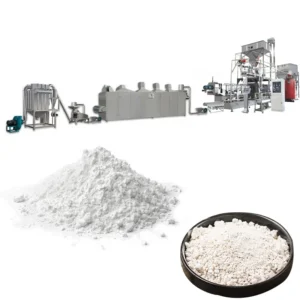
API Standard Pregelatinized Starch Line for Oilfield Drilling Fluid. High Yield Modified Starch Equipment
¥65.00 Select options This product has multiple variants. The options may be chosen on the product page -
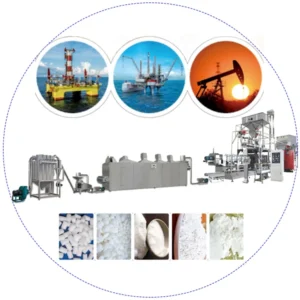
Modified and Pregelatinized Starch Processing Equipment – Pregelatinized Corn Cassava Modified Starch Puffing Machine
¥65.00 Select options This product has multiple variants. The options may be chosen on the product page