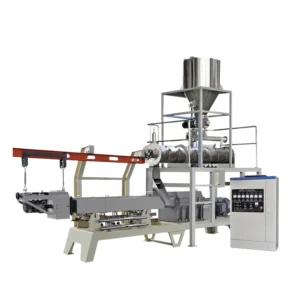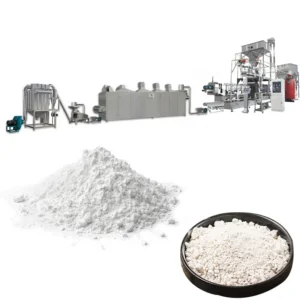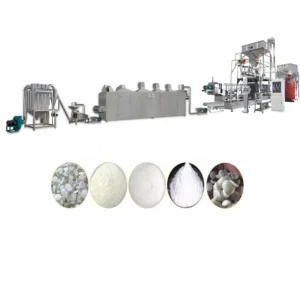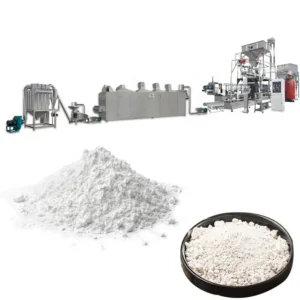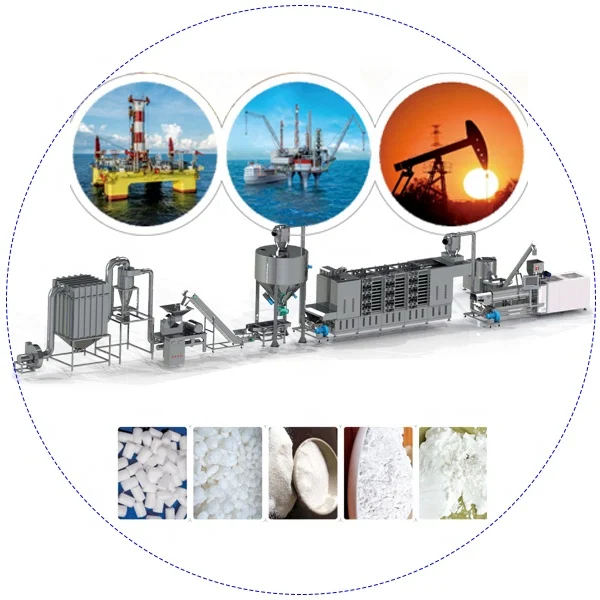


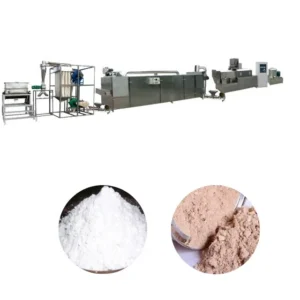
MT65 / MT70 / MT85 Modified Starch Twin-Screw Extrusion Line, 500–600 kg/h output capacity, modular barrel and screw design — engineered for corn and cassava starch modification with co-rotating twin-screw extruders.
- Screw configuration and die design specified to raw material behavior and target gelatinization degree
- Six coordinated stations: feeding, extruding, cutting, heating, conveying and cooling — throughput matched across every section
- Dryer with independently controllable belt speed and temperature aligned to extruder discharge rate
- CE and ISO certified complete line delivered turnkey from batching to drying
Each production line undergoes in-house trial runs on customer-supplied raw material before shipment, with a full test report and screw configuration record provided for verification.
Description
Screw Geometry Matched to Your Starch Source — we reconfigure modular screw sections and die profiles around your actual corn or cassava feedstock, so gelatinisation degree and modification targets are validated before the line ships.
Technical Specifications
| Parameter | Value |
|---|---|
| Product Type | Modified Starch Twin-Screw Extrusion Line |
| Model Options | MT65 / MT70 / MT85 |
| Screw Type | Co-rotating twin-screw, modular sectional design |
| Line Stations | Feeding, extruding, cutting, heating, conveying, cooling, mixer, dryer |
| Mixer Features | Stainless steel contact parts, safety interlock on cover and discharge |
| Dryer Control | Independent net belt speed and temperature adjustment |
| Control System | Automated PLC/MCC (language options to be confirmed) |
| MT65 Installed Power | 72 kW |
| MT65 Power Consumption | 50 kW |
| MT65 Output Capacity | 140–160 kg/h (basis not stated in source — confirm raw material type, moisture content and target starch modification) |
| MT65 Dimensions | 2200 × 1000 × 2300 mm |
| MT70 Installed Power | 92 kW |
| MT70 Power Consumption | 65 kW |
| MT70 Output Capacity | 240–260 kg/h (basis not stated in source — confirm raw material type, moisture content and target starch modification) |
| MT70 Dimensions | 2600 × 1000 × 2300 mm |
| MT85 Installed Power | 108 kW |
| MT85 Power Consumption | 75 kW |
| MT85 Output Capacity | 500–600 kg/h (basis not stated in source — confirm raw material type, moisture content and target starch modification) |
| MT85 Dimensions | 4500 × 1000 × 2600 mm |
| Certification | CE (since 2014), ISO |
| Warranty | 24 months with lifetime service support |
Application Suitability
| Application | Material or Output |
|---|---|
| Pre-gelatinised starch for textile sizing | Corn starch, cassava starch at controlled moisture |
| Modified starch for food processing | Tapioca starch, corn starch with targeted viscosity modification |
| Denatured starch for paper-making and building materials | Cassava or corn starch with cross-linking treatment |
| Pre-gelatinised starch for oil drilling fluids | Corn starch processed for cold-water solubility |
| Modified starch for casting binders | High-amylose corn starch with thermal degradation control |
Why Nominal Output Figures Mislead Starch Processors
A turnkey modified starch extrusion line quoted at a flat capacity number rarely holds that throughput when your specific starch source and target modification degree enter the barrel.
Actual output depends on the raw material chemistry and the gelatinisation window you need to hit.
I learned this the hard way. A couple of years back, we configured a pre-gelatinised starch line based on cassava starch specs for a Southeast Asian buyer. When their actual corn starch arrived at the workshop, the gelatinisation temperature gap was over ten degrees. The entire screw combination had to be rebuilt, and trial production dragged on for nearly two weeks. Since then, I never sign off on a line configuration without a pilot run on the buyer’s real feedstock. Capacity numbers without a stated material basis are just brochure filler [NEED_CITE: gelatinisation temperature variance between corn and cassava starch].
Barrel Zones and Residence Time Control
In a modified starch processing line, the twin-screw extruder is where the actual chemical transformation happens. The co-rotating modular screw design lets us arrange conveying, kneading, shearing and venting elements in a sequence that matches your starch’s gelatinisation curve. Corn starch typically requires a higher barrel temperature profile and longer residence time in the cooking zone compared to tapioca starch, which gelatinises faster but is more sensitive to shear degradation. Getting this sequence wrong means either incomplete modification or molecular breakdown that ruins viscosity.
Matching Dryer Capacity to Extruder Output
The dryer is the station most likely to bottleneck a modified starch processing line if it was selected on generic assumptions. After extrusion, the starch exits the die at high moisture and must be cooled and dried to a stable shelf-ready state. If the dryer belt speed or temperature is set too aggressively, surface case-hardening traps internal moisture. Too slow, and the extruder is forced to idle. Our net belt dryers offer independent speed and temperature control at each zone, so the drying curve can be tuned to the specific modified starch product exiting the die.
Power Draw, Screw Load and Process Stability
The installed power figures across the MT65, MT70 and MT85 reflect the mechanical energy available for starch shearing and cooking inside the barrel. A higher installed power on the MT85 means the main motor can maintain screw speed under the viscous load of high-concentration starch dough without torque spikes. Power consumption values indicate the typical operating draw during steady-state extrusion. When actual consumption drifts significantly above the listed figures, it usually signals that screw wear is increasing internal recirculation, or that the feed moisture is outside the designed range [NEED_CITE: relationship between motor load and screw wear in starch extrusion]. The gap between installed and consumed power also tells you how much headroom the extruder has when switching between starch types with different viscoelastic properties.
The Hidden Cost of Skipping a Pre-Shipment Trial
Buyers who accept a starch extrusion line without a workshop trial on their own raw material often face extended commissioning on site. The screw configuration that worked on the manufacturer’s test starch may produce incomplete gelatinisation or excessive dextrinisation on a different corn variety. Reconfiguring screw elements in a buyer’s factory means production downtime, wasted raw material, and a learning curve that could have been resolved before the crate was sealed [NEED_CITE: typical commissioning delays caused by unverified screw configurations].
Why This Is Where Starch Processors Source Their Lines
Every station from the batch mixer to the dryer is specified by one engineering team, so throughput is matched rather than assembled from mismatched vendor quotes. The screw configuration and die design are documented against your specific starch source and target modification product, not copied from a generic template. Before the modified starch processing line leaves our Jinan workshop, we run your actual raw material through the extruder and document gelatinisation degree, output rate and product texture. Electrical schematics, voltage and control language are confirmed against your site conditions before production starts, so there are no surprises during installation. CE and ISO documentation accompanies every shipment, and a 24-month warranty covers the complete line.
Documentation & Verification
- Line layout drawing showing throughput matching across mixer, extruder, dryer and cooler stations
- Screw element arrangement record tied to your starch source and target modification degree
- Electrical schematic with confirmed voltage, frequency and HMI language for your facility
- Factory trial run report on your raw material documenting output and gelatinisation results
- CE declaration of conformity and ISO certificate for the complete line
- Wear parts list covering screw segments, die plates and dryer belt sections
Installation, Commissioning & Support
- Foundation requirements sized to the MT85 footprint of 4500 × 1000 mm with vibration isolation
- Dedicated power circuit planned around the MT70 installed load of 92 kW with voltage confirmation
- Line arrives in sectional modules for sequential assembly matching your facility access constraints
- First-run parameter setting covers barrel temperature profile, screw speed and dryer belt calibration
- Operator training includes screw element changeover procedure for switching between starch sources
- Spare screw segments and die plates shipped with the initial order to cover the first replacement cycle
What We Need to Configure Your Line
To size the right extrusion model and screw combination, share the type of starch you will process, the target modification product and your required daily output. We also need your local voltage and frequency, the preferred control language, and whether you can send a sample batch of your raw material for a workshop trial run before we finalise the line proposal.
Frequently Asked Questions
Q: How is the actual output capacity of the modified starch processing line determined?
A: Output depends on the starch source, its moisture content at feeding, and the degree of gelatinisation or modification required. We confirm capacity by running your actual raw material through the extruder in our testing workshop, measuring steady-state throughput and product quality, and documenting the results in a trial run report before finalising the quotation.
Q: How do you adapt the screw configuration for different starch types?
A: Each screw section — conveying, kneading, shearing, venting — is selected and sequenced based on the gelatinisation temperature and shear sensitivity of your specific starch. Corn starch, cassava starch and tapioca starch each require a different modular arrangement to achieve target viscosity and modification without over-processing or leaving uncooked fractions.
Q: Will the control system match our factory’s voltage and language requirements?
A: We confirm your site voltage, frequency and preferred HMI language during the specification stage. Electrical schematics are produced accordingly, and the PLC/MCC control system is programmed before the line ships, so the operator interface and safety interlocks function correctly from the first day of commissioning.
Q: Can we send our own raw material for a pre-shipment trial?
A: Yes, and we strongly recommend it. We run your actual starch through the extruder at our Jinan workshop, record the screw configuration, barrel temperatures, output rate and gelatinisation degree, and share the trial report with you before the line is packed. This eliminates guesswork during on-site commissioning.
Q: What about spare parts for the screws and dies?
A: A wear parts list is provided with every line, identifying screw segments, die plates and dryer belt sections that experience the highest wear. We ship an initial set of spares with the line so that the first replacement can be handled without production interruption, and ongoing supply is available through our after-sales channel.
Related products
-
Automatic Modified Starch Making Machine Oil Drilling Starch Processing Production Line
¥30.00 Select options This product has multiple variants. The options may be chosen on the product page -
Corn Cassava Modified Starch Powder Production Line Electric-powered Motor Automatic 400kg/h Processing Equipment New Condition
¥65.00 Select options This product has multiple variants. The options may be chosen on the product page -
Cassava & Pregelatinized Corn Starch Extrusion Equipment – CE Certified Industrial Twin-Screw Modified Starch Line
¥65.00 Select options This product has multiple variants. The options may be chosen on the product page -
Big Capacity Modified Starch Industrial Use and Food Additives
¥50.00 Select options This product has multiple variants. The options may be chosen on the product page