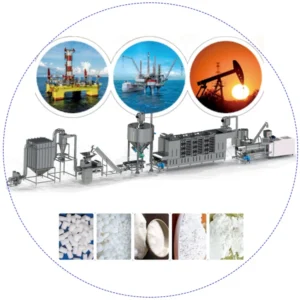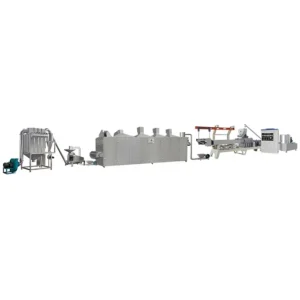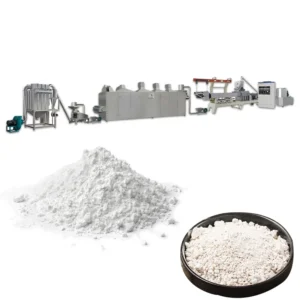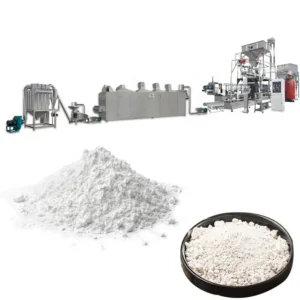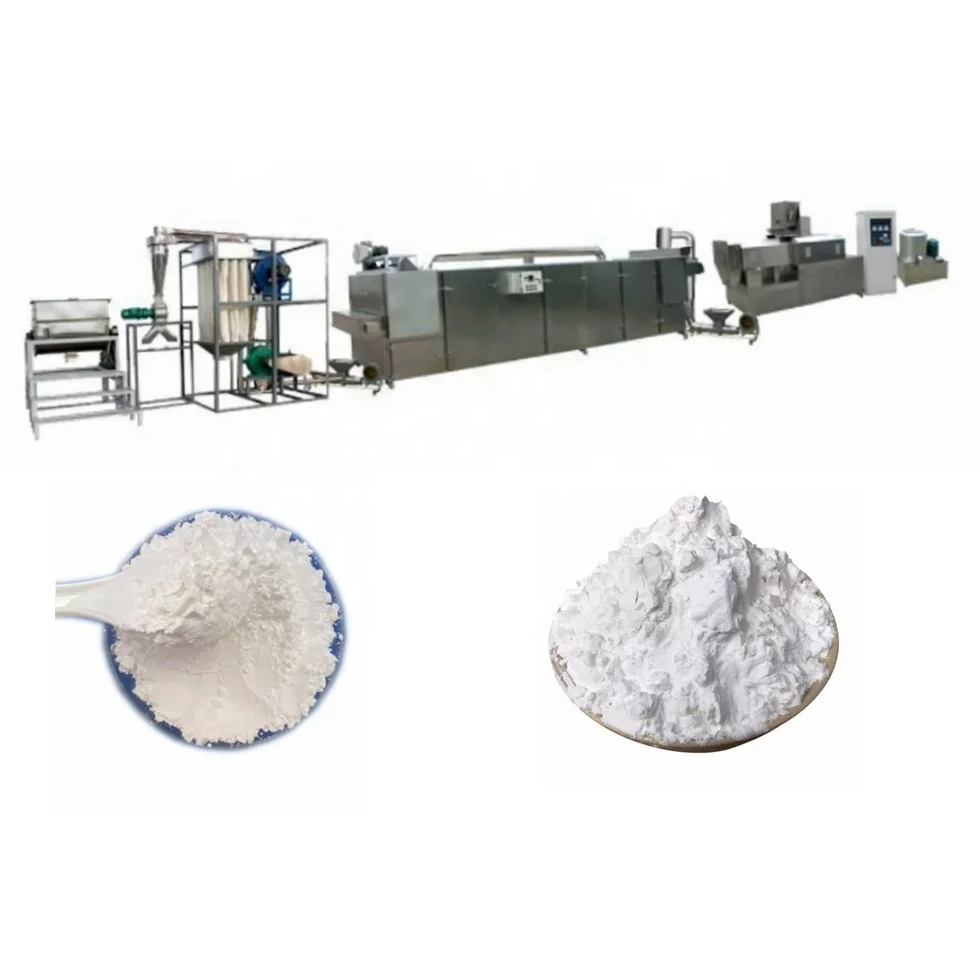


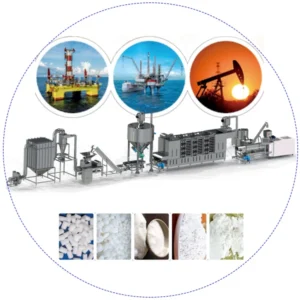
Modified Starch Processing Line, Twin-Screw Extruder, 45-200 kW, PLC/MCC Control — engineered as one integrated turnkey project from batching through extrusion to cooling and grinding.
- Screw configuration and die design matched to your starch raw material and target modification degree
- Throughput balanced across every station to prevent bottlenecks
- Flexible heating via gas, diesel, electricity, or steam
Every station is utility-planned and capacity-matched under a single supplier, with trial runs on your raw material in our testing workshop before shipment.
Description
Screw Configuration Matched to Raw Material — Twin-screw extrusion parameters are specified against the buyer’s actual starch formulation, verified through in-house trial runs before the line ships.
Technical Specifications
| Parameter | Value |
|---|---|
| Product Type | Modified Starch Production Line |
| Output Capacity | 100–1500 kg/h (basis not stated in source — confirm raw material type, moisture content, and target modification degree) |
| Power | 45–200 kW |
| Screw Type | Twin screw |
| Control System | Automated PLC / MCC control |
| Voltage | 220–440V, tri-phase (frequency to be confirmed) |
| Fuel Options | Gas, diesel, electricity, or steam heating |
| Line Stations | Twin-screw extruder, cooling conveyor, pulse grinder |
| Contact Material | Food-grade stainless steel on all product contact surfaces |
| Standards | CE, ISO certified |
| Assembly State | Complete integrated production line with supporting equipment |
Application Suitability
| Application | Material or Output |
|---|---|
| Modified tapioca starch for food processing | Raw tapioca starch requiring controlled gelatinisation and pregelatinisation |
| Modified corn starch for industrial use | Corn flour processed for oil drilling, paper making, or textile sizing |
| Pregelatinised cassava starch | Cassava flour with high amylopectin content requiring precise thermal treatment |
| Fortified nutritional starch blends | Rice flour, soybean flour, and nutritional grain flour mixtures |
What "Rated Capacity" Really Means on a Starch Line
The number on the quotation only holds if your raw material matches the test conditions.
I once watched a modified starch line stall at barely half its nameplate output because the buyer’s local tapioca supply had a different amylopectin ratio than the corn starch the line was originally configured for. Gelatinisation temperature shifted, expansion behaviour changed, and the downstream grinder could not keep up with the altered product density. That line spent days on-site being re-parameterised before it produced acceptable material. A modified starch processing line turnkey proposal should always state which raw material and moisture content the capacity figure was based on — and ideally prove it with a trial run report on your actual flour [NEED_CITE: starch gelatinisation behaviour across different botanical sources].
Throughput Matching Across Every Station
A modified starch line fails when one station runs faster or slower than the rest. The twin-screw extruder, cooling conveyor, and pulse grinder must each handle the same mass flow rate at steady state. On a modified starch processing line turnkey project, we calculate the residence time inside the extruder barrel, the belt speed and length needed for adequate cooling, and the grinder throughput at the target particle size — then verify that no station creates a bottleneck or product backlog. This balance is documented in the line layout and capacity calculation before fabrication begins.
Utility Planning for Real Workshop Conditions
Starch processing workshops vary widely in available utilities. Some buyers have steam boilers already installed, others prefer direct gas firing for the dryer and conditioner sections. The electrical supply may be 380V/50Hz in one country and 440V/60Hz in another [NEED_CITE: voltage and frequency standards by export market]. A proper turnkey project maps every utility connection — electrical load per motor, gas pressure at the burner, compressed air for pneumatic valves, and water flow for cooling jackets — against the buyer’s confirmed site conditions before the line enters production.
Screw Geometry and Starch Modification Degree
The twin-screw configuration on this line is not a fixed catalog item; the screw elements, barrel zone count, and die opening are selected based on the raw material and the modification target. Pregelatinised starch demands a different shear profile and barrel temperature curve than starch modified for industrial viscosity control. Longer barrel sections extend residence time for thorough gelatinisation, while specific kneading block arrangements manage the shear forces that break down granule structure. The 45–200 kW power range covers lines from small-batch specialty production to high-volume industrial starch output, with motor sizing matched to the torque required for the buyer’s formulation.
The Hidden Cost of Skipping a Trial Run
Lines shipped without material-specific testing routinely need extended on-site commissioning. Screw configurations copied from a generic build may produce the wrong degree of starch modification, forcing the operator to run at reduced throughput or accept off-spec product. When the cooling conveyor cannot match the extruder output, product piles up and moisture migration degrades quality before grinding. These problems are solvable — but solving them on the buyer’s floor costs far more in lost production time than a trial run in the factory would [NEED_CITE: industrial extrusion commissioning delays due to untested raw materials].
Why Source the Full Line from One Supplier
Every station on this modified starch line — batching, extrusion, cooling, grinding, and packing — is designed as one project with matched throughput, eliminating the coordination gaps that occur when equipment comes from separate vendors. Screw and die geometry is specified against the buyer’s raw material sample, not a generic starch profile. The in-house testing workshop runs trial production on the customer’s own flour formulation before shipment, producing a documented report rather than an assumption. PLC and MCC control architecture is integrated across all stations so that process parameters remain consistent from the mixer to the packing scale. Electrical schematics and voltage specifications are confirmed against the buyer’s facility before fabrication, preventing commissioning delays [NEED_CITE: CE machinery directive requirements for industrial equipment].
Documentation & Verification
- Line layout drawing with throughput balance calculated for your starch type
- Trial run report on your raw material from the in-house testing workshop
- Electrical schematic with voltage and frequency matched to your facility
- Screw and die configuration record specifying element arrangement and die geometry
- CE declaration of conformity and ISO certificate for customs clearance
- Operation and maintenance manual with wear parts list
Installation, Commissioning & Support
- Foundation load and floor space plan calculated from the full line footprint and 1000–5000 kg equipment weight
- Power distribution schedule mapping each 45–200 kW motor to dedicated circuit breakers
- Pre-shipment factory assembly and test run before line disassembly for container loading
- On-site parameter tuning against your local raw material during commissioning
- Operator training covering PLC interface navigation, screw speed adjustment, and emergency stops
- Wear parts list with lead times for screws, dies, and grinder screen replacements
What We Need to Configure Your Line
To build an accurate modified starch processing line turnkey proposal, we need your raw material type and a sample for trial testing, your target modification degree or end-use specification, daily production volume, available workshop dimensions, and local voltage and frequency. Let us also know your preferred heating fuel and whether HMI language requirements affect operator training.
Frequently Asked Questions
Q: How is line capacity verified, and what raw material and moisture assumptions underpin the stated output?
A: The stated 100–1500 kg/h range depends entirely on raw material type, moisture content, and modification target. We verify capacity by running your actual starch sample in our in-house testing workshop and documenting the achieved throughput, product quality, and process parameters in a trial report before the line is quoted.
Q: How are screw configuration, barrel zones, and die design selected for different starch types and modification targets?
A: Each starch source — tapioca, corn, cassava — has distinct gelatinisation temperatures and shear sensitivity. We select screw element arrangement, barrel heating zone count, and die geometry based on your specific raw material and the viscosity or functional property your end product requires.
Q: How is throughput balanced between the extruder, cooling conveyor, and pulse grinder to prevent bottlenecks?
A: We calculate mass flow rate at steady state across every station. Cooling belt speed and length are matched to extruder output and product temperature, while grinder capacity is verified at the target particle size to ensure continuous operation without material backlog.
Q: What workshop footprint and utility connections are required for the complete line?
A: We provide a scaled layout drawing showing the full line footprint including operator walkways. Utility requirements — electrical load, heating fuel connection, compressed air, and water supply — are confirmed against your site conditions before production begins.
Q: Can I send my raw material for a trial run before placing the order, and what does the trial report cover?
A: Yes, sending a raw material sample is standard practice. The trial report documents achieved output rate, product expansion and texture, process parameter settings, and any adjustments needed to meet your target specification.
Related products
-
Modified Starch for Construction Adhesives Production – Custom Built Double Screw Extruder Line
¥65.00 Select options This product has multiple variants. The options may be chosen on the product page -
Pre-gelatinized Starch Production Line – Modified Starch Integrated Puffing Equipment
¥65.00 Select options This product has multiple variants. The options may be chosen on the product page -
API Standard Pregelatinized Starch Line for Oilfield Drilling Fluid. High Yield Modified Starch Equipment
¥65.00 Select options This product has multiple variants. The options may be chosen on the product page -
Automatic Pregelatinized Starch Processing Machine – Large-Scale New Condition Modified Starch Production Line
¥65.00 Select options This product has multiple variants. The options may be chosen on the product page