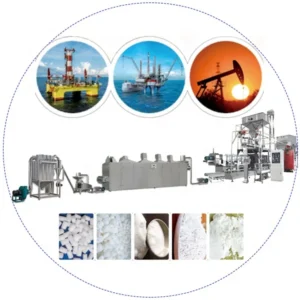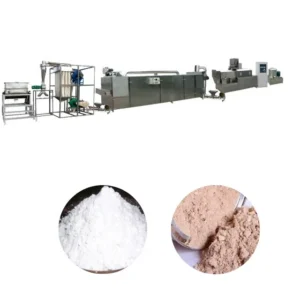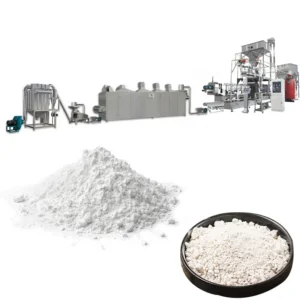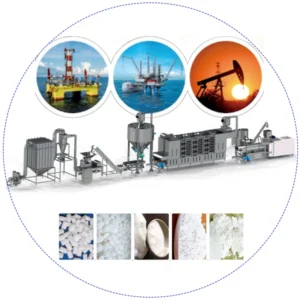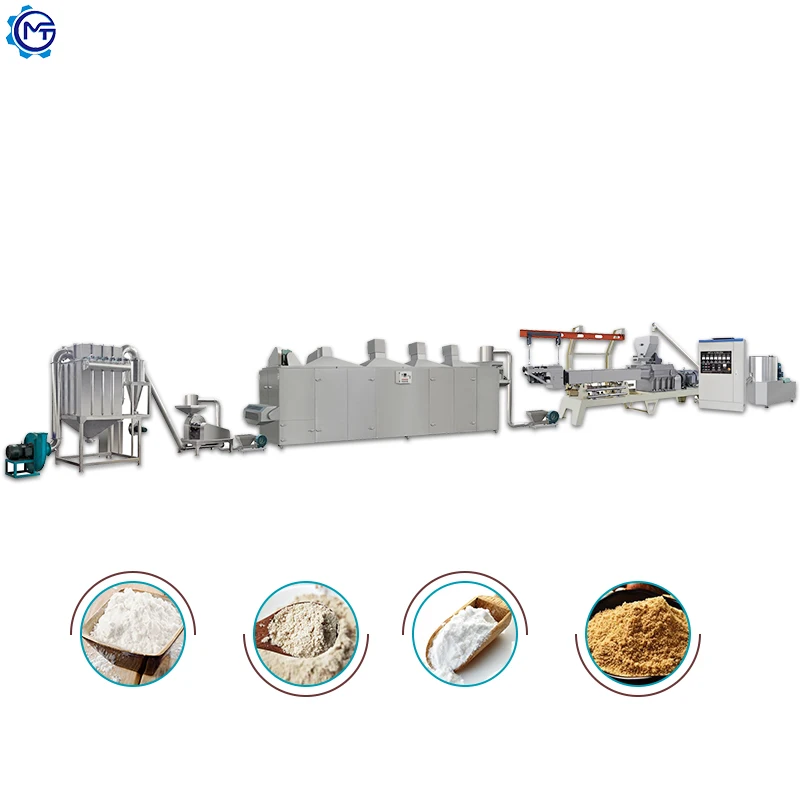


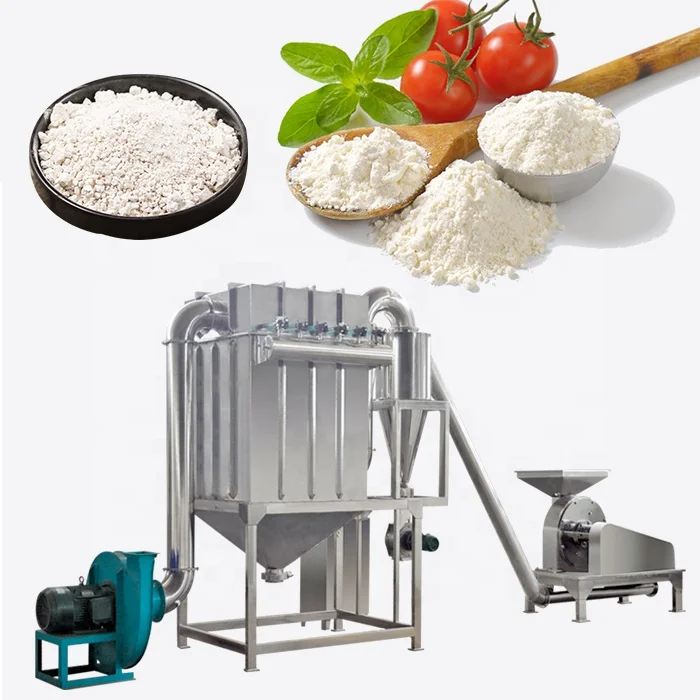


Modified & Pregelatinized Starch Processing Line, Twin-Screw Extruder, 80–500 kg/h, PLC Control — throughput-matched from mixing through extrusion, drying, conditioning, and grinding to eliminate bottlenecks. Screw configuration and die design specified to your starch feedstock — wheat, corn, or potato — with barrel temperature and moisture control targeting precise gelatinisation degree and viscosity. Energy options include electricity, gas, diesel, or steam to match your plant infrastructure.
- In-house trial run on your raw material before shipment with full documentation
- Line layout and capacity calculation verified across every station
- Electrical schematic with voltage, frequency, and control language confirmed pre-production
Description
Throughput-Matched Engineering — every station from mixing to grinding is sized against your starch feedstock, not a generic catalogue rating.
Technical Specifications
| Parameter | Value |
|---|---|
| Product Type | Modified & Pregelatinized Starch Processing Line |
| Capacity Range | 80–500 kg/h (basis not stated in source — confirm raw material type, moisture content and target starch modification degree) |
| Extruder Type | Twin-screw extruder |
| Raw Materials | Wheat flour, corn starch, potato starch |
| Key Contact Material | Food grade stainless steel 304 |
| Frame Material | Stainless steel 201 |
| Control System | Available with PLC or MCC control (specific model to be confirmed) |
| Motor Brand | Siemens (made in China) or China top brand; Delixi or Delta inverter (source value — verify against manufacturer catalog) |
| Energy Options | Electricity / gas / diesel / steam |
| Power (Electrical Heating) | Approx. 100 kW (rated or peak not specified in source) |
| Power (Gas/Diesel Heating) | Approx. 50–60 kW (rated or peak not specified in source) |
| Mixer Motor | 4.0 kW |
| Mixer Batch Output | 3.0–4.0 kg/time (basis not stated in source — confirm batch time and raw material) |
| Screw Conveyor Motor | 1.1 kW |
| Screw Conveyor Output | 0–150 kg/h (basis not stated in source — confirm material and screw speed) |
| Screw & Barrel Material | 45 steel (source value — verify against manufacturer catalog) |
| Die Configuration | Interchangeable dies for different shapes |
| Voltage & Frequency | Three-phase 380V/50Hz; single-phase 220V/50Hz (customizable to customer’s local voltage) |
| Standards | CE, ISO (specific standard number not stated in source — verify) |
Application Suitability
| Application | Material or Output |
|---|---|
| Food-grade modified starch production | Wheat flour, corn starch, or potato starch requiring specific viscosity and gelling properties |
| Industrial pregelatinized starch manufacturing | Corn or potato starch feedstock for paper manufacturing and non-food applications |
| Functional food ingredient processing | Wheat, corn, or potato starch modified for use in processed food formulations |
| Fortified starch blending | Base starch combined with micronutrient additives for nutritional programmes |
What the Nominal Capacity Figure Leaves Out
The real capacity of your modified starch processing line turnkey depends entirely on what you feed into it.
A processor I worked with in Colombia specified a line based on a quoted throughput number. They ran corn starch during the vendor’s factory test and accepted the machine. When it arrived on-site, they switched to cassava starch — and the gelatinisation degree never reached specification. Two weeks of re-tuning screw elements and barrel zones followed, with production completely stalled. The extruder was not undersized; it was configured for the wrong carbohydrate chain. That gap between a nameplate number and a real-world result is where most turnkey starch projects lose time. [NEED_CITE:]
Screw Geometry Dictates What the Starch Becomes
Twin-screw extrusion changes starch structure through shear, heat, and residence time — all governed by the element arrangement inside the barrel. A modified starch processing line turnkey configured for corn starch uses a different screw combination than one built for potato starch, because the granule size, amylose ratio, and gelatinisation temperature differ between feedstocks. The screw configuration and die design on this line are specified after reviewing your raw material data sheet and target starch properties such as viscosity, stability, and gelatinisation degree.
Temperature Profile Controls the Modification Window
Barrel zones on this extruder are independently heated, allowing a staged temperature curve that brings the starch through gelatinisation without degrading the polymer chains. Wheat flour, corn starch, and potato starch each enter their gelatinisation phase at different points. Getting that curve wrong means either under-processed starch that fails viscosity tests or over-processed material with broken chains and lost functionality. The energy flexibility across electricity, gas, diesel, and steam lets the thermal system match whatever utility infrastructure your plant already has, avoiding costly transformer upgrades. [NEED_CITE:]
Why Extruder Output Alone Is the Wrong Metric
The twin-screw extruder is only one station in the chain. If the dryer cannot remove moisture fast enough at the extruder’s actual output rate, material backs up and the line stalls. If the grinder is undersized, particle distribution drifts outside specification and batches fail quality checks. The 4.0 kW mixer, the screw conveyor rated for continuous feed, the dryer, the conditioning station, and the grinder on this line are all throughput-matched against each other. That matching is based on the confirmed capacity tied to your specific raw material and modification target, not a generic peak number.
The Cost of Copying a Configuration from Another Feedstock
Every starch type responds differently to shear and heat inside the barrel. When a screw combination designed for corn starch is applied unchanged to wheat flour, the resulting product often shows inconsistent expansion and unpredictable cold-paste viscosity. On a project where the wrong die plate was installed, the pregelatinized starch came out with a particle size distribution that failed the customer’s downstream screening specification — requiring an entire regrind cycle before shipment could be approved. These are not equipment defects. They are specification mismatches that compound across every hour of production. [NEED_CITE:]
Why Buyers Choose This Line Configuration
Throughput matching across every station means the mixer batch cycle, conveyor rate, dryer residence time, and grinder feed rate are calculated together before the line ships. Screw and die configurations are documented against your specific starch type, not pulled from a standard build. An in-house testing workshop allows trial runs on your actual raw material before dispatch, so gelatinisation degree and capacity are verified in advance rather than discovered during commissioning. Electrical schematics and voltage confirmation are finalised against your local supply before production starts. Pre-sales engineering, installation, commissioning, and operator training are handled under one project scope, eliminating coordination gaps between separate vendors.
Documentation & Verification
- Line layout and capacity calculation matched to your starch feedstock and target modification degree
- Screw and die configuration record specific to your raw material type
- Trial run report on your raw material from in-house testing workshop before dispatch
- Electrical schematic with voltage, frequency, and HMI language confirmed to your local supply
- CE declaration of conformity and ISO certificate for customs and regulatory clearance
- Wear parts list covering screws, dies, and barrel elements with replacement intervals
Installation, Commissioning & Support
- Foundation and floor space planning based on full line footprint from mixer through grinder
- Dedicated electrical circuit sized to the confirmed heating load and motor draw
- Stations arrive fully assembled; conveyor and ducting connections completed on-site
- First-run parameter setting covers barrel zone temperatures, screw speed, and moisture addition rate
- Operator training addresses screw element changes and die swap procedures
- Spare wear parts inventory recommended based on your confirmed production schedule and raw material abrasiveness
What to Include in Your Inquiry
To configure a modified starch processing line turnkey that matches your production target, share your starch feedstock type and current moisture content, the modification properties you need such as target viscosity or gelatinisation degree, and your planned daily output volume. Include your local voltage and frequency, preferred HMI language, and whether your facility uses steam, gas, or electrical heating. If you have existing upstream or downstream equipment that this line must integrate with, provide those connection specifications.
Frequently Asked Questions
Q: How is the quoted line capacity verified before shipment?
A: Capacity figures are based on a specific raw material, moisture level, and target modification degree. We run your actual starch feedstock in our in-house testing workshop and document the throughput, gelatinisation results, and product properties in a trial run report provided before the line ships.
Q: How do screw and die configurations differ between wheat, corn, and potato starch?
A: Each starch type has a distinct granule structure and gelatinisation temperature. The screw element sequence, compression ratio, and die geometry are selected to match your feedstock’s amylose content and your target viscosity, ensuring controlled expansion and consistent modification throughout production.
Q: How are voltage, frequency, and control language confirmed?
A: During the specification phase, we collect your local supply data and HMI language preference. The electrical schematic and control configuration are finalised and documented before production begins, preventing commissioning delays caused by incompatible power supply or unreadable interface text.
Q: What does the in-house trial run actually cover?
A: The trial run processes your raw material through the extruder under production-representative conditions. We measure throughput, product moisture, gelatinisation degree, and particle characteristics. The documented results ship with the line so your team has validated process parameters from day one of commissioning.
Q: How are the dryer and grinder sized relative to the extruder?
A: Every downstream station is calculated against the extruder’s confirmed output for your specific starch and modification target. The dryer residence time and the grinder feed rate are matched to prevent material backlog or idle capacity, keeping the entire line running at a steady, specification-holding pace.
Related products
-
Automatic 304 Stainless Steel Modified Corn Starch Making Machine TWIN SCREW 500kg/h Capacity Starch Processing Production Line
¥50.00 Select options This product has multiple variants. The options may be chosen on the product page -
Cassava & Pregelatinized Corn Starch Extrusion Equipment – CE Certified Industrial Twin-Screw Modified Starch Line
¥65.00 Select options This product has multiple variants. The options may be chosen on the product page -
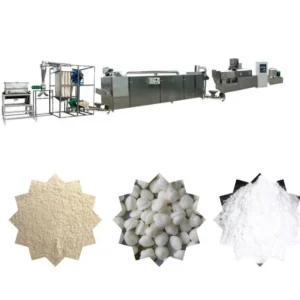
Pregelatinized Low-Cost Modified Starch Line – High-Efficiency Automated Starch Processing Machine
¥65.00 Select options This product has multiple variants. The options may be chosen on the product page -
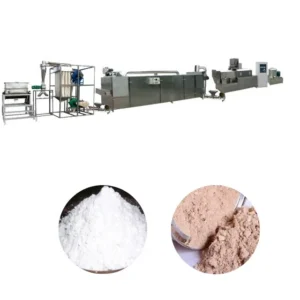
Big Capacity Modified Starch Industrial Use and Food Additives
¥50.00 Select options This product has multiple variants. The options may be chosen on the product page