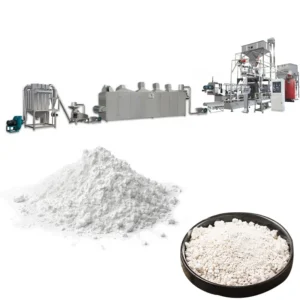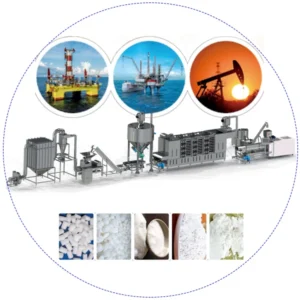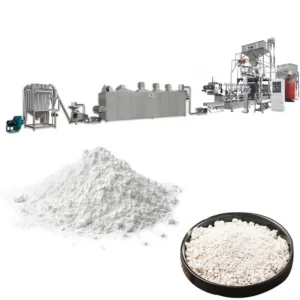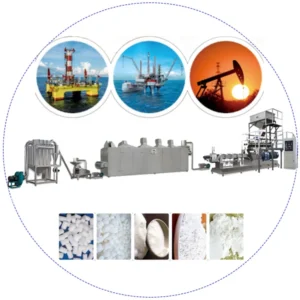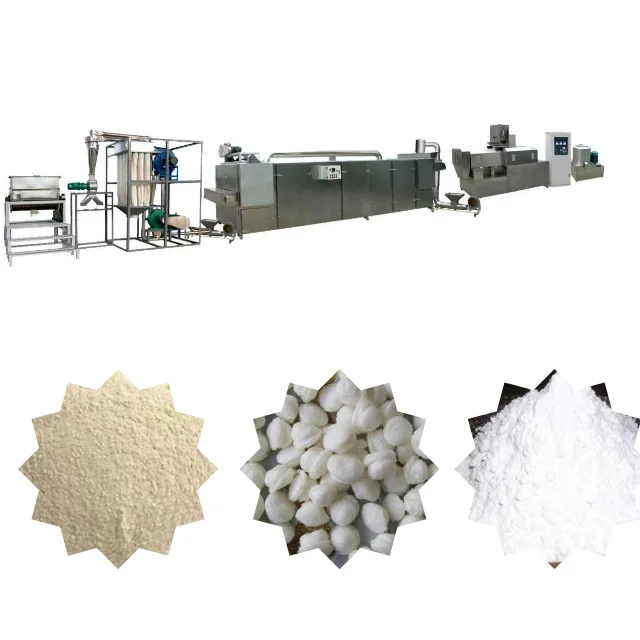


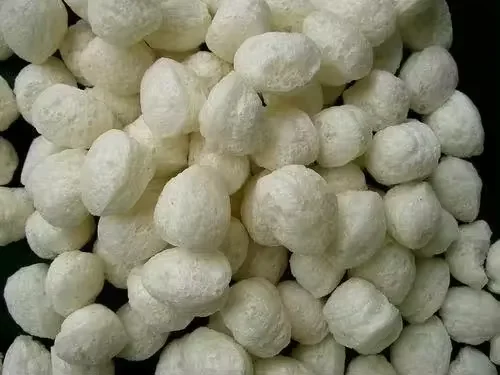
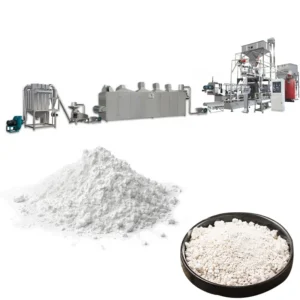
MT85 / MT100 / MT110 / MT135 Modified Starch Processing Line, Twin-Screw, Electric/Steam/Gas Dryer — complete turnkey layout from material blending through extrusion, drying, grinding and packing with throughput matched across every station.
- Automatic lubricating and cooling system supports stable continuous operation
- Frequency speed control and configurable dryer heating adapt to local utility conditions
- Trial runs on your corn, tapioca or potato starch formulation in our in-house testing workshop before shipment
Single-supplier accountability covers line layout, installation, commissioning and ongoing wear part supply.
Description
Matched Throughput Across All Stations — A modified starch processing line only performs as well as its weakest link; this twin-screw extrusion system from batching to packing is designed so the dryer and grinder never choke on the extruder’s output.
Technical Specifications
| Parameter | Value |
|---|---|
| Product Type | Modified Starch Processing Line |
| Model | MT85 / MT100 / MT110 / MT135 |
| Screw Type | Twin-screw |
| Installed Power | 90 kW (MT85) / 180 kW (MT100) / 200 kW (MT110) / 240 kW (MT135) |
| Real Consumption | 63 kW (MT85) / 120 kW (MT100) / 150 kW (MT110) / 165 kW (MT135) |
| Capacity | 100–200 kg/h (MT85) / 500–600 kg/h (MT100 & MT110) / 1000–1500 kg/h (MT135) — basis to be confirmed on buyer’s raw material |
| Raw Materials | Corn starch, tapioca starch, potato starch |
| Control System | Frequency speed controlling system |
| Lubrication | Automatic lubricating and cooling on extruder |
| Heating Source Options (Dryer) | Electric / steam / gas |
| Grinder Contact Material | Stainless steel 304 |
| Grinder Discharge | Bottom butterfly valve |
| Grinding Fineness | Less than 10 mm |
| Line Sequence | Material preparation → blending → mixing → extruding → drying → grinding → packing |
| Warranty | 1 year |
Application Suitability
| Application | Material or Output |
|---|---|
| Pre-gelatinized starch for instant food mixes | Corn or tapioca starch, gelatinized and dried to target solubility |
| Modified starch for textile sizing | Corn starch extruded under controlled shear to adjust thermal viscosity |
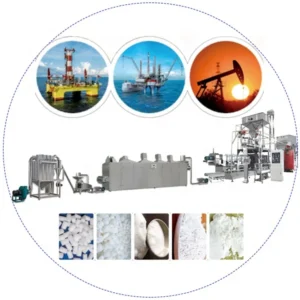
| Modified starch for oil drilling mud | Potato or tapioca starch processed for freeze-thaw stability |
| Starch binders for papermaking | Corn starch modified for film-forming and transparency |
| Construction-grade starch additives | Blended starch formulations processed for gel strength and stability |
What "Rated Capacity" Hides in a Modified Starch Processing Line
Nominal capacity means nothing until the line runs your actual starch formulation.
When a buyer evaluates a modified starch processing line turnkey proposal, the headline throughput figure often comes from a factory test on a reference material — not the buyer’s own corn, tapioca, or potato starch blend. Gelatinisation temperature, shear sensitivity, and moisture absorption differ sharply across starch sources. A line rated at 600 kg/h on potato starch may deliver considerably less on a high-amylose corn variety unless screw speed, barrel heating zones, and die geometry are reconfigured before production begins. [NEED_CITE: starch gelatinisation behaviour varies by botanical source and amylose content]
Throughput Matching Between Extruder, Dryer, and Grinder
A turnkey starch line must treat every station as one system. If the twin-screw extruder pushes 600 kg/h of wet, gelatinized starch into a dryer rated for only 400 kg/h evaporation, moisture stays trapped and downstream grinding turns inconsistent. The modified starch processing line turnkey configuration here sizes the dryer surface area and the grinder throughput to the extruder’s actual output on the buyer’s material, preventing hidden bottlenecks that only appear during sustained production runs.
Utility Planning for Local Conditions in Southeast Asian Facilities
Power availability and heating fuel costs vary widely across starch-producing regions. Dryer heating can be configured to electric, steam, or gas depending on the buyer’s existing boiler infrastructure or local gas supply. Frequency speed controlling on the extruder motor allows operators to adjust screw RPM within the control panel rather than swapping pulleys — a practical advantage when raw material batches shift. [NEED_CITE: industrial voltage and frequency standards by country]
Reading the Specs That Matter for Starch Extrusion
Twin-screw design is the baseline for starch modification because co-rotating screws generate the shear and mixing intensity required to break down native granule structure and achieve uniform gelatinisation. Automatic lubricating and cooling on the extruder barrel extends continuous run time between maintenance stops — important when a plant targets three-shift operation. Stainless steel 304 contact surfaces in the grinder prevent iron contamination that would discolour light starch powders. The bottom butterfly valve discharge keeps product flow steady and avoids dead zones where residual starch could harden between batches. Capacity figures across the MT85 through MT135 range must be validated against the buyer’s specific formulation and moisture targets, since the same screw profile behaves differently on corn starch versus tapioca starch.
The Cost of Skipping a Trial Run on Your Raw Material
I spent years sourcing equipment for food and starch plants before moving to the supplier side, and now I commission turnkey projects across Southeast Asia. The mistake I watched a buyer make — and later helped another avoid — was accepting a workshop trial done on potato starch, then commissioning the line on corn starch at the Thai factory. Gelatinisation temperature was off by nearly fifteen degrees; screw speed and barrel zone settings had to be rebuilt from scratch during what should have been a smooth start-up week. That delay cost the buyer two weeks of lost production and raw material waste before the process stabilised. When a modified starch processing line turnkey project omits a pre-shipment trial on the buyer’s exact material, the entire commissioning schedule absorbs that risk. [NEED_CITE: typical delays and cost impact of post-installation process reconfiguration]
Why Procure This Line Under One Supplier
Line accountability stays with one source — blending, extrusion, drying, grinding, and packing are engineered together rather than stitched from separate vendors with different control systems. Screw configuration and die design are specified to the buyer’s starch type and target modification properties, not copied from a generic build. An in-house testing workshop runs the buyer’s raw material before shipment, so process parameters are documented and transferred at installation rather than discovered on-site. Frequency speed controlling and configurable dryer heating simplify local adaptation without hardware swaps. Installation, commissioning, and operator training are delivered as a single project scope with matched documentation.
Documentation & Verification
- Line layout drawing with throughput calculation matched across every station
- Screw and die configuration record for buyer’s specific starch formulation
- Trial run report on buyer’s raw material conducted before shipment
- Electrical schematic with voltage, frequency, and control language confirmed
- Factory test record and packing photographs before container loading
- Operation and maintenance manual with wear parts list
Installation, Commissioning & Support
- Foundation load assessment based on extruder and dryer footprint and total installed power
- Dedicated electrical circuit sized to real consumption figures for each model variant
- Dryer heating source connection matched to buyer’s confirmed steam, gas, or electric supply
- Screw speed and barrel temperature parameters set from trial run data during commissioning
- Operator training covering frequency speed control interface and automatic lubrication monitoring
- Spare screw elements and die plates identified in wear parts list with replacement intervals
Preparing Your Project Brief
To move a modified starch processing line turnkey project from inquiry to layout proposal, the most useful details are the starch type and source (corn, tapioca, potato), the target modification properties such as viscosity range or freeze-thaw stability, and the intended daily output. Also confirm the local voltage and frequency standard, available heating fuel for the dryer, and the control language preferred by the operating team. If your formulation includes additives or blends, share the ingredient list and ratios early so the screw configuration can account for them.
Frequently Asked Questions
Q: How is line capacity verified against my specific starch raw material?
A: Capacity is validated through a trial run in the in-house testing workshop using the buyer’s actual starch formulation. Screw speed, barrel temperature profile, and die geometry are adjusted during this test, and the resulting throughput is documented in the trial report. This ensures the modified starch processing line turnkey capacity figure reflects your material, not a generic reference starch.
Q: What voltage and frequency details are confirmed before production begins?
A: The buyer’s local voltage, phase configuration, and frequency are confirmed during the specification stage, and the electrical schematic is prepared accordingly. Control panel language is also set before the line ships so operators can read the frequency speed controlling interface in their working language from day one of commissioning.
Q: How do you ensure throughput is matched between the extruder, dryer, and grinder?
A: Each station is sized based on the extruder’s verified output from the trial run. Dryer surface area and residence time are calculated to handle the moisture load, and grinder capacity is matched to the dried output rate. The modified starch processing line turnkey layout documents this throughput chain so no station becomes a bottleneck.
Q: What does on-site installation and commissioning include?
A: Engineers supervise unpacking, mechanical assembly, utility connections, and first production runs on-site. Screw and barrel parameters from the trial run are loaded, then fine-tuned on the buyer’s production-grade material. Operator training covers the frequency speed controlling system, automatic lubrication checks, grinder operation, and daily maintenance routines.
Q: How are spare wear parts supplied and scheduled?
A: A wear parts list covering screw elements, die plates, and grinder screens is included with the line documentation. Recommended replacement intervals are based on the trial run data and the abrasiveness of the buyer’s starch formulation. Spare parts are available for order alongside the initial shipment or separately as production accumulates wear.
Related products
-
Automatic Deep Processing Machine – Food Grade Modified & Pregelatinized Starch Manufacturing Line
¥65.00 Select options This product has multiple variants. The options may be chosen on the product page -
Twin-Screw Extrusion Line for Modified Starch. Producing Pregelatinized Adhesive & Food Grade Powder
¥65.00 Select options This product has multiple variants. The options may be chosen on the product page -
High-Efficiency Customizable Modified Starch Production Line – Automatic Corn Pellet Adhesive Making Equipment
¥65.00 Select options This product has multiple variants. The options may be chosen on the product page -
Pre-gelatinized Starch Production Line – Modified Starch Integrated Puffing Equipment
¥65.00 Select options This product has multiple variants. The options may be chosen on the product page