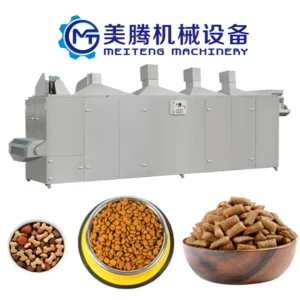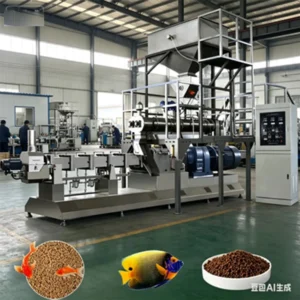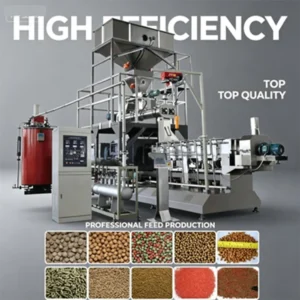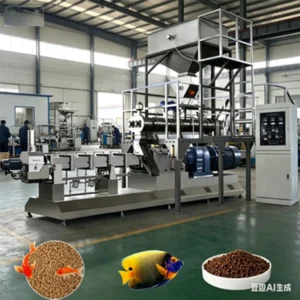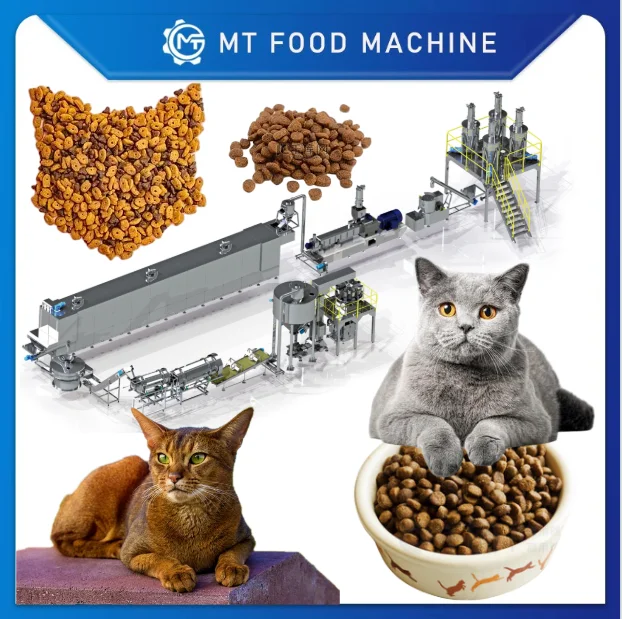


Multi-Species Cat Food Processing Line, pet food making machine with PLC automation, multi-species formulation capability, and full-line integration from batching to packing — engineered for dry kibble, semi-moist treats, and flexible recipe changeover.
- Screw configuration and die design specified to buyer’s raw material for target kibble density
- Every station throughput-matched across mixing, extrusion, drying, coating, and packing
In-house trial runs on customer raw material confirm actual output and product specification before shipment.
Description
Turnkey Line Matching — Every station on this pet food processing line is throughput-balanced under a single supplier scope, from raw material batching through extrusion, drying, coating, and final packing.
Technical Specifications
| Parameter | Value |
|---|---|
| Product Type | Pet Food Extrusion Production Line |
| Output Capacity | 250–300 kg/h (basis not stated in source — confirm raw material formulation, moisture content, and kibble size before quoting) |
| Control System | PLC controlled with recipe management |
| Product Formats | Dry kibble, semi-moist pet food, treats |
| Line Configuration | Multi-species formulation capable |
| Automation Level | Full automation across batching to packing |
| Energy Design | Energy saving configuration |
| Interface | User-friendly HMI with multi-language support |
| Standards | CE certified, ISO certified |
Application Suitability
| Application | Material or Output |
|---|---|
| Commercial dry cat kibble production | High-protein meat meal blends with corn or rice base |
| Multi-life-stage cat food formulations | Variable protein and fat ratios for kitten, adult, and senior recipes |
| Semi-moist pet treat extrusion | Soft dough formulations with humectants and palatants |
| Multi-species plant flexibility | Changeover between cat, dog, and specialty species recipes on shared equipment |
Why "300 kg per Hour" Means Nothing Without the Formulation
A rated capacity figure is only meaningful when tied to the exact raw material blend, moisture content, and kibble geometry you intend to produce.
I learned this the hard way. Two years ago I configured a cat food line for a Middle East client, quoted at 300 kg/h based on standard cereal-heavy formulations. Their actual recipe ran heavy on animal protein — over 40% meat meal — and on-site we could barely hold 200 kg/h. The screw profile and die plate were designed for a completely different material behaviour. We spent two weeks in our testing workshop reconfiguring the screw elements and die geometry before the line finally shipped. When their plant manager watched the first stable run at target output, his only comment was "this should have been done before." That moment changed how I approach every pet food processing line turnkey project [NEED_CITE: effect of raw material protein content on extrusion throughput and screw wear].
Matching Throughput from Batching to Packing
The most common failure in pet food line procurement is treating the extruder as the only station that matters. A twin-screw extruder rated at a given output will choke if the upstream batching system cannot deliver consistent feed rate, or if the downstream dryer cannot remove moisture fast enough to keep pace. On this pet food processing line turnkey configuration, every station is sized against the same throughput calculation — mixer batch cycle, extruder screw speed, dryer belt length and residence time, coating drum volume, and packing head speed. The result is a line where no single station creates a bottleneck that forces the rest to idle.
Screw and Die Configuration Against Your Recipe
Extrusion is not a one-size-fits-all process. The screw element sequence — conveying, kneading, and reverse elements — determines shear intensity and residence time inside the barrel. High-protein cat food formulations behave fundamentally differently from starch-dominant dog kibble: they expand less, require different compression ratios, and demand die geometry that controls density precisely. Before we finalise the screw configuration record, we need your actual formulation sheet. We then run trial batches in our testing workshop on your raw material, measuring expansion ratio, bulk density, and kibble hardness against your market specification [NEED_CITE: twin-screw extrusion screw profile design for high-protein pet food formulations].
Reading the Specifications That Actually Matter
The PLC control system does more than automate start-stop sequences. With recipe management, operators store screw speed, barrel temperature zones, feeder rate, and dryer temperature as named profiles — one for kitten kibble, another for adult maintenance, a third for semi-moist treats. Changeover between formulations becomes a matter of loading the correct recipe rather than manual adjustment from memory. The full automation scope covers volumetric or gravimetric feeders at the batching stage, ensuring that ingredient ratios remain consistent across production runs. Energy saving design in the dryer section typically involves heat recovery from exhaust air, reducing the thermal load on the facility’s boiler or gas supply. Multi-species capability means the line is configured with sufficient cleaning access and quick-release fittings to allow product changeover without extended downtime.
What Happens When Stations Are Mismatched
When an extruder is paired with an undersized dryer, kibble exits the barrel at a moisture level that the dryer cannot bring down within the required residence time. The result is product that either goes out of specification or forces the operator to slow the entire line. Similarly, a coating drum with insufficient volume cannot apply palatant evenly at full extruder output, leading to flavour inconsistency that your customer will notice immediately. These mismatches rarely appear in the quotation stage because each vendor quotes their own equipment in isolation [NEED_CITE: throughput mismatch consequences in multi-vendor food processing lines].
What This Scope Covers That Others Leave Out
The layout and capacity calculation document shows matched throughput figures at every station, not just the extruder nameplate. Screw and die configuration is recorded against your specific formulation — never copied from a generic build. An in-house trial run on your raw material confirms output, expansion, and density before the line leaves our factory. Electrical schematics are prepared with your destination voltage, frequency, and control language confirmed before production begins. CE and ISO certification covers the complete line, not individual machines purchased separately.
Documentation & Verification
- Line layout showing throughput-matched capacity at each station
- Screw and die configuration record tied to your formulation
- Trial run report on your raw material confirming output before shipment
- Electrical schematic with voltage and control language for your market
- Factory test record with photos and parameter logs
- CE declaration of conformity and ISO certificate for the full line
Installation, Commissioning & Support
- Foundation plan based on actual line footprint and dryer weight distribution
- Power supply specification matching PLC and extruder motor voltage and frequency
- Assembly sequence for extruder barrel sections and dryer modular panels
- First-run parameter tuning on your raw material during on-site commissioning
- Operator training on PLC recipe management and changeover procedures
- Wear parts list with screw elements and die plates specific to your configuration
What We Need to Move Forward
To prepare a meaningful line proposal, share your target formulation — including protein source, fat level, and moisture target — along with your intended kibble size range and daily production requirement. Confirm your facility voltage and frequency, preferred PLC language, and available floor space with ceiling height. If you have existing upstream or downstream equipment you plan to integrate, provide those specifications so we can match interfaces.
Frequently Asked Questions
Q: How is the line capacity verified on my specific raw material formulation?
A: We run your actual raw material blend in our in-house testing workshop before the line ships. The trial measures real output rate, expansion ratio, bulk density, and kibble hardness against your product specification. Results are documented in a trial run report that accompanies the shipment, so you know exactly what to expect at commissioning.
Q: How do you ensure throughput matching between extruder, dryer, and coating stations?
A: Every station is sized from a single throughput calculation based on your target output and formulation. The dryer belt length and residence time are calculated against the moisture removal requirement at full extruder output, and the coating drum volume is matched to the palatant application rate your recipe demands.
Q: What is included in the turnkey scope — does it cover batching through packing?
A: Yes. The scope covers raw material batching and mixing, extrusion, drying, coating and flavouring, cooling, and packing. Each station is supplied and configured under one project scope, so throughput matching and interface compatibility are our responsibility, not split across multiple vendors.
Q: Can I run a trial on my raw material before the line ships?
A: Yes. Our testing workshop is equipped to run trial batches on customer-supplied raw material before dispatch. This allows us to confirm screw configuration, die selection, and process parameters on your actual formulation, and adjust if needed before the line is crated for shipment.
Q: What voltage and control language options are confirmed before production?
A: Before production begins, we confirm your facility voltage, frequency, and phase specification, as well as the preferred PLC interface language. These are locked into the electrical schematic and control programming so that the line is ready for connection on arrival without on-site rewiring or software changes.
Related products
-
Premium Pet Food Processing Equipment Dog Cat Feed Making Machine
¥9,500.00 Select options This product has multiple variants. The options may be chosen on the product page -
Durable Stainless Steel Twin Screw Extruder Floating Sinking Aquatic Fish Feed Processing Production Equipment
¥65.00 Select options This product has multiple variants. The options may be chosen on the product page -
MT Brand 450-550kg/h PLC Controlled Multi-Species Pet Food Processing Line
¥40,000.00 Select options This product has multiple variants. The options may be chosen on the product page -
Energy Saving Automatic Twin Screw Extruder Floating Sinking Aquatic Fish Feed Industrial Production Processing Line
¥65.00 Select options This product has multiple variants. The options may be chosen on the product page