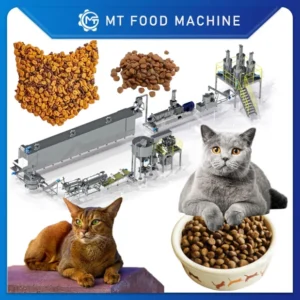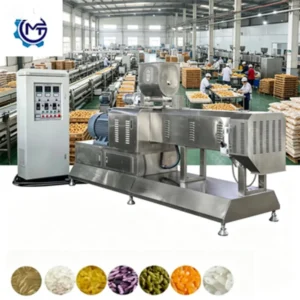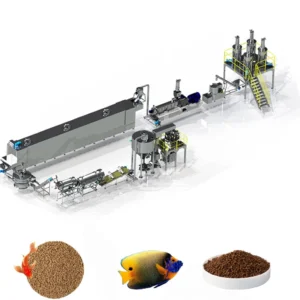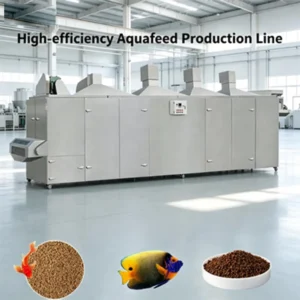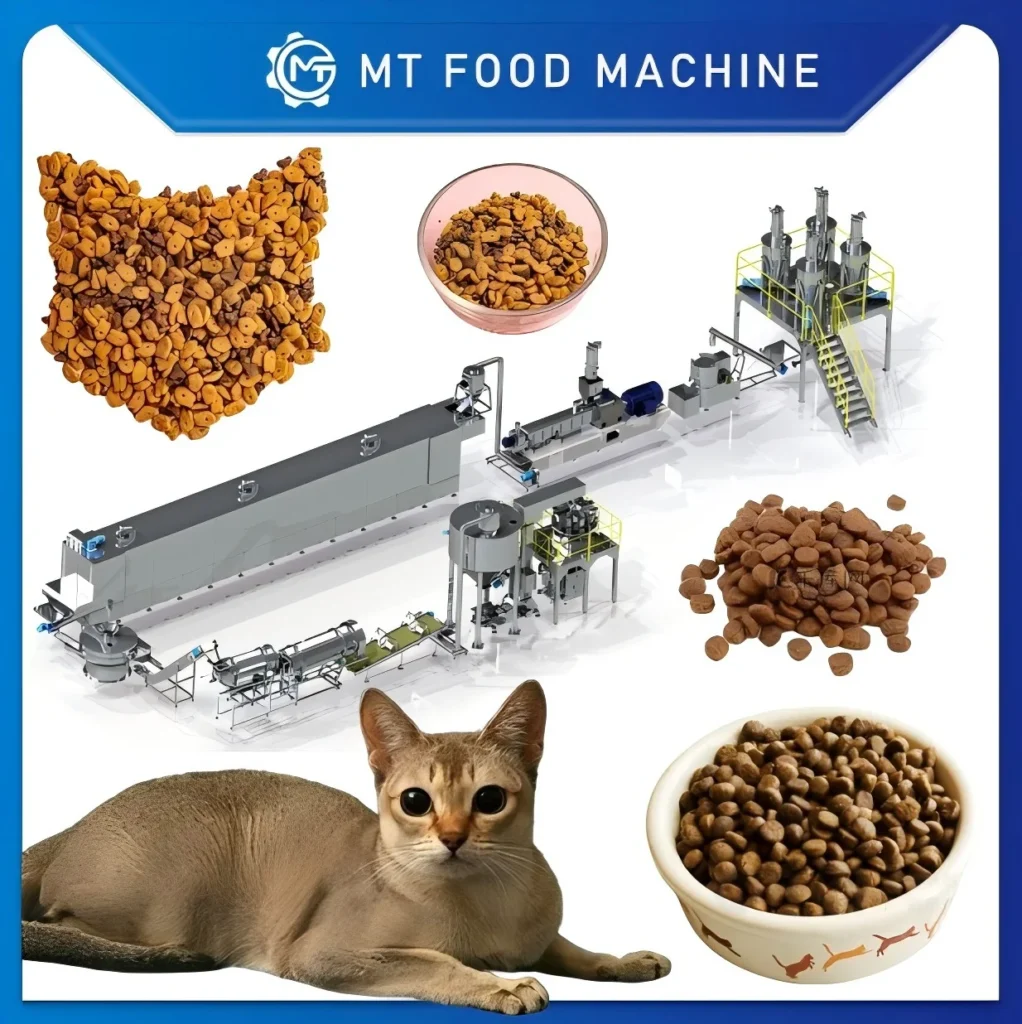


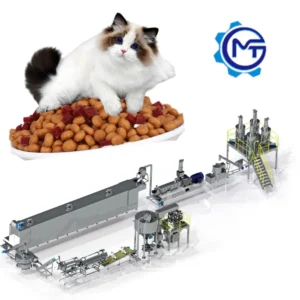
MT-70 Multi-Species Pet Food Extrusion Line, Twin-Screw, PLC Controlled — delivered as a complete turnkey project from batching through extrusion, drying, flavouring, cooling and packing.
- Screw configuration and die design are specified to your raw material formula and target kibble density, controlling expansion and texture across dog, cat and fish feed formats
- Throughput at every station is calculated and matched so the dryer and coating drum never bottleneck the extruder output
- CE and ISO certified manufacturing with in-house trial runs on your actual raw material before shipment, plus full line layout and capacity documentation provided
Description
Throughput-Matched Turnkey Configuration — Every station from batching to packing is engineered under one supplier, so the extruder output is never throttled by an undersized dryer or flavouring drum downstream.
Technical Specifications
| Parameter | Value |
|---|---|
| Model | MT-70 |
| Product Type | Multi-Species Pet Food Extrusion Line |
| Extruder Type | Twin-screw |
| Output Capacity | 200–250 kg/h (basis not stated in source — confirm raw material formula, moisture content and kibble size) |
| Control System | PLC Controlled with MCC integration |
| Line Stations | Batching, extrusion, drying, flavouring/coating, cooling, packing |
| Applications Covered | Dog food, cat food, fish feed (multi-species) |
| Assembly State | Complete production line |
| Standards | CE, ISO |
| Warranty | 1 year |
Application Suitability
| Application | Material or Output |
|---|---|
| Dry kibble production | Corn, poultry meal, bone meal, fresh meat slurry blends for dog and cat markets |
| Aquatic feed production | Floating and sinking pellet formats for catfish, tilapia and shrimp |
| Multi-species feed runs | Single extrusion platform switched between pet and aquatic formulas |
| Fortified pet nutrition | Vitamin and mineral premix incorporation during batching and extrusion |
What a Nominal Capacity Figure Leaves Out in a Pet Food Extrusion Production Line Turnkey
Real throughput only shows up when your actual formula hits the barrel.
I once watched a kibble line stall on its first week because the supplier quoted a capacity based on pure corn grits, while the buyer’s recipe carried a heavy fresh chicken slurry load with bone powder. The extruder could not gelatinise the starch properly at the quoted screw speed, and the kibble density collapsed. We spent two full weeks re-profiling the barrel temperature zones and screw elements before the line held steady output [NEED_CITE: raw material impact on extrusion throughput and kibble density]. A pet food extrusion production line turnkey is only as reliable as the formula it was tested on, which is why pre-shipment trial runs on the buyer’s exact raw material matter more than any brochure number.
Barrel Temperature Profiling Across Recipe Variations
A twin-screw extruder handles recipe changes by adjusting shear and heat across multiple barrel zones. On the MT-70, the PLC-controlled system lets operators set independent temperature targets for each zone, so a high-moisture meat slurry formula receives different thermal treatment than a dry corn-based mix. This zone-level control is what keeps starch gelatinisation consistent when a pet food extrusion production line turnkey switches between dog kibble, cat kibble and aquatic feed formats on the same platform.
Screw Element Configuration and Die Selection for Target Density
The screw configuration determines how long material stays in the barrel and how much mechanical energy it absorbs. For floating fish feed, the elements are arranged to maximise expansion at the die face, while sinking pellets need a higher-compression setup that drives air out before the material exits. Die hole diameter and land length are matched to the target kibble size and density specification. Getting these two parameters wrong means the product either floats when it should sink or crumbles during the drying stage [NEED_CITE: screw configuration effect on extrudate expansion and density].
Reading the Specs That Actually Matter on the Floor
The twin-screw design on the MT-70 gives it a self-wiping action that single-screw extruders lack, which means sticky meat-heavy formulas do not build up on the barrel walls between batches. The PLC control with MCC integration allows repeatable process parameters across shifts, so an operator on the night run can pull up the exact screw speed, barrel temperature and feeder rate that the day shift used. The line stations — batching, extrusion, drying, flavouring, cooling, packing — are specified as a matched set, meaning the dryer capacity is calculated against the extruder output and the coating drum is sized for the same throughput. Voltage and frequency remain configurable for the target installation site, which must be confirmed before electrical panels are wired.
The Hidden Cost of Mismatched Line Stations
When a buyer sources the extruder from one vendor and the dryer from another, the dryer often turns out to be undersized for the actual extruder output. Wet kibble piles up at the dryer infeed, residence time drops, and moisture leaves the dryer above the safe storage threshold. The product then moulds in the bag within weeks, and the buyer traces the problem back to the line design rather than the raw material [NEED_CITE: moisture content and shelf life in dry pet food production]. This kind of bottleneck is avoidable when throughput calculations cover every station in the pet food extrusion production line turnkey from the start.
Why Procurement Through a Single Line Integrator Changes the Outcome
The MT-70 is delivered with every station throughput-matched under one engineering team, so the dryer, flavouring drum and cooler are never the weak link. Screw and die configuration is specified against the buyer’s raw material formula and target kibble density rather than copied from a generic build. The in-house testing workshop allows trial runs on the customer’s actual ingredients before the line ships, catching density and texture problems at the factory instead of on the production floor. Electrical schematics, voltage and control language are confirmed for the installation site during the engineering phase. Installation, commissioning and operator training are scheduled as a continuous sequence so the line reaches stable production without gaps between phases.
Documentation & Verification
- Line layout showing throughput calculation at every station from batching to packing
- Trial run report generated on your raw material formula before shipment
- Screw and die configuration record matched to your target kibble density
- Electrical schematic with voltage and frequency locked to your site supply
- CE declaration of conformity and ISO certificate for the complete line
- Wear parts list with recommended replacement intervals for screws and dies
Installation, Commissioning & Support
- Foundation and floor space planning based on the full MT-70 line footprint
- Dedicated power circuit sizing confirmed against the line’s rated total load
- Sequential station assembly from extruder through dryer to packing end
- First-run parameter setting using the trial run report as the baseline
- Operator training covering PLC interface, screw change and die swap procedures
- Spare screw elements and dies stocked for the first replacement cycle
Before You Send an Inquiry
Share your target product format — kibble size, shape and whether you need floating or sinking aquatic feed — along with the raw material formula you intend to run. Confirm the local voltage, frequency and the control language your operators will need. If you have existing upstream batching equipment or downstream packing machines, list them so the pet food extrusion production line turnkey can be scoped around what is already on your floor.
Frequently Asked Questions
Q: How is the 200–250 kg/h capacity verified, and on what raw material formula?
A: That figure depends entirely on the raw material formula, moisture content and kibble size. We verify it by running your actual ingredients through the MT-70 in our testing workshop before shipment. The trial run report documents the achievable throughput on your specific recipe, so you know what to expect before the line arrives at your facility.
Q: How do you ensure the dryer and flavouring drum are matched to the extruder output?
A: Each station is calculated against the extruder’s verified output on your formula. The dryer residence time and airflow are sized so that kibble exits at the target moisture level, and the flavouring drum diameter and rotation speed are set to coat the full throughput without product backlog or uneven seasoning coverage.
Q: What voltage, frequency and control language options are confirmed before shipping?
A: We confirm the exact voltage, frequency and phase for your facility during the engineering stage, and the PLC interface language is set to match your operators. Electrical schematics are updated to reflect these choices before the panels are wired, so there are no delays at commissioning.
Q: Can I send my raw material for a trial run before committing to the full line order?
A: Yes. Our in-house testing workshop is built for exactly this purpose. You send a representative sample of your formula, and we run it through the MT-70 under production-like conditions. The results — throughput, kibble density, expansion ratio — are documented in a trial report you review before the order proceeds.
Q: How is on-site installation and operator training scheduled for a complete line?
A: Installation follows a phased sequence from extruder placement through dryer, cooler and packing station. Commissioning begins immediately after mechanical assembly, using the trial run parameters as the starting point. Operator training covers daily operation, screw and die changes, PLC navigation and routine maintenance across all stations.
Related products
-
1.0-1.5t/h High Capacity Multi-Species Fish Feed Processing Line to Produce Fish Food
¥45,000.00 Select options This product has multiple variants. The options may be chosen on the product page -
Premium Pet Food Processing Equipment Dog Cat Feed Making Machine
¥9,500.00 Select options This product has multiple variants. The options may be chosen on the product page -
200-250kg/h Capacity PLC Controlled Multi-Species Dog Food Processing Line with MT-70 Extruder
¥35,000.00 Select options This product has multiple variants. The options may be chosen on the product page -
MT70 200-250kg/h Dog Cat Pet Food Processing Line 380V 50HZ Three Phase 45KW
¥35,000.00 Select options This product has multiple variants. The options may be chosen on the product page