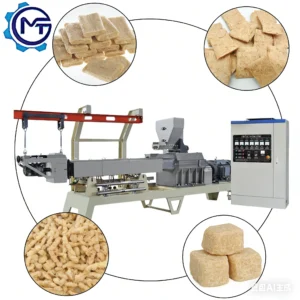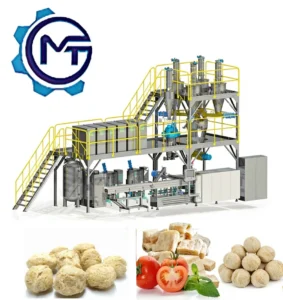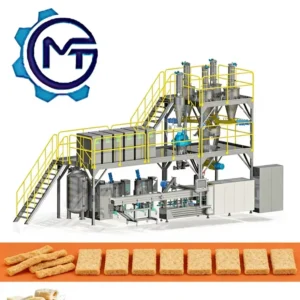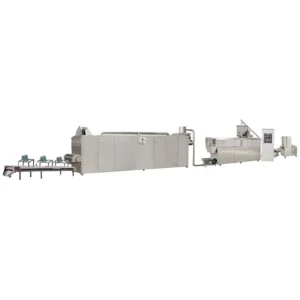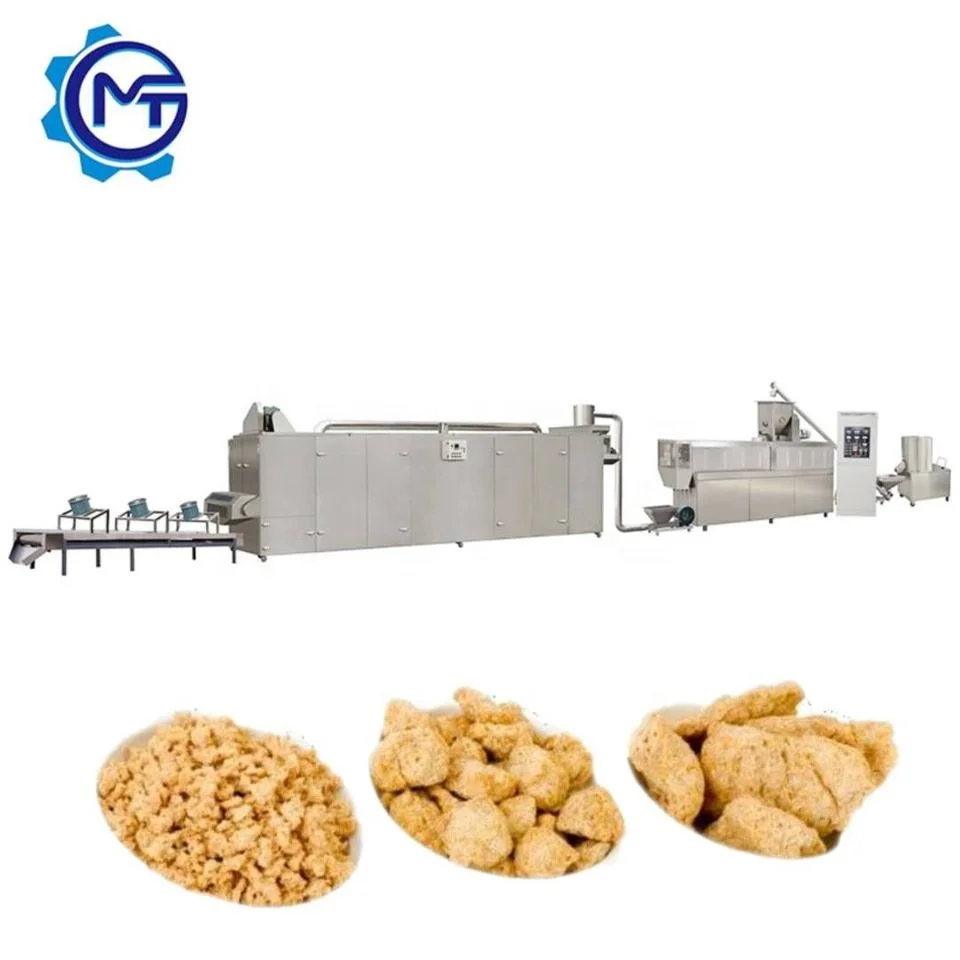


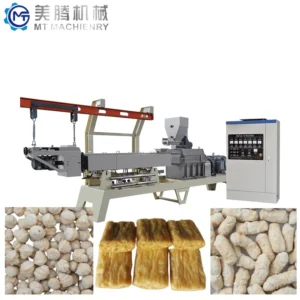
Plant Based Meat Processing Line, Twin-Screw Extrusion, CE Certified — delivers texturized vegetable protein from soybean meal, peanut meal, or pea protein through matched mixing, extrusion, drying, and cooling stations. Screw configuration and die design are specified to your raw material blend, controlling fibre texture and density via barrel temperature and moisture profile. Complete turnkey layout with throughput matched across every station prevents bottlenecks common in assembled lines. In-house trial runs on your formulation before shipment ensure product development starts before installation, supported by full documentation from layout to wear parts list.
Plant Based Meat Processing Line, Twin-Screw Extrusion, CE Certified — delivers texturized vegetable protein from soybean meal, peanut meal, or pea protein through matched mixing, extrusion, drying, and cooling stations. Screw configuration and die design are specified to your raw material blend, controlling fibre texture and density via barrel temperature and moisture profile. Complete turnkey layout with throughput matched across every station prevents bottlenecks common in assembled lines. In-house trial runs on your formulation before shipment ensure product development starts before installation, supported by full documentation from layout to wear parts list.
Description
Turnkey line engineering — every station from the powder mixer through the twin-screw extruder to the cooling conveyor is sized together under one project scope, so throughput matches at every point rather than bottlenecking at the dryer.
Technical Specifications
| Parameter | Value |
|---|---|
| Product Type | Texturized Vegetable Protein (TVP) Production Line |
| Extruder Models Available | MT65, MT70, MT85 (Twin-Screw) |
| MT65 Output Capacity | 150–200 kg/h (basis not stated in source — confirm raw material / moisture content) |
| MT70 Output Capacity | 200–300 kg/h (basis not stated in source — confirm raw material / moisture content) |
| MT85 Output Capacity | 600–800 kg/h (basis not stated in source — confirm raw material / moisture content) |
| MT65 Installed / Real Power | 85 kW / 65 kW |
| MT70 Installed / Real Power | 120 kW / 90 kW |
| MT85 Installed / Real Power | 195 kW / 165 kW |
| Powder Mixer Tank Volume | 150 kg |
| Powder Mixer Rotary Speed | 385 rpm |
| Dryer Belt Effective Length | 3.5 m |
| Dryer Heater Configuration | Far infrared, 3.9 kW × 24 elements |
| Cooling Machine Temperature Range | 0–260 °C (verify against manufacturer catalog) |
| Construction Material | Food-grade stainless steel (all contact surfaces) |
| Control System | Available with PLC or MCC control |
| Certification | CE |
| Warranty | 1 year complete line |
Application Suitability
| Application | Material or Output |
|---|---|
| TVP chunks and granules for meat analogue production | Low-temperature soybean meal, defatted soy flour |
| Plant-based meat base ingredient | Pea protein isolate or concentrate |
| Textured protein for sausage and ham formulation | Peanut meal, soy-pea protein blends |
| High-moisture meat analogue fibre | Soy protein with wheat gluten addition |
| Quick-frozen food and canned food protein ingredient | Custom plant protein blends |
What a "Plant Based Meat Processing Line" Quote Leaves Out
Capacity numbers on a nameplate mean nothing until they are validated against your actual protein blend.
When a buyer receives a proposal for a plant based meat processing line, the extruder output figure is often calculated on a reference material that does not match the buyer’s formulation. Pea protein behaves differently from soy under shear and heat — different gelatinisation onset, different melt viscosity, different fibre alignment at the die face. A line that runs smoothly on the supplier’s test material can take days of trial and error on site before the product meets market expectations [NEED_CITE: twin-screw extrusion behaviour across plant protein sources]. The real cost of a mismatch is not just wasted raw material during commissioning, but delayed market entry while the production team adjusts screw speed, barrel temperature zones, and die geometry without the original equipment designer present.
Screw Configuration Matched to Your Protein Blend
Every plant protein has a distinct denaturation temperature and shear sensitivity. The screw element sequence — conveying sections, kneading blocks, and reverse elements — must be arranged to match the specific blend of soybean meal, pea protein, or peanut meal the buyer will run. A generic screw build copied from a different application will either under-process the material, leaving a powdery crumb with no fibre structure, or over-shear it, destroying the laminar texture that downstream customers expect in ham and sausage applications.
Die Geometry and Fibre Alignment Control
The die plate determines how the melt expands and cools at the moment it exits the barrel. Orifice diameter, land length, and the number of openings together control the cooling rate and the degree of protein fibre alignment. For TVP destined for sliced deli-style meat analogues, a multi-hole die with longer land length produces the dense, directional fibre structure required. For loose granules used in minced meat formulations, a wider orifice with shorter land gives a more open, crumbly texture.
Matching Station Throughput Across the Line
An extruder rated at a given output is only as productive as the station with the lowest real capacity. The powder mixer must deliver blended batches fast enough to keep the extruder fed continuously. The dryer belt must remove moisture at a rate that matches extruder output — if the belt runs too slow, product piles up ahead of it, and moisture levels drift outside specification [NEED_CITE: moisture management in protein extrusion drying stages]. The cooling conveyor must bring the product temperature down to a safe packing threshold before it reaches the bagging station. This plant based meat processing line is configured as a single project so that every station is specified against the same throughput basis.
What the Power Ratings Actually Mean
The installed power and real power figures for each extruder model tell two different stories. Installed power is the sum of every motor and heater on the machine. Real power is what the line draws under normal running conditions, which is the number that determines electrical infrastructure requirements. For the MT70-class extruder, the installed figure sits at 120 kW while real consumption settles around 90 kW — that gap matters when sizing transformers, cable runs, and circuit protection in a new facility. The dryer’s far infrared heater array alone draws substantial power across 24 elements, and that load must be on a dedicated circuit to avoid voltage drop affecting the extruder main motor.
The Hidden Cost of Generic Line Assembly
When a buyer assembles a line from separate vendors — one for the mixer, another for the extruder, a third for the dryer — no single supplier takes responsibility for throughput matching. The extruder vendor quotes against their machine alone. The dryer vendor sizes their belt to a figure the buyer provides. If those numbers do not align in practice, each vendor points to the other’s equipment as the cause of the bottleneck [NEED_CITE: turnkey versus component-sourced food processing line performance]. The result is weeks of finger-pointing during commissioning while production schedules slip and raw material costs accumulate.
Why Buyers Source This Line as a Single Project
The plant based meat processing line is designed under one engineering scope from the initial layout drawing to the final packing station. Screw configuration and die design are specified against the buyer’s raw material sample, not selected from a generic catalogue. An in-house testing workshop runs trial batches on the buyer’s actual protein blend before the line ships, producing a test report that confirms fibre texture and output under real conditions. Food-grade stainless steel construction across all contact and structural surfaces meets the hygiene requirements for food ingredient production. Voltage, frequency, and PLC control language are confirmed for the target market before production begins, eliminating commissioning delays caused by mismatched electrical standards or untranslated operator interfaces.
Documentation & Verification
- Line layout drawing with throughput calculation for each station matched to your protein formulation
- Screw and die configuration record specifying element sequence for your raw material blend
- Trial run report on your protein sample confirming fibre texture and output before shipment
- Electrical schematic with voltage and frequency confirmed for your facility
- Operation and maintenance manual with wear parts list and replacement intervals
- CE declaration of conformity covering the complete line assembly
Installation, Commissioning & Support
- Foundation and floor loading plan accounting for extruder footprint up to 24000 × 3500 mm on the MT85 configuration
- Dedicated circuit planning for dryer infrared array and extruder main motor real power draw
- Mechanical assembly and alignment of all stations on site with throughput verification against trial run data
- First production run supervision with screw speed, barrel temperature, and die pressure adjustment to your material
- Operator training covering PLC interface navigation, recipe storage, and emergency stop procedures
- Wear parts supply schedule for screws, dies, and mixer blades with recommended stock levels
Before You Request a Quotation
To configure this plant based meat processing line accurately, share your primary protein source and any secondary ingredients in the blend, along with the target product format — whether TVP chunks, granules, or high-moisture fibre. Specify your facility voltage, frequency, and preferred PLC control language. Indicate the daily or hourly production target and available floor space so the layout can be drawn to fit your building envelope. If you can ship a raw material sample for a pre-shipment trial run, the line configuration will be locked to your actual formulation before production starts.
Frequently Asked Questions
Q: How is output capacity verified on my specific pea or soy protein formulation?
A: Before the line ships, your raw material sample is run through the extruder in our testing workshop. The trial produces a documented report covering output rate, fibre texture, and product density achieved under controlled conditions. This means capacity figures are tied to your actual formulation, not to a generic reference material that may behave differently in production.
Q: What screw configuration and die design are specified for my raw material?
A: The screw element sequence and die geometry are selected based on your protein blend and target product format. Kneading block placement, reverse element position, and die orifice dimensions are recorded in a configuration document that ships with the line, ensuring the setup is purpose-built rather than copied from a generic application.
Q: Are the dryer and cooling stations sized to the extruder’s real output?
A: Every station on this line is specified against the same throughput basis during the layout phase. The dryer belt length, heater capacity, and cooling conveyor rate are all calculated to match the extruder’s verified output on your material, preventing station-level bottlenecks that would otherwise limit actual production.
Q: What voltage, frequency, and control language options are available?
A: The electrical system and PLC interface are confirmed for your target market before production begins. Voltage and frequency are specified to match your facility supply, and the control language is set to your operator team’s requirement, avoiding commissioning delays caused by unconfirmed electrical standards.
Q: Can I arrange a trial run on my own raw material before the line ships?
A: Yes. You can send a raw material sample to the testing workshop for a pre-shipment trial run. The resulting test report documents fibre structure, density, and throughput data, so product development begins before installation rather than consuming weeks of on-site commissioning time.
Related products
-
High Productivity Single Screw Extruder Machine New Condition Textured Soya Meat & Soy Protein Like Meat Making Machine
Price range: ¥20.00 through ¥30.00 Select options This product has multiple variants. The options may be chosen on the product page -
Vegetarian Beef Substitute Making Machine with Twin Screw Extruder
¥9,500.00 Select options This product has multiple variants. The options may be chosen on the product page -
Twin Screw Extruder for High Moisture Vegetarian Meat
¥9,500.00 Select options This product has multiple variants. The options may be chosen on the product page -
Small Multifunctional Textured Soy Protein Machine – Soy Protein Production Line – Vegetarian Meat Processing Equipment
¥65.00 Select options This product has multiple variants. The options may be chosen on the product page