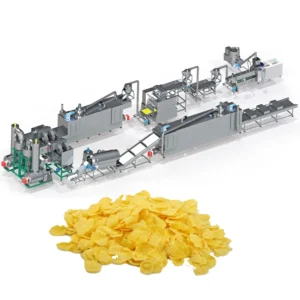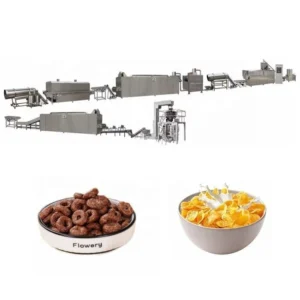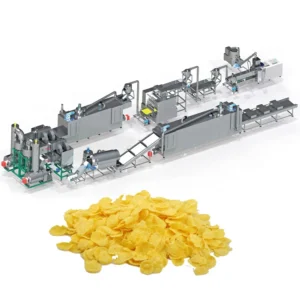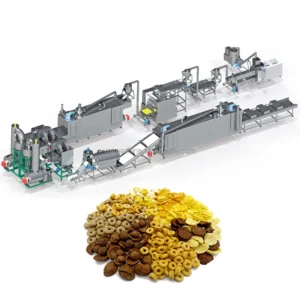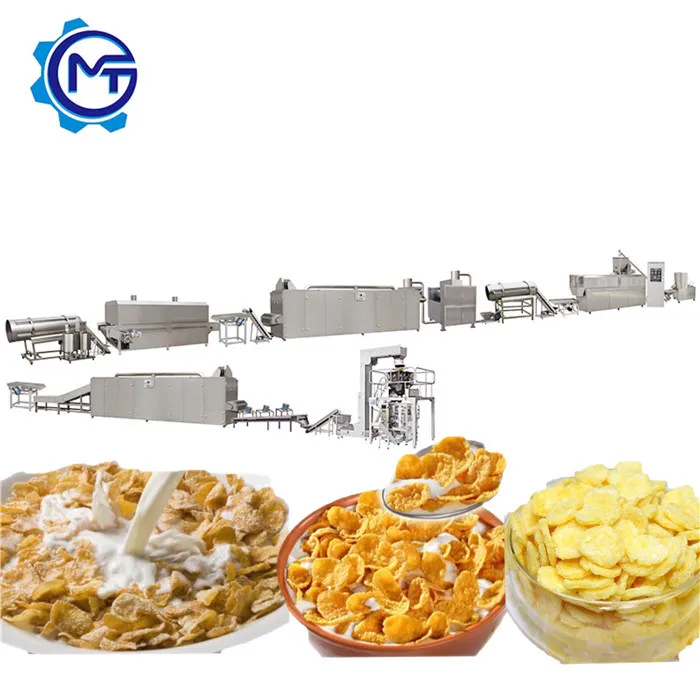

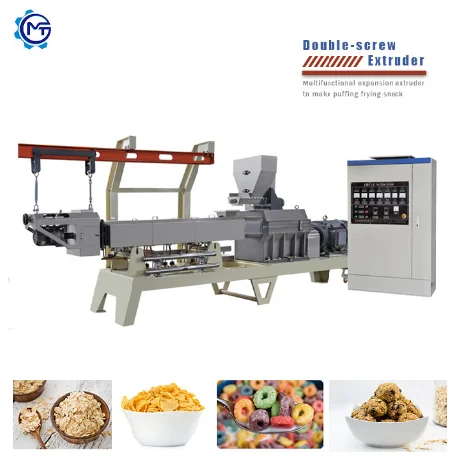

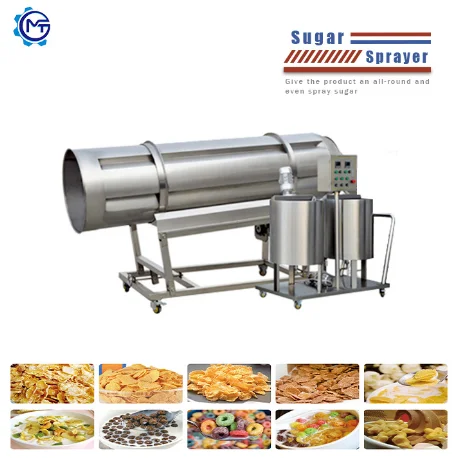
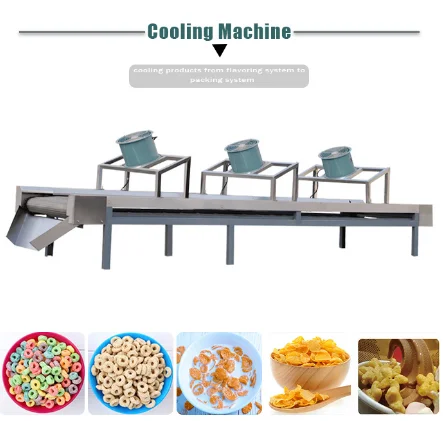
MT75 Corn Flakes Production Line, Twin Screw, PLC & MCC Control — complete turnkey layout from batching through extrusion, flaking, drying, roasting, coating to packing.
- Screw configuration and die design specified to your corn or cereal formulation for target flake density and expansion
- Hydraulic flaking rollers with infrared temperature control and hot air roasting oven ensure uniform blistering and crispness
Every station is throughput-matched under one supplier, eliminating bottlenecks that arise when equipment is assembled from separate vendors. Trial runs on your raw material are conducted in-house before shipment.
Description
Screw Configuration Matched to Your Cereal Formulation — Every extruder build on this line is specified against the buyer’s raw material analysis and target flake density, not assembled from a generic library.
Technical Specifications
| Parameter | Value |
|---|---|
| Product Type | Corn Flakes Production Line |
| Model Options | MT70 / MT85 / MT75 |
| Screw Type | Twin Screw |
| Installed Power | MT70 — 160 kW; MT85 — 190 kW; MT75 — 210 kW |
| Power Consumption | MT70 — 120 kW; MT85 — 140 kW; MT75 — 150 kW |
| Output Capacity | MT70 — 150–200 kg/h (basis to be confirmed); MT85 — 300–400 kg/h (basis to be confirmed); MT75 — 300–500 kg/h (basis to be confirmed) |
| Overall Dimensions | MT70 — 41 × 1.5 × 2.2 m; MT85 — 43 × 1.5 × 3.2 m; MT75 — 45 × 1.5 × 3.5 m |
| Control System | PLC and MCC automated control |
| Heating Source (Dryer) | Gas or Electric |
| Flaking Machine Drive | Double motors for independent roller operation with hydraulic system |
| Flaking Temperature Control | Infrared sensor |
| Roasting Oven | Hot air circulating with dual fans and cyclone dust removal |
| Coating System | Double tumble sugar melting, elevator, coating drum, spraying nozzle |
| Raw Materials | Corn, rice, wheat, oat, barley powder |
| Assembly State | Complete turnkey line |
| Certification | CE, ISO |
Application Suitability
| Application | Material or Output |
|---|---|
| Natural corn flakes production | Corn grits and corn flour base |
| Sugar-coated breakfast cereal | Corn flakes with sugar glaze and syrup coating |
| Multi-grain cereal flakes | Rice, wheat, oat, and barley powder blends |
| Shaped breakfast cereal variants | Ball, tube, ring, star, wheel, and loop formats from cereal dough |
Why "Rated Capacity" Means Nothing Without Your Raw Material
A line only holds its throughput when the extruder screw profile, die geometry, and downstream stations are all calculated against the formulation you actually run.
I once spent two weeks on a job site watching a corn flakes line choke because the supplier had quoted capacity based on standard corn grits, but the buyer was running a high-sugar formulation that made the dough far more viscous. The flaking rollers jammed, the dryer couldn’t keep pace with the slower extrusion, and the whole line sat idle while we swapped roller assemblies. That situation could have been caught with a trial run on the buyer’s actual material before the machines ever left the factory [NEED_CITE: twin-screw extrusion behavior under varying starch and sugar ratios].
When evaluating a corn flakes production line turnkey package, the first question should not be about nominal output figures. It should be whether the supplier has tested your exact recipe in their own workshop and adjusted screw pitch, barrel temperature zones, and die opening to match the expansion and moisture behavior of your dough.
How Barrel Temperature Profiling Shapes Your Flake
A corn flakes production line turnkey system depends on precise thermal management inside the extruder barrel. The twin-screw design allows multiple heating and cooling zones along the barrel length, each set independently. For corn-based formulations, the gelatinization of starch requires a specific temperature ramp — too low and the dough exits under-cooked with poor expansion; too high and surface burning occurs before the die. The screw configuration works together with barrel temperature to control shear rate, which directly influences flake density after pressing.
Matching Flaking Pressure to Dough Moisture Content
The hydraulic flaking station on this line uses double independent motors driving each roller, which allows differential speed adjustment when processing doughs of varying stickiness. The infrared sensor monitors roller surface temperature in real time, feeding back to the control system to maintain consistent flake thickness across extended runs [NEED_CITE: hydraulic roller pressure and flake thickness uniformity in cereal processing]. High-moisture doughs need lighter pressing to avoid squeezing out internal moisture pockets, while drier formulations require heavier compression. Getting this balance wrong at the flaking stage means the roasting oven downstream cannot produce the uniform blistering that consumers expect from a quality corn flake.
Reading the Specs That Actually Matter
The twin-screw extrusion at the heart of this line is chosen because cereal doughs containing whole corn or multi-grain blends require the mixing and self-wiping action that twin screws provide — a single-screw design would leave unmixed zones where starch fails to gelatinize uniformly. Installed power ratings across the MT70, MT85, and MT75 models range from 160 kW to 210 kW, which reflects the torque needed to push dense cereal doughs through the die plate. The hot air roasting oven features dual circulating fans and a cyclone dust removal device, a configuration that maintains even air distribution across the bed of flakes while capturing fines before they scorch on heating elements. PLC and MCC control across the entire line ensures that once a process recipe is established during commissioning, operators can recall exact parameters for repeatable batch production without manual adjustment drift over the run.
The Hidden Cost of Mis-Sized Downstream Equipment
When an extruder and a flaking machine are sourced from different vendors, the downstream dryer and roasting oven often get specified to a nominal capacity that does not account for actual moisture load from the pressing stage. The result is a line that technically runs but accumulates wet product ahead of the oven, forcing the operator to slow the extruder down to match [NEED_CITE: throughput mismatch between extrusion and drying stages in cereal lines]. Over a production shift, this means the line never reaches its quoted output, energy consumption per kilogram of finished cereal climbs, and the roasting profile becomes inconsistent as product density on the belt varies.
Why Sourcing the Full Line from One Builder Matters
Every station on this corn flakes line — mixing, extruding, flaking, drying, roasting, coating, cooling, and packing — is specified under one engineering team, so throughput calculations account for real transfer losses between stages rather than assuming ideal conditions. The screw configuration and die design are selected against the buyer’s specific raw material and target flake characteristics, not pulled from a standard catalog. Before shipment, trial runs using the buyer’s actual corn or multi-grain formulation take place in the in-house testing workshop, revealing issues with dough viscosity or roller adhesion that would otherwise surface only after installation. Pre-sales engineering through on-site installation, commissioning, and operator training are handled by the same supplier, so accountability for line performance rests in one place rather than scattered across multiple equipment vendors.
Documentation & Verification
- Line layout and capacity calculation showing throughput matching from mixer to packer
- Screw and die configuration record built for your specific corn or cereal formulation
- Trial run report on your raw material conducted before dispatch
- Electrical schematic with voltage and frequency confirmed to your local standard
- CE declaration of conformity and ISO certificate for customs and regulatory compliance
Installation, Commissioning & Support
- Foundation planning for line footprints up to 45 m in length with utility trench mapping
- Power supply assessment for installed loads up to 210 kW across extruder and dryer stations
- PLC and MCC control commissioning with operator language set before production begins
- Trial run parameter lock-in using your raw material to establish baseline process recipes
- Wear parts supply program covering screws, dies, and flaking rollers with documented lead times
Before You Request a Quotation
To size a corn flakes production line turnkey project accurately, share your raw material composition including moisture percentage, the specific cereal grain or blend you intend to process, and your target daily or hourly output. Confirm your facility’s available floor length and ceiling height, as well as local voltage and frequency standards. If you are running a coated variant with sugar or flavoring, specify the coating percentage and type so the coating drum and spraying system can be matched to your product.
Frequently Asked Questions
Q: How is the line capacity verified against my specific corn or cereal raw material?
A: The supplier runs your actual raw material through the extruder and downstream stations in an in-house testing workshop before the line ships. Screw pitch, die opening, barrel temperature, and flaking pressure are adjusted during this trial, and the verified throughput is recorded in a trial run report that accompanies your shipment documentation.
Q: What trial runs are conducted on my raw material before shipment?
A: A full process trial is executed using your formulation, covering extrusion, flaking, drying, and roasting. The trial confirms that the dough behaves correctly at each stage — proper gelatinization in the barrel, clean release from the flaking rollers, and uniform blistering in the roasting oven — with results documented in a report shared before dispatch.
Q: How is throughput matched between the extruder, flaking machine, and roasting oven?
A: All stations are engineered under one supplier, so capacity calculations include real transfer losses and moisture loads between stages. The dryer belt speed, roasting oven fan capacity, and cooling conveyor length are each sized to handle the actual output and moisture content exiting the upstream station.
Q: How are voltage, frequency, and control language confirmed before commissioning?
A: Electrical specifications are confirmed during the quotation stage, and the PLC and MCC panels are built to match your facility’s local voltage and frequency standard. Control interface language is set before the line leaves the factory so operators can begin training immediately upon installation.
Q: What spare wear parts are available and how are they supplied after installation?
A: Wear parts including extruder screws, die plates, and flaking rollers are documented in a parts list provided at delivery. Replacements are manufactured to the same configuration as your original tooling and shipped on request, with lead times confirmed at the time of order placement.
Related products
-
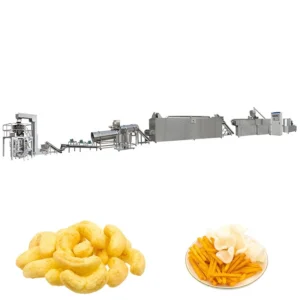
Corn Flake Making Machine Corn Puffs Making Machine Snack Food Production Line
Price range: ¥500.00 through ¥1,200.00 Select options This product has multiple variants. The options may be chosen on the product page -
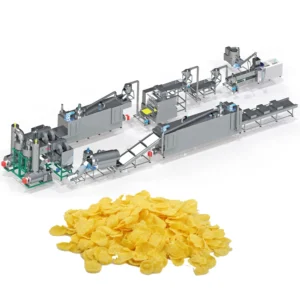
New Automatic Cornflakes Making Machine Oats Snack Food Chips Extruder Processing Line
¥30.00 Select options This product has multiple variants. The options may be chosen on the product page -

200kg/h Breakfast Cereal Extruder Making Machine Hot Sale Corn Flake Production Line
¥30,000.00 Select options This product has multiple variants. The options may be chosen on the product page -

Hot Selling Automatic Corn Flakes Breakfast Cereal Production Line Making Machine
¥20,000.00 Select options This product has multiple variants. The options may be chosen on the product page