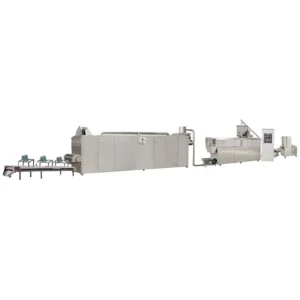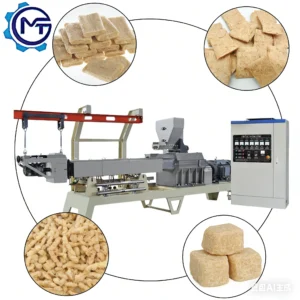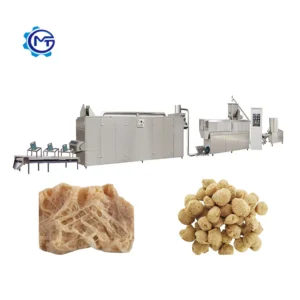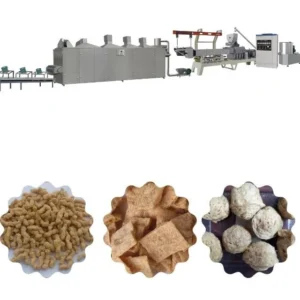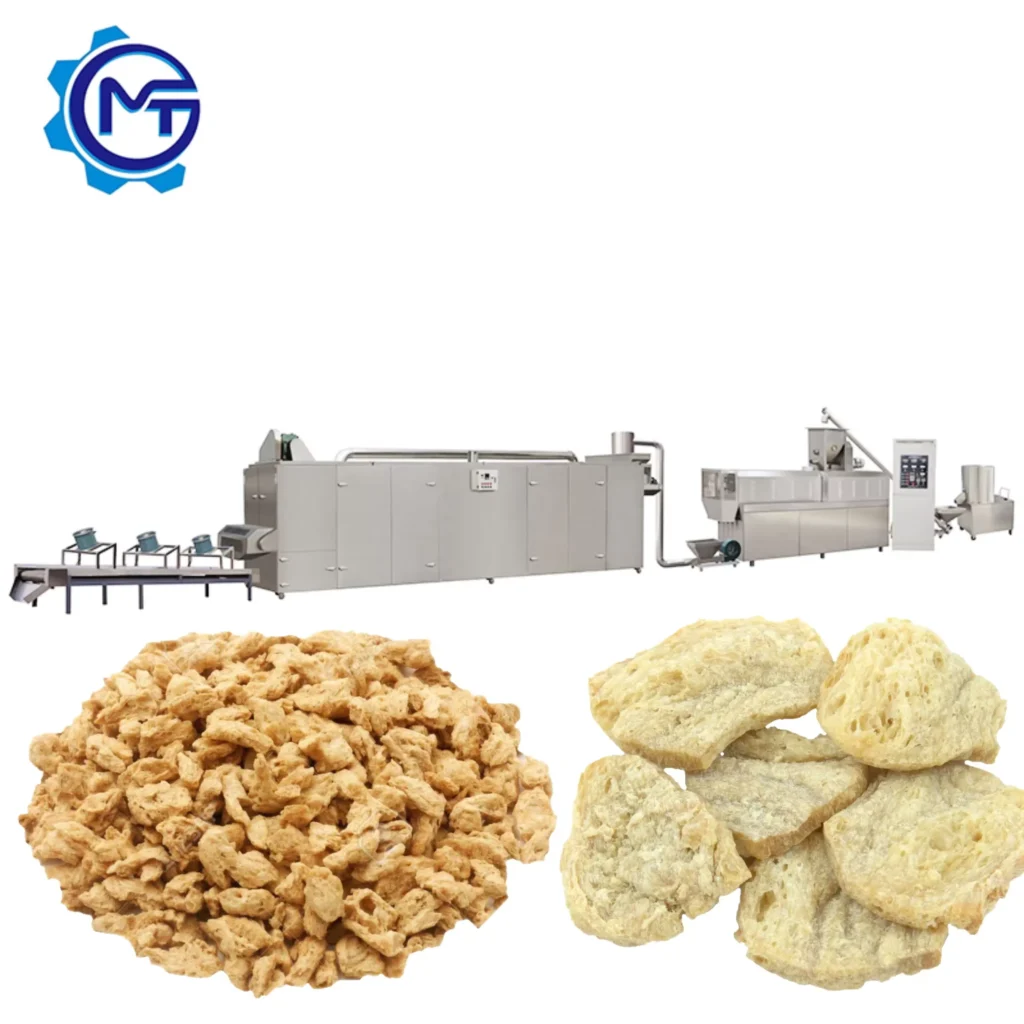


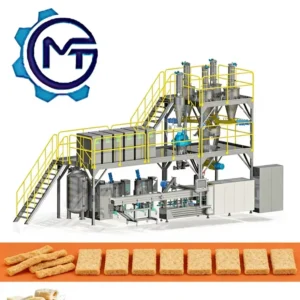
MT65 / MT70 / MT75 / MT85 Twin Screw Extrusion Line, 100-300 kg/h, PLC & MCC Control — engineered for textured soybean protein and plant-based meat processing, from defatted soya flour through extrusion to finished soya chunks.
- Complete turnkey layout: mixer, twin-screw extruder, multi-layer dryer, cooling machine, all throughput-matched under one supplier
- Screw length and die profile specified to your raw material formulation and target fibre density
- Every line ships with a trial run report on your actual raw material, plus full electrical schematics confirming voltage and frequency before commissioning
Description
Integrated Line Accountability — Every station from the vertical mixer through the cooling conveyor is sourced and throughput-matched under single-supplier responsibility, eliminating the finger-pointing that occurs when extruders and dryers arrive from separate vendors.
Technical Specifications
| Parameter | Value |
|---|---|
| Product Type | Textured Soybean Protein Extrusion Line |
| Model Options | MT65 / MT70 / MT75 / MT85 |
| Screw Type | Twin Screw |
| Extruder Screw Length | 1050 mm or 1520 mm (model dependent) |
| Main Motor Power | 22 kW / 30 kW / 45 kW (model dependent) |
| Installed Power | 84 kW (MT65) to 210 kW (MT85) |
| Power Consumption | 59 kW (MT65) to 140 kW (MT85) |
| Output Capacity | 100-150 kg/h (MT65) up to 250-300 kg/h (MT85) (basis not stated in source — confirm raw material and moisture content) |
| Control System | PLC and MCC |
| Mixer Type | Vertical, stainless steel 304 mixing ruler |
| Mixer Power Options | 4 kW / 7.5 kW / 15 kW |
| Mixer Capacity Options | 20-30 kg / 70-80 kg / 170-180 kg |
| Dryer Heating Source | Fuel / Gas / Electricity (selectable) |
| Dryer Drive | Double pitch roller chain drive, round-trip drying |
| Rotary Cutting Motor Power | 0.75 kW |
| Line Stations | Mixer → Screw Conveyor → Twin Screw Extruder → Air Conveyor → Multi-layer Dryer → Cooling Machine |
| Overall Dimensions | Up to 45000 × 1500 × 3500 mm (MT85) |
| Standards | CE, ISO |
Application Suitability
| Application | Material or Output |
|---|---|
| Soya chunks and soya nuggets | Defatted soya flour processed into fibrous meat analogues |
| Textured vegetable protein for frozen food supply | Low temperature soya flakes extruded into structured protein pieces |
| Plant-based meat substitutes for fast food production | Soybean dregs or peanut dregs restructured into layered fibre formations |
| Maigre snack base material | Defatted soya flour at controlled moisture for dense protein snacks |
When Nominal Capacity Ignores Your Raw Material
A textured soybean protein production line turnkey quoted at a clean capacity figure often assumes laboratory-grade defatted soya flour at a fixed moisture percentage. Your actual feedstock behaves differently, and the line must prove it can handle that before it ships.
I ran into this on a soy meat making machine export order where trial runs on standard defatted soya meal looked fine, but the customer’s local raw material had lower protein content and coarser fibre. Once the extruder started on their actual stock, the screw configuration could not build proper texturized structure — the product came out loose and granular instead of layered and fibrous. The entire line required reconfiguration and half a month of on-site adjustment before the output met specification. That is the gap between a quoted number and a working plant. [NEED_CITE: raw material variability in soy protein extrusion]
Throughput Matching Across Every Station
When a textured soybean protein production line turnkey is assembled from separate vendors, the extruder may outpace the dryer, or the mixer may not feed fast enough to keep the extruder running at its rated screw speed. This line is configured so the mixer capacity, screw conveyor feed rate, extruder output, dryer belt load, and cooling conveyor speed are calculated together. The MT85 at higher output, for example, requires the larger mixer option and a dryer with sufficient belt area to handle the increased volume without product overlap or under-drying.
Screw Configuration Specified to Fibre Target
The twin-screw extruder in this line is not supplied with a generic screw build. Screw length options of 1050 mm or 1520 mm, combined with die geometry and barrel temperature profiling, are selected based on the buyer’s raw material and the target fibre structure — whether that is a loose nugget for rehydration or a dense chunk with visible layered grain. The longer screw length allows extended residence time for more complete protein alignment, which matters when the feedstock has variable protein concentration. [NEED_CITE: screw length and residence time in protein texturization]
Reading the Specifications Against Your Production Target
The motor power progression from 22 kW on the MT65 to 45 kW on the larger models determines how much shear energy the screws can apply to the protein mass. Higher shear is necessary for raw materials with coarse fibre that resist alignment. The installed power range from 84 kW to 210 kW across the model tiers accounts for the extruder drive, heating zones, feeding motor, and pump motor combined — buyers should confirm their facility’s available transformer capacity against these figures before selecting a model. The multi-layer dryer offers fuel, gas, or electric heating, which affects both operating cost and the temperature precision available for controlling final moisture content in the finished soya chunks. Control through PLC and MCC allows recipe storage and repeatable batch parameters, which directly affects consistency when the same line runs different formulations across shifts.
The Hidden Cost of Mismatched Line Stations
When the dryer capacity lags behind extruder output, product backs up on the air conveyor and sits at high moisture long enough to develop surface stickiness and uneven internal structure. Operators then slow the extruder to match the dryer, running below the line’s designed throughput and changing the shear profile inside the barrel. This alters the protein texturization that the screw configuration was built to achieve, producing a different product than what was specified. The problem compounds when cooling capacity is also undersized, leaving product at elevated temperature going into packaging where condensation and mould risk increase. [NEED_CITE: moisture management in extruded protein drying]
Why Source the Complete Line Here
The in-house machine testing workshop allows trial runs on the buyer’s actual raw material before shipment, so screw configuration and die design are validated against real feedstock rather than assumed specifications. Every station — mixing, extrusion, drying, cooling — is calculated and supplied as a matched set, preventing the throughput imbalances that arise when equipment is sourced from multiple vendors. The line layout and capacity calculation document shows the throughput match across every station with the buyer’s confirmed raw material and target product specification. Electrical schematics include voltage and frequency confirmation for the target market, preventing commissioning delays caused by incorrect motor wiring or control transformer ratios. A documented wear parts list covers screws, dies, and dryer chain components so that the first replacement cycle does not halt production while parts are sourced.
Documentation & Verification
- Line layout and capacity calculation with throughput matched across all stations for your raw material
- Screw and die configuration record specified to your protein content and target fibre structure
- Trial run report on your actual defatted soya flour conducted in the testing workshop before dispatch
- Electrical schematic with voltage and frequency confirmed for your facility
- CE declaration of conformity and ISO certificate included with shipping documentation
- Operation and maintenance manual with wear parts list for ongoing production support
Installation, Commissioning & Support
- Foundation and floor space planning based on line dimensions up to 45000 × 1500 × 3500 mm
- Power supply requirements confirmed for installed loads ranging from 84 kW to 210 kW
- Phased assembly sequence for mixer, extruder, dryer, and cooling machine with utility connection schedule
- On-site screw configuration fine-tuning against actual raw material behaviour during commissioning
- Operator training covering PLC recipe management and MCC safety interlocks
- Wear parts stocking guidance for screws, dies, and dryer chain components
What to Include with Your Inquiry
Provide your raw material specification including protein content, particle size, and typical moisture range so the screw configuration and dryer parameters can be matched from the start. Confirm your local voltage and frequency, the control language your operators require, and the target product format — whether soya nuggets, soya chunks, or a specific fibre density for meat analogue applications. If you have existing upstream or downstream equipment that this line must integrate with, include those connection points and throughput figures.
Frequently Asked Questions
Q: How is line throughput verified across all stations before shipment?
A: Each station — mixer, extruder, dryer, cooler — is calculated against the others using your confirmed raw material and moisture assumptions. A trial run is conducted in the testing workshop on your actual feedstock, and a report documents the achieved output, product structure, and moisture content at each stage. This confirms the textured soybean protein production line turnkey performs as a matched system.
Q: What does the installation and commissioning schedule look like on site?
A: Installation follows a phased sequence from mixer placement through extruder alignment to dryer and cooling machine connection. Commissioning includes screw configuration adjustment against your actual raw material, PLC parameter setting, and operator training on recipe management. The full process typically spans several days depending on facility readiness and utility connections.
Q: How is screw configuration matched to my specific raw material formulation?
A: The screw element arrangement and die geometry are selected based on your protein content, fibre coarseness, and target product texture. Trial runs on your actual defatted soya flour or soya flakes are conducted before shipment, and the configuration record documents the build that achieved the required fibre structure and density.
Q: What utility details must be confirmed before production begins?
A: Voltage, frequency, and available transformer capacity must match the line’s installed power requirement. The dryer heating source — fuel, gas, or electricity — should be selected based on your facility’s available energy supply. Control language and PLC interface requirements should also be specified during the configuration stage.
Q: How are spare wear parts supplied after commissioning?
A: A documented wear parts list covers screws, dies, and dryer chain components specific to your line configuration. These parts are manufactured to the same specifications as the originals, ensuring replacement components maintain the screw configuration and product quality established during the trial run and commissioning process.
Related products
-
Twin Screw Extruder for High Moisture Vegetarian Meat
¥9,500.00 Select options This product has multiple variants. The options may be chosen on the product page -
New Pea and Soybean Protein Production Line Equipment with Mechanical Extruder Food Grade Stainless Steel High Productivity
¥65.00 Select options This product has multiple variants. The options may be chosen on the product page -
Soybean Protein Making Machine Automatic Soy Chunk Production Line
¥30.00 Select options This product has multiple variants. The options may be chosen on the product page -
High Capacity Soy Protein Vegetarian Meat Processing Line
¥9,500.00 Select options This product has multiple variants. The options may be chosen on the product page