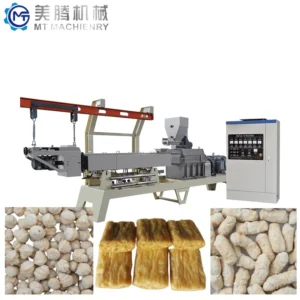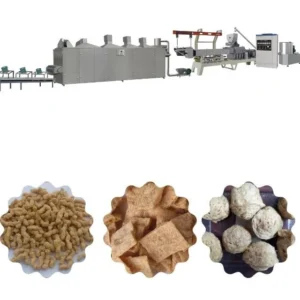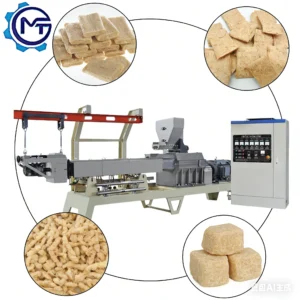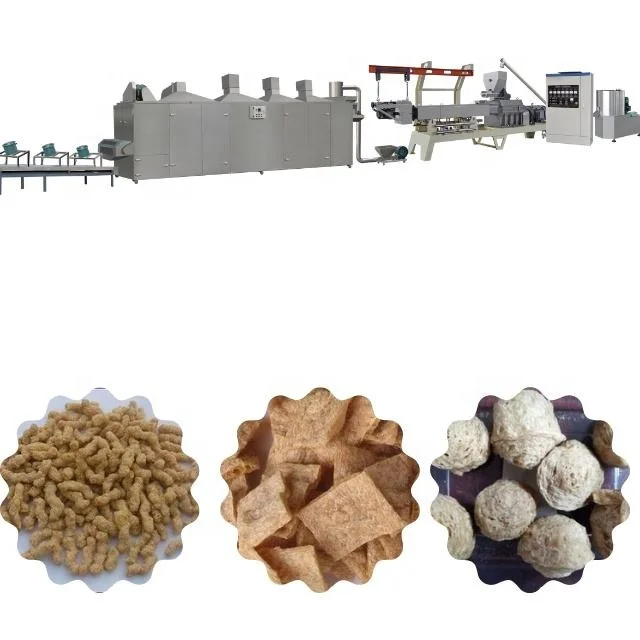
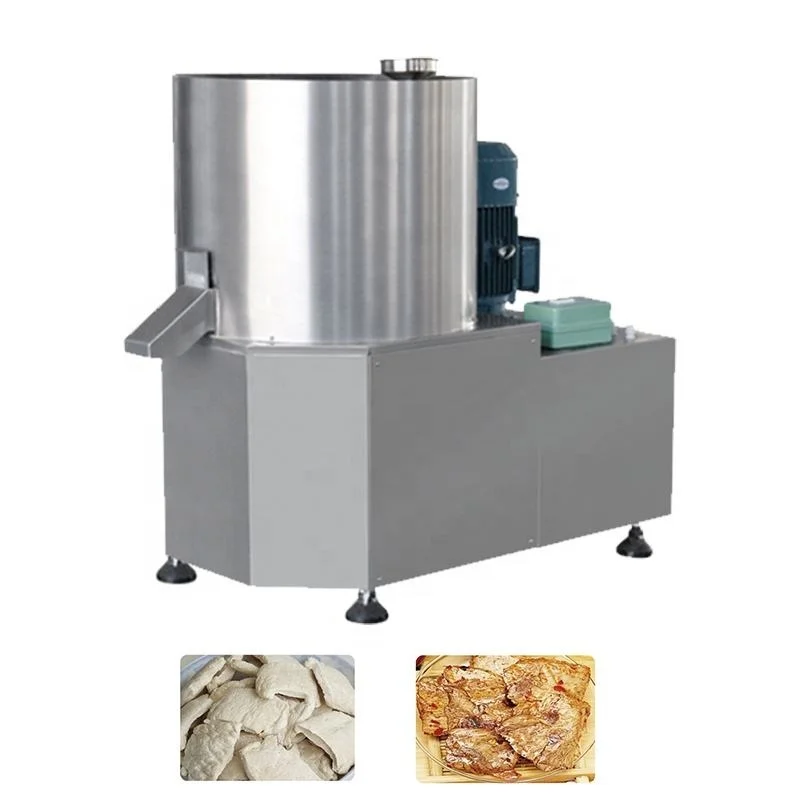
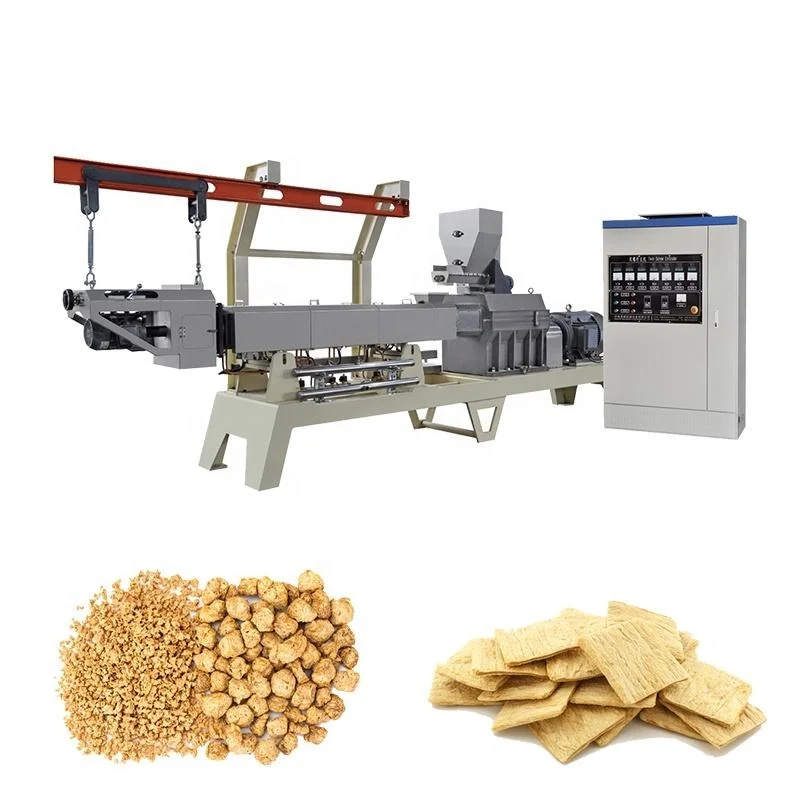
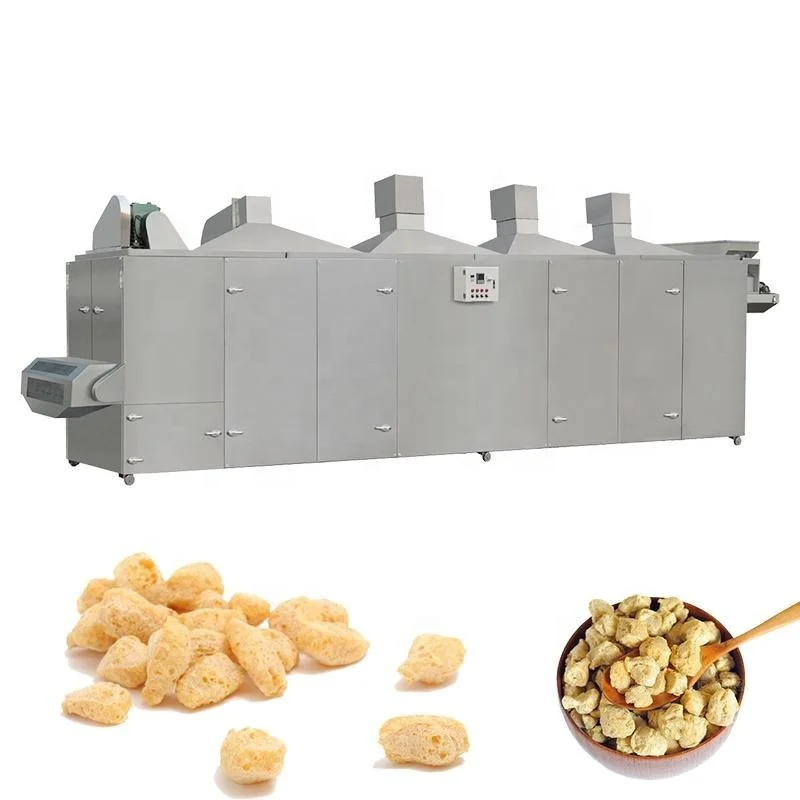
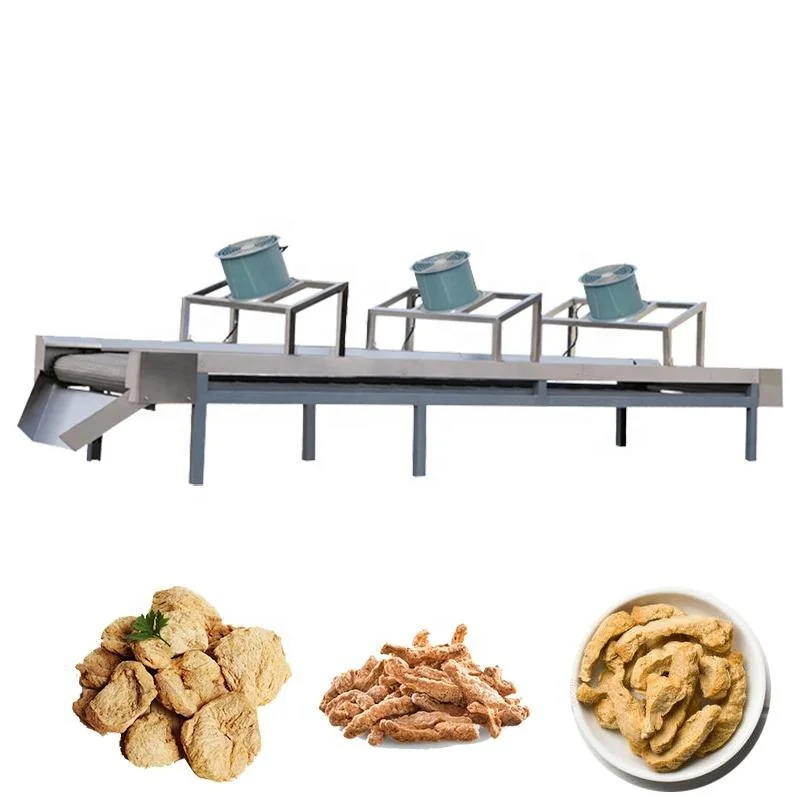
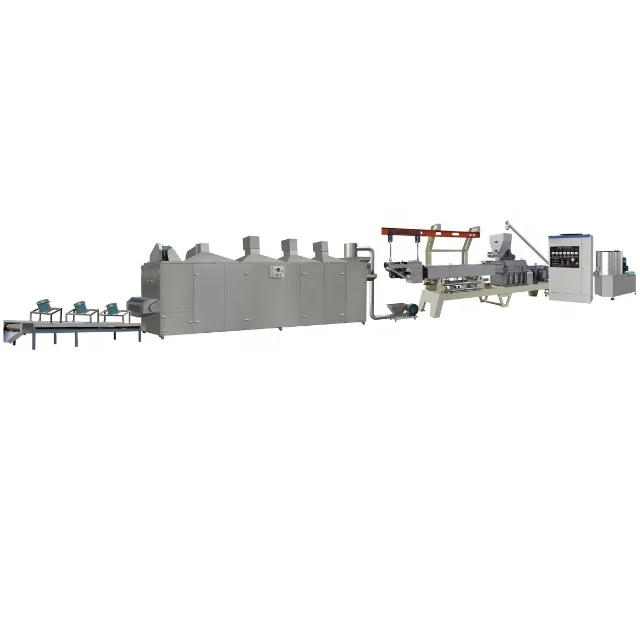
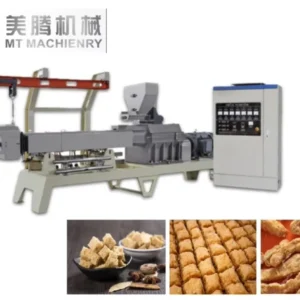
MT65 Textured Vegetable Protein Production Line, Twin-Screw, 85 kW Installed Power — complete turnkey system from raw material preparation through mixing, extrusion, drying, cooling, and packing.
Designed as one integrated project where throughput is balanced across every station, eliminating bottlenecks between the twin-screw extruder and downstream drying or cooling capacity. Screw configuration and die design are specified to your soybean meal or peanut meal formulation to achieve the target fibre texture and density.
- Models MT65 / MT70 / MT85 covering multiple capacity tiers
- Stainless steel construction throughout food-contact zones
- CE and ISO certified with in-house trial runs on your raw material before shipment
Delivered with line layout, capacity calculation, electrical schematic, and screw configuration record — all confirmed to your voltage, frequency, and control language before production begins.
Description
Throughput Balanced Across Every Station — A complete textured vegetable protein production line turnkey engineered so mixer, extruder, dryer, and cooler run at matched capacity on your actual soy or peanut meal formulation.
Technical Specifications
| Parameter | Value |
|---|---|
| Product Type | Textured Vegetable Protein Production Line |
| Extruder Models Available | MT65 / MT70 / MT85 |
| Screw Type | Twin-screw |
| Installed Power | MT65 — 85 kW; MT70 — 120 kW; MT85 — 195 kW |
| Real Power Consumption | MT65 — 65 kW; MT70 — 90 kW; MT85 — 165 kW |
| Output Capacity | MT65 — 150-200 kg/h; MT70 — 200-300 kg/h; MT85 — 600-800 kg/h (basis not stated in source — confirm raw material, moisture, and formulation) |
| Overall Dimensions (L×W×H) | MT65 — 18000×1300×2300 mm; MT70 — 20000×1500×2400 mm; MT85 — 24000×3500×4300 mm |
| Powder Mixer | 300-600 kg/h, 385 rpm, 10 min/batch, 150 kg tank volume, 4 kW |
| High-Temperature Roaster | 300-400 kg/h, 3.5 m effective belt length, far infrared + gas heating |
| Cooling Machine | 0–260 °C range, 200–300 kg/h capacity |
| Line Sequence | Raw material prep → mixing → conveying → extrusion → conveying → drying → cooling → packing |
| Contact Material | Stainless steel (food-grade) |
| Control System | PLC / MCC status to confirm per project |
| Voltage & Frequency | Configurable per target market (to confirm before production) |
| Standards | CE, ISO |
| Warranty | 1 year complete, lifetime maintenance service |
Application Suitability
| Application | Material or Output |
|---|---|
| Textured soy protein for meat alternatives | Low-temperature soybean meal, defatted soy flour |
| Plant-based meat ingredient supply | Peanut meal, soy protein concentrate blends |
| TVP for ham and sausage manufacturing | Fibrous soy chunks and shreds from meal formulations |
| Textured protein for canned and quick-frozen foods | High-moisture extruded soy pieces and granules |
| Ingredient production for fast food chains | Dry and semi-moist TVP granules matching target rehydration profile |
Why "Rated Capacity" Rarely Tells the Whole Story on a TVP Line
A textured vegetable protein production line turnkey only holds its rated throughput when every station — not just the extruder — is sized to the buyer’s actual raw material and moisture profile.
On a recent installation in West Africa, the client’s soybean meal had a protein content noticeably lower than the standard reference sample. The fibre structure collapsed coming out of the die, and the extruder could not sustain its nameplate output because the downstream dryer was suddenly overwhelmed by a wetter, denser product. Four days of screw and die reconfiguration on site brought the line back to stable production, but those were four days the client spent paying idle operators. That textured vegetable protein production line turnkey experience reinforced a simple rule: capacity figures mean very little until they are proven on your specific formulation. [NEED_CITE: protein content variation in commercial soybean meal batches]
Matching Every Station to Prevent Bottlenecks
The extruder is the heart of any textured vegetable protein production line turnkey, but it is only one link in the chain. If the powder mixer batches at half the rate the extruder consumes, the entire line starves. If the dryer belt is too short for the moisture load exiting the die, product piles up and fibre texture degrades. Each station in this line — mixer, conveyor, twin-screw extruder, high-temperature roaster, cooling machine — is specified together so throughput aligns from raw material in to packed product out.
Utility Planning Before the Floor Plan
A complete line drawing means little if the workshop cannot supply the electrical load or if the gas feed to the roaster falls short. The MT85 configuration alone draws up to 165 kW in real consumption, and the roaster adds gas demand on top of that. Utility planning starts during the proposal stage: voltage and frequency are confirmed for the destination market, dedicated circuits are mapped to each station, and gas line sizing is calculated against the roaster’s consumption rate. This prevents the costly rewiring and re-piping that delays commissioning on poorly planned installations. [NEED_CITE: industrial voltage and frequency standards by export market]
Reading the Specification Sheet Beyond the Headline Numbers
Screw type matters because twin-screw extrusion generates the shear and residence time necessary to align soy protein molecules into a fibrous, meat-like structure — something a single-screw configuration struggles to achieve on low-temperature meal. Installed versus real power tells you what the line actually draws under load; the MT70, for example, is rated at 120 kW installed but consumes around 90 kW in operation, which affects your transformer sizing and running cost calculation. The high-temperature roaster uses far infrared elements combined with gas heating to drive moisture down evenly across the belt, preserving the fibre integrity formed in the extruder barrel rather than case-hardening the surface. Overall dimensions determine workshop layout: the MT85 line stretches 24 metres long and needs a ceiling clearance exceeding 4.3 metres, which rules out low-roof facilities without structural modification.
The Hidden Cost of Specifying Stations in Isolation
When the extruder is ordered from one vendor and the dryer from another, nobody takes responsibility for the gap between them. A cooler rated below the extruder’s real output forces the line to run at reduced speed, turning a nominal 200 kg/h system into a 140 kg/h bottleneck. Mismatched conveying capacity causes material surges that jam the die. These are not theoretical risks — they are the most common reasons a textured vegetable protein production line turnkey fails to meet its nameplate capacity in the first month of operation. [NEED_CITE: common causes of throughput shortfall in multi-vendor food processing lines]
Why Procurement Through a Single Turnkey Supplier Changes the Outcome
Throughput matching across every station is only possible when one supplier engineers the entire sequence, rather than bolting together equipment from separate vendors. Screw configuration and die design are selected against your specific soybean or peanut meal formulation, not copied from a generic build. The in-house testing workshop runs your actual raw material before the line ships, so fibre structure and moisture targets are validated in advance rather than discovered on site. Voltage, frequency, and control language are confirmed during the proposal stage, eliminating the commissioning delays that happen when electrical standards are assumed rather than verified. CE and ISO certification covers the complete line, providing the documentation customs and local inspectors require without gaps between individual machine certificates.
Documentation & Verification
- Line layout and capacity calculation showing throughput match for your soy meal formulation
- Screw and die configuration record tailored to your target fibre texture
- Trial run report on your raw material from the in-house testing workshop
- Electrical schematic with voltage, frequency, and control language confirmed for your market
- CE declaration of conformity and ISO certificate covering the complete line
- Wear parts list with part numbers for screws, dies, and belt sections
Installation, Commissioning & Support
- Foundation and floor space planned around the selected model’s overall dimensions, up to 24 metres for MT85
- Dedicated electrical circuits sized to real power draw, up to 165 kW for MT85 extruder station
- Equipment shipped in modular sections for workshop door and ceiling clearance
- Screw and die parameters fine-tuned on site against your production-formulation raw material
- Operator training covering extruder barrel temperature zones, roaster belt speed, and cooler settings
- First-order spare wear parts included: screws, dies, and conveyor belt segments
Preparing Your Inquiry
To receive a line configuration that reflects your actual production environment, share your raw material type and protein content, target daily output, workshop dimensions including ceiling height, and local voltage and frequency. Specify the control language your operators need and whether existing upstream or downstream equipment must be integrated. If a trial run on your material is required before shipment, send a representative sample along with your target product specification.
Frequently Asked Questions
Q: How is line throughput verified against my raw material before shipment?
A: Your soybean or peanut meal sample runs through the twin-screw extruder in our in-house testing workshop. We adjust screw configuration, barrel temperatures, and die selection until the fibre structure and moisture content meet your specification, then document the results in a trial run report included with your shipment.
Q: How do you match dryer and cooler capacity to the extruder?
A: Every station is calculated together during the proposal stage. The high-temperature roaster belt length and heating capacity are sized to the moisture load exiting the extruder, and the cooling machine is rated to handle the full output rate, preventing downstream bottlenecks that reduce actual line throughput.
Q: What does the installation and commissioning schedule look like?
A: The line arrives in modular sections sized to your workshop access. Our engineers handle placement, electrical connection verification, and first-run parameter tuning on your raw material. Operator training covers extruder controls, roaster settings, and daily maintenance, typically completed within the commissioning window before handover.
Q: Which electrical and control options are confirmed before production?
A: Voltage, frequency, and control language are specified during the proposal stage based on your local grid standards and operator requirements. The electrical schematic is included in your documentation package so your facility team can prepare circuits before the equipment arrives.
Q: What spare wear parts come with the line?
A: The initial spare parts package includes screws, dies, and conveyor belt sections identified in the wear parts list. Replacement lead times are documented so you can plan reorder points before the first scheduled changeover.
Related products
-
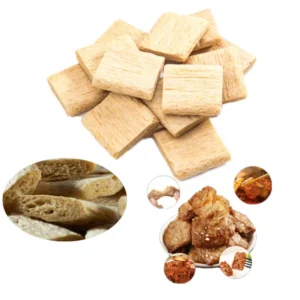
High-yield Soybean Protein Automated Production Line Single Screw Extruder for TVP
Price range: ¥20.00 through ¥30.00 Select options This product has multiple variants. The options may be chosen on the product page -
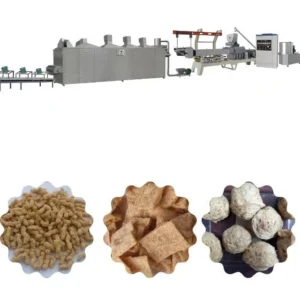
Vegetable Meat Making Machine Textured Soybean Protein Maker
¥30.00 Select options This product has multiple variants. The options may be chosen on the product page -
New High Efficiency Protein Production Line Plant Protein Equipment for Artificial Vegetarian Meat Processing Food Grade
¥65.00 Select options This product has multiple variants. The options may be chosen on the product page -
Twin Screw Extruder for High Moisture Vegetarian Meat
¥9,500.00 Select options This product has multiple variants. The options may be chosen on the product page