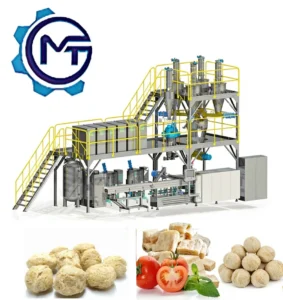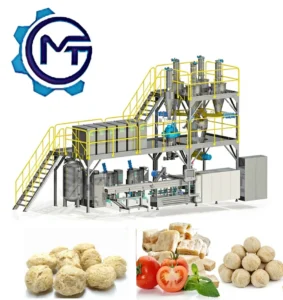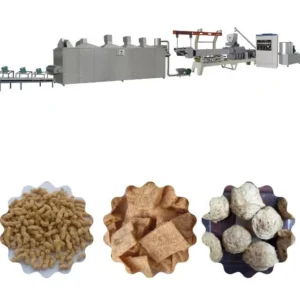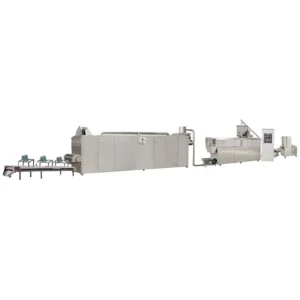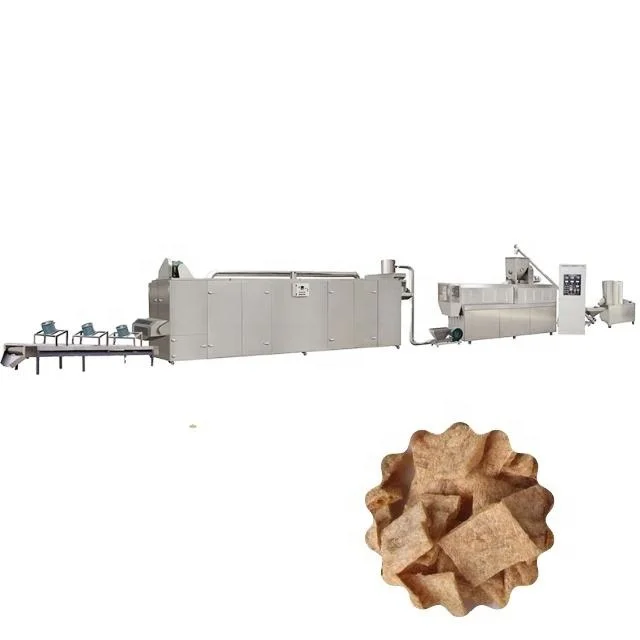


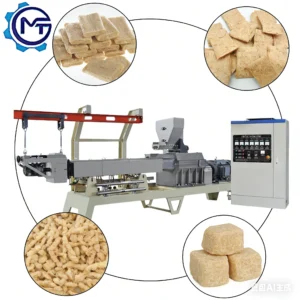
MT65 Textured Soybean Protein Production Line, Twin-Screw Extruder, 85 kW Installed Power — a complete turnkey system from raw material mixing through extrusion, drying, cooling, and packing for plant-based meat applications.
- Screw configuration and die design matched to your soybean meal formulation and target fiber structure, ensuring consistent texture and density across TSP/TVP output
- Line capacity verified through in-house trial runs on your specific raw material before shipment, eliminating throughput bottlenecks between stations
Description
Turnkey throughput matching — every station from batching through cooling is sized to the same output target, so no single unit bottlenecks the textured soybean protein production line turnkey.
Technical Specifications
| Parameter | Value |
|---|---|
| Model | MT65 |
| Product Type | Textured Soybean Protein Production Line |
| Screw Type | Twin-screw |
| Installed Power | 85 kW |
| Actual Power Consumption | 65 kW |
| Output Capacity | 150–200 kg/h (basis not stated in source — confirm raw material formulation / moisture content) |
| Overall Dimensions (Line) | 18000 × 1300 × 2300 mm |
| Mixer Tank Volume | 150 kg |
| Mixer Rotary Speed | 385 rpm |
| Mixer Power | 4 kW |
| Mixer Output | 300–600 kg/h (basis not stated in source — confirm batch composition / mixing time) |
| High-temperature Roaster Belt Length | 3.5 m effective |
| Roaster Heating Elements | 24 × 3.9 kW far infrared |
| Roaster Gas Consumption | 6.8 m³/h (basis not stated in source — confirm fuel type / heating value) |
| Cooling Machine Capacity | 200–300 kg/h (basis not stated in source — confirm inlet temperature / ambient conditions) |
| Construction Material | Stainless steel (food-grade contact surfaces) |
| Certification | CE |
| Warranty | 1 year |
Application Suitability
| Application | Material or Output |
|---|---|
| Textured soybean protein for sausages and canned foods | Low-temperature soybean meal |
| Peanut meal-based meat analogues | Defatted peanut protein |
| Vegetarian ham and quick-frozen fillings | Soy isolate and gluten blends |
| Fast food patty and nugget binders | Textured vegetable protein granules |
Why Nominal Capacity Often Fails on Your Actual Protein Blend
A textured soybean protein production line turnkey rated at a fixed output on generic soy grits will rarely hold that same throughput when you switch to a high-protein isolate formulation.
I watched a buyer in Southeast Asia commit to a line based on a brochure figure, only to discover on-site that their soybean isolate — higher in protein content than the supplier’s test material — produced a dense, poorly fibrous output. The screw profile and moisture window that worked in the factory trial did not transfer. The commissioning team spent over a week adjusting barrel temperatures and die clearance before the fiber structure met the buyer’s specification [NEED_CITE: material-dependent extrusion behavior in high-protein formulations]. That kind of delay is avoidable when the raw material is tested before the line ships.
Barrel Segments and Screw Elements Shape the Fiber Matrix
The twin-screw configuration allows the screw profile to be rearranged as the formulation changes. Kneading blocks, reverse-flight segments, and conveying elements are selected in sequence to control shear intensity and residence time inside the barrel. For low-temperature soybean meal, a moderate shear profile preserves protein solubility while still achieving the gelatinization needed for fiber formation. When the raw material shifts toward a higher protein concentrate, the screw arrangement must increase mechanical energy input to open the protein structure. This flexibility is why the textured soybean protein production line turnkey relies on twin-screw architecture rather than a fixed-geometry single screw.
Die Geometry Controls Density and Rehydration Speed
The die plate determines how the extrudate expands as it exits the barrel. A larger die orifice with fewer holes yields a denser, slower-rehydrating chunk suited for canned and stewed applications, while a multi-hole die with smaller orifices produces a lighter, faster-absorbing granule for instant soup mixes and fast food patties. Selecting the wrong die means the end user either waits too long for rehydration or ends up with a mushy texture that falls apart during cooking [NEED_CITE: die land length and expansion ratio in protein extrusion]. The die must be specified to the buyer’s target product format, not carried over from a previous build.
Matching Dryer and Cooler Capacity to Extruder Output
The roaster on this line uses 24 far infrared elements across a 3.5-meter belt to reduce moisture after extrusion. If the belt loading density exceeds what the heating zone can handle, residual moisture remains inside the protein pieces, leading to microbial spoilage during storage. The cooling machine downstream must then bring the product temperature down to ambient range before packing. When any of these three stations — extruder, roaster, cooler — is undersized relative to the others, the entire line slows to the pace of the bottleneck. Capacity calculations must therefore account for the moisture reduction target at the roaster and the inlet temperature at the cooler, not just the extruder’s raw output [NEED_CITE: moisture balance in sequential drying and cooling stages].
The Cost of Skipping Pre-shipment Material Trials
Buyers who accept a generic screw and die setup often discover texture problems only after installation. Reworking the screw profile on-site means ordering replacement elements, waiting for international shipping, and losing production days. In some cases the die must be replaced entirely if the orifice pattern cannot produce the required fiber density. These delays compound when the buyer has already committed to downstream packaging contracts and retail listing dates. A pre-shipment trial run on the buyer’s actual formulation removes this variable before the line leaves the factory.
Why Source This Line From One Supplier
The line is configured from raw material preparation through packing under a single supply contract, eliminating the finger-pointing that occurs when a mixer from one vendor feeds an extruder from another. The in-house testing workshop runs the buyer’s raw material before shipment, generating a documented trial report that accompanies the machine. Food-grade stainless steel is used on every product-contact surface, meeting the hygiene requirements of food safety audits. Screw and die configurations are recorded per project, so reorders and wear-part replacements match the original setup without guesswork. CE certification covers the complete line, simplifying import clearance in markets that require conformity documentation.
Documentation & Verification
- Line layout drawing showing station-by-station throughput calculation for your protein formulation
- Screw element sequence and die orifice record matched to your target fiber density
- Factory trial run report conducted on your raw material before dispatch
- Electrical schematic with voltage and frequency confirmed against your facility supply
- Operation manual covering start-up, shutdown, and screw cleaning procedures
- Wear parts list with part numbers for screws, dies, and barrel liners
Installation, Commissioning & Support
- Foundation plan based on the 18000 × 1300 × 2300 mm line footprint and load-bearing requirements
- Dedicated 85 kW power circuit with voltage and frequency verified before wiring
- Twin-screw barrel alignment check and die seating verification during first start-up
- Roaster gas line and far infrared element commissioning with temperature profiling
- Operator training on screw configuration changes when switching between soy and peanut meal
- Wear part inventory review covering screws, die plates, and mixer blades for first-year operation
Before You Request a Quote
Send your raw material specification — protein content, moisture level, and particle size — along with the target product format and expected daily output. Provide your facility’s voltage and frequency so the motor and control panel can be built to match. If you have existing upstream or downstream equipment that must interface with this line, share the connection dimensions and throughput rates so the layout accounts for them.
Frequently Asked Questions
Q: How is line capacity verified on my specific soybean meal or peanut meal formulation?
A: We request a sample of your raw material and run it through our in-house testing workshop before shipment. The trial records throughput, fiber structure, and moisture at each station, producing a report that confirms whether the rated capacity holds on your exact formulation.
Q: What screw configuration and die design is specified for my target fiber structure?
A: The screw element sequence and die orifice pattern are selected based on your protein content, desired chunk size, and rehydration requirement. A configuration record is generated for your project and retained for future wear-part reorders.
Q: Is the dryer and cooler capacity matched to the extruder output?
A: The roaster belt length, heating element count, and cooling machine capacity are all calculated against the extruder’s output on your specific material. This prevents any single station from becoming a bottleneck during continuous production.
Q: Can I send my raw material for a trial run before the line ships?
A: Yes. The testing workshop runs your formulation through the twin-screw extruder and supporting stations. You receive a trial run report documenting output rate, product texture, and recommended operating parameters before the equipment is packed.
Q: What documentation is provided for voltage confirmation and operator training?
A: You receive an electrical schematic with voltage and frequency noted, an operation manual covering start-up and screw-change procedures, and on-site training during commissioning so your operators can run the line independently.
Related products
-
Automatic TVP Vegetarian Meat Manufacturing Plant
¥9,500.00 Select options This product has multiple variants. The options may be chosen on the product page -
High Capacity Soy Protein Vegetarian Meat Processing Line
¥9,500.00 Select options This product has multiple variants. The options may be chosen on the product page -
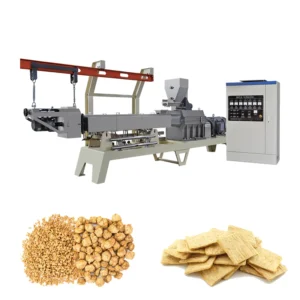
New Condition Soybean Protein Machine for Soy Chunks Production Textured Vegetable Protein Production Line
¥30.00 Select options This product has multiple variants. The options may be chosen on the product page -
Twin Screw Extruder for Textured Vegetable Protein (TVP)
¥9,500.00 Select options This product has multiple variants. The options may be chosen on the product page