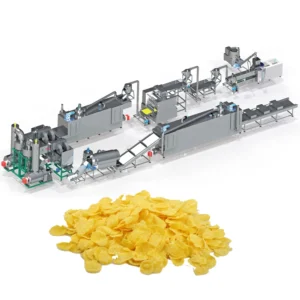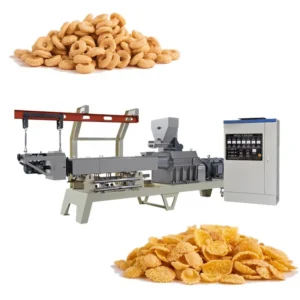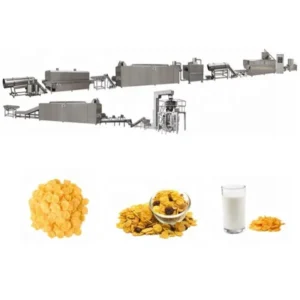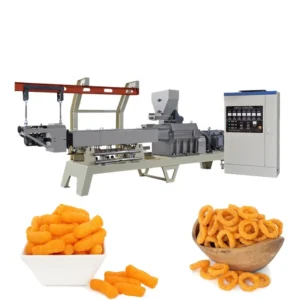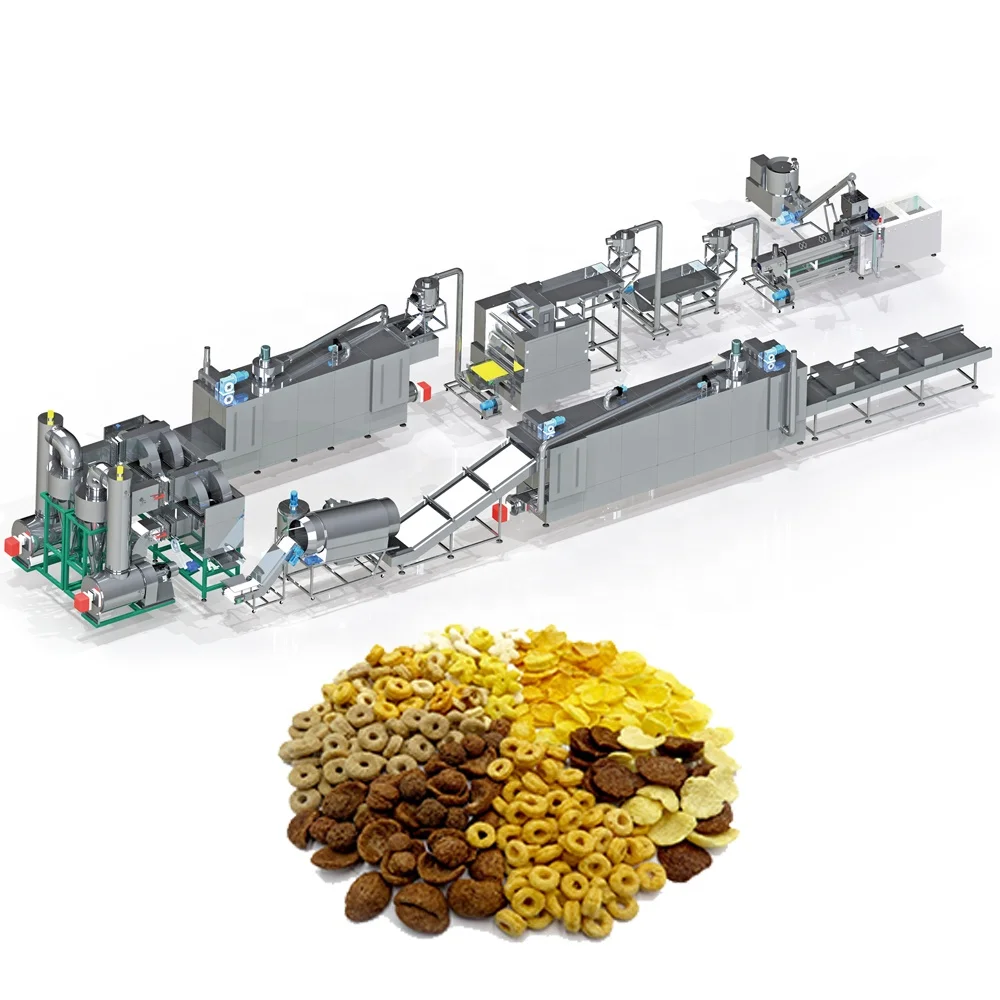




MT70 / MT85 / MT75 Corn Flakes Production Line, Twin-Screw Extrusion, PLC & MCC Control — engineered as one integrated turnkey project from batching through packing.
- Every station is throughput-matched so extruder output aligns with flaking, roasting and coating capacity, eliminating line bottlenecks
- Screw configuration and die design are specified to your raw material recipe and target flake density, not copied from generic builds
Trial runs on your actual raw material are completed in our testing workshop before shipment, with a full capacity calculation and layout document included.
Description
Whole-Line Throughput Matching — every station from mixing to packing is calculated against your actual recipe so no single machine chokes the rest of the corn flakes production line turnkey project.
Technical Specifications
| Parameter | Value |
|---|---|
| Product Type | Corn Flakes Production Line (Twin-Screw Extrusion) |
| Models Available | MT70, MT85, MT75 |
| Screw Type | Twin-Screw |
| Installed Power | MT70: 160 kW · MT85: 190 kW · MT75: 210 kW |
| Power Consumption | MT70: 120 kW · MT85: 140 kW · MT75: 150 kW |
| Output Capacity | MT70: 150–200 kg/h (basis to be confirmed) · MT85: 300–400 kg/h (basis to be confirmed) · MT75: 300–500 kg/h (basis to be confirmed) |
| Overall Dimensions (L×W×H) | MT70: 41 × 1.5 × 2.2 m · MT85: 43 × 1.5 × 3.2 m · MT75: 45 × 1.5 × 3.5 m |
| Control System | PLC for flaking machinery; MCC and PLC available for full line |
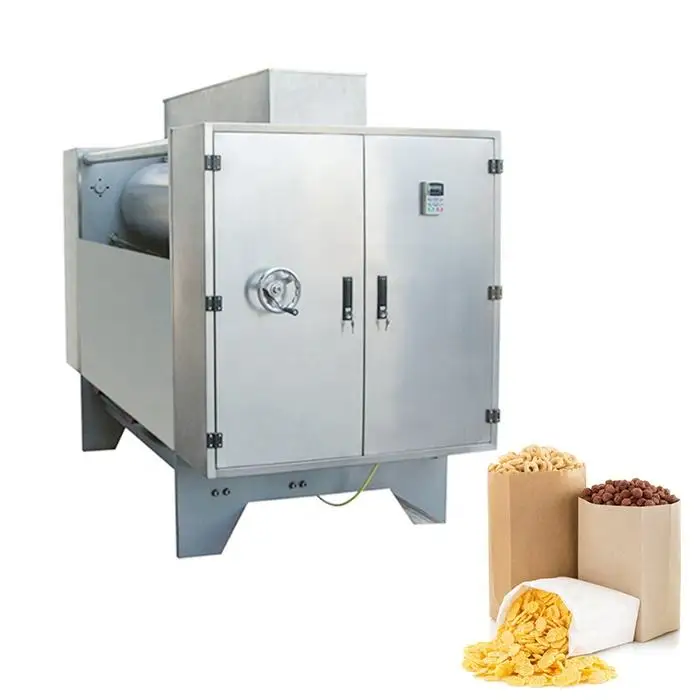
| Flaking Machinery | Hydraulic double rollers, separate motor drives, infrared temperature sensor |
| Dryer Heating Source | Gas or Electric (configurable) |
| Roasting Oven | Hot air with dual circulating fans, conciliation burner, cyclone dust removal |
| Coating System | Double tumble sugar melting, elevator, coating drum, spraying nozzle |
| Basic Raw Materials | Corn, rice, wheat, oat, barley powder |
| Final Products | Natural corn flakes, sugar-coated flakes, shaped cereals (ball, tube, ring, star, etc.) |
| Certification | CE, ISO |
Application Suitability
| Application | Material or Output |
|---|---|
| Natural corn flakes for breakfast cereal market | Corn grits or corn flour, flaked and roasted without coating |
| Sugar-coated corn flakes | Corn base with sugar or honey spray and tumble coating |
| Multi-grain breakfast cereals | Blends of rice, wheat, oat, and barley powder extruded and flaked |
| Shaped cereal snacks | Corn or rice dough formed into rings, stars, wheels, fruit loops |
| Fortified breakfast cereal lines | Vitamin- or mineral-enriched grain blends requiring precise moisture control |
Why Your Corn Flakes Line Capacity Means Nothing Without a Raw Material Baseline
A capacity figure is only honest when the recipe and moisture content behind it are written down.
I spent years on assembly floors before moving into technical sales for complete extrusion projects, and the most expensive mistake I watched a customer make involved a line rated for a nominal throughput on standard corn grits. When the mill swapped to a high-fat local variety after installation, the flaking rollers slipped, the dryer could not keep up, and two weeks of production vanished. The corn flakes production line turnkey proposal had looked perfect on paper. Nobody had confirmed the fat content, the particle size, or the conditioning moisture. [NEED_CITE: raw material variability and extrusion throughput correlation]
Matching Every Station to Your Actual Recipe
A corn flakes production line turnkey project is not just an extruder bolted to a dryer. The mixing station must batch at a rate the twin-screw extruder can digest. The flaking machinery, with its hydraulic double rollers and separate motor drives, has to compress cooked grits at a speed the downstream dryer accepts without pile-up. If any single stage is oversized or undersized, the whole line stutters. We calculate throughput station by station using your recipe data before the layout is finalized.
The Flaking Gap That Decides Your Product
Flake thickness controls crispness, bowl life, and how well sugar coating adheres later. The hydraulic roller system on this line holds gap tolerance under continuous load, and the infrared sensor monitors roller surface temperature so the dough sheet does not stick or tear mid-run. When you are switching between a thin natural flake and a thicker base for sugar coating, the roller adjustment must be repeatable across batches. [NEED_CITE: flake thickness tolerance and consumer crispness preference studies]
Reading the Specs That Matter for Grain Extrusion
The twin-screw extruder on MT70, MT85, and MT75 models features automatic lubrication and cooling, which keeps barrel temperatures stable during long shifts — critical when corn starch gelatinisation must happen within a narrow thermal window. Screw configuration and die geometry are specified to your grain blend and target pellet shape, not pulled from a generic library. The roasting oven uses two separate circulating fans and a cyclone dust removal device, giving you even surface blistering without scorching edges. Dryer heating is configurable between gas and electric, so you match the utility profile of your plant rather than rewriting the facility later. Power consumption ranges from 120 kW on the MT70 up to 150 kW on the MT75, which tells you the electrical infrastructure each model demands before you sign anything.
What Happens When Stations Are Sized Independently
I have walked into plants where the extruder ran at full capacity but the roasting oven could only handle a fraction of the output, forcing operators to dump hot extrudate into bins and let it cool unevenly before it could move forward. The sugar coating drum ended up with half-dried flakes that clumped instead of coating evenly. In another case, the voltage at the installation site did not match the extruder motor rating, and commissioning stalled until a transformer was sourced locally. [NEED_CITE: industrial motor voltage mismatch and commissioning delay incidents] These are failures of project planning, not machine quality.
Why Procurement Through One Contractor Changes the Outcome
The corn flakes production line turnkey scope here covers layout, utility planning, phased installation, and commissioning schedule under a single responsible party. Throughput is matched across every station — extruder, flaking, drying, roasting, coating, cooling, packing — so no bottleneck hides between vendor boundaries. Screw and die configuration is recorded against your specific raw material and target product, not copied from a previous customer’s build. An in-house testing workshop runs your actual recipe before the line ships, which means you see real output data, not brochure numbers. CE and ISO documentation is prepared alongside electrical schematics with confirmed voltage and frequency for your site. Operator training is scheduled as part of commissioning, not offered as an optional extra after the containers arrive.
Documentation & Verification
- Line layout drawing with throughput calculation for every station on your corn flakes recipe
- Trial run report on your grain blend performed in the testing workshop before dispatch
- Screw and die configuration record tied to your target flake thickness and density
- Electrical schematic with voltage, frequency, and control language confirmed for your facility
- CE declaration of conformity and ISO certificate matched to the shipped equipment list
- Packing photographs and customs documentation for every crate in the shipment
Installation, Commissioning & Support
- Floor plan review for the 41–45 m line footprint including utility connection points
- Dedicated power circuit sized to the selected model’s 160–210 kW installed power requirement
- Flaking machinery hydraulic system filled, pressurized, and calibrated on site
- First-run parameter log capturing barrel temperature, roller gap, and dryer setpoints
- Operator training covering PLC interface, screw change procedure, and daily lubrication checks
- Wear parts list with reorder intervals for screws, dies, and roller surfaces
What We Need From You to Start Engineering
Send us your grain blend composition, target flake dimensions, and whether you plan to run natural, sugar-coated, or both formats. Confirm the voltage, frequency, and preferred control language at your installation site. If you can share your workshop length, ceiling height, and any existing upstream or downstream equipment, we will shape the layout around those constraints. Samples of your raw material sent to our testing workshop allow us to validate throughput before the quotation stage.
Frequently Asked Questions
Q: How do you verify the line output capacity against my specific raw material recipe?
A: We run your grain blend in our in-house testing workshop using the same twin-screw extruder model that will ship. The trial captures actual throughput, flake density, and moisture profile. You receive a written report with these numbers before the purchase order is finalized, so there is no guesswork after installation.
Q: How is throughput balanced between the extruder, flaking, roasting, and coating stations?
A: Each station is calculated against your target hourly output and recipe moisture curve. The flaking roller speed, dryer belt length, roasting oven residence time, and coating drum cycle are all matched so material flows continuously without buffer bins or manual intervention between stages.
Q: What does the turnkey project scope actually include?
A: It covers line layout, utility planning for power and gas, a phased installation schedule, commissioning with your raw material on site, operator training, and a wear parts supply plan. One contractor is responsible from factory test through to stable production output.
Q: How do you confirm voltage, frequency, and control language before production starts?
A: We collect your site electrical specifications during the quotation stage and record them on the electrical schematic. Motors, heaters, and PLC interfaces are built to those values. The control panel language is set before the factory test so operators can read alarms and setpoints in their preferred language on day one.
Q: Can I send my raw material for testing before the line ships?
A: Yes. Ship a representative sample of your corn, rice, or multi-grain blend to our workshop. We extrude, flake, and roast it on the matched equipment and send you the output samples along with the trial run report. This step is built into the project timeline before the production order is released.
Related products
-
Complete Corn Flakes Production Line Breakfast Cereal Processing Machine Core Motor Component Cornflakes Processing Equipment
¥19,000.00 Select options This product has multiple variants. The options may be chosen on the product page -

MT Cocoa Flour Puffed Breakfast Cereal Production Line-High Large Capacity Multi-Fuel (Steam/Gas/Electric) New Shandong Origin
¥8,000.00 Select options This product has multiple variants. The options may be chosen on the product page -
Automatic Instant Breakfast Cereals Snack Food Making Machine
¥10,000.00 Select options This product has multiple variants. The options may be chosen on the product page -
Corn Flakes Breakfast Cereal Production Line Making Machine Automatic
¥8,000.00 Select options This product has multiple variants. The options may be chosen on the product page