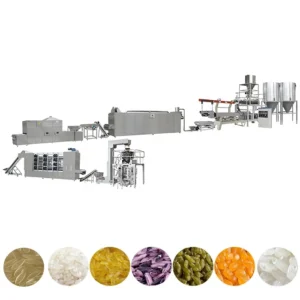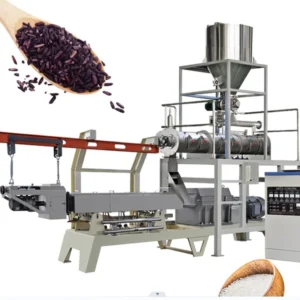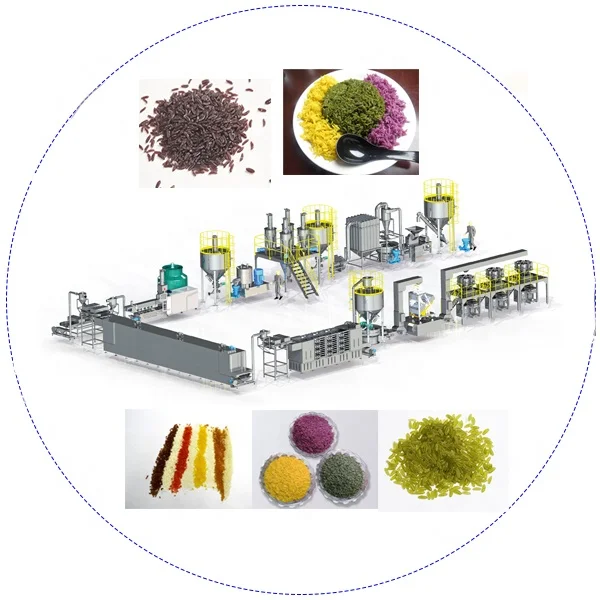
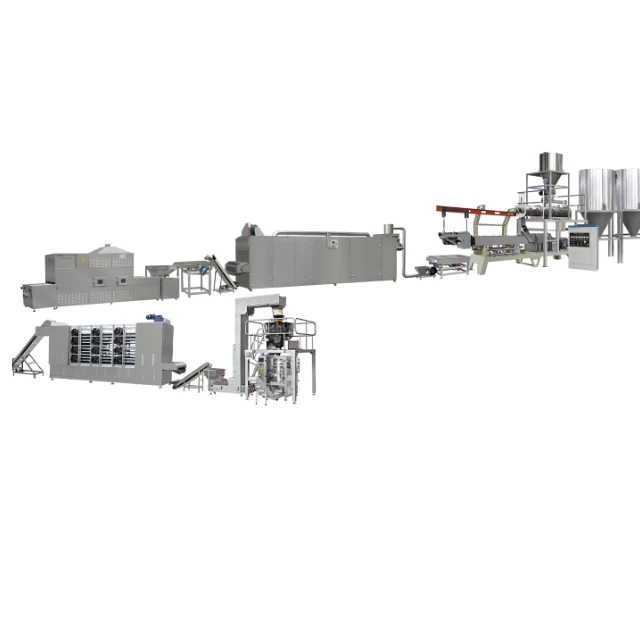

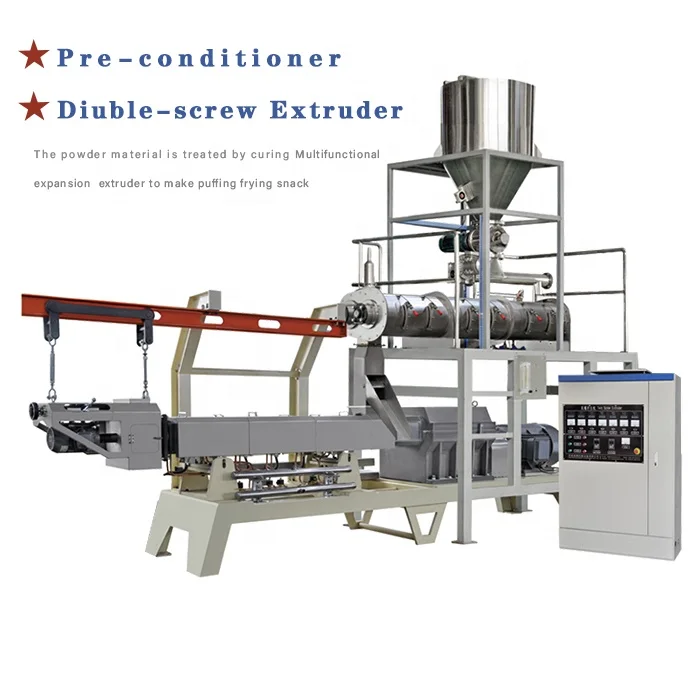

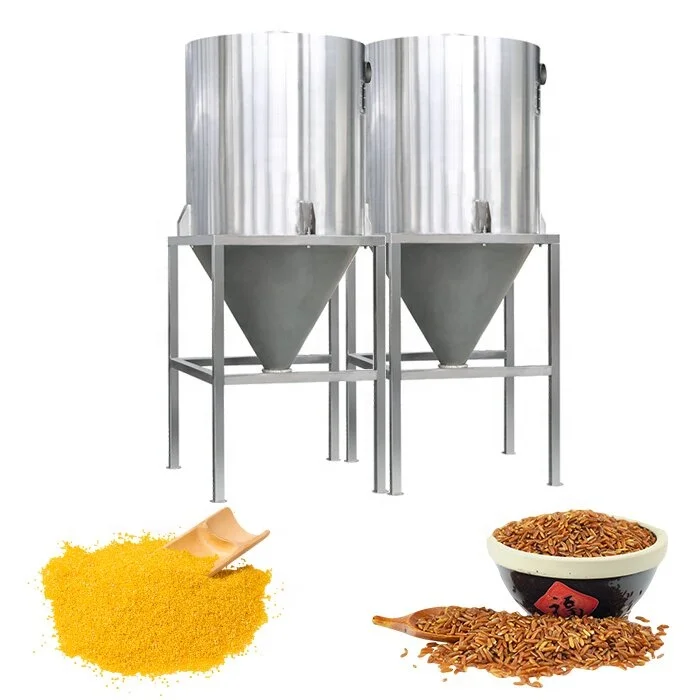
MT65 / MT70 / MT85 / MT75 / MT95 Fortified Rice Kernel Extrusion Production Line, twin-screw, CE certified — complete turnkey from mixing through extrusion, drying, cooling and packing.
- Screw and die configuration specified to your raw material blend of broken rice, starch and micro-nutrients for target kernel density and cooking behaviour
- Throughput matched across every station so no single unit bottlenecks the line
- Circulation mesh belt dryer with frequency-controlled speed for consistent moisture profile
Trial runs on your ingredient formulation are completed in our testing workshop before shipment, with a full report confirming kernel texture and density.
Description
Integrated throughput engineering — Every station from batching through packing is sized against your specific raw material blend, so the line sustains its rated output without hidden bottlenecks at the dryer or cooling stages.
Technical Specifications
| Parameter | Value |
|---|---|
| Product Type | Fortified Rice Kernel Extrusion Production Line |
| Model | MT65 / MT70 / MT85 / MT75 / MT95 |
| Installed Power | MT65: 85 kW; MT70: 120 kW; MT85: 235 kW; MT75: 180 kW; MT95: 260 kW |
| Power Consumption | MT65: 60 kW; MT70: 85 kW; MT85: 165 kW; MT75: 135 kW; MT95: 195 kW |
| Output Capacity | MT65: 80–100 kg/h; MT70: 100–120 kg/h; MT85: 200–300 kg/h; MT75: 300–500 kg/h; MT95: 800–1000 kg/h (basis to be confirmed) |
| Overall Dimensions (L×W×H) | MT65: 28×1.2×2.2 m; MT70: 30×1.5×2.2 m; MT85: 34×3.5×4.3 m; MT75: 32×3.5×4.3 m; MT95: 36×3.5×4.3 m |
| Control System | Frequency speed control (PLC / MCC available based on configuration) |
| Screw Type | Twin-screw extruder (single-screw feeding option available) |
| Screw Material | Special wear-resistant alloy |
| Dryer Type | Circulation mesh belt dryer with frequency motor speed control |
| Heating Source | Electric or gas |
| Line Stations | Mixing → Extruding → Vibrating → Low-temperature drying → Cooling → High-temperature roasting → Cooling → Packing |
| Lubrication | Automatic lubricating and cooling system |
| Assembly State | Complete turnkey line |
| Standards | CE certified, ISO certified |
Application Suitability
| Application | Material or Output |
|---|---|
| Nutrition programme fortified rice | Broken rice and rice bran blended with vitamins and minerals |
| Artificial rice kernel production | Broken rice, rice bran, and starch bases |
| Multi-grain nutritional rice | Corn, millet, wheat, oats, and buckwheat with starch |
| Legume-enriched rice analogues | Beans and pulses blended with cereal starches |
| Institutional feeding programme supply | Standardised kernel size and cooking behaviour for large-scale distribution |
Why "Rated Capacity" Means Nothing Without Your Raw Material Formula
A line capacity figure is only valid against the exact ingredient blend, moisture content, and kernel size it was tested on.
I have seen buyers receive a Fortified Rice Kernel Extrusion Production Line Turnkey quoted at a specific throughput, only to discover during commissioning that their actual formula — perhaps high in whey protein or fibre — behaves completely differently from the supplier’s standard test material. The extruder stalls, the dryer cannot keep pace, and weeks are lost reconfiguring screw elements on-site. [NEED_CITE: material formulation impact on extrusion throughput stability] When capacity is stated without naming the raw material basis, it is a theoretical ceiling rather than a working commitment. The only way to validate output is through a pre-shipment trial run using your own formulation, documenting kernel density, moisture curve, and cooking integrity under controlled conditions.
Matching Screw Configuration to Your Grain and Micronutrient Blend
The twin-screw extruder in this line is configured after reviewing your specific blend of broken rice, starch, millet, or buckwheat alongside any vitamin and mineral premix you intend to incorporate. Screw element sequence, compression ratio, and die aperture collectively determine whether the kernel exits the barrel with the elasticity and density your market expects. A formulation high in legume flour demands a different shear profile than one built on pure rice starch.
Throughput Balancing Across Every Station in the Line
A Fortified Rice Kernel Extrusion Production Line Turnkey is only as productive as its slowest station. The circulation mesh belt dryer, the vibrating conveyor, and the cooling belt must each handle the extruder output without material backing up or cooling too slowly. This line is designed so that each station’s throughput is calculated against the others, preventing the common failure where a high-capacity extruder feeds into an undersized dryer that becomes the real bottleneck. [NEED_CITE: throughput balancing in food extrusion line engineering]
How Installed Power and Dimensions Map to Your Production Target
The installed power ranges from 85 kW on the MT65 to 260 kW on the MT95, reflecting the mechanical work needed to gelatinise starch and form kernels at increasing volumes. Power consumption figures sit lower — 60 kW to 195 kW — because not all motors run at full load simultaneously. Overall line length stretches from 28 metres to 36 metres depending on model, which directly affects your floor plan: the MT85 and above require a building bay at least 34 metres long with clearance for the mesh belt dryer and cooling conveyors. Frequency speed control across the line allows operators to adjust individual station speeds without stopping the full system. The automatic lubricating and cooling system on the extruder barrel supports continuous multi-shift operation without manual intervention on bearing temperature.
The Hidden Cost of Skipping a Pre-Shipment Trial Run
Commissioning a line without a prior trial run on your actual raw material formula turns your factory floor into the testing laboratory. Screw elements are swapped, die plates are re-ordered, and dryer temperature profiles are adjusted iteratively — all while production targets are missed and raw material is wasted. [NEED_CITE: cost of post-installation commissioning delays in food processing] Buyers who skip the trial step frequently report that the first two to three weeks of operation are consumed entirely by parameter tuning, during which output quality is inconsistent and unsaleable.
Why Source This Line From a Single Supplier
Every station — mixing, extrusion, vibrating, low-temperature drying, cooling, roasting, and packing — is supplied by one manufacturer, meaning interface dimensions, control signals, and throughput calculations are reconciled before the line ships. Screw and die configurations are documented against your raw material rather than copied from a generic catalogue. An in-house testing workshop allows your formulation to be run on the actual extruder model before it leaves the factory. Electrical schematics, voltage, and frequency are confirmed against your site supply before production begins, avoiding the commissioning delays that arise from mismatched power standards. Operator training and wear parts lists are provided so that screw and die replacements are available from day one.
Documentation & Verification
- Line layout and capacity calculation showing throughput at every station for your target output
- Trial run report on your raw material blend confirming kernel density and cooking behaviour
- Screw and die configuration record specific to your ingredient formula
- Electrical schematic with voltage and frequency confirmation for your site
- Operation and maintenance manual with wear parts list and replacement intervals
Installation, Commissioning & Support
- Floor space of 28–36 metres length required depending on model, with level concrete foundation
- Dedicated power circuit matching confirmed voltage and frequency, sized to installed kW rating
- Line arrives in modular sections; extruder barrel and dryer belt assembled on-site
- First-run commissioning includes screw speed, barrel temperature, and dryer belt frequency calibration
- Operator training covers formulation adjustment, die changeover, and emergency stop procedures
- Wear parts inventory including replacement screw elements and die plates supplied with initial shipment
What to Share With Your Inquiry
Provide your raw material formula — including the proportion of broken rice, starch base, legume flour, and micronutrient premix — along with your target daily output in kilograms. Share your facility’s available floor length and ceiling height, local voltage and frequency, and preferred control language. If you have existing upstream milling or downstream packing equipment, describe its throughput so the line can be matched.
Frequently Asked Questions
Q: How is the line capacity verified, and what raw material formulation is it based on?
A: Capacity is verified through a trial run in the testing workshop using your actual raw material blend, including any vitamin and mineral premix. The trial run report documents throughput, kernel density, moisture curve, and cooking behaviour. Any capacity figure quoted without specifying the raw material basis should be treated as provisional until your formulation has been tested on the exact extruder model.
Q: Can the screw and die configuration be tailored to my specific grain and micronutrient blend?
A: Yes. Screw element sequence, compression ratio, and die aperture are selected after reviewing your ingredient list, including proportions of broken rice, starch, legume flour, and micronutrients. The configuration record is documented and specific to your formulation, not copied from a generic catalogue build.
Q: Is a trial run on my raw material performed before shipment?
A: A trial run is conducted in the supplier’s in-house testing workshop before the line ships. The resulting report covers kernel density, texture, moisture content at each drying stage, and cooking integrity. This allows any screw or die adjustments to be completed at the factory rather than during on-site commissioning.
Q: What voltage, frequency, and control language options are confirmed before production?
A: Electrical schematics and voltage specifications are confirmed against your site supply before the line enters production. Control language is agreed upon during the specification stage so that the operator interface, PLC labels, and documentation all match your team’s working language upon delivery.
Q: How is throughput balanced across mixing, extrusion, drying, and packing?
A: Each station’s capacity is calculated against the others during the layout design phase. The circulation mesh belt dryer, vibrating conveyor, and cooling belt are all sized so that material flows without backing up at any point. The line layout document shows throughput at every station for your target output.
Related products
-
CE cerelac Instant Baby Food Porridge Making Machine Production Line
¥35,000.00 Select options This product has multiple variants. The options may be chosen on the product page -

Industrial Automatic 500kg/h Baby Cereal Nutrition Powder Extruder Manufacturing Process Line
¥8,238.27 Add to cart -
150-500kg/h Twin Screw Extruder Baby Rice Flour Making Machine
¥9,500.00 Select options This product has multiple variants. The options may be chosen on the product page -

High Productivity New Condition Safe Healthy and Nutritious Baby Food Meal Replacement Powder Production Line
¥30.00 Select options This product has multiple variants. The options may be chosen on the product page