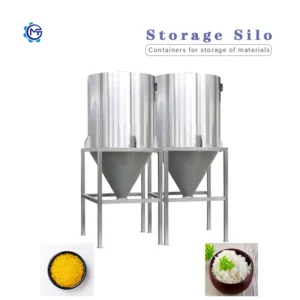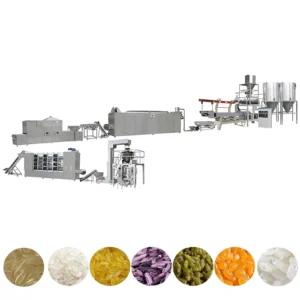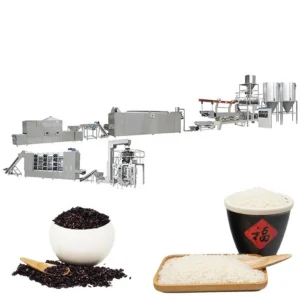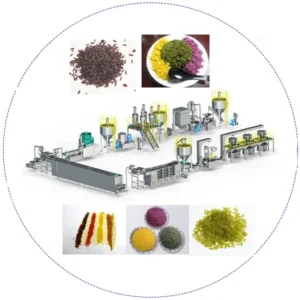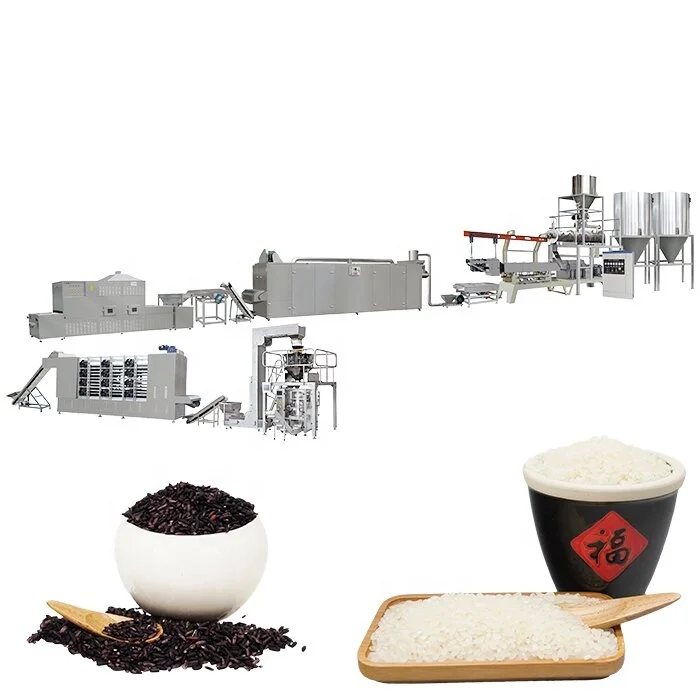


Nutritional Fortified Rice Processing Line, Twin-Screw Extruder, 110 kW Main Power, PLC Frequency Control — engineered for complete starch gelatinisation and precise grain density across artificial and fortified rice formats.
- 2500 mm screw length with matched die configuration for target grain size
- Multi-stage drying configurable for electric, gas, diesel, or steam heating
- Full line integration from powder mixing through polishing, cooling, and packing
Every station throughput is calculated against your raw material blend, with a pre-shipment trial run in our testing workshop and complete electrical documentation confirmed to your plant voltage before production starts.
Description
Complete line integration — Every station on this nutritional fortified rice production line turnkey system is throughput-matched under one supplier, eliminating the bottleneck stalls that plague multi-vendor assemblies.
Technical Specifications
| Parameter | Value |
|---|---|
| Product Type | Nutritional Fortified Rice Processing Line |
| Extruder Type | Twin-screw |
| Extruder Screw Length | 2500 mm |
| Extruder Main Power | 110 kW |
| Extruder Feeder Power | 1.5 kW |
| Extruder Cutting Power | 2.2 kW |
| Extruder Oil Pump Power | 0.75 kW |
| Mixing Machine Power | 15 kW |
| Mixing Machine Batch Capacity | 130 kg–150 kg per batch (basis to be confirmed) |
| Mixing Machine Dimensions | 1450 × 1550 × 980 mm |
| Mixing Tank Thickness | 1.5 mm stainless steel |
| Mixing Tank Cover Thickness | 1.2 mm |
| Vibrating Screen Power | 0.2 kW |
| Vibrating Screen Dimensions | 1700 × 1210 × 740 mm |
| Cooling Dryer Power | 2.2 kW |
| Cooling Dryer Dimensions | 5000 × 1500 × 1900 mm |
| Drying Box Heating Type | Electric heating (gas / diesel / steam available on request) |
| Control System | Frequency control on extruder main motor, feeder, and cutter |
| Voltage & Frequency | Customizable (e.g. 3ph 380V 50Hz, 3ph 415V 60Hz, 3ph 220V 60Hz) |
| Line Output Capacity | To be confirmed based on raw material and grain size target |
| Standards | CE certified equipment |
Application Suitability
| Application | Material or Output |
|---|---|
| Fortified rice for nutrition programmes | Rice flour blended with vitamin and mineral premix |
| Artificial golden rice | Rice flour with beta-carotene or colourant additives |
| Self-heating and instant rice formats | Starch-based blends requiring controlled gelatinisation |
| Konjac and shirataki rice analogues | Konjac flour and specialty starch compositions |
| Retail-ready minute rice | Rice grits and modified starch with rapid rehydration targets |
Why the Screw Configuration Matters More Than the Nameplate Capacity
Your raw material defines the real output, not the brochure number.
I spent years on the assembly floor before moving into line planning, and the pattern is always the same: a buyer receives a twin-screw extruder rated for a certain throughput, but when their actual rice flour blend with high protein additives enters the barrel, the torque alarm triggers and production stalls. One project last year involved a nutritional powder blend that behaved nothing like the standard starch-base assumption, and three full days of trial production were consumed by parameter adjustments alone [NEED_CITE: twin-screw extrusion torque behaviour with varying protein-to-starch ratios]. That is exactly why every nutritional fortified rice production line turnkey project we configure starts with a physical trial on your material before any specification is locked.
Throughput Matching Across Every Station
The extruder is only one link in the chain. If the drying box cannot handle the moisture load that the twin-screw discharges, or if the polishing drum cycles slower than upstream output, the entire nutritional fortified rice production line turnkey installation loses effective capacity. Our line configuration calculates throughput at each station — powder mixing, extrusion granulation, vibrating screening, drying, polishing, cooling, and packing — so that no single unit becomes the constraint that limits your shift output.
Die Design and Grain Density Control
The die plate determines grain shape, size, and apparent density. Fortified rice meant for government nutrition programmes often must match the dimensions and cooking behaviour of natural milled rice, which demands precise die orifice sizing and cutting frequency coordination. Frequency control on the cutter motor allows operators to adjust grain length in real time without stopping the extruder, maintaining consistent product specification across long production runs [NEED_CITE: die geometry influence on extruded rice grain dimensions].
Screw Length and Starch Gelatinisation
The 2500 mm screw length provides sufficient residence time for complete starch gelatinisation at typical rice flour moisture levels. Incomplete gelatinisation leaves raw starch centres that cause grain breakage during drying and produce a chalky texture after cooking. The twin-screw configuration generates the shear and heat profile needed to fully gelatinise the starch matrix while incorporating vitamin and mineral premixes uniformly throughout each grain. Longer barrel contact time also allows better moisture distribution before the die, which translates to more uniform expansion and fewer off-spec grains rejected at the vibrating screen.
The Cost of Skipping the Material Trial
When an extruder ships without a prior trial on the buyer’s actual blend, the first week of installation becomes an expensive experiment. Screw elements may need to be reconfigured, barrel temperature zones retuned, and feeder rates adjusted — all while raw material is consumed and production deadlines slip [NEED_CITE: cost of unplanned commissioning delays in food extrusion projects]. For fortified rice, where nutritional additive ratios are tightly regulated, running off-spec product also means discarding blended material that cannot be reworked. A trial run in the testing workshop before shipment compresses that learning curve into days rather than weeks on your factory floor.
Why This Line Configuration Approach Works
Every station from the 15 kW powder mixer through the 5000 mm cooling dryer is sourced and specified by the same engineering team, so interface points — material transfer heights, conveyor speeds, moisture handoff conditions — are designed together rather than adapted after delivery. Screw and die configurations are documented against your specific raw material sample. Voltage and frequency are confirmed against your plant electrical supply before production begins, not discovered at uncrating. The testing workshop runs your actual blend so that the trial run report accompanies the shipment, giving your operators a validated starting point from day one of commissioning.
Documentation & Verification
- Line layout and capacity calculation with throughput matched across all stations
- Screw and die configuration record specified to your grain size and density target
- Trial run report on your raw material blend from the in-house testing workshop
- Electrical schematic with confirmed voltage and frequency matching your plant supply
- Factory test record and CE declaration of conformity included with shipment
Installation, Commissioning & Support
- Foundation plan accounts for the 2500 mm extruder length and full line footprint
- Dedicated circuit sizing confirmed for the 110 kW main drive and 15 kW mixer loads
- Frequency-controlled cutter and feeder calibrated to your grain length specification during commissioning
- Operator training covers screw configuration adjustment for different fortified rice formulations
- Wear parts list identifies die plates and screw elements with replacement intervals
What We Need to Configure Your Line
To move from inquiry to line proposal, we need your raw material formulation including flour type, additive ratios, and target moisture content. Provide your plant voltage and frequency supply, daily production target in kilograms, and available floor space dimensions. If you can ship a sample of your blend to our testing workshop, we will run it through the extruder and document the results before finalising the specification.
Frequently Asked Questions
Q: How is line capacity verified against my specific raw material blend and moisture target?
A: We run your actual raw material sample through the twin-screw extruder in our testing workshop before the line ships. The trial documents throughput, torque load, gelatinisation quality, and grain density under controlled conditions, giving you verified capacity data based on your blend rather than generic assumptions.
Q: What voltage and frequency options are confirmed before production starts?
A: The line electrical system is configurable for three-phase supplies including 380V 50Hz, 415V 60Hz, and 220V 60Hz configurations. We confirm your exact plant supply voltage and frequency during the specification stage, and the electrical schematic in the documentation package reflects that confirmed configuration.
Q: How do you match throughput between the extruder, dryer, and packing stations to avoid bottlenecks?
A: Each station is calculated against the extruder output under your specific raw material conditions. The drying box, cooling dryer, and downstream equipment are sized so that moisture removal rate, cooling time, and packing speed all sustain continuous operation without material queuing or idle gaps.
Q: Can I run a trial on my raw material before the line ships?
A: Yes. Our in-house testing workshop is equipped to process your raw material sample through the extruder configuration planned for your line. The resulting trial run report travels with the shipment, providing your team with validated parameters for commissioning.
Q: What documentation is provided for installation, commissioning, and operator training?
A: The documentation package includes the line layout drawing, capacity calculation, screw and die configuration record, electrical schematic, trial run report, operation and maintenance manual, and a wear parts list with recommended replacement intervals for your production conditions.
Related products
-

High Precision Automatic 500kg/h Baby Food Nutrition Powder Rice Extrusion Processing Line
¥8,238.27 Add to cart -

Industrial Automatic 500kg/h Baby Cereal Nutrition Powder Extruder Manufacturing Process Line
¥8,238.27 Add to cart -
High Precision Automatic 500kg/h Baby Food Nutrition Powder Rice Extrusion Processing Line
¥9,500.00 Add to cart -

Automatic Instant Powder Production Line Nutritional Powder Extruder Machine
¥10,000.00 Select options This product has multiple variants. The options may be chosen on the product page