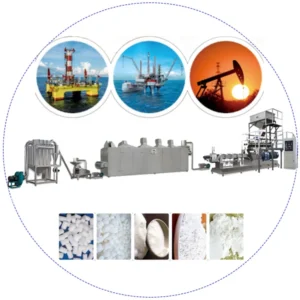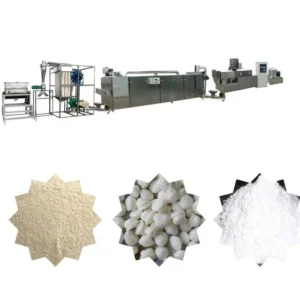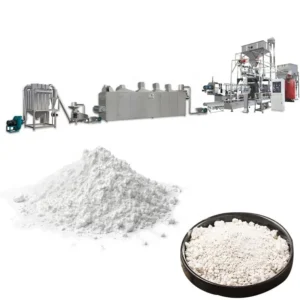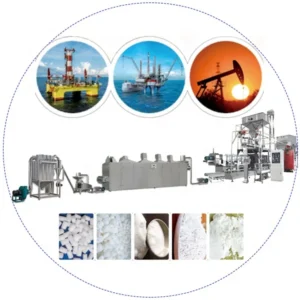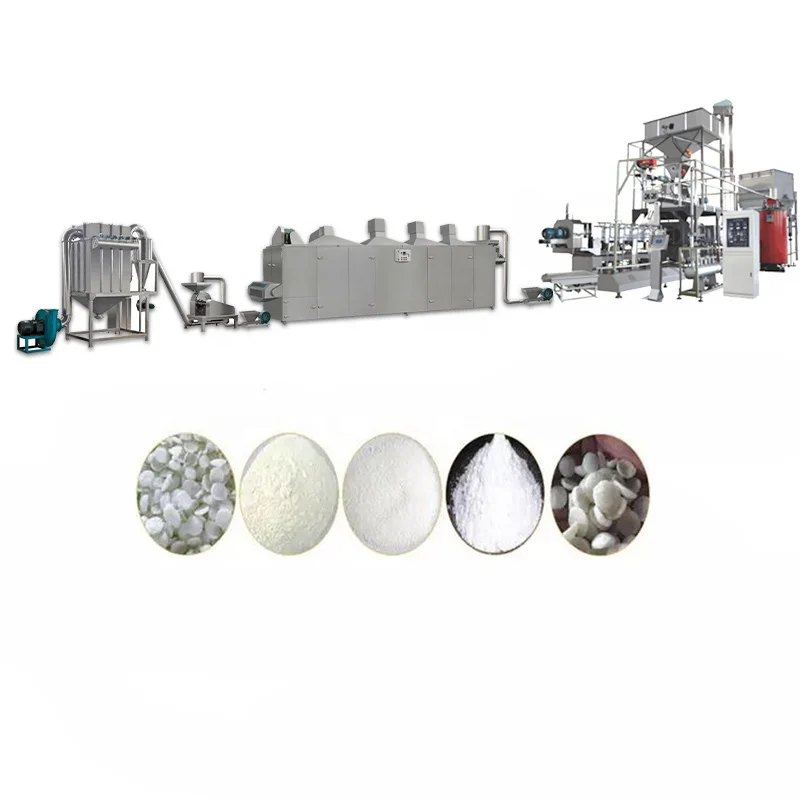


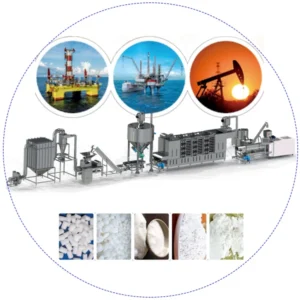
Modified Starch Processing Line, Twin-Screw Extrusion, Stainless Steel 304 Contact Parts — designed for controlled pre-gelatinization of corn, tapioca, or potato starch with matched drying and grinding stations.
Every station from blending through extrusion to packing is throughput-balanced under one layout, with screw configuration and barrel profile specified to your feedstock’s gelatinization behavior and target viscosity.
Turnkey delivery covers line layout planning, utility matching, trial runs on your raw material before shipment, and on-site commissioning with operator training.
Description
Throughput-matched line design — every station from blending to packing is calculated against your actual starch feedstock to prevent downstream bottlenecks before the first bolt is tightened.
Technical Specifications
| Parameter | Value |
|---|---|
| Product Type | Modified Starch Production Line |
| Extruder Type | Twin Screw Extruder |
| Model Options | MT85 / MT100 / MT110 / MT135 |
| Installed Power (MT85) | 90 kW |
| Installed Power (MT100) | 180 kW |
| Installed Power (MT110) | 200 kW |
| Installed Power (MT135) | 240 kW |
| Real Power Consumption (MT85) | 63 kW |
| Real Power Consumption (MT100) | 120 kW |
| Real Power Consumption (MT110) | 150 kW |
| Real Power Consumption (MT135) | 165 kW |
| Output Capacity (MT85) | 100–200 kg/h (basis not stated in source — confirm raw material type and moisture content) |
| Output Capacity (MT100) | 500–600 kg/h (basis not stated in source — confirm raw material type and moisture content) |
| Output Capacity (MT110) | 500–600 kg/h (basis not stated in source — confirm raw material type and moisture content) |
| Output Capacity (MT135) | 1000–1500 kg/h (basis not stated in source — confirm raw material type and moisture content) |
| Control System | Frequency speed controlling system |
| Heating Source Options (Dryer) | Electric / Steam / Gas |
| Material Contact Parts | Stainless Steel 304 |
| Grinding Fineness | Less than 10 mm |
| Processing Flow | Materials preparation → Blending → Mixing → Extruding → Drying → Grinding → Packing |
| Assembly State | Complete turnkey line |
| Standards | CE, ISO certified facility |
| Warranty | 1 year |
Application Suitability
| Application | Material or Output |
|---|---|
| Pre-gelatinized starch for food processing | Corn starch, tapioca starch, potato starch |
| Modified starch for textile sizing | Corn starch with controlled thermal viscosity |
| Modified starch for oil drilling fluids | Tapioca starch with specific gel strength |
| Modified starch for papermaking and construction | Potato starch with freeze-thaw stability |
What a Nominal Capacity Quote Actually Means for Your Starch Line
A modified starch processing line turnkey is only as reliable as the weakest throughput match between its stations.
When an extruder is quoted at a nominal output without accounting for the specific starch variety, moisture content, or target degree of gelatinization, the number on paper rarely holds up on the factory floor. I have seen lines where the twin-screw extruder pushed material faster than the dryer could handle, leaving wet product backing up in the cooling conveyor and forcing an unplanned two-week shutdown [NEED_CITE: throughput mismatch between extruder and dryer in starch processing]. The grinder downstream then receives unevenly dried flakes, producing inconsistent particle size that fails the buyer’s specification. A modified starch processing line turnkey must be engineered backward from the packing station to the mixer, not forward from the extruder nameplate.
Screw Configuration Dictates Gelatinization Uniformity
The twin-screw extruder sits at the heart of any modified starch processing line turnkey. Corn, tapioca, and potato starch each have different granule sizes, gelatinization temperatures, and shear sensitivities. A screw profile designed for corn starch will over-shear tapioca, breaking the polymer chains and destroying the viscosity profile the end customer requires. Barrel temperature zones must be mapped to the specific thermal behavior of the feedstock, and die design controls the residence time and expansion ratio of the extrudate. Getting this wrong means the product leaves the extruder under-gelatinized or thermally degraded before it ever reaches the dryer.
Dryer Sizing Is Where Most Lines Lose Capacity
The dryer is the station most frequently undersized in a starch extrusion project. Starch holds moisture differently depending on its botanical origin and the degree of modification achieved in the barrel. A dryer specified only on volumetric flow will struggle when a high-moisture tapioca batch enters after a low-moististure corn run. Selectable heating sources — electric, steam, or gas — allow the dryer to align with local utility infrastructure, but the airflow volume, belt speed, and zone temperatures must be matched to the extruder’s real output, not its brochure number [NEED_CITE: dryer capacity calculation methods for starch extrusion lines]. When the dryer becomes the bottleneck, operators are forced to slow the extruder, and the entire line runs below its designed economics.
Reading the Specs Beyond the Nameplate
Installed power and real power consumption tell different stories. The MT135 draws 240 kW at peak but runs at 165 kW under normal load, which affects transformer sizing and running costs. Stainless steel 304 contact parts across grinding and material handling stations ensure food-grade compliance and resist the mildly acidic conditions some modified starches create during cooling. The frequency-controlled drive system stabilizes extruder output across the capacity range, which matters when switching between starch types that demand different screw speeds. Grinding fineness below 10 mm is adequate for most industrial starch applications, but buyers targeting fine food-grade powders should confirm whether an additional micronizing stage is needed downstream.
The Hidden Cost of Mismatched Line Stations
When the extruder, dryer, and grinder are sourced from separate vendors, no single supplier owns the throughput calculation. The extruder vendor quotes high, the dryer vendor assumes a lower moisture load, and the grinder is rated for a different particle feed size. The result is a line that technically runs but never hits its designed output without constant operator intervention [NEED_CITE: risks of assembling processing lines from multiple vendors]. Downtime accumulates in short, frequent stoppages rather than one visible breakdown, making the root cause hard to trace back to the original specification gap.
Why Source the Complete Line Under One Scope
Sourcing the entire modified starch processing line turnkey from a single supplier means one party is responsible for the throughput match at every transfer point. Screw configuration and die design are specified to the buyer’s raw material before production begins, not copied from a generic build. An in-house testing workshop allows trial runs on the customer’s actual starch before the line ships, catching gelatinization or density issues early. Line layout and capacity calculation documents are provided so the buyer can verify station-to-station balance. Pre-sales consultation extends through on-site installation, commissioning, and operator training, ensuring the line runs to specification from day one.
Documentation & Verification
- Line layout and capacity calculation confirming throughput at every station
- Screw and die configuration record matched to your starch type
- Trial run report on customer raw material from the in-house testing workshop
- Electrical schematic with voltage, frequency, and control language confirmation
- CE declaration of conformity and ISO certificate for the production facility
- Operation and maintenance manual with wear parts list
Installation, Commissioning & Support
- Foundation plan aligned to the extruder’s installed power and vibration profile
- Dedicated electrical circuit sized for real power consumption up to 165 kW on the MT135
- Dryer heating source configured to local steam, gas, or electric supply before dispatch
- On-site commissioning with throughput verification across all stations
- Operator training covering screw speed adjustment and die changeover procedures
- Wear parts list for screws, dies, and grinder screens with recommended replacement intervals
What to Share When Requesting a Quotation
To configure a modified starch processing line turnkey that actually holds its rated output, provide the specific starch variety (corn, tapioca, potato), target degree of modification, and required end-product particle size. Include your workshop dimensions, ceiling height, and local voltage and frequency standards so the electrical package and dryer heating source are specified correctly from the start.
Frequently Asked Questions
Q: How is line capacity verified on my specific starch raw material before shipment?
A: The in-house testing workshop runs a trial on your actual corn, tapioca, or potato starch feedstock. Extruder screw speed, barrel temperature, and die configuration are adjusted until the target gelatinization and output are achieved, and a trial run report is issued before the line ships.
Q: How do you ensure throughput matching between the extruder, dryer, and grinding stations?
A: A line layout and capacity calculation document is prepared during the proposal stage. Each station’s throughput is calculated against the extruder’s real output on your raw material, and the dryer airflow and grinder feed rate are sized accordingly to prevent bottlenecks.
Q: What voltage, frequency, and control language options are confirmed before production?
A: An electrical schematic is issued for buyer approval before manufacturing starts. Voltage, frequency, and control panel language are confirmed in writing to match the destination facility’s utility supply and operator requirements.
Q: What is included in the turnkey project scope?
A: The scope covers line layout planning, utility requirement specification, equipment supply, phased installation guidance, on-site commissioning, throughput verification, and operator training. Wear parts and ongoing maintenance support are available after handover.
Q: How are screw configuration and die design selected for different starch types?
A: Corn, tapioca, and potato starch differ in granule size and gelatinization temperature. Screw element arrangement and die geometry are specified to the buyer’s raw material and target product properties, ensuring controlled pre-gelatinization without over-shearing the polymer chains.
Related products
-
Automatic Modified Tapioca Starch Production Line 304 Stainless Steel Flour Mill and Bakery Machine
¥30.00 Select options This product has multiple variants. The options may be chosen on the product page -
Twin-Screw Extrusion Line for Modified Starch. Producing Pregelatinized Adhesive & Food Grade Powder
¥65.00 Select options This product has multiple variants. The options may be chosen on the product page -
Big Capacity Modified Starch Industrial Use and Food Additives
¥50.00 Select options This product has multiple variants. The options may be chosen on the product page -
Automatic Pregelatinized Starch Processing Machine – Large-Scale New Condition Modified Starch Production Line
¥65.00 Select options This product has multiple variants. The options may be chosen on the product page