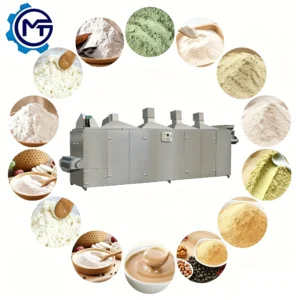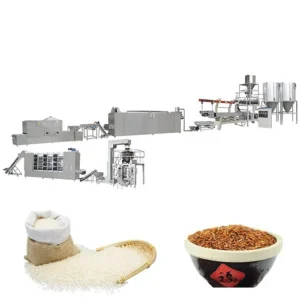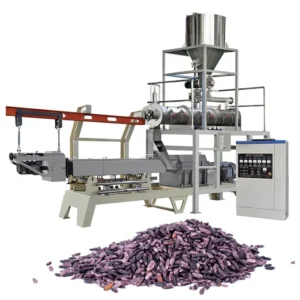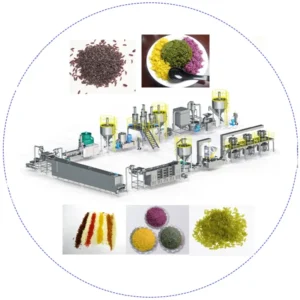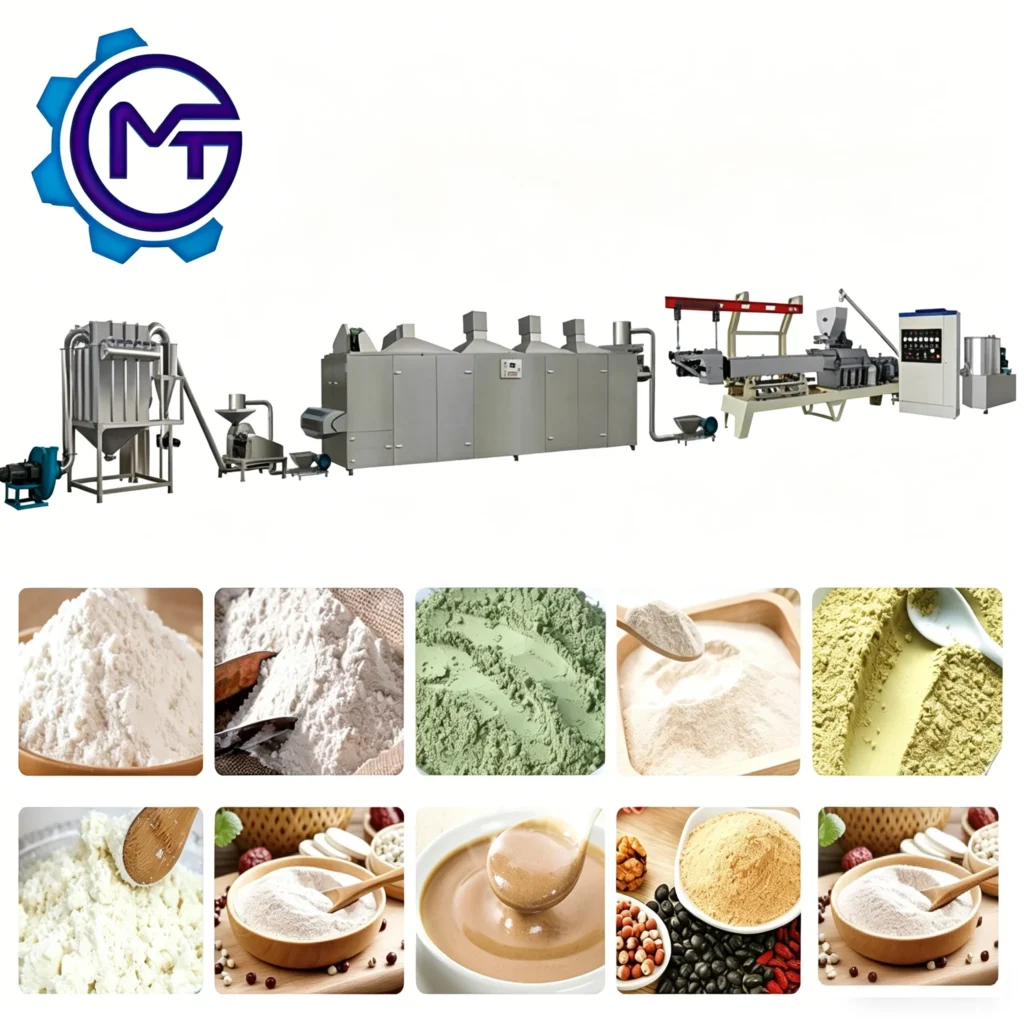


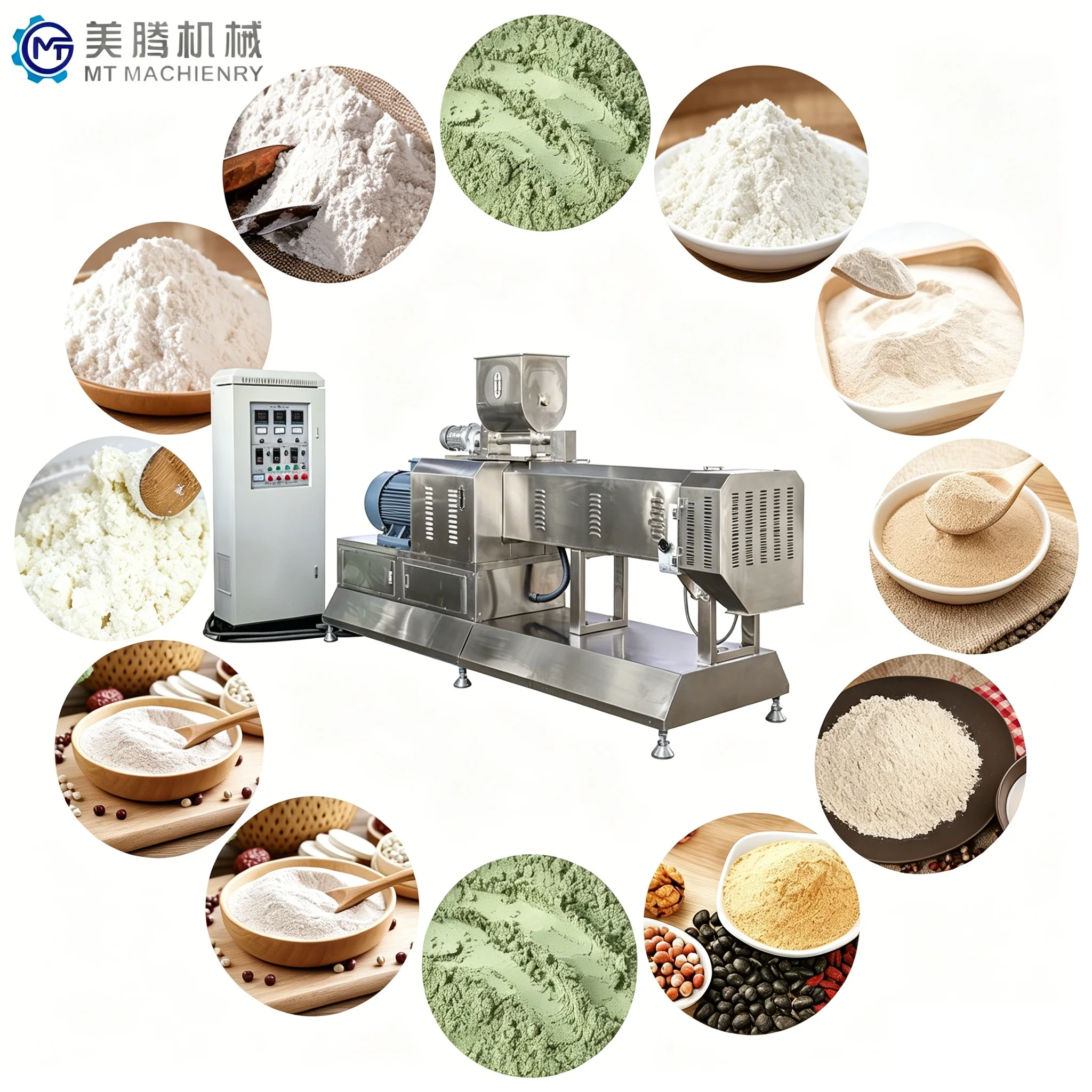


Baby Cereal Nutrition Powder Production Line, 200-500 kg/h, Food-Grade 304 SS, PLC Touch Control — engineered as a complete turnkey project from batching through extrusion, drying, and packing with every station’s throughput balanced to sustain declared output on your grain formulation.
- Twin-screw configuration and die design matched to target powder particle size, gelatinisation degree, and raw material behaviour
- Flexible heat source options (electric / gas / steam) integrated with factory utility planning and phased installation schedule
- In-house trial runs on your actual raw material before shipment, with full documentation including line layout, capacity calculation, and screw configuration record
Description
Thermodynamic Profiling — Every barrel zone and dryer pass is mapped to your grain formulation before the line is built, not adjusted after commissioning fails.
Technical Specifications
| Parameter | Value |
|---|---|
| Product Type | Baby Cereal Nutrition Powder Production Line |
| Processing Capacity | 200–500 kg/h (basis not stated in source — confirm raw material, moisture, and formulation) |
| Construction Material | Food-Grade 304 Stainless Steel (contact surfaces) |
| Control System | PLC with Touch Control Panel & Digital System |
| Heat Source Options | Electric / Gas / Steam (configurable to site utility) |
| Automation Level | Fully Automatic |
| Line Stations | Mixers, Extruder, Baking Ovens, Drying (full line composition to confirm) |
| Warranty | 1 Year |
| After-Sales Service | Overseas Engineer Service Available |
| Voltage & Frequency | To be confirmed against target market supply |
| Screw Type | To be confirmed (single or twin screw based on formulation) |
| Language Options | Control interface language to be confirmed |
Application Suitability
| Application | Material or Output |
|---|---|
| Infant and baby cereal porridge powder | Rice, corn, oats, and blended grain bases at controlled moisture |
| Fortified nutrition powder for feeding programmes | Grain blends with added vitamin and mineral premix |
| Instant breakfast cereal powder | Corn, wheat, and multi-grain formulations requiring full gelatinisation |
| Value-added grain processing | Beans, millet, sorghum, and specialty cereals for nutritional food markets |
What "200–500 kg/h" Actually Means on Your Grain Blend
Capacity is only real when measured against the exact formulation you intend to run.
I remember a nutrition powder project for a Southeast Asian client a few years back. They ordered a line rated at 500 kg/h based on a standard grain recipe. When their actual formulation arrived — significantly higher in fat content than the reference blend — the material would not expand properly through the extruder. Real throughput dropped to roughly half the quoted figure. The dryer was suddenly oversized for the actual feed rate, and the entire line rhythm fell apart [NEED_CITE: impact of fat content on extrusion expansion in grain-based formulations].
That baby cereal nutrition powder production line turnkey project ended up requiring a screw reconfiguration and a revised dryer profile before it could hold any stable output. Since then, every nutrition powder line I work on starts with the buyer sending a representative sample of their actual raw material. We run it through the testing workshop, document the expansion behaviour, gelatinisation degree, and moisture loss at each stage, and only then finalise the line configuration. The capacity number on the quotation is the capacity the line will deliver on that specific formulation, not a catalogue figure borrowed from a different recipe [NEED_CITE: importance of pre-shipment trial runs in extrusion equipment procurement].
Formulation-Driven Extrusion for Nutrition Powders
Baby cereal powder is not a single product. A rice-dominant formulation behaves very differently from a corn-and-bean blend inside the extruder barrel. Starch gelatinisation temperature, protein denaturation, and fat interference all shift depending on the grain ratio and moisture content you feed in.
The baby cereal nutrition powder production line turnkey configuration must therefore start with the formulation, not the machine catalogue. Screw pitch, compression ratio, and barrel zone temperatures are specified after the trial run confirms how your particular blend responds to shear and heat.
Matching Dryer and Extruder Throughput End-to-End
A common failure in nutrition powder lines is an extruder that runs at full output while the dryer cannot keep pace, creating a backlog that forces the operator to reduce feed rate. The reverse problem — an oversized dryer running half-empty — wastes thermal energy and can over-dry the powder, degrading the nutritional profile.
Every station on this line is sized against the verified throughput from the trial run. The baking oven residence time, the drying pass count, and the cooling conveyor speed are all calculated from the actual moisture reduction curve of your formulation [NEED_CITE: thermal processing requirements for infant cereal powder moisture targets]. This end-to-end matching is what makes the baby cereal nutrition powder production line turnkey approach fundamentally different from assembling individual machines from separate vendors.
Reading the Specs That Matter for Powder Quality
The PLC control system with touch panel is not just about automation — it stores the barrel temperature profile and screw speed recipe for each formulation you run, so the operator can reproduce the same gelatinisation degree batch after batch without manual guesswork. Food-grade 304 stainless steel on all contact surfaces matters especially for infant food applications where hygiene audits require cleanability documentation and corrosion resistance against repeated washdowns.
The configurable heat source — electric, gas, or steam — determines your operating cost structure and must match the utility infrastructure already available at your facility. A line specified for electric heating in a region where industrial gas is cheaper will carry unnecessary operating expense for its entire lifespan. The control interface language and voltage frequency must also be confirmed before production starts, otherwise commissioning delays are guaranteed once the machine arrives on your floor.
The Cost of Skipping the Trial Run
When a nutrition powder line ships without a prior trial on the buyer’s actual formulation, the first production run becomes the experiment. Screw configurations that worked on a reference recipe may produce powder with incorrect particle density, incomplete gelatinisation, or excessive moisture. Adjusting the line after installation means weeks of lost production, wasted raw material, and engineer visits that could have been avoided with a test run measured in hours [NEED_CITE: typical material waste during post-installation extrusion line commissioning].
Buyers who skip the trial phase often discover that their local grain supply has a different particle size distribution or moisture content than the supplier’s test material, and the entire screw profile must be reworked.
Why Procure This Line Here
Every station — from the mixer through extrusion, baking, drying, and packing — is supplied as one coordinated system, so throughput mismatches between machines from different vendors do not occur. The screw configuration and die design are specified to your raw material and target powder texture, not copied from a generic build.
Our in-house testing workshop runs your actual formulation before shipment, producing a documented trial report so you know the line works before it leaves the factory. The engineering team covers twin-screw expertise across grain-based nutrition powders, infant cereal, and fortified food applications. Documentation includes a complete line layout with capacity calculations at every station, not just the extruder nameplate.
Documentation & Verification
- Line layout with throughput calculation at each station from mixer to packing
- Trial run report on your grain formulation covering expansion and moisture data
- Screw and die configuration record matched to target powder particle size
- Electrical schematic with voltage and frequency confirmed to your market
- Factory test record documenting full line run before dispatch
- Operation and maintenance manual with wear parts replacement schedule
Installation, Commissioning & Support
- Foundation and floor space plan based on confirmed line layout and station dimensions
- Dedicated power circuit sizing confirmed against PLC system and heating load requirements
- Assembly sequence and rigging plan for extruder, oven, and dryer modules on arrival
- First-run parameter setting on your grain blend with barrel zone and screw speed documentation
- Operator training covering recipe storage on the touch panel and changeover procedures
- Wear parts list covering screws, dies, and seals with recommended replacement intervals
What to Prepare Before Requesting a Quotation
To configure the line accurately, we need your target formulation including grain types, ratios, and any added fat or premix components. Share your daily production target, available workshop floor area and ceiling height, and the local voltage and frequency standard.
If you have existing upstream batching or downstream packing equipment, provide the interface specifications so the line can be matched. We also recommend sending a representative raw material sample so the testing workshop can verify extrusion behaviour before the proposal is finalised.
Frequently Asked Questions
Q: How is the 200–500 kg/h capacity verified on my specific grain formulation?
A: We run your actual raw material blend through the testing workshop before finalising the line. The trial documents expansion behaviour, gelatinisation degree, and throughput at each station. The capacity written on your quotation reflects these measured results, not a catalogue estimate based on a different recipe.
Q: What screw configuration and die design do you recommend for my target powder texture?
A: Screw pitch, compression ratio, and die opening are selected after the trial run confirms how your formulation responds to shear and heat. We document the exact configuration in the project record so replacements can be manufactured to the same specification when wear parts are due.
Q: How do you ensure the dryer and cooling stations keep pace with extruder output?
A: Each station is sized against the verified throughput from your trial run. The baking oven residence time and drying pass count are calculated from your formulation’s moisture reduction curve, so no single station bottlenecks or runs underloaded at full line speed.
Q: Can you run a trial with my raw material before shipment?
A: Yes. The testing workshop runs your actual grain blend and produces a trial report covering extrusion expansion, moisture loss, powder density, and gelatinisation data. This report is shared with you before the line ships, confirming the configuration meets your product specification.
Q: How is the line layout planned for a complete turnkey project?
A: The layout accounts for every station from mixing through packing, with utility connections, material flow paths, and maintenance access mapped to your workshop dimensions. A phased installation schedule and commissioning sequence are provided so each module is integrated in the correct order on your floor.
Related products
-
Fully Automatic Fortified Nutrition Powder Baby Food Production Line
¥8,238.27 Select options This product has multiple variants. The options may be chosen on the product page -

High Quality Automatic PLC Controlled 500kg/h Twin Screw Extruder Machine for Baby Rice Nutrition Powder
¥8,238.27 Add to cart -
Industrial Instant Corn Paste Production Line Nutritional Powder Processing Equipment Meal Replacement Nutrition Powder Machine
¥65.00 Select options This product has multiple variants. The options may be chosen on the product page -

Automatic Instant Powder Production Line Nutritional Powder Extruder Machine
¥10,000.00 Select options This product has multiple variants. The options may be chosen on the product page