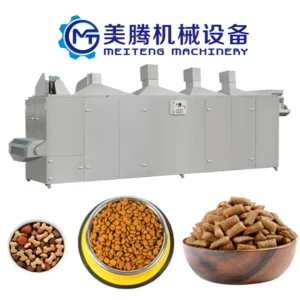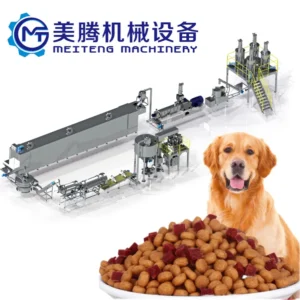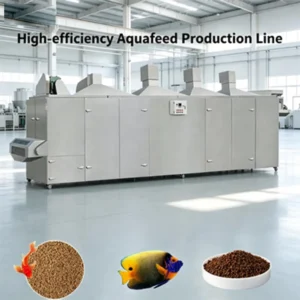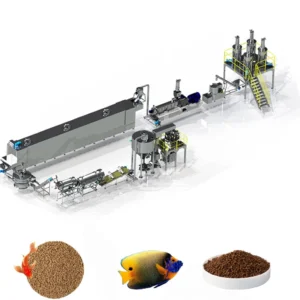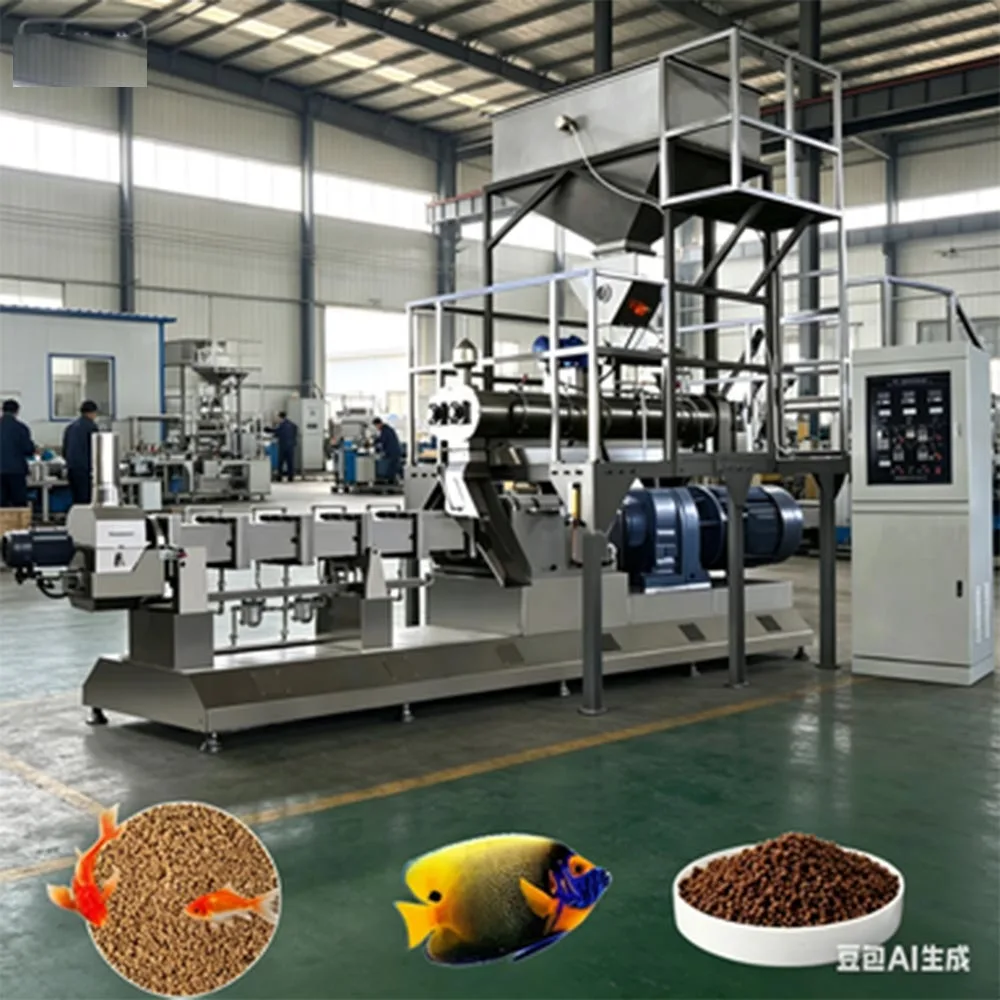


Complete Aquatic Pellet Manufacturing Fish Feed Production Line, Twin-screw extrusion, 0.5–12 mm pellet range — configured for floating and sinking aquatic feed across catfish, tilapia and shrimp growth stages.
- Screw configuration and die design specified to buyer’s raw material formulation, with moisture and shear profile tuned to target pellet density and expansion.
- Integrated feeding, mixing, extruding and pelletizing stations in a compact layout, with throughput matched across every station to eliminate bottlenecks.
Trial runs on customer raw material conducted in our in-house testing workshop before shipment, with full documentation from line layout to electrical schematics.
Description
Throughput-Matched Turnkey Design — Every station from batching through extrusion to packing is calculated against the same raw material formulation, so no single unit bottlenecks the fish feed production line turnkey output.
Technical Specifications
| Parameter | Value |
|---|---|
| Product Type | Twin Screw Extrusion Aquatic Feed Production Line |
| Output Capacity | 500 kg/h floating fish feed pellets (basis not stated in source — confirm raw material formulation / moisture content / pellet diameter) |
| Pellet Size Range | 0.5 mm to 12 mm, adjustable via die plate change |
| Screw Configuration | Twin-screw, profile matched to formulation |
| Automation Level | Fully automatic, continuous whole-process operation |
| Control System | Simple control panel (PLC / MCC options available on request) |
| Line Stations Integrated | Feeding, mixing, extruding, pelletizing |
| Main Structure Material | Stainless steel contact surfaces |
| Power Matching | Engineered for low specific energy consumption across all stations |
| Operation Mode | Continuous production requiring minimal manual supervision |
| Certification | CE, ISO |
Application Suitability
| Application | Material or Output |
|---|---|
| Floating pellets for catfish grow-out stages | Fish meal, soybean meal, wheat flour, vitamin premix at varying moisture levels |
| Sinking pellets for tilapia and carp | High-starch formulations with adjusted barrel temperature profiles |
| Starter feed for shrimp post-larvae | Fine-grind raw materials producing 0.5 mm to 1.5 mm micro-pellets |
| Mid-range aquaculture pellets for mixed species | Standard protein-to-starch ratios at 3 mm to 6 mm diameter |
| Broodstock and specialty aquatic feed | High-fat and high-protein recipes requiring specific screw shear profiles |
Why "500 kg/h" Means Nothing Without the Raw Material Context
Capacity is a function of your formulation, not a plate on the machine.
I have watched aquaculture producers sign off on a fish feed production line turnkey order based on a headline output figure, only to discover during commissioning that their actual recipe — higher fiber, different moisture, local protein sources — holds the extruder back to a fraction of that number. The extruder barrel fills differently with cassava starch than it does with corn flour, and die back-pressure changes with every pellet diameter [NEED_CITE: relationship between raw material rheology and extruder throughput]. When throughput is quoted without naming the raw material premise, the number is decorative. Before any capacity claim enters a purchase contract, the supplier must run your specific formulation through a test extruder and document the actual output at your target pellet size and moisture content. That trial report is the only capacity figure worth planning around.
Screw Configuration and Die Design as Formulation-Specific Variables
A twin-screw extruder does not have one universal screw profile. The flight depth, pitch angle, and kneading block arrangement determine how much shear energy transfers into the dough mass, which directly governs starch gelatinisation and final pellet buoyancy. For floating fish feed, the screw must generate enough internal pressure to trap steam cells inside the pellet as it exits the die. For sinking feed aimed at bottom-dwelling species, a different configuration compresses the material more tightly, driving air out before the die plate. The fish feed production line turnkey package should specify the exact screw elements and die orifice geometry matched to the buyer’s raw material blend, not a generic build carried over from the previous order.
Balancing Every Station Against the Extruder’s Real Output
An extrusion line is only as fast as its slowest downstream station. I recall a project in Colombia where a floating feed line was specified at full extruder capacity, but the dryer installed on-site was a legacy unit from a prior owner — it could only handle roughly seventy percent of the extruder’s output. The entire line choked at the drying stage, and the producer lost two months of planned production while a replacement dryer was sourced and installed. Throughput matching means calculating the residence time and evaporation load for the dryer, the cooling belt speed, and the coating drum batch cycle against the extruder’s verified output on the buyer’s actual recipe, then sizing each station with enough headroom to absorb normal production variation [NEED_CITE: throughput balancing methodology for extrusion-based feed lines].
Decoding the Core Parameters for Aquatic Feed Extrusion
The 0.5 mm to 12 mm pellet range covers post-larvae starter feed through grow-out pellets for large carnivorous species, but achieving the extremes of that range requires different die plates and often different screw element arrangements. At the fine end, die land length must be short to avoid excessive back-pressure on small orifices, and the cutter speed must match the extrudate exit velocity to keep pellet length consistent. Stainless steel contact surfaces prevent iron-catalyzed oxidation of fish oils and fat-soluble vitamins during long production runs, preserving feed palatability and nutritional value. The fully automatic control system maintains barrel zone temperatures within tight bands, which matters because a three-degree drift in the final cooking zone can shift pellet density enough to turn floating feed into slow-sinking feed. Continuous operation with minimal manual oversight reduces the batch-to-batch variation that plagues lines where operators manually adjust feed rate and steam injection.
The Hidden Cost of a Mismatched Line Configuration
When equipment is sourced from separate vendors, each supplier optimizes for their own station without responsibility for the overall line balance. The extruder vendor quotes maximum barrel output; the dryer vendor quotes maximum evaporation rate; neither accounts for the moisture profile of the specific pellet leaving the die. The result is a fish feed production line turnkey installation that never reaches nameplate capacity, with operators constantly adjusting parameters to compensate. Wear accelerates on screws and dies that run outside their designed throughput window, and spare parts consumption climbs well above the projections in the original business plan [NEED_CITE: impact of throughput mismatch on extruder wear part lifespan]. Downtime for unplanned screw changes then further erodes effective annual output.
Why Procurement Through a Single Line Integrator Matters
Every station — batching, mixing, extrusion, drying, coating, cooling, packing — is designed under one engineering team, so throughput calculations reference the same formulation across all equipment. The screw configuration and die design are documented specifically for the buyer’s raw material and target pellet density rather than borrowed from a catalogue build. An in-house testing workshop allows trial runs on the customer’s actual ingredients before shipment, producing a verified output report that replaces guesswork with data. Voltage, frequency, and control panel language are confirmed against the destination market’s electrical standards before production begins, preventing the commissioning delays that occur when a 60 Hz motor arrives at a 50 Hz site. Twin-screw extrusion expertise spans floating and sinking aquatic feed, pet kibble, snack pellets, and breakfast cereals, so screw element libraries and process knowledge transfer across product categories when the buyer diversifies.
Documentation & Verification
- Line layout drawing with throughput calculations for every station based on your formulation
- Trial run report documenting actual output, pellet density, and moisture on your raw material
- Screw element arrangement and die plate specification recorded for your product formulation
- Electrical schematic with confirmed voltage, frequency, and control language for your facility
- CE declaration of conformity and ISO certification included with shipping documentation
- Factory acceptance test record with photographs before crate packing
Installation, Commissioning & Support
- Foundation and floor space plan aligned to the compact stainless steel line layout
- Dedicated power circuit sizing matched to the total connected load of all integrated stations
- Phased installation schedule coordinating extruder, dryer, and packing equipment arrival sequences
- First-run parameter setting on your raw material with documented screw speed and barrel temperatures
- Operator training covering die changes across the 0.5 mm to 12 mm pellet range
- Wear parts list identifying screw elements, die plates, and cutter blades with recommended stock levels
- Preventive maintenance calendar based on continuous twin-screw duty cycle
What to Include With Your Inquiry
Provide your raw material formulation or at minimum the primary protein and starch sources with approximate ratios, along with the target pellet diameter range and whether floating or sinking density is required. Share your facility’s available floor area and ceiling height so the line layout can be drafted to fit, and confirm the local voltage and frequency supply to avoid motor and control mismatches. If you are replacing or expanding an existing line, describe the upstream and downstream equipment that will interface with the new installation so connection points and throughput handoffs are engineered from the start.
Frequently Asked Questions
Q: How is the 500 kg/h capacity verified and what raw material premise does it depend on?
A: The stated capacity depends on raw material formulation, moisture content, and pellet diameter, all of which influence extruder fill rate and die throughput. Verification happens through a trial run in the testing workshop using the buyer’s actual ingredients, producing a documented output figure at the target pellet specification before any purchase commitment is finalized.
Q: How do you match screw configuration and die design to my specific aquatic feed formulation?
A: Each screw element — feed flights, kneading blocks, reverse elements — is selected based on the starch-to-protein ratio, fat content, and fiber level of your recipe. Die orifice diameter and land length are calculated to produce the required pellet density, whether floating or sinking, and the complete configuration is recorded in your project documentation.
Q: What is the phased installation and commissioning schedule for a complete turnkey line?
A: Installation follows a sequenced plan where batching and mixing equipment is positioned first, followed by the extruder and dryer, then coating and packing stations. Commissioning proceeds station by station with the extruder running on your raw material to establish baseline parameters before downstream equipment is brought online and the full line is balanced.
Q: How is throughput balanced between extrusion, drying, and coating stations to avoid bottlenecks?
A: Each downstream station is sized against the extruder’s verified output on your specific formulation, with dryer evaporation capacity, cooling belt residence time, and coating drum cycle rate all calculated to handle the full production flow plus a practical margin for normal operating variation.
Q: Can I send my raw material for a trial run before shipment?
A: Yes, the in-house testing workshop accepts the buyer’s raw material for trial extrusion runs that replicate production conditions. The resulting report documents actual output, pellet appearance, density, and moisture content, giving the buyer verified data before the line leaves the factory.
Related products
-
MT High Capacity Pet Food Extrusion Production Line for Dogs Cats Birds Fish Cattle and More (150kg/h-3T/h)
¥35,000.00 Select options This product has multiple variants. The options may be chosen on the product page -
Full Automatic Pet Feed Production Line Large Twin Screw Grain Extrusion Machine
¥9,500.00 Select options This product has multiple variants. The options may be chosen on the product page -
200-250kg/h Capacity PLC Controlled Multi-Species Dog Food Processing Line with MT-70 Extruder
¥35,000.00 Select options This product has multiple variants. The options may be chosen on the product page -
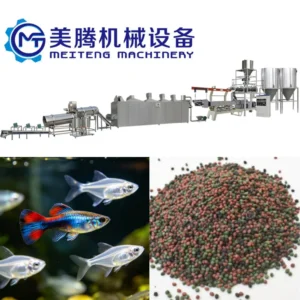
200-300kg/h Capacity Multi-Species Fish Feed Processing Line to Produce Fish Food
¥34,000.00 Select options This product has multiple variants. The options may be chosen on the product page