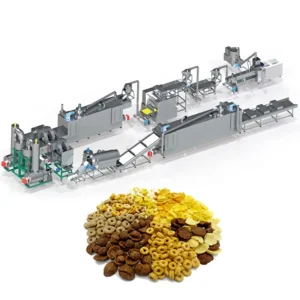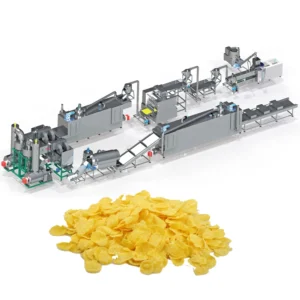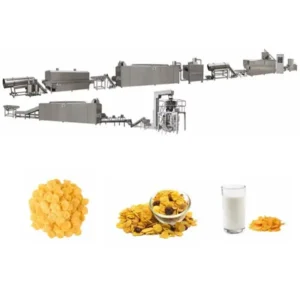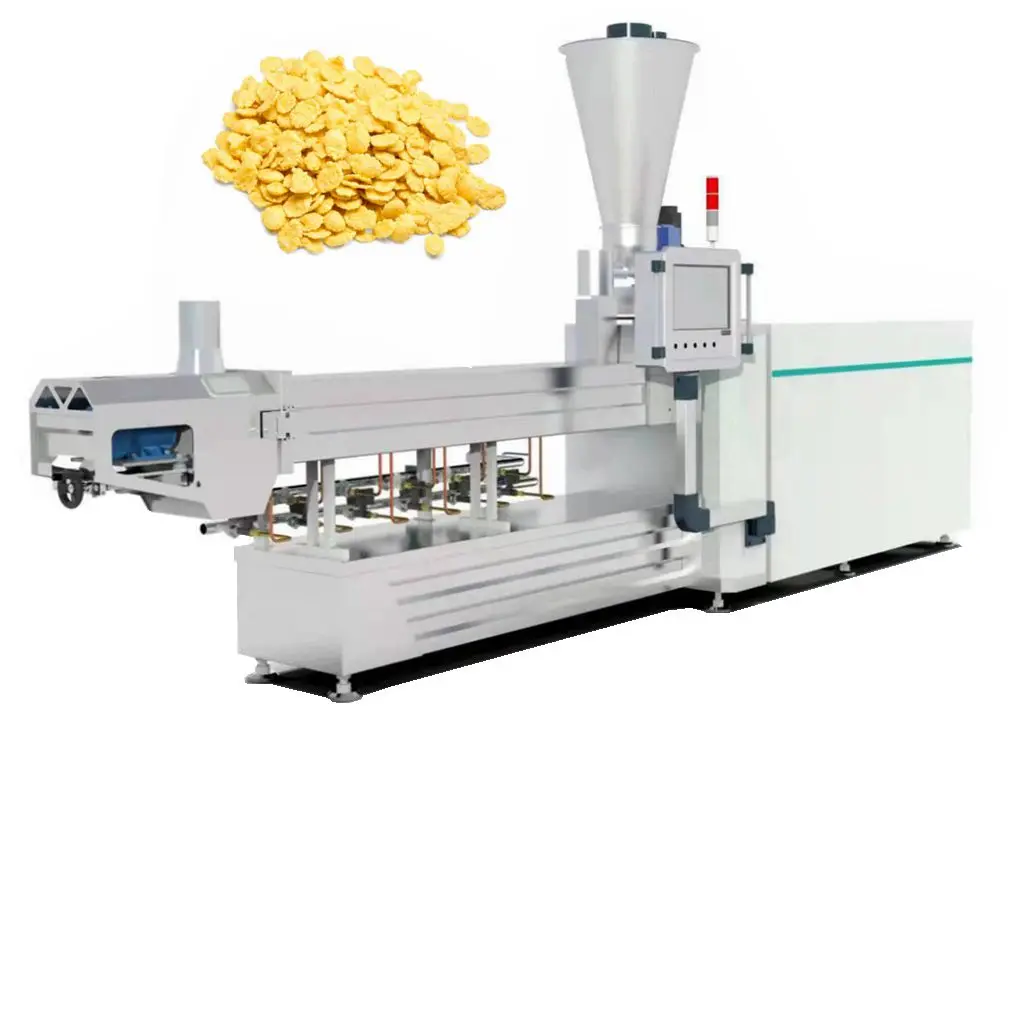


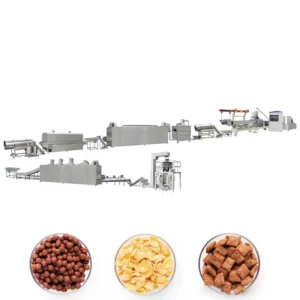
MT-65/MT-70/MT-85/MT-75 Corn Flakes Processing Line, Twin Screw Extruder, PLC Control — delivered as a complete turnkey project with throughput matched across every station from batching to packing.
- Screw configuration and die design specified to your raw material and target flake density
- In-house trial runs on your formulation validate capacity before shipment
Engineers provide full line layout, utility planning, and on-site commissioning with operator training to ensure the cereal line meets production targets from day one.
Description
Matched Throughput Across Every Station — A complete corn flakes production line from batching to packing where extruder output, flaking capacity, and dryer belt speed are calculated together so no single machine holds back the rest of the project.
Technical Specifications
| Parameter | Value |
|---|---|
| Product Type | Corn Flakes Breakfast Cereal Processing Line |
| Model Options | MT-65 / MT-70 / MT-85 / MT-75 |
| Extruder Type | Twin Screw |
| Installed Power | 84 kW (MT-65) / 132 kW (MT-70) / 186 kW (MT-75) / 239 kW (MT-85) |
| Real Power Consumption | 59 kW (MT-65) / 92 kW (MT-70) / 140 kW (MT-75) / 167 kW (MT-85) |
| Output Capacity | 120–150 kg/h (MT-65) / 200–250 kg/h (MT-70) / 300–400 kg/h (MT-85) / 400–500 kg/h (MT-75) (basis not stated in source — confirm raw material moisture and formulation) |
| Overall Dimensions (L×W×H) | 21000×1200×2200 mm (MT-65) / 23000×1500×2200 mm (MT-70) / 24000×1500×2800 mm (MT-75) / 28000×3500×4300 mm (MT-85) |
| Control System | PLC with real-time monitoring, alarm, and data storage; MCC integrated |
| Flaking Machine | Cast iron rollers, 45# steel shaft, adjustable roller gap, water cooling system, capacity 100–400 kg/h (basis not stated in source — confirm feedstock and flake thickness) |
| Hot Air Roaster | Max temperature up to 400°C, electric or gas heating, high-pressure blower, capacity 100–400 kg/h (basis not stated in source — confirm flake moisture and throughput) |
| Dryer | 3 / 5 / 7 layers available, electric or gas heating, adjustable mesh belt speed and drying time, capacity 100–500 kg/h (basis not stated in source — confirm product moisture reduction target) |
| Sugar Spraying System | Total Power 28.75 kW, Roller Size Ø600×2700 mm |
| Packing Machine | Vertical automatic, models 420 / 520 / 620 / 720, optional air compressor and nitrogen system |
| Line Stations | Mixer → Screw Conveyor → Twin Screw Extruder → Air Conveyor → Dryer → Hoister → Flavoring Drum & Oil Sprayer → Cooling Machine → Packing Machine |
| Raw Materials | Corn, rice, millet, wheat, oat, barley (powder/flour or grits form) |
| Assembly State | Complete turnkey line from batching to packing |
| Certifications | CE (since 2014), ISO |
Application Suitability
| Application | Material or Output |
|---|---|
| Plain corn flakes for breakfast cereal retail | Corn grits or corn flour, toasted and cooled |
| Sugar-coated and honey-glazed corn flakes | Corn base with sugar spray and drum coating |
| Multi-grain breakfast flakes | Blends of rice, millet, wheat, oat, and barley flour |
| Fortified breakfast cereals with vitamin premix | Cereal flour with nutritional additives blended at mixer stage |
| Cocoa flakes and chocolate-flavored loops | Corn or multi-grain base with cocoa powder in formulation |
| Shaped cereal pieces (Cheerios, stars, corn balls, honey rings) | Extruded through interchangeable die plates before flaking or roasting |
Why the Stated Capacity May Not Be Your Actual Capacity
When a corn flakes production line turnkey proposal quotes a single output number without naming the raw material moisture, formulation ratio, or flake thickness target, that number is only half the story. Real throughput depends on what you actually put into the hopper, not what the brochure assumes.
I have walked into workshops in Shandong where an extruder was rated for a certain hourly output on paper, but the buyer’s corn grits had a different moisture profile than the factory test used. The dough coming out of the die was stickier, the flaking rollers could not keep pace, and half-cooked material piled up on the conveyor waiting for the dryer. Two weeks of line rebalancing followed. The extruder itself was never the problem — the gap between stations was [NEED_CITE: throughput matching principles for multi-stage food processing lines].
Phased Layout Planning for a Cereal Factory Build
A corn flakes production line turnkey project starts with a floor plan that accounts for every station’s footprint, utility drops, and material flow direction. The MT-85 configuration spans 28 meters in length and requires over 3.5 meters in width, which means the building envelope, ceiling clearance for the hoister, and drainage for the flaking machine’s water cooling system must all be confirmed before foundation work begins. Utility planning covers electrical load distribution across the extruder motor, dryer heating elements, and roaster blower, as well as compressed air lines for the packing station and cooling water circuits for the flaking rollers.
Throughput Matching Between Extrusion, Flaking, and Drying
The twin-screw extruder pushes cooked dough through the die at a rate determined by screw speed, barrel temperature profile, and feedstock moisture. That output must land on the flaking machine at a rate the cast iron rollers can compress into uniform flakes. Those flakes then enter the hot air roaster where residence time at temperatures approaching 400°C determines surface crispness. If the dryer belt speed is set too slow for the upstream flow, flakes back up and over-dry at the edges. If it runs too fast, moisture remains trapped inside the flake and shelf life suffers. Every station on this line is specified so its maximum throughput aligns with the station before and after it [NEED_CITE: multi-stage cereal line throughput synchronization].
Reading the Specs for Production Reality
The installed power figures — ranging from 84 kW on the MT-65 to 239 kW on the MT-85 — represent the total connected load across all motors and heating elements, while the real power numbers show what the line actually draws during steady-state operation. That gap matters for transformer sizing and utility connection agreements. The PLC control system with MCC integration stores batch data in real time, which means if a particular corn grits lot produces flakes that are too thick or too brittle, the operator can trace back to the exact screw speed, barrel zone temperature, and dryer belt speed that ran during that batch. The flaking machine’s adjustable roller gap lets you set flake thickness to match what your market expects — thinner flakes for quick-soak retail packs, thicker flakes for foodservice portions that hold up in milk longer. The multi-layer dryer, available in 3, 5, or 7 layer configurations, determines how much belt length the flakes travel through heated air, and that distance directly controls final moisture content.
The Hidden Cost of Mismatched Station Capacity
When the extruder runs faster than the dryer can handle, partially dried flakes accumulate on transfer conveyors and begin clumping before they reach the flavoring drum. The sugar spray system then coats unevenly — some flakes get a heavy glaze while others pass through nearly bare. Downstream, the cooling machine receives an inconsistent load, and the packing station alternates between starved and flooded. This is not a failure of any single machine; it is a layout and specification error that compounds through every subsequent shift [NEED_CITE: bottleneck propagation in continuous food processing lines].
Why Source This Line From One Supplier
The complete line from mixer to packing machine comes from a single factory, so the screw conveyor feed rate is calibrated to the twin-screw extruder intake, and the hoister discharge height matches the flavoring drum inlet. In-house trial runs on your actual corn grits or multi-grain blend take place in the testing workshop before any machine ships, meaning the screw configuration and die selection are validated on your specific raw material. The electrical schematic is prepared with your plant’s voltage and frequency confirmed before production starts, avoiding the situation where a cabinet wired for 380V/50Hz arrives at a site running 440V/60Hz. Commissioning includes on-site operator training covering PLC parameter adjustment, roller gap calibration, and dryer belt speed tuning. Wear parts lists cover screws, dies, and flaking roller surfaces so the first replacement order can be placed before the original parts wear through.
Documentation & Verification
- Line layout drawing showing station positions, utility drop points, and material flow direction for your specific model
- Capacity calculation sheet matching extruder output to flaking, roasting, and drying throughput on your formulation
- Trial run report produced in the testing workshop using your raw material before equipment dispatch
- Electrical schematic with voltage, frequency, and control language confirmed for your destination market
- CE declaration of conformity and ISO certificate included in the shipping documentation package
- Operation and maintenance manual with screw configuration record and wear parts replacement intervals
Installation, Commissioning & Support
- Foundation and floor leveling requirements sized to the MT-85 footprint of 28000×3500 mm with drainage for flaking machine water cooling
- Dedicated electrical circuit planning based on real power draw of up to 167 kW for the MT-75 configuration
- Equipment arrives in modular sections; extruder barrel segments and dryer layers are assembled and aligned on site
- First-run commissioning includes PLC parameter loading, barrel temperature profiling, and flaking roller gap adjustment
- Operator training covers batch recipe storage, alarm response, and real-time data retrieval from the PLC interface
- Spare wear parts package includes twin screws, die plates, and flaking roller surface inserts for initial replacements
What We Need to Build Your Line Proposal
To prepare a layout and capacity calculation that reflects your actual production conditions, share your target product type (plain flakes, sugar-coated, or shaped pieces), the primary raw material and its moisture content, your planned daily output in kilograms, and the available floor space with ceiling height in your facility. We also need your local voltage and frequency standard, the preferred control language for the PLC interface, and whether you require a trial run on your raw material in our testing workshop before shipment.
Frequently Asked Questions
Q: How is line capacity verified against my specific raw material formulation and moisture content?
A: Before shipment, your raw material is run through the twin-screw extruder in the in-house testing workshop. The trial documents actual output rate, flake thickness, and moisture levels at each station. The resulting trial run report is shared with you so the capacity figures in the proposal reflect your formulation, not a generic test grain.
Q: How do you ensure throughput matching between the extruder, flaking machine, roaster, and dryer?
A: Each station is specified so its maximum throughput aligns with the station upstream and downstream. The capacity calculation sheet included in the proposal documents this matching across the full line, from the mixer feed rate through to the packing machine cycle speed.
Q: What utility requirements must my plant prepare before installation?
A: The electrical load plan details real power consumption for your chosen model, along with dedicated circuit requirements. Water cooling connections for the flaking machine, compressed air for the packing station, and gas supply if you select gas-heated drying are all mapped in the line layout drawing before equipment arrives on site.
Q: What is the commissioning timeline and operator training process for a complete turnkey cereal line?
A: Engineers arrive on site for assembly, alignment, and first-run commissioning. Training covers PLC parameter entry, recipe storage, roller gap adjustment, and alarm troubleshooting. Operators run supervised production batches until they can independently manage changeovers between product types.
Q: How do you handle voltage, frequency, and control language confirmation for different export markets?
A: Voltage and frequency are confirmed during the specification stage before production begins. The electrical schematic and PLC interface language are set to match your plant’s local standard, and this configuration is recorded in the documentation package shipped with the equipment.
Related products
-

Small Scale Breakfast Cereal Manufacturing Machine for Corn Flakes Process Line
¥45,000.00 Select options This product has multiple variants. The options may be chosen on the product page -
1000 Lbs Automatic Corn Flakes Production Line Mixer Breakfast Cereal Corn Flakes Production Line
¥45,000.00 Select options This product has multiple variants. The options may be chosen on the product page -

200kg/h Breakfast Cereal Extruder Making Machine Hot Sale Corn Flake Production Line
¥30,000.00 Select options This product has multiple variants. The options may be chosen on the product page -
New Technical Automatic Cereal Nutritional Powder Instant Porridge Baby Food Making Machine
¥10,000.00 Select options This product has multiple variants. The options may be chosen on the product page