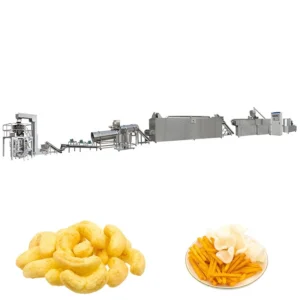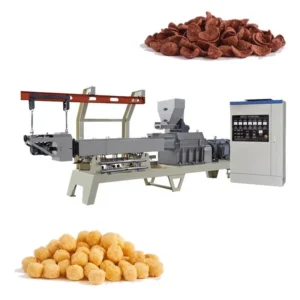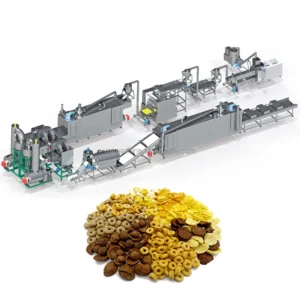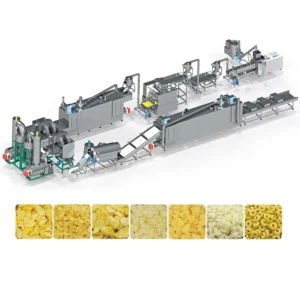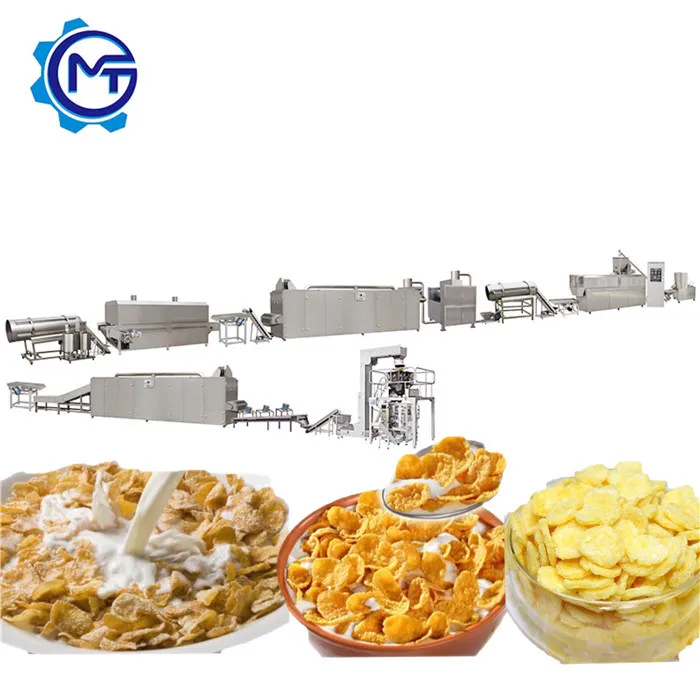

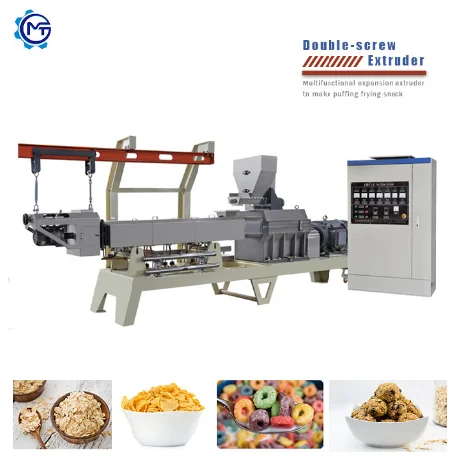

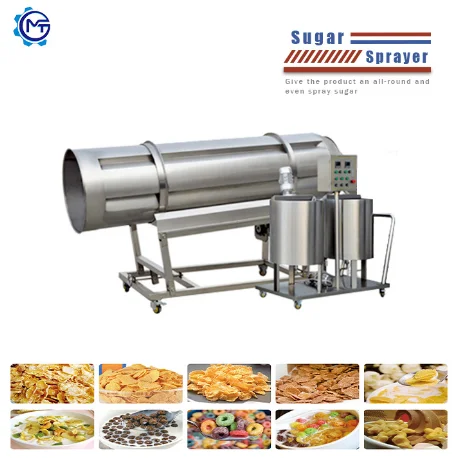
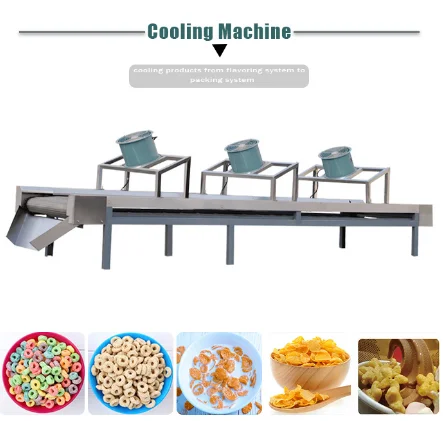
MT70 / MT85 / MT75 Corn Flakes Breakfast Cereal Processing Line, Twin Screw Extruder, PLC & MCC Control, Gas/Electric Dryer — complete turnkey system from mixing to packing for natural and sugar-coated flakes.
Screw configuration and die design are matched to your raw material and target flake density, while the hydraulic double-roller flaking station and infrared-sensor temperature control ensure uniform thickness. Hot air roasting with dual circulating fans and cyclone dust removal delivers consistent blistering and crispness across every batch.
- Line layout and capacity calculation provided with throughput matched across every station, backed by in-house trial runs on your raw material before shipment.
Description
Throughput-Matched Stations — Every unit from mixer to cooler is calculated against the extruder’s actual output on your grain recipe, preventing material pile-ups between stages.
Technical Specifications
| Parameter | Value |
|---|---|
| Product Type | Corn Flakes Breakfast Cereal Processing Line |
| Extruder Type | Twin Screw |
| Model Options | MT70, MT85, MT75 |
| Installed Power | 160 kW (MT70) / 190 kW (MT85) / 210 kW (MT75) |
| Power Consumption | 120 kW (MT70) / 140 kW (MT85) / 150 kW (MT75) |
| Output Capacity | 150–200 kg/h (MT70) / 300–400 kg/h (MT85) / 300–500 kg/h (MT75) (basis not stated in source — confirm raw material type and moisture content) |
| Overall Dimensions | 41 × 1.5 × 2.2 m (MT70) / 43 × 1.5 × 3.2 m (MT85) / 45 × 1.5 × 3.5 m (MT75) |
| Flaking Machinery Drive | Double motors for separate roller driving; hydraulic system for double rollers |
| Flaking Temperature Control | Infrared sensor for even temperature pipe control |
| Dryer Heating Source | Gas or Electric |
| Roasting Oven | Hot air roasting with conciliation burner, dual circulating fans, cyclone dust removal |
| Coating System | Double tumble for sugar melting, elevator, coating drum, spraying nozzle |
| Control System | PLC (flaking machinery); MCC and PLC available for line |
| Raw Materials | Corn, rice, wheat, oat, barley powder |
| Screw Feature | Wear-resistant manufacturing; automatic lubricating and cooling function |
| Certification | CE (since 2014), ISO certified |
Application Suitability
| Application | Material or Output |
|---|---|
| Natural corn flakes | Corn grits, maize flour, whole grain corn meal |
| Sugar-coated corn flakes | Extruded corn pellets with sugar or honey syrup coating |
| Fortified breakfast cereal shapes | Corn, rice, wheat, oat, and barley powder blends (ball, tube, stick, ring, fruit loop, star, wheel, flower, heart shapes via die adjustment) |
| Nutrition programme cereals | Multi-grain fortified flour blends targeting specific density and coating uniformity |
Why "300 kg/h" Can Mean Very Different Things on a Corn Flakes Line
Capacity only holds when every station keeps pace with the extruder’s actual discharge rate on your specific grain blend.
A corn flakes production line turnkey rated at a nominal throughput often fails on real material. Corn grits at different moisture levels expand differently through the die, changing the volume that enters the flaking rolls. If the dryer and hot air roasting oven were sized for a lighter rice blend, wet corn flakes pile up at the cooling conveyor. We have seen lines stalled for weeks while engineers reprogrammed PLC logic to match station speeds that should have been calculated before the machines left the factory [NEED_CITE: throughput mismatch causes in breakfast cereal lines].
Matching Extruder Discharge to Flaking and Drying Stages
The twin-screw extruder pushes cooked dough through a die, and that output volume determines what every downstream station must handle. Corn dough at higher moisture occupies more space than a drier wheat blend, even at the same mass flow rate. A corn flakes production line turnkey must account for this volumetric difference when sizing the flaking rolls and the dryer belt width. Our line configuration starts with your raw material data and calculates each station’s required throughput before any machine enters production.
Die Geometry and Flake Thickness Control
The die opening and screw configuration together define how the dough exits the extruder barrel. A wider die produces a thicker rope that the hydraulic double-roller flaking machinery must compress to target thickness. Infrared-sensor temperature control on the flaking rolls keeps the surface even across the roller face, which matters when running corn grits that tend to cool unevenly. The die design is recorded for each buyer’s target flake specification so repeat orders stay consistent [NEED_CITE: die design influence on cereal flake density].
Reading the Power and Footprint Data
Installed power spans from 160 kW on the MT70 to 210 kW on the MT75, with actual consumption running lower at 120 kW to 150 kW. This gap reflects motor sizing for peak startup torque rather than continuous draw. Line lengths range from 41 m to 45 m, which affects workshop layout and utility routing. The PLC-controlled flaking machinery integrates with the broader MCC system so that a fault at any station can pause the entire corn flakes production line turnkey in sequence rather than dumping product between stages.
The Cost of Skipping Station-Level Throughput Calculation
When the roasting oven cannot keep up with extruder output, half-toasted flakes move to coating while still holding internal moisture. Sugar syrup then seals that moisture inside, and the final product goes soft within days on the shelf. We have traced this failure back to lines where each machine was quoted individually without a unified throughput calculation across the full sequence [NEED_CITE: moisture retention defects in sugar-coated cereals]. The result is product recalls and lost shelf contracts rather than a simple reprogramming fix.
Why Source the Full Line from One Supplier
Every station on this corn flakes production line turnkey is specified under one layout document, so the mixer batch size, extruder output, dryer belt speed, and roasting oven dwell time all derive from the same throughput target. Screw configuration and die design are matched to your raw material rather than copied from a generic build. Our testing workshop runs your actual grain blend before shipment, generating a trial report that confirms flake density and surface blistering. On-site commissioning includes operator training on the PLC interface and a wear parts list covering screws, dies, and flaking roller surfaces.
Documentation & Verification
- Line layout with throughput calculation matched to your grain recipe and moisture level
- Screw and die configuration record tied to your target flake density and shape
- Trial run report on your raw material confirming output and product quality before dispatch
- Electrical schematic with voltage and frequency confirmed against your facility supply
- CE declaration of conformity and ISO certificate for customs and compliance clearance
Installation, Commissioning & Support
- Foundation plan based on the 41–45 m line footprint and station weights for your workshop floor
- Dedicated power circuit sized for the 160–210 kW installed load and local voltage confirmed before production
- PLC and MCC commissioning with parameter sets tuned to your corn or multi-grain recipe
- Operator training on flaking roll gap adjustment, roasting temperature, and sugar coating drum speed
- Wear parts inventory covering extruder screws, dies, and hydraulic flaking roller surfaces for first replacement cycle
What to Include in Your Inquiry
Send us your primary grain type and moisture content, the daily output target for your market, and your facility’s voltage and frequency. Let us know whether you are producing natural flakes, sugar-coated flakes, or both, and whether an existing mixer or packing system will connect to the line. If you can ship a sample of your raw material, we will run it through our testing workshop and return a trial report with the proposal.
Frequently Asked Questions
Q: How is line capacity verified on my specific raw material and moisture level?
A: We run your actual grain blend through our in-house testing workshop before shipment. The extruder processes your material at the target moisture, and we measure real discharge rate through the die, flake thickness after the hydraulic rollers, and final crispness after roasting. A trial report documents these results and forms the basis of the capacity guarantee.
Q: How do you ensure dryer and coating drum capacity matches extruder output?
A: Every station is calculated from the same throughput baseline derived from your raw material data. The dryer belt width and speed, roasting oven dwell time, and sugar coating drum volume are all specified to handle the extruder’s actual volumetric output, not a generic rating. This prevents material pile-ups between stages.
Q: How are screw configuration and die design chosen for my target flake shape and density?
A: The screw elements are arranged to achieve the shear and residence time your grain requires for proper gelatinisation. Die openings are sized to produce the rope diameter that your flaking machinery will compress to target thickness. Both are recorded in a configuration document so repeat builds stay identical.
Q: Can I run a trial on my raw material before the line ships?
A: Yes. Our testing workshop has extruders and downstream equipment available for buyer trials. You can send your grain blend, and we will process it through the relevant stages, sending you a report covering output rate, flake density, and surface quality. You are also welcome to visit and observe the trial in person.
Related products
-

Hot Selling Automatic Corn Flakes Breakfast Cereal Production Line Making Machine
¥20,000.00 Select options This product has multiple variants. The options may be chosen on the product page -
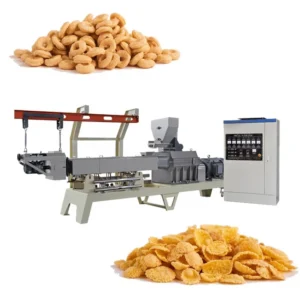
Corn Flakes Machine Breakfast Cereal Corn Flakes Production Line Cornflakes Making Machine
¥85,800.00 Select options This product has multiple variants. The options may be chosen on the product page -

MT Cocoa Flour Puffed Breakfast Cereal Production Line-High Large Capacity Multi-Fuel (Steam/Gas/Electric) New Shandong Origin
¥8,000.00 Select options This product has multiple variants. The options may be chosen on the product page -
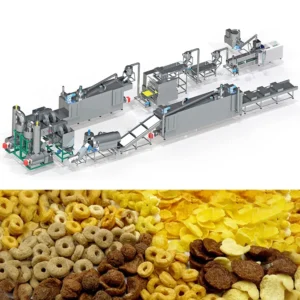
Automatic Instant Breakfast Cereals Snack Food Making Machine
¥10,000.00 Select options This product has multiple variants. The options may be chosen on the product page