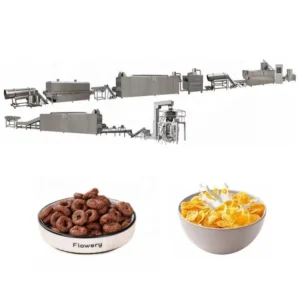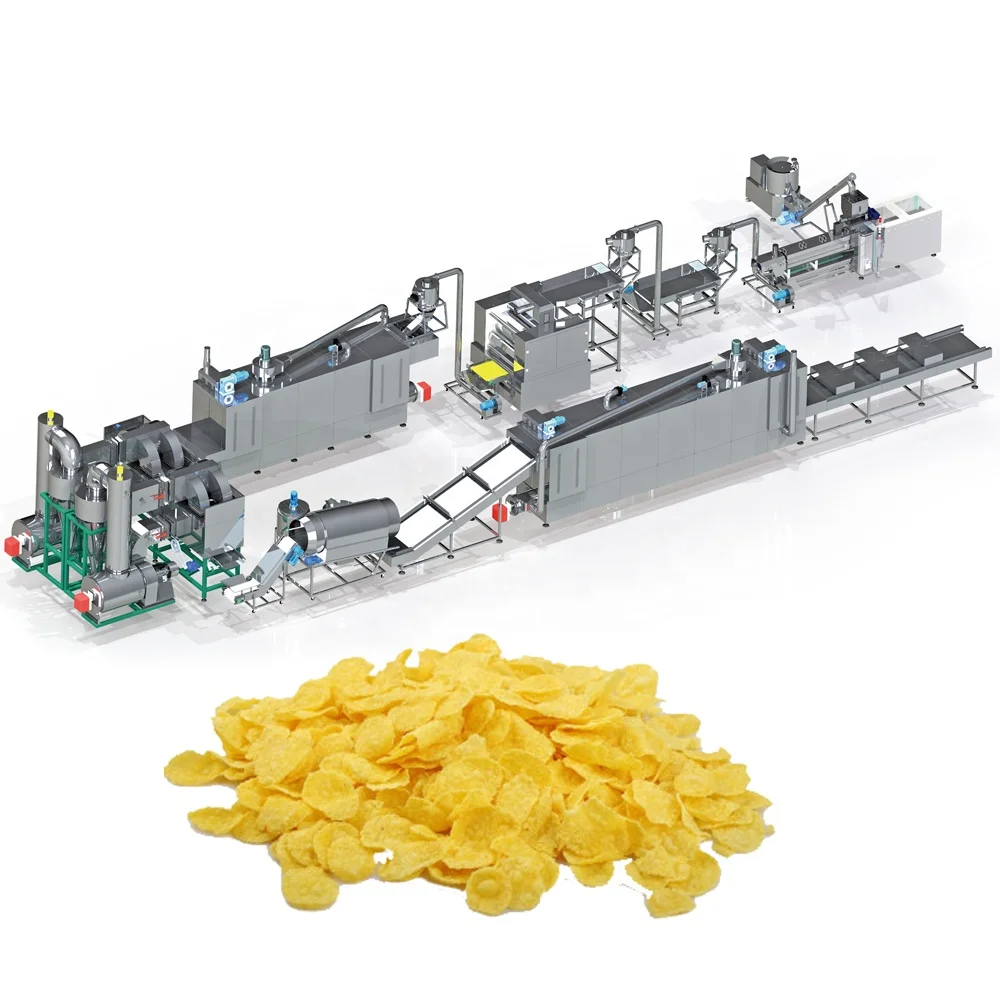


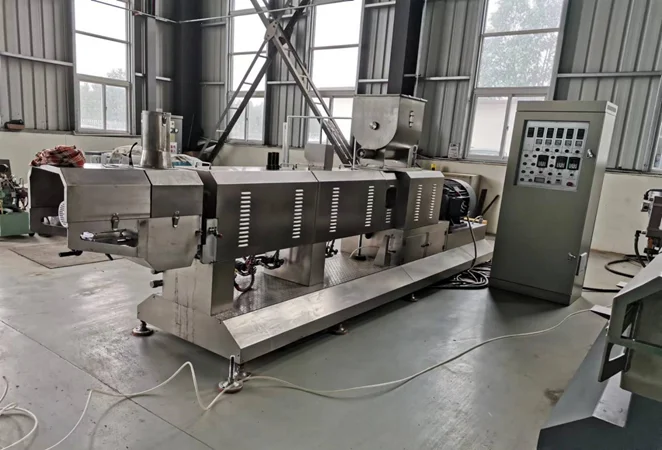


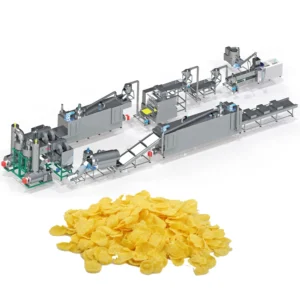
MT75 Twin Screw Corn Flakes Production Line, 210kW Installed Power, PLC Control — complete turnkey system from mixing through extrusion, flaking, drying, hot air roasting to packing.
- Twin-screw configuration matched to corn flour rheology and target flake density
- Hydraulic double-roller flaking with infrared temperature sensing
- Roasting oven with conciliation burner and cyclone dust removal
We run trial production on your actual raw material in our testing workshop before shipment, with full line layout and capacity calculation provided.
Description
Matched throughput across every station — we size the extruder, flaking rollers, dryer, and roasting oven against the same raw material throughput target so no single unit bottlenecks the line.
Technical Specifications
| Parameter | Value |
|---|---|
| Product Type | Twin Screw Corn Flakes Production Line |
| Models Available | MT70 / MT75 / MT85 |
| Screw Type | Twin-screw |
| Installed Power | MT70: 160 kW; MT75: 210 kW; MT85: 190 kW |
| Power Consumption | MT70: 120 kW; MT75: 150 kW; MT85: 140 kW |
| Output Capacity | MT70: 150–200 kg/h; MT75: 300–500 kg/h; MT85: 300–400 kg/h (basis not stated in source — confirm raw material, moisture, product format) |
| Voltage | 380V / 220V (frequency configurable to site requirement) |
| Control System | PLC at flaking station; line-wide control configurable |
| Overall Dimensions | MT70: 41×1.5×2.2 m; MT75: 45×1.5×3.5 m; MT85: 43×1.5×3.2 m |
| Flaking Roller Drive | Double motors, separate roller driving; hydraulic system |
| Flaking Temperature Control | Infrared sensor |
| Dryer Heating Source | Gas or Electric |
| Roasting Oven | Conciliation burner, dual circulating fans, cyclone dust removal |
| Coating System | Double tumble sugar melting, elevator, coating drum, spraying nozzle |
| Contact Material | Stainless steel on food contact parts |
| Standards | CE, ISO |
Application Suitability
| Application | Material or Output |
|---|---|
| Natural corn flakes for breakfast cereal packaging | Corn flour at specified moisture, flaked and roasted to blistered surface finish |
| Sugar-coated corn flakes with gloss finish | Corn flakes base with sugar syrup tumble coating and secondary drying |
| Shaped cereal formats — rings, balls, stars, fruit loops, wheels | Corn, rice, wheat, oat, or barley powder through interchangeable extruder die |
| Fortified breakfast cereal for institutional nutrition programs | Blended grain and micronutrient powder through twin-screw extrusion platform |
What "300 kg/h" Leaves Out About Corn Flake Line Capacity
Quoted output means nothing until you know which flour, what moisture, and which flake thickness the number was measured on.
I have watched lines arrive at cereal plants where the extruder nameplate promised a certain throughput, only for the actual corn flour blend — different starch content, different particle size from what the vendor tested — to choke at the die or produce flakes that broke apart on the conveyor. The extruder runs, but the flaking station downstream cannot keep up because the moisture profile is wrong, and the dryer backs up because the flakes carry too much water [NEED_CITE: twin-screw extrusion throughput dependency on raw material composition]. That is the gap between a catalog number and a corn flakes production line turnkey that actually delivers.

Matching Extruder Screw Profile to Corn Flour Starch Behaviour
A corn flakes production line turnkey starts with the screw configuration. Corn flour gelatinises at a different temperature window and shear sensitivity than rice or oat blends, and the screw elements must be sequenced to match. The twin-screw design on the MT70, MT75, and MT85 allows element rearrangement so the barrel temperature profile and shear intensity align with the buyer’s actual grain formulation rather than a generic build.
Balancing Flaking, Drying, and Roasting Against Extruder Output
The flaking station uses a hydraulic double-roller system with infrared temperature sensing to hold consistent flake thickness — critical because uneven thickness means the hot air roasting oven will blister some flakes and leave others underdone. The conciliation burner with dual circulating fans in the roasting oven distributes heat across the full tray width, and the cyclone dust removal keeps fine particulates from re-depositing on the product surface [NEED_CITE: cereal roasting uniformity requirements in commercial production]. Every station must be sized so the extruder does not starve the flaker or flood the dryer.
Reading the Spec Sheet for What It Means on the Floor
Installed power and power consumption tell different stories: the MT75 draws 210 kW installed but runs at 150 kW consumption, meaning the motors are sized with headroom for startup surge and hard formulations without tripping breakers. The PLC at the flaking station controls roller gap and temperature, which holds flake thickness batch after batch — manual adjustment drifts as the rollers heat up through a shift. Stainless steel on all food contact parts meets the hygiene standard that cereal buyers in regulated markets require for audit compliance. Voltage is listed at 380V/220V, but frequency must be confirmed before the electrical cabinet is wired; I have seen drives sit idle for weeks because a 60 Hz market received 50 Hz components.

The Hidden Cost of Mismatched Stations in a Cereal Line
When an extruder is paired with a dryer that cannot handle its output moisture load, flakes spend too long in the drying bed and develop case hardening — dry outside, wet inside — which ruins shelf stability. When the roasting oven is undersized relative to the flaking station, the line must slow down to let the oven catch up, and the extruder sits idle burning energy with no product moving. These mismatches are invisible on a quotation that lists each machine separately [NEED_CITE: throughput balancing in multi-station food processing lines]. The buyer discovers the bottleneck only after commissioning.
Why Source the Complete Line from One Supplier
Throughput matching across every station — extruder, flaking rollers, dryer, roasting oven, and coating drum — is calculated in one layout rather than negotiated across separate vendors who each size for their own machine. Screw configuration and die design are specified to the buyer’s corn flour formulation and target flake density, not copied from a standard build. An in-house testing workshop runs trial production on the buyer’s actual raw material before the line ships, so product development starts in the factory, not on the buyer’s floor after installation. Pre-sales layout design, on-site commissioning, operator training, and wear parts supply stay under one responsibility.
Documentation & Verification
- Line layout drawing with throughput calculation at each station matched to target output
- Screw element arrangement and die plate record specified to buyer’s corn flour formulation
- Electrical schematic with voltage, frequency, and PLC language confirmed against site requirement
- Trial run report on buyer’s raw material conducted in testing workshop before dispatch
- CE declaration of conformity and ISO certificate included with shipping documentation
- Operation and maintenance manual with wear parts list and replacement intervals
Installation, Commissioning & Support
- Floor plan must accommodate line lengths up to 45 m with clearance for dryer and roaster access
- Dedicated circuit required for 210 kW installed power on MT75 with breaker rated for startup surge
- Line ships in station modules; flaking rollers and roasting oven require on-site alignment and leveling
- First production run includes screw speed, barrel temperature, and roller gap parameter setting
- Operator training covers PLC interface at flaking station and roasting oven burner adjustment
- Wear parts stock includes screw elements, die plates, and flaking roller surfaces with lead times
What to Prepare Before Requesting a Quotation
To size a corn flakes production line turnkey correctly, share your corn flour specification sheet including starch content and particle size distribution, your target flake thickness and blister level, and whether the line will produce natural flakes, sugar-coated variants, or both. Confirm the local voltage and frequency at the installation site — photograph the main distribution board if possible — and the PLC language your operators require. If you have existing upstream batching or downstream packing equipment, provide make and model so the line interfaces match.
Frequently Asked Questions
Q: How is the output capacity of the line verified against my corn flour?
A: We run trial production on your actual corn flour formulation in our testing workshop before the line ships. The trial confirms screw configuration, moisture profile, flake thickness, and roasting behaviour. A written trial report with your material is included with the documentation package, so you know the quoted capacity applies to your product, not a generic benchmark.
Q: How are extruder, flaking, drying, and roasting stations balanced to prevent bottlenecks?
A: Each station is sized against the same throughput target during layout design. The extruder output moisture determines dryer residence time; the flaking station speed determines roasting oven load. We calculate and document the balance at every interface so no single unit limits the line below the target output.
Q: What voltage, frequency, and PLC language options are confirmed before production?
A: We require the buyer’s site electrical specification — voltage, phase, and frequency — before the electrical cabinet is wired. The PLC language at the flaking station is set to the operator’s preference. Frequency mismatch is a common cause of delayed commissioning, so we confirm this at quotation stage.
Q: What wear parts should I stock for the first year of operation?
A: Screw elements, die plates, and flaking roller surfaces are the primary wear items. We provide a wear parts list with the documentation package and stock replacements for dispatch. Lead times for first replacement depend on the screw configuration and roller specification chosen for your line.
Related products
-
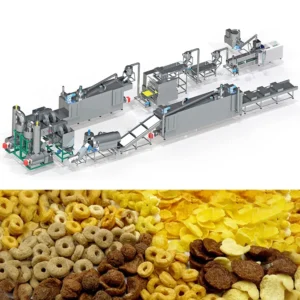
Automatic Instant Breakfast Cereals Snack Food Making Machine
¥10,000.00 Select options This product has multiple variants. The options may be chosen on the product page -
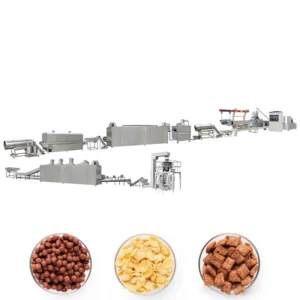
Kelloggs Corn Flakes Breakfast Cereal Normal Making Machine Breakfast Cereal Extruder Production Line
¥30,000.00 Select options This product has multiple variants. The options may be chosen on the product page -
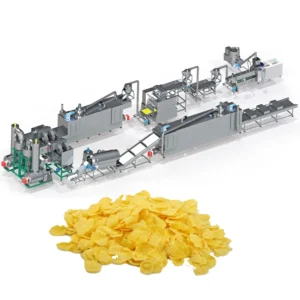
New High Efficiency Electric Corn Flakes Production & Manufacturing Machine
¥7,500.00 Select options This product has multiple variants. The options may be chosen on the product page -
New Automatic Cornflakes Making Machine Oats Snack Food Chips Extruder Processing Line
¥30.00 Select options This product has multiple variants. The options may be chosen on the product page