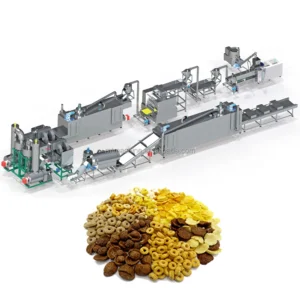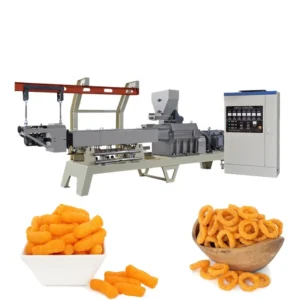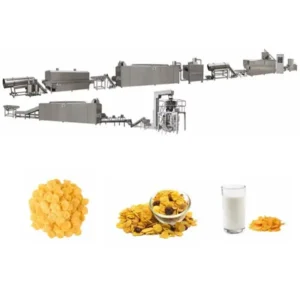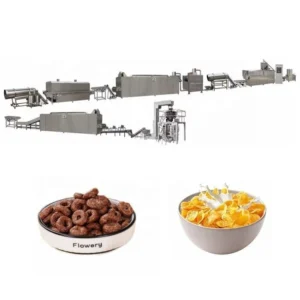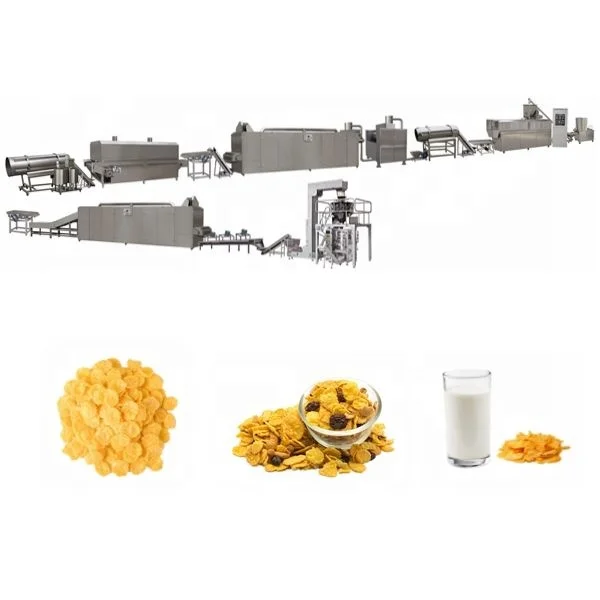


MT65 / MT70 / MT85 Corn Flakes Production Line, Twin-Screw Extruder, PLC Control — configured from batching through pressing, drying and sugar coating with throughput matched at every station.
- Screw configuration and die design specified to your grain recipe and target flake density, with sectional 38CrMoAL modules for precise shear and moisture control during gelatinisation.
- Gas-fired dual-side oven and adjustable roller press deliver consistent crispness and uniform flake thickness across the full belt width.
Trial runs on your actual maize variety run in our testing workshop before shipment, with screw records, electrical schematics and capacity calculations documented for your review.
Description
Turnkey Line Matching — Every station from batching to packing is throughput-balanced so the extruder, flake press, dryer and sugar coater run at the same pace without one blocking the next.
Technical Specifications
| Parameter | Value |
|---|---|
| Product Type | Corn Flakes Production Line |
| Model | MT65 / MT70 / MT85 |
| Screw Type | Twin screw, co-rotating sectional modules |
| Screw Material | 38CrMoAL alloy, nitriding process |
| Rated Power | MT65: 70 kW / MT70: 100 kW / MT85: 200 kW |
| Actual Power Consumption | MT65: 40 kW / MT70: 70 kW / MT85: 150 kW |
| Output Capacity | MT65: 100–150 kg/h (basis not stated in source — confirm raw material type, moisture content and pellet thickness); MT70: 200–240 kg/h (basis not stated in source); MT85: 300–400 kg/h (basis not stated in source) |
| Overall Dimensions | MT65: 20000×1200×2200 mm; MT70: 25000×1500×2200 mm; MT85: 30000×3500×4300 mm |
| Motor | SIEMENS (China) |
| Inverter | Delta |
| Control System | PLC and MCC |
| Feeding System | Food-grade stainless steel twin screw feeder with speed-adjusted converter |
| Gearbox | Automatic lubrication function |
| Cutting Mechanism | Rotary knife in die head seat, V-belt drive |
| Mixer Capacity | 10–30 kg/load |
| Mixer Power | 4 kW |
| Corn Flakes Press Machine Power | 16.12 kW |
| Corn Flakes Press Roller Size | 510×310×1050 mm |
| Press Features | Adjustable roller distance for flake thickness; integrated cooling system |
| High-Temperature Oven Dimensions | 4.5×1.4×1.8 m |
| High-Temperature Oven Power | 3.75 kW |
| Oven Fuel | Gas, dual-side baking system |
| Sugar Spraying System Power | 28.75 kW |
| Sugar Spraying Roller Size | Ø600×2700 mm |
| Multilayer Dryer Options | 3-layer 5 m to 7-layer 11 m; electric or steam heating; 0–200 °C; stainless steel double-layer mesh belt |
| Voltage & Frequency | Configurable to target market (basis to be confirmed) |
| Certification | CE / ISO |
| Warranty | 1 year from commissioning completion |
Application Suitability
| Application | Material or Output |
|---|---|
| Breakfast corn flakes from maize | Corn powder, corn grits |
| Multigrain flaked cereals | Wheat, oat, rye, rice blends |
| Sugar-coated cereal flakes | Corn or cereal base with sugar spraying |
| Fortified breakfast cereals | Grain blends with soybean powder or nutritional additives |
| Plain and flavored flaked formats | Various grain powders through extrusion and pressing |
Why the Corn Flakes Production Line Turnkey Must Match Every Station
A 300 kg/h extruder feeding a 150 kg/h dryer does not produce 300 kg/h of corn flakes.
I once watched a line in South Asia where the extruder ran flat-out but the dryer backed up so badly that half-cooked pellets sat in the hoister for twenty minutes, swelling unevenly before they ever reached the press. The operator kept slowing the extruder down, which dropped barrel temperature, which changed gelatinisation. By noon the flakes came out brittle and undersized. That corn flakes production line turnkey had every machine on paper, but nobody had checked whether the stations agreed on throughput. [NEED_CITE: throughput mismatch causes in extrusion-based cereal lines]
How Screw Configuration Shapes Flake Texture
The twin-screw extruder uses sectional modules cut from 38CrMoAL nitrided alloy, and the arrangement of those modules determines how much shear the corn mash receives inside the barrel. A corn flakes production line turnkey aimed at thick, crunchy flakes needs a longer compression zone and a specific die land length to hold back-pressure steady. Swap the raw material to a higher-fat soybean blend and the same screw profile will slip, producing under-gelatinised pellets that crack when the press rollers close. We set the configuration to the buyer’s recipe before the machine ships, not after commissioning reveals a problem.
Dryer and Oven Sequencing for Consistent Moisture Drop
After the extruder cuts the pellets, the multilayer dryer pulls moisture down in stages — the stainless steel mesh belt carries them through up to seven layers at temperatures reaching 200 °C. The gas-fired high-temperature oven then toasts both sides of each flake simultaneously. If the dryer exits the pellets too wet, the oven surface-sears them while the core stays soft; too dry and the flakes shatter at the sifter. [NEED_CITE: moisture gradient control in multi-stage cereal drying] Getting that sequence right is the reason the line is designed as a single coordinated project rather than a stack of standalone machines.
Reading the Specs That Actually Matter for Flake Quality
The press machine’s 510×310×1050 mm rollers and adjustable gap directly set flake thickness — a 0.3 mm change in gap alters how the oven toasts the centre versus the edge. The Delta inverter on the extruder and cutting motor keeps screw speed constant even as raw material viscosity shifts between batches, which matters because a 5 RPM drop at the die face changes pellet weight and therefore flake diameter. The food-grade stainless steel twin screw feeder runs on its own converter so feed rate can be tuned independently of screw speed, decoupling throughput from barrel residence time. Gas heating in the oven, rather than electric elements, delivers the rapid radiant heat that sets surface crispness without over-drying. Together these parameters define the window inside which the line produces corn flakes that meet market expectations for crunch, colour and bowl life.
The Hidden Cost of Skipping a Pre-Shipment Trial Run
Lines that leave the factory without a trial on the buyer’s actual grain tend to discover recipe problems during commissioning, when every hour of downtime costs production days. I saw a West African project where the local maize variety had a coarser grind than the standard test flour; the pellets tore at the press rollers, and the sugar coating pooled in the cracks instead of forming an even shell. The sugar spraying system’s Ø600×2700 mm drum was perfectly capable, but the upstream texture was wrong. A trial run in the testing workshop would have flagged the grind size in a single afternoon. [NEED_CITE: raw material variability impact on extruded cereal quality]
Why a Single-Supplier Project Reduces Finger-Pointing
Every station on this corn flakes production line turnkey is specified by the same engineering team, which means the hoister capacity, dryer belt speed, press throughput and sugar drum volume are calculated against one another rather than ordered from separate catalogues. The twin-screw expertise spans the entire material path — from how the mixer’s 10–30 kg batch load feeds the conveyor, through barrel gelatinisation, to the final sifter and packing machine. Screw and die configuration is recorded against the buyer’s target flake density. The in-house testing workshop runs the actual raw material before dispatch, producing a trial report rather than a generic certificate. On-site installation includes line-level commissioning so that control logic across PLC and MCC is tuned as a single system, not station by station.
Documentation & Verification
- Line layout and capacity calculation matching extruder, press, dryer and coater throughput
- Trial run report on buyer’s specific maize or grain recipe before shipment
- Screw and die configuration record tied to target flake thickness and density
- Electrical schematic with voltage and frequency confirmed for destination market
- Operation and maintenance manual covering every station from mixer to packing machine
- Wear parts list with lead times for screws, dies and press roller consumables
Installation, Commissioning & Support
- Floor plan and utility layout sized to the chosen model’s footprint up to 30 m long
- Dedicated power circuit planned around the MT85’s 200 kW rated draw
- Modular station delivery allowing phased assembly in height-restricted buildings
- First-run parameter setting across PLC and MCC for the buyer’s recipe
- Operator training on roller gap adjustment, screw speed tuning and dryer temperature staging
- Spare screw modules and die inserts stocked for first replacement cycle
What to Include in Your Inquiry
Send your target grain type and any blend ratios, the daily output you plan to run, and the workshop dimensions including clear height. Confirm the local voltage and frequency, the control language your operators read, and whether you need sugar-coated, plain or both flake formats. If you already have upstream milling or downstream packing equipment, share those specs so the line interfaces correctly. A sample of your raw material — at least 50 kg — allows us to run a trial before the quotation is finalised.
Frequently Asked Questions
Q: How is line throughput verified across every station to avoid bottlenecks?
A: Each station — mixer, extruder, dryer, press, oven, sugar drum, sifter — is capacity-calculated against the others during layout design. The line layout document shows the matched throughput at every point so no single machine limits the rest. This calculation is reviewed with the buyer before production begins.
Q: Can a trial run be conducted on our specific maize variety and recipe before shipment?
A: Yes. Send a raw material sample to the in-house testing workshop, and a full extrusion and pressing trial is run using the proposed screw configuration and die design. A written trial report covering pellet texture, flake thickness and surface quality is delivered before the line ships.
Q: How are voltage, frequency and control language confirmed before production?
A: The electrical schematic is drafted with the buyer’s destination-market power standards and preferred HMI language. This document is signed off before the control panels are wired, so the PLC and MCC arrive configured for the local grid and operator interface requirements.
Q: What does on-site installation and operator training cover?
A: Engineers assemble every station, run the full line with the buyer’s raw material, and tune screw speed, roller gap and oven temperature to the target flake specification. Operators are trained on daily start-up, recipe changeover and routine maintenance including screw module and die replacement.
Q: How are screw configuration and die design selected for different grain inputs?
A: The screw module arrangement and die geometry are matched to the buyer’s raw material composition, moisture content and target flake density. Higher-fat or higher-fibre blends require different compression zones and die land lengths, and the configuration record documents every choice made.
Related products
-
New High Efficiency Electric Corn Flakes Production & Manufacturing Machine
¥7,500.00 Select options This product has multiple variants. The options may be chosen on the product page -
Automatic Cornflakes Making Machine Corn Flakes Breakfast Cereals Processing Production Line
¥500.00 Select options This product has multiple variants. The options may be chosen on the product page -
1000 Lbs Automatic Corn Flakes Production Line Mixer Breakfast Cereal Corn Flakes Production Line
¥45,000.00 Select options This product has multiple variants. The options may be chosen on the product page -
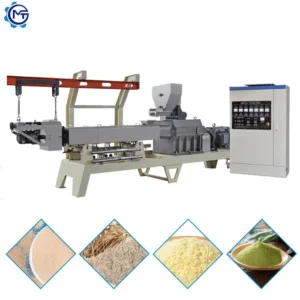
New Technical Automatic Cereal Nutritional Powder Instant Porridge Baby Food Making Machine
¥10,000.00 Select options This product has multiple variants. The options may be chosen on the product page