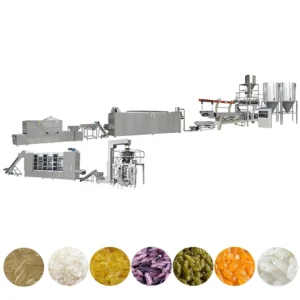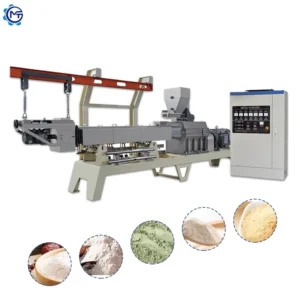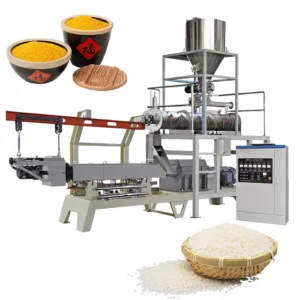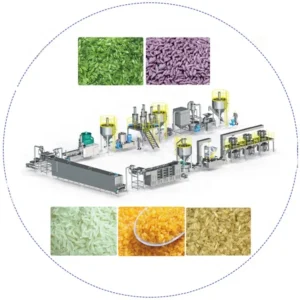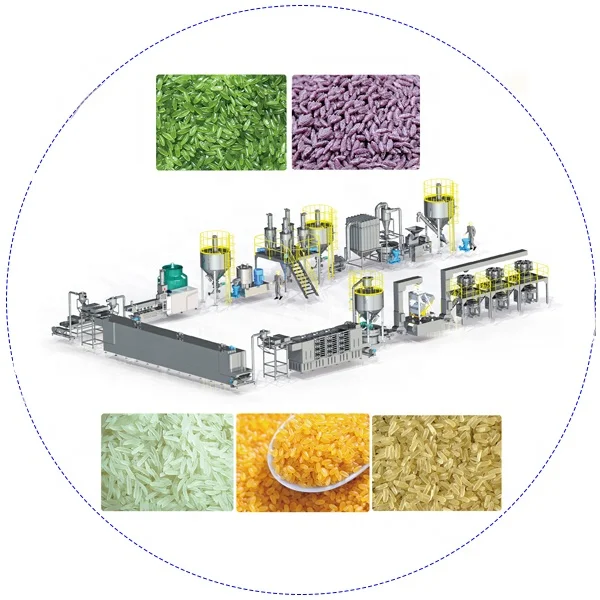
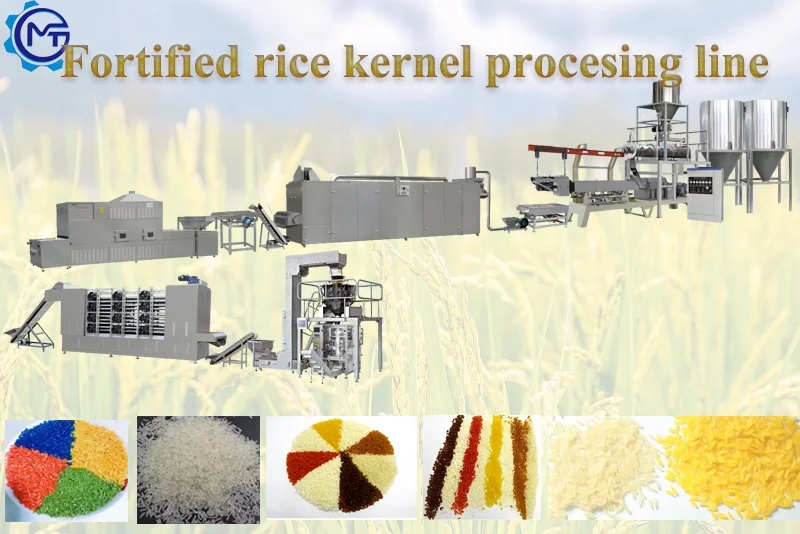
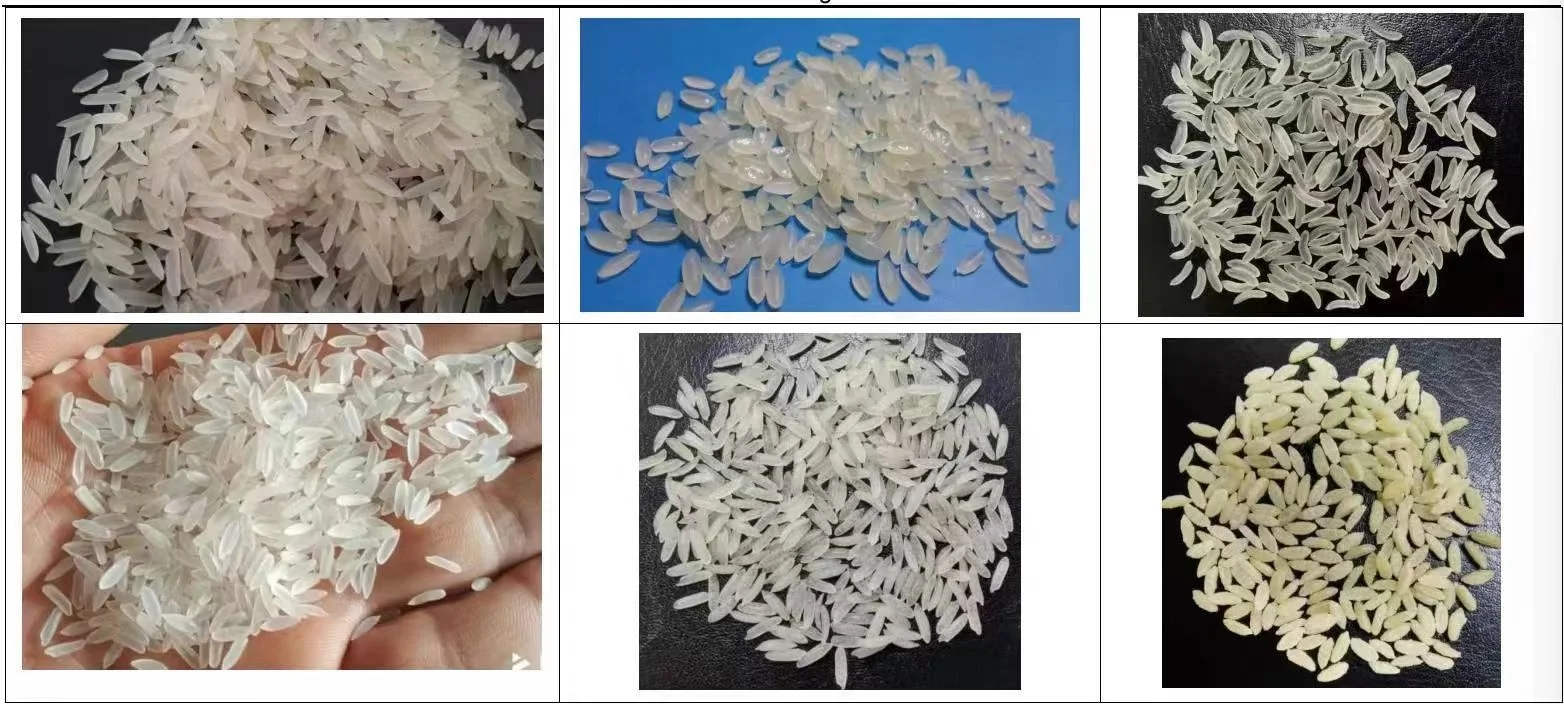
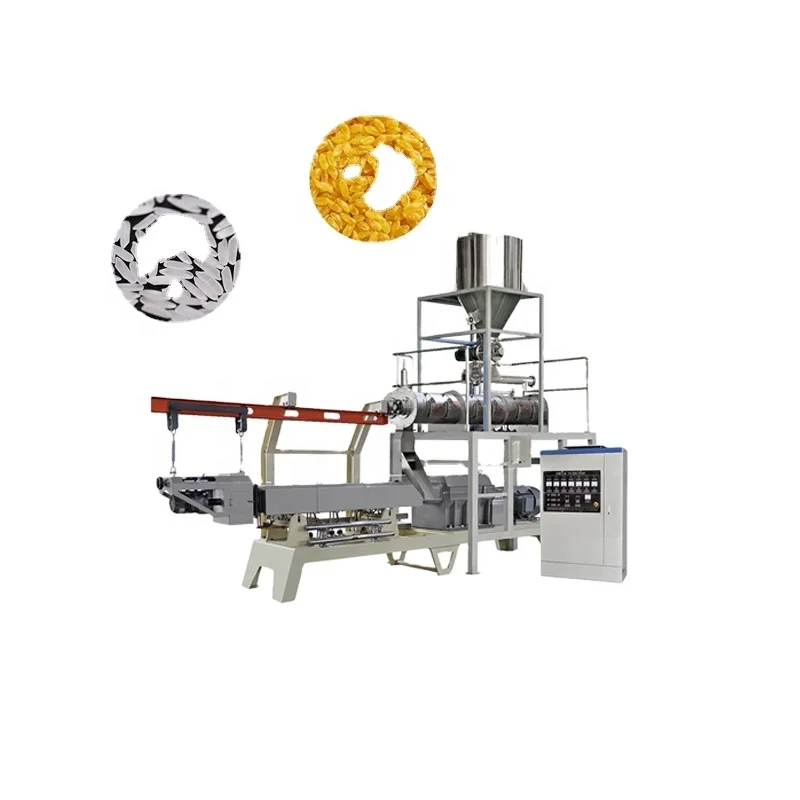
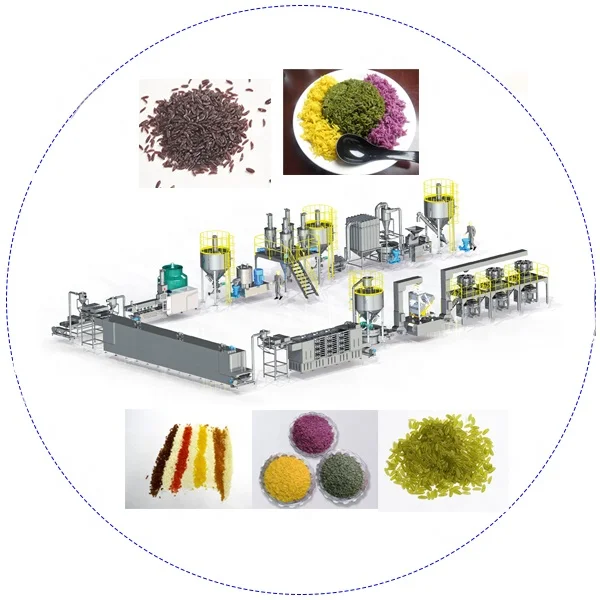
MT65 Fortified Rice Production Line, Twin-Screw Extruder, 85 kW Installed Power — complete turnkey layout from batching through extrusion, drying and packing under one supplier.
Screw configuration and die design are specified to the buyer’s raw material and target kernel density, while line stations are throughput-matched to eliminate bottlenecks between the extruder, mesh-belt dryer and packing end.
- Basic materials include broken rice, corn, millet, wheat, starch with added vitamins and minerals
- Frequency speed control with automatic lubricating and cooling system
- In-house trial run on customer raw material before shipment, with full report provided
Description
Balanced Throughput Across Every Station — each mixing, extruding, drying and packing unit is matched to the MT65 twin-screw extruder output so the line never bottlenecks at a single machine.
Technical Specifications
| Parameter | Value |
|---|---|
| Product Type | Fortified Rice Production Line |
| Installed Power | 85 kW |
| Power Consumption | 60 kW |
| Capacity | 80–100 kg/hr (basis not stated in source — confirm raw material / moisture) |
| Overall Dimensions | 28 × 1.2 × 2.2 m |
| Screw Type | Twin screw |
| Control System | Frequency speed control with high automation |
| Feeding System | Single or double screw feeding selectable per material |
| Lubrication | Automatic lubricating and cooling system |
| Drying Oven Heating Source | Electric or gas |
| Standards | CE, ISO |
Application Suitability
| Application | Material or Output |
|---|---|
| Fortified rice for nutrition programmes | Broken rice, rice flour, corn, wheat with vitamin and mineral premixes |
| Artificial rice from milling by-products | Rice bran, broken rice, starch binders |
| Grain-based nutritional kernels | Millet, oats, buckwheat, bean flour with micro-nutrient addition |
Why Nominal Line Capacity Rarely Survives First Production Day
Rated throughput only holds when the screw profile and barrel temperatures match the buyer’s exact flour blend and moisture level.
A fortified rice production line turnkey quoted at a clean capacity figure often assumes a standard rice flour recipe at ideal moisture. In practice, nutrition programme suppliers add vitamin and mineral premixes that alter dough rheology, and broken-rice feedstock varies in starch damage from batch to batch. The extruder then surges or produces half-formed kernels until the barrel zones and screw elements are re-profiled on site — a process that can consume several days of commissioning time [NEED_CITE: extrusion process stability and raw material variability].
Screw Configuration Dictates Kernel Density and Cooking Behaviour
The twin-screw extruder at the heart of this fortified rice production line turnkey is configured after reviewing the buyer’s raw material composition and target kernel density. Screw element spacing, pitch and kneading block arrangement determine shear intensity inside the barrel, which controls how completely the starch gelatinises before the die plate. A rice kernel destined for rapid-cook formats needs a different internal structure than one designed to withstand long boiling in field kitchens, and that difference is engineered at the screw level rather than adjusted later on the dryer.
Matching Dryer and Cooler Capacity to the Extruder Output
A frequent cause of line stoppages is a mesh-belt dryer that cannot evaporate moisture fast enough to keep pace with the extruder, forcing the operator to throttle feed rate and lose throughput. The drying and cooling stations on this line are sized to handle the extruder’s maximum output, and the electric or gas heating option allows the buyer to select the energy source available at the plant. Low-temperature drying preserves heat-sensitive vitamins added in the mix, while the downstream high-temperature roasting step develops the surface colour and texture buyers expect in artificial rice kernels [NEED_CITE: thermal sensitivity of vitamin premixes during drying].
What the Power and Dimension Figures Mean on the Floor
The 85 kW installed power across the 28-metre line length covers the twin-screw extruder main drive, the vibrating conveyor, the multi-pass dryer and both cooling stages. Actual power consumption sits around 60 kW under normal load, which informs transformer sizing and dedicated circuit planning. Frequency speed control on the extruder and downstream conveyors lets the operator fine-tune line speed without stopping, while the automatic lubricating and cooling system reduces manual greasing intervals on the screw bearings — a practical advantage in continuous-shift operations where missed lubrication leads to premature wear.
The Hidden Cost of Skipping a Pre-Shipment Trial Run
When a line ships without a trial run on the buyer’s actual recipe, all configuration adjustments happen during on-site commissioning, often under production pressure. Screw elements may need swapping, barrel temperature zones re-profiled, and die aperture re-selected — work that delays first saleable output and can strain the relationship between buyer and supplier. These delays are rarely captured in the initial project timeline, yet they directly affect the return on the capital invested in the fortified rice production line turnkey [NEED_CITE: commissioning delays in food extrusion projects].
Why Procurement Through This Turnkey Line Channel Works
Every station from the batching mixer through extrusion, drying, roasting and packing is supplied by one manufacturer, so throughput calculations are based on actual machine-to-machine hand-off rather than catalogue figures from different vendors. The in-house testing workshop runs the buyer’s raw material before shipment, generating a trial report that locks in screw and die configuration. Electrical schematics confirm voltage, frequency and control language for the destination market before the control cabinets are wired. CE and ISO documentation accompanies each shipment, and wear parts lists identify screw elements, die plates and dryer belt sections that should be stocked from day one.
Documentation & Verification
- Line layout drawing showing station-by-station throughput balance for the MT65 configuration
- Trial run report on buyer’s fortified flour blend recording screw speed, barrel temperatures and kernel density
- Screw and die configuration record matched to the target rice kernel shape and cooking time
- Electrical schematic with confirmed voltage, frequency and PLC language for the destination country
- CE declaration of conformity and ISO certificate included with shipping documentation
Installation, Commissioning & Support
- Foundation plan references the 28 × 1.2 × 2.2 m overall footprint and load-bearing points for each station
- Dedicated circuit sized for 85 kW installed power with separate breaker for the dryer heating source
- Extruder barrel sections arrive assembled; screw elements installed and aligned during commissioning
- First production run validates the trial-run screw configuration against actual site conditions
- Operator training covers frequency speed control settings for different raw material batches
- Wear parts list specifies twin-screw elements, die plates and mesh-belt sections for initial spares inventory
Preparing Your Line Inquiry
To move from a general capacity discussion to a firm configuration, the buyer should share the exact flour blend composition including vitamin and mineral premix percentages, target daily output in kilograms, and available plant floor dimensions. Confirming local voltage, frequency and preferred control language at inquiry stage prevents rewiring or reprogramming during commissioning. If the buyer already operates upstream milling or downstream packing equipment, interface dimensions and conveyor heights should be provided so the line integrates without modification.
Frequently Asked Questions
Q: How is line capacity verified against the buyer’s actual raw material and recipe?
A: The buyer sends a representative sample of the production-grade flour blend, including all vitamin and mineral premixes. A trial run is performed in the testing workshop, recording screw speed, barrel zone temperatures, moisture content and kernel density. The resulting report confirms achievable throughput before the configuration is locked for production.
Q: What voltage, frequency and control language options are available for the destination market?
A: The electrical system is configured after the buyer confirms local supply specifications. Control panels are built with the agreed voltage and frequency, and the operator interface is programmed in the requested language. This confirmation step takes place before the control cabinets are assembled and wired.
Q: How are screw configuration and die design selected for different fortified rice formulations?
A: The screw element sequence and die aperture are chosen based on the starch content, fat level and particle size of the buyer’s flour blend. Higher fiber or protein content typically requires adjusted kneading block placement to maintain consistent gelatinisation and kernel shape across the die plate.
Q: Is a trial run on the buyer’s raw material performed before shipment?
A: Yes. The testing workshop runs the buyer’s exact recipe through the MT65 extruder and supporting stations. The trial report documents process parameters and product quality measurements, forming the baseline configuration that is replicated when the line is installed at the buyer’s facility.
Q: How is throughput matched between the extruder, dryer and packing stations to prevent bottlenecks?
A: Each station is selected so its maximum handling capacity equals or exceeds the extruder output. The dryer belt length and heating capacity, the cooler airflow and the packing scale speed are all calculated against the extruder’s rated throughput on the confirmed raw material.
Related products
-

High Precision Automatic 500kg/h Baby Food Nutrition Powder Rice Extrusion Processing Line
¥9,500.00 Add to cart -
Fully Automatic 500kg/h Baby Cereal Nutrition Powder Extrusion Drying Line with PLC Control
¥9,500.00 Add to cart -
Small Scale MT Brand Automatic Baby Food Nutrition Powder Rice Flour Making Machine with 500kg/h Production Capacity PLC Control
¥9,500.00 Add to cart -

Automatic Instant Powder Production Line Nutritional Powder Extruder Machine
¥10,000.00 Select options This product has multiple variants. The options may be chosen on the product page