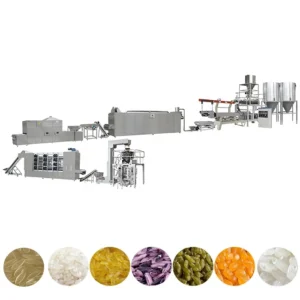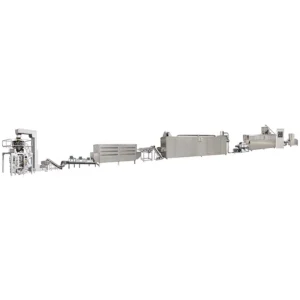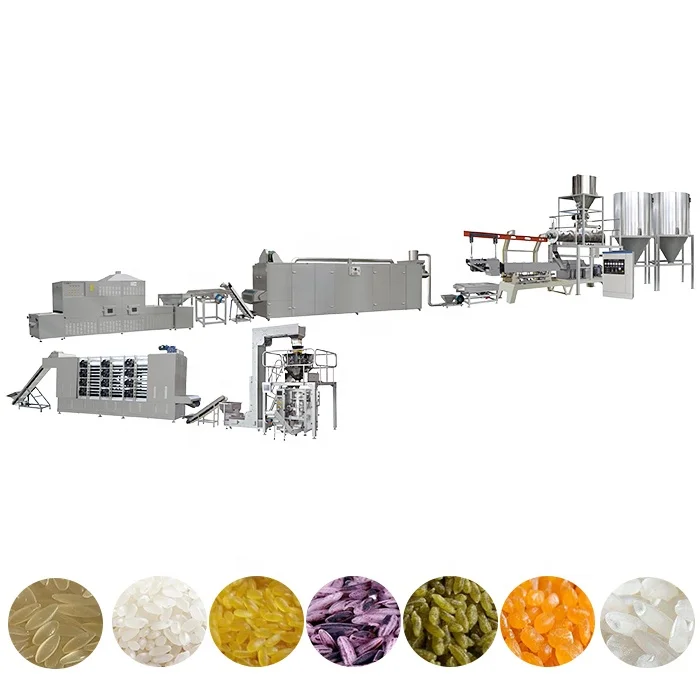


Fortified Rice Production Line, Twin Screw Extruder, Three-Stage Process, Turnkey Integration — engineered for plant builders executing complete nutritional rice projects.
- Twin-screw extrusion with screw and die configuration matched to raw material and target grain shape, controlling expansion and density across varied formulations
- Integrated vibrating screen, drying box, air conveyor and lifting machine maintain continuous flow with throughput balanced at every station
In-house testing workshop validates your fortified rice formulation before shipment, with trial run reports confirming yield and grain quality against your specification.
Description
Integrated line engineering — throughput matched across every station from batching to packing, with on-site commissioning schedules phased to the contractor’s site readiness rather than the factory’s shipping date.
Technical Specifications
| Parameter | Value |
|---|---|
| Product Type | Fortified Rice Production Line |
| Line Configuration | Fully Automatic Three-Stage Production Line |
| Process Stations | Mixing, Feeding, Extruding, Screening, Drying, Cooling, Packing |
| Extruder Type | Twin Screw |
| Mixing System | Powder Mixer with Preset Ratio Blending |
| Conveying | Feeder, Air Conveyor, Lifting Machine |
| Drying System | Vibrating Screen with Fan and Drying Box |
| Assembly State | Turnkey Integrated Line |
| Material Contact Grade | Food Grade |
| Output Capacity | (basis to be confirmed with manufacturer based on formulation) |
| Voltage & Frequency | (configurable to target installation site — confirm before order) |
Application Suitability
| Application | Material or Output |
|---|---|
| Fortified rice production for institutional feeding programmes | Rice flour blended with vitamin and mineral premix |
| Artificial rice grain manufacturing | Broken rice, corn starch, and legume flour composites |
| Nutritional rice for infant weaning products | Pre-cooked rice flour with protein and micronutrient fortification |
| Government nutrition programme supply | Multi-grain flour blends shaped into rice-grain geometry |
What a "Nominal Capacity" Quote Leaves Out About Fortified Rice Lines
Capacity confirmed on the buyer’s actual formulation, not a standard test starch, before the line ships.
I once stood in a humidity-controlled commissioning room watching a nutritional powder line produce perfect grains on standard rice flour, only to arrive at the customer’s facility and discover their premix contained 30% whey protein isolate that shifted gelatinisation temperature entirely. Four days of screw speed and barrel temperature recalibration followed while the plant manager waited at the workshop door each morning. The Fortified Rice Production Line turnkey approach means the testing workshop runs your specific blend — with its exact protein, fat, and fibre ratios — before the extruder ever leaves the factory [NEED_CITE: gelatinisation behaviour of protein-fortified starch matrices].
How Screw Configuration Shapes Grain Density and Cooking Behaviour
The twin-screw extruder on this Fortified Rice Production Line uses screw elements and die geometry specified to the buyer’s raw material profile, not copied from a generic build. High-protein formulations require different shear profiles than pure starch blends to achieve the target grain density without surface cracking. The die face cut determines whether the artificial grain mimics long-grain or short-grain rice geometry, which directly affects how the product behaves during consumer cooking.
Why Dryer and Extruder Sizing Must Be Matched Before Fabrication
An extruder pushing material faster than the downstream vibrating screen and drying box can handle creates a bottleneck where wet grains clump and stick to the screen mesh. The drying box fan capacity and residence time must be calculated against the extruder’s actual output moisture content, not its theoretical maximum throughput. When the line is engineered as one system under a single supplier, the dryer capacity is locked to the extruder’s real-world output on your formulation [NEED_CITE: moisture migration kinetics in extruded cereal grains during convective drying].
Reading the Specs That Actually Matter on Site
The powder mixer with preset ratio blending ensures the vitamin-mineral premix disperses uniformly before the material enters the feeder — uneven blending creates hot spots of micronutrients that can degrade under extrusion heat. The air conveyor and lifting machine eliminate manual transfer points where fortified rice grains can fracture before drying is complete. Food-grade contact materials throughout the line meet the sanitary requirements of products destined for infant formula or institutional nutrition programmes. The three-stage process — extrusion, screening, drying — prevents undersized or misshapen grains from entering the dryer, which would waste thermal energy and contaminate the finished batch.
The Hidden Cost of Skipping a Pre-Shipment Trial Run
Lines that ship without a formulation-specific trial run force all product development into the commissioning window, compressing what should be a controlled parameter sweep into a few high-pressure days on the factory floor. Screw configurations designed for generic starch produce grain surfaces that either fracture during drying or fail to cook properly at the consumer stage. When the dryer capacity is undersized relative to the extruder output, the packing station receives product at moisture levels that invite mould growth within weeks of bagging [NEED_CITE: shelf-life degradation in extruded rice products above target moisture].
Engineering the Line Around Your Site, Not the Catalogue
Every station from the mixer to the packing belt is sized against the same throughput calculation, so the Fortified Rice Production Line turnkey project avoids the common failure where one vendor’s extruder overwhelms another vendor’s dryer. Screw and die configurations are documented and recorded for each buyer’s formulation, so replacement parts match the original build rather than reverting to generic geometry. The in-house testing workshop runs the customer’s actual raw material before shipment, shifting product development risk from the commissioning site to the factory. Electrical schematics confirm voltage and frequency against the installation country’s grid standard before the control cabinet is wired. On-site commissioning includes operator training on screw speed and barrel temperature adjustments for seasonal raw material variation.
Documentation & Verification
- Line layout showing throughput matched across mixing, extrusion, drying, and packing stations
- Trial run report on buyer’s own raw material from the in-house testing workshop
- Screw and die configuration record specific to the target rice grain shape
- Electrical schematic with voltage and frequency confirmed to the installation site
- Factory test record signed off before crating and dispatch
Installation, Commissioning & Support
- Foundation and floor load calculation provided for the full three-stage line footprint
- Dedicated power circuit sizing based on extruder motor rating and drying box heater load
- Phased assembly sequence matching the contractor’s site readiness schedule
- Screw speed and barrel temperature profiles calibrated on-site to local raw material batches
- Operator training covering preset ratio blending adjustments and screen mesh replacement
- Wear parts list covering screw elements, die plates, and screen mesh with lead times
What to Include With Your Project Enquiry
Plant contractors and nutrition programme suppliers should provide the target rice grain specification — including shape, size, and cooking time requirements — along with the raw material formulation and local voltage standard. Workshop trial runs require a representative sample of the actual premix blend, including any protein or fat components that alter extrusion behaviour. Confirming the installation site’s ambient temperature and humidity range allows the drying box fan specification to be sized correctly before fabrication.
Frequently Asked Questions
Q: How is line capacity verified on the buyer’s actual fortified rice formulation before shipment?
A: The testing workshop receives a sample of the buyer’s complete raw material blend and runs it through the configured extruder and dryer at production-scale parameters. The trial run report documents screw speed, barrel temperature profile, grain density, and moisture content at the packing station, confirming the line holds the quoted throughput on that specific formulation rather than on a generic starch test.
Q: How is throughput matched between the extruder, dryer, and packing station?
A: Each station is sized from a single capacity calculation based on the buyer’s formulation moisture and density. The extruder output determines the dryer residence time and fan capacity, which in turn sets the packing station feed rate. No station is selected from a catalogue page without reference to the upstream and downstream equipment.
Q: What site preparation is required for a complete turnkey installation?
A: The line layout document specifies floor load per station, utility drop points for power and compressed air, and clearance dimensions for maintenance access. The electrical schematic confirms voltage and frequency to the local grid, and the phased installation schedule aligns equipment arrival with the contractor’s site readiness milestones.
Q: How are screw and die configurations selected for different rice grain shapes?
A: The screw element sequence is designed around the raw material’s gelatinisation temperature and shear sensitivity, while the die plate geometry determines grain cross-section and length. Both are recorded in the configuration document so replacement parts match the original build and maintain grain consistency across production runs.
Related products
-
Automatic Nutritional Powder Making Machine Safe Rice Cereal for Babies
¥30.00 Select options This product has multiple variants. The options may be chosen on the product page -
Compact Automatic Baby Cereal Nutrition Powder Production Line with 500kg/h Capacity and PLC Control
¥9,500.00 Add to cart -
500kg/h Automatic PLC Controlled Nutrition Baby Food Extruder Machine for Rice Cereal Processing
¥9,500.00 Add to cart -

Hygienic Stainless Steel Infant Rice Powder Processing Line Automatic 500kg/h Capacity PLC Controlled
¥9,500.00 Add to cart