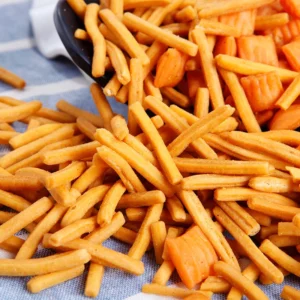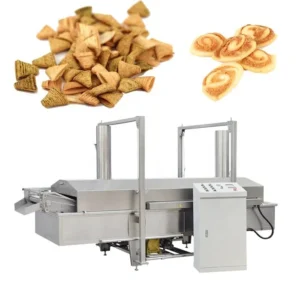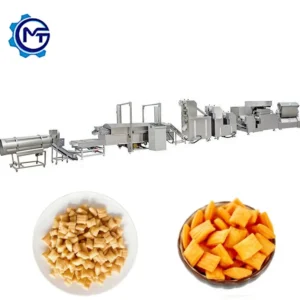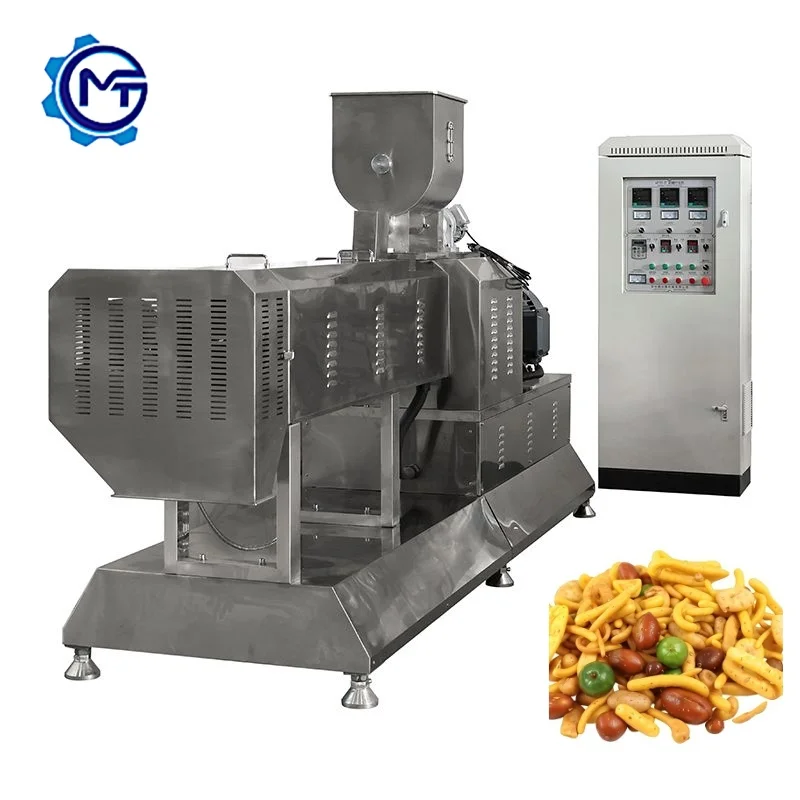
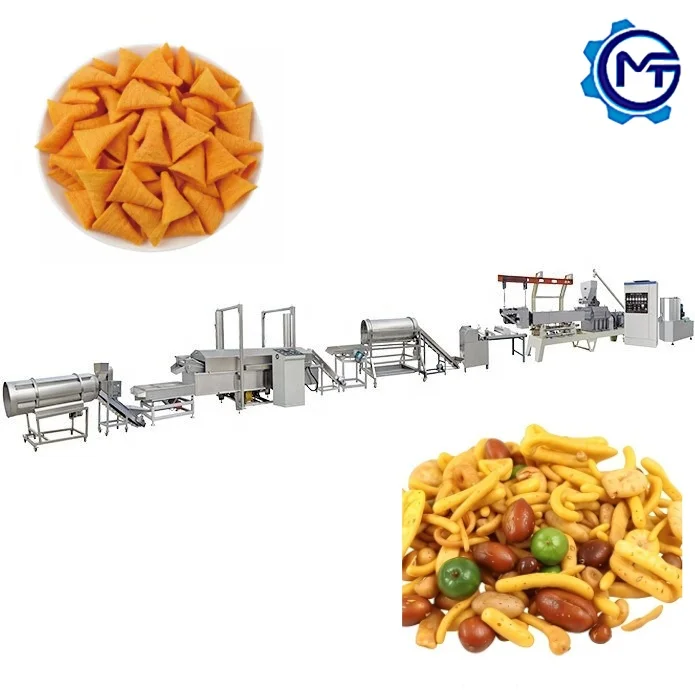

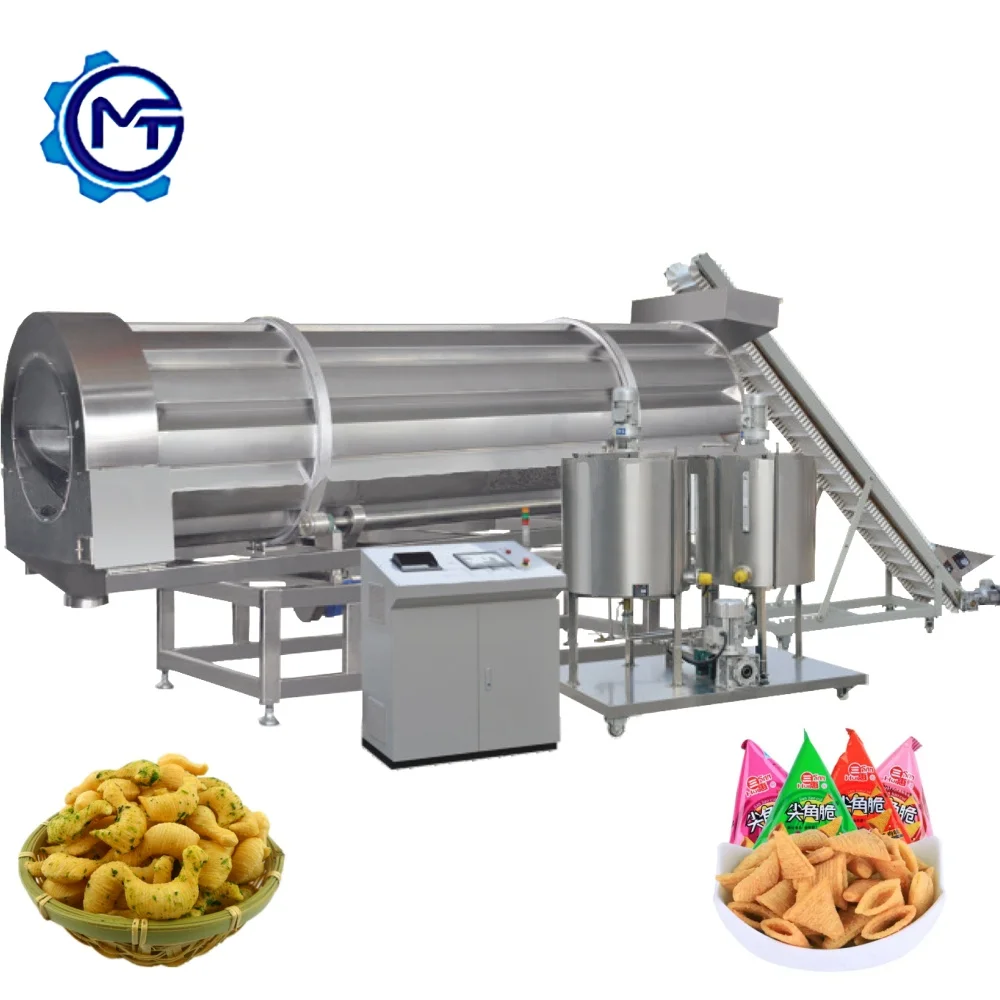
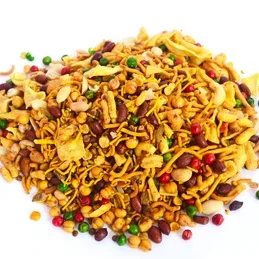

Fried Snack Production Line, 380V/50Hz, PLC Control, 60 kW Heating — throughput-matched from extrusion through frying, de-oiling, seasoning, and packing under one supplier. Continuous double-layer mesh belt fryer with stepless speed control and oil circulation filtration ensures consistent product color and texture across batches. Dual electricity/gas heating adapts to local utility conditions.
- Screw and die configuration specified to your raw material and target product
- Trial run on customer recipe in our testing workshop before shipment
- Complete electrical schematic with voltage, frequency, and control language confirmed pre-delivery
Description
Throughput-Matched Engineering — Every station on this fried snack production line is calculated against your actual recipe and target output, so no single machine bottlenecks the next.
Technical Specifications
| Parameter | Value |
|---|---|
| Product Type | Continuous Frying Machine / Fried Snack Production Line |
| Overall Dimensions (L×W×H) | 6700 × 2200 × 1200 mm |
| Net Weight | 2000 kg |
| Oil Capacity | 320 L |
| Heating Tube Power | 60 kW |
| Rated Power (control/auxiliary) | 2.6 kW |
| Voltage & Frequency | 380V / 50Hz |
| Control System | PLC |
| Heating Method | Electricity or Gas (dual option) |
| Belt Type | Upper and lower double-layer mesh belt |
| Speed Control | Frequency conversion stepless speed regulation |
| Oil Filtration | Continuous oil circulation filtration system |
| Slag Discharge | Bottom slag discharge system |
| Lifting System | Automatic lifting for upper hood and mesh belt |
| Material | Food-grade 304 Stainless Steel |
| Capacity Range | 100–1000 kg/h (basis not stated in source) |
| Warranty | 1 Year (core components included) |
| Certification | CE, ISO |
Application Suitability
| Application | Material or Output |
|---|---|
| Fried nimko production | Chickpea flour, besan dough sheets cut into strips |
| Extruded fried snack lines | Corn grits, rice flour, wheat-based pellets post-extrusion |
| Traditional fried chips | Potato slices, tapioca sheets, plantain rounds |
| Puffed pellet frying | 2D/3D starch-based pellets requiring oil immersion |
| Snack seasoning integration | Fried output fed directly to flavouring drums |
What "100–1000 kg/h" Actually Depends On
Capacity on a fryer is meaningless without stating the product, moisture level, and residence time that produced the number.
I spent years on assembly floors before moving into line planning here in Shandong, and the most expensive mistakes I have watched clients make came from taking a capacity range at face value. A buyer orders a fryer rated for the top of the range, then discovers their specific dough formulation requires nearly double the dwell time inside the oil bath. Throughput drops, upstream extruders pile product on the conveyor, and the whole fried snack production line turnkey concept falls apart before the seasoning drum ever sees a single piece.
The range stated for this continuous fryer reflects different product densities, moisture contents, and frying durations across snack categories. A light, thin-cut chip passes through the oil in a fraction of the time needed for a dense besan nimko strip. Until your specific raw material, cut geometry, and target moisture after frying are defined, no one can tell you which end of that range your line will actually run at [NEED_CITE: frying time variables by snack product type]. That is why we run your material in our testing workshop before anything ships.
Matching Oil Residence Time to Your Snack Format
The double-layer mesh belt on this fryer submerges product completely and controls travel speed through frequency-driven stepless regulation. This matters because different snack formats demand different oil exposure windows. A thin extruded pellet may need only seconds of immersion, while a traditional nimko strip requires a longer pass to drive internal moisture down to the level where crunch is stable through packaging and shelf life. The fried snack production line turnkey configuration we propose specifies belt speed based on trial data, not catalog assumptions.
Oil Filtration as a Quality Variable, Not a Convenience Feature
Continuous oil circulation filtration removes fine particulate and carbonized fragments before they accumulate and alter heat transfer. In snack frying, degraded oil shifts surface color toward dark brown while the interior remains underdone — a defect that shows up as inconsistent batch color on the packing table. The 320 L oil volume in this system, combined with bottom slag discharge, keeps suspended solids below the threshold where flavor carry-over becomes detectable. For buyers running high-protein doughs like besan, this filtration loop is the difference between a clean golden finish and a mottled surface that triggers rejection at the retailer [NEED_CITE: oil degradation impact on snack surface quality].
Reading the Power and Heating Specs Correctly
The 60 kW heating tube array and 2.6 kW control circuit are separate loads, and both must be accounted for in the buyer’s electrical planning. Total installed power at the fryer station is the sum of heating and auxiliary circuits, which determines transformer sizing and dedicated breaker allocation. The dual electricity-or-gas heating option exists because export markets differ sharply in energy cost structure: a plant running on subsidized natural gas in one region faces completely different unit economics than one paying industrial electricity tariffs elsewhere. Voltage and frequency are confirmed during the specification phase, before production starts, so the control panel and heating contactors match the site supply [NEED_CITE: industrial voltage and frequency standards by export market].
The PLC governing belt speed, oil temperature, and filtration pump sequencing stores recipe parameters so shift operators can recall proven settings rather than adjusting manually each run. Food-grade 304 stainless steel construction across all contact surfaces meets hygiene expectations in snack markets with strict metal-detection and cleanability audits. The automatic lifting system for the upper hood and mesh belt shortens the cleaning window between product changeovers, which matters on lines that alternate between seasoned and unseasoned formats.
When Undersized Frying Capacity Derails a Line
A fryer that cannot keep pace with the extruder upstream forces operators to slow the entire line or let product accumulate on transfer conveyors. Sitting extruded pieces lose surface moisture unevenly, which means they enter the oil at inconsistent states and exit with variable color and texture. I have seen lines where the extrusion station was specified correctly but the frying stage was selected from a generic catalog page without recalculating for the buyer’s actual piece weight and required dwell time. The result is a line that technically runs but produces reject rates that erase the margin on every shift.
Why Procurement Starts With Your Material, Not Our Catalog
We build the fried snack production line turnkey proposal around your raw material behavior, not a standard template. Screw and die configurations upstream are matched to your flour particle size and starch content. The fryer belt speed and oil temperature profile are set during a trial run on your actual recipe in our testing workshop. Electrical schematics confirm voltage, frequency, and PLC language before fabrication begins. Every station — mixing, extrusion, frying, de-oiling, seasoning, packing — is throughput-calculated as a single system so nothing starves and nothing floods. Documentation covers line layout with capacity calculations, trial run reports, screw configuration records, and operation manuals specific to your product format.
Documentation & Verification
- Line layout drawing with station-by-station throughput calculations for your snack format
- Trial run report from our testing workshop using your supplied raw material
- Electrical schematic confirming voltage, frequency, and PLC interface language
- Screw and die configuration record matching your target product geometry
- CE declaration of conformity and ISO certificate for customs clearance
- Machinery test report and video outgoing inspection before crating
Installation, Commissioning & Support
- Foundation leveling for the 6700 mm fryer footprint with drainage slope planning
- Dedicated electrical circuit sized for combined 60 kW heating and 2.6 kW auxiliary load
- Oil fill procedure and initial filtration system priming during first commissioning
- PLC parameter loading with recipe profiles for each confirmed snack format
- Operator training on belt speed adjustment, oil change intervals, and slag discharge
- Wear parts list covering mesh belt sections, heating tubes, and filtration elements
What We Need to Configure Your Line
To move from inquiry to a concrete proposal, share your target snack format with sample dimensions, the raw material specification including flour type and particle size, and your daily output target in finished weight. We also need your site voltage and frequency, preferred PLC operating language, and whether your facility has natural gas available if you are considering the gas heating option. If you have upstream or downstream equipment already installed, send us the model and throughput data so we can verify integration.
Frequently Asked Questions
Q: How is the fryer capacity verified before shipment?
A: We run your actual raw material in our in-house testing workshop and document oil temperature, belt speed, residence time, and finished product moisture in a trial run report. The capacity figure we quote is based on that trial data, not a generic catalog range. This ensures the fried snack production line turnkey output matches your specific recipe and product format.
Q: How do you match throughput between extrusion and frying stages?
A: Each station is calculated against the piece weight, moisture content, and dwell time your product requires. The extruder output rate is set to feed the fryer at its verified capacity, with transfer conveyors and buffer tables sized to prevent accumulation. No station is selected independently.
Q: What electrical details are confirmed before production starts?
A: We confirm site voltage, frequency, phase configuration, and PLC display language during the specification phase. The electrical schematic and heating contactor ratings are built to match your local supply. This avoids commissioning delays caused by mismatched control components or unreadable HMI text.
Q: Does the trial run include our seasoning and packing requirements?
A: The trial covers extrusion through frying and de-oiling with your material. Seasoning drum speed and coating quantity are validated based on the fried product surface condition we observe during the trial. Packing speed is then matched to the confirmed line output rate.
Related products
-
Frying Crispy 3D Corn Bugles Pellets Fried Chips Snacks Food Machine Production Line Bugles Making Extruder
¥100.00 Select options This product has multiple variants. The options may be chosen on the product page -
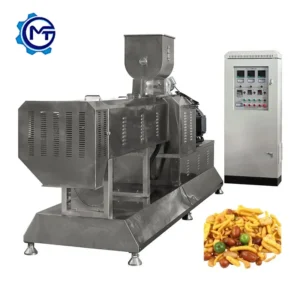
New 100-200kgh Automatic Fried Nimko Extruder Machine Food Grade Stainless Steel for High Productivity Fried Snacks Processing
¥8,575.00 Select options This product has multiple variants. The options may be chosen on the product page -
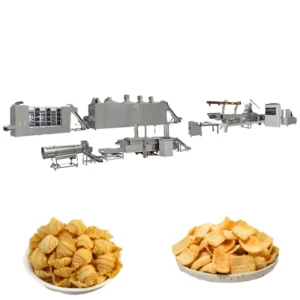
Hot Selling Puffed Ball Snacks Food Processing Line Fried Snacks Processing Line Corn Puff Snacks Machine
¥100.00 Select options This product has multiple variants. The options may be chosen on the product page -
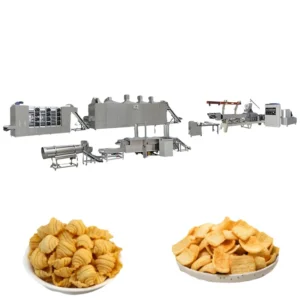
New Doritos Chips Frying Equipment Machine Automatic Tortilla Corn Chips Making Line Portable High Productivity
¥100.00 Select options This product has multiple variants. The options may be chosen on the product page