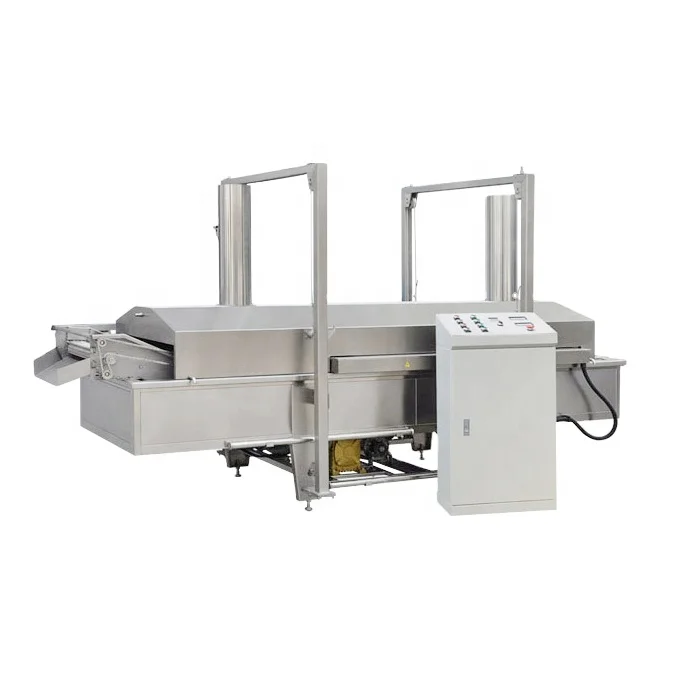
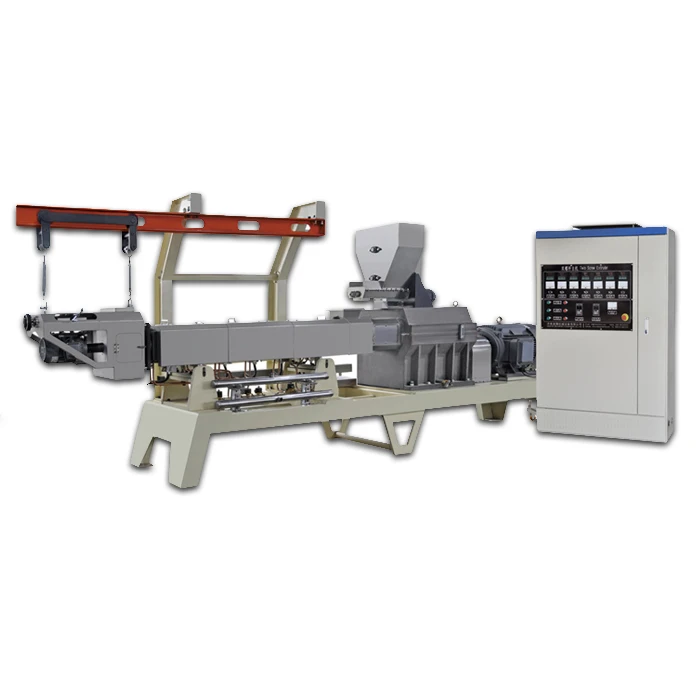
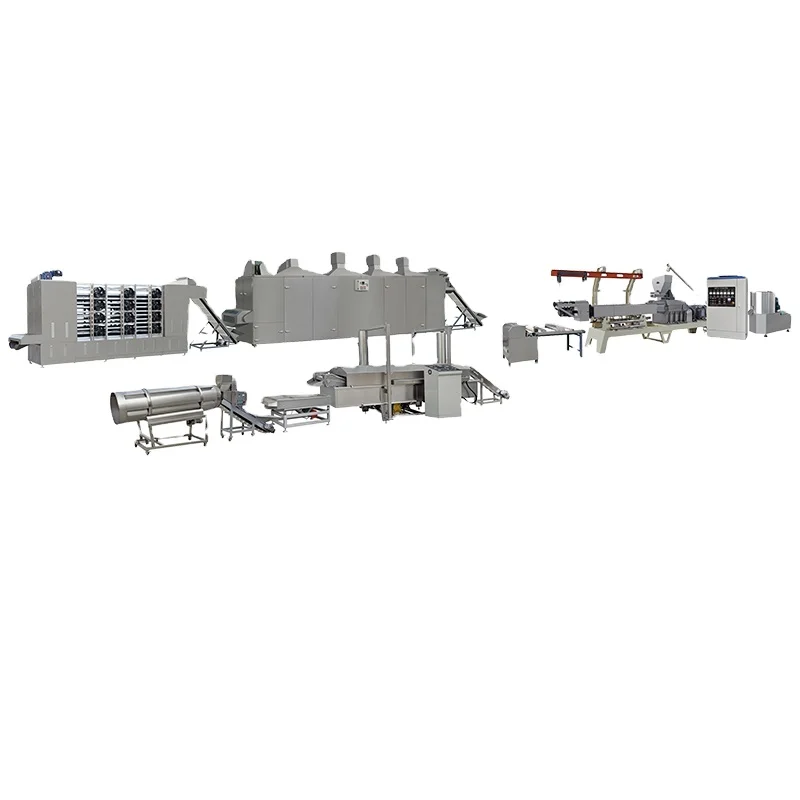

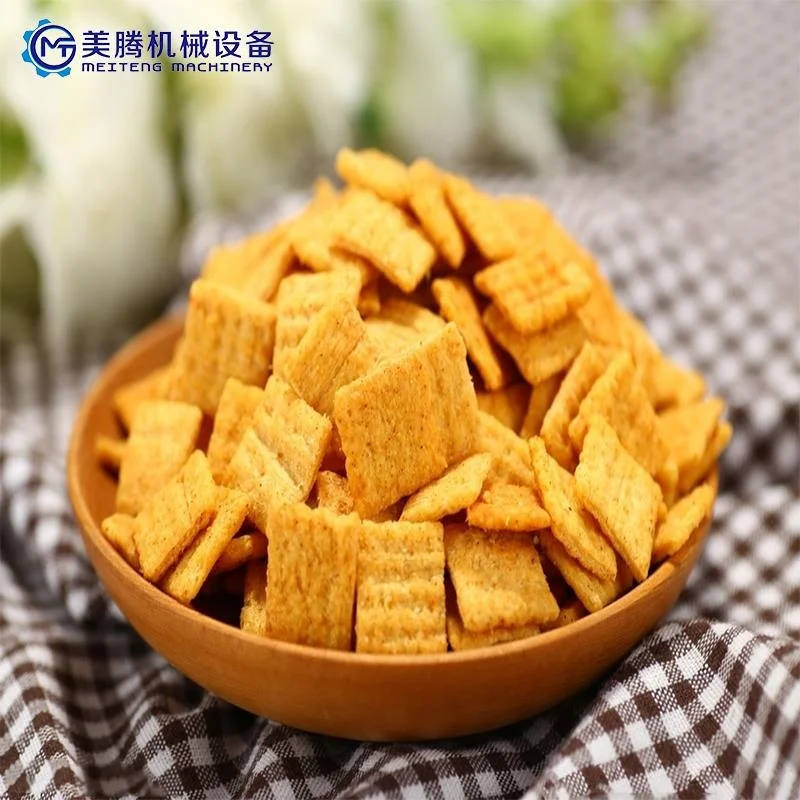
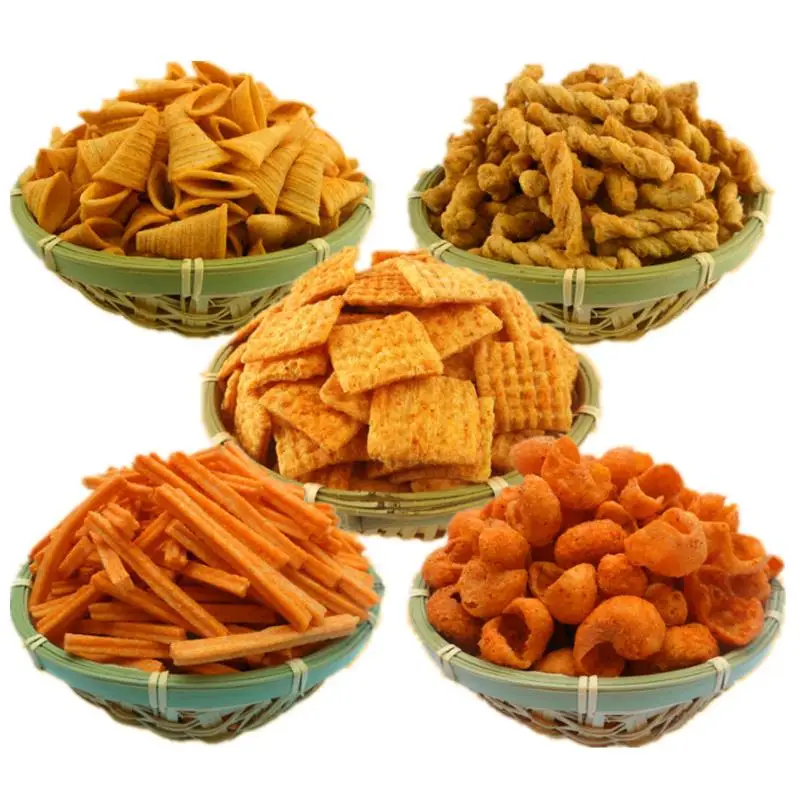
Trial runs on your actual raw material in our in-house testing workshop confirm real output before the line ships.
Description
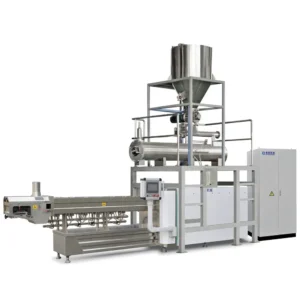
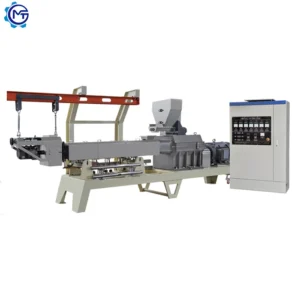
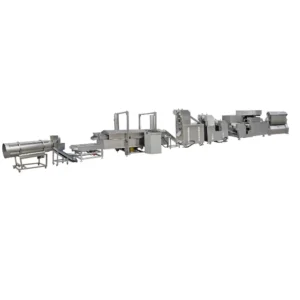
Integrated Throughput Matching — Every station in the fried puffs snack production line is sized to the next, eliminating the bottleneck gaps that appear when equipment is assembled from separate vendors.
Technical Specifications
| Parameter | Value |
|---|---|
| Product Type | Fried Puffs Snack Production Line (Extrusion & Frying) |
| Available Models | MT65, MT70, MT75, MT85, MT95 |
| Extruder Type | Twin-screw |
| Installed Power Range | 142 kW (MT65) to 370 kW (MT95) |
| Operating Power Range | 100 kW (MT65) to 280 kW (MT95) |
| Output Capacity | MT65: 120–150 kg/h (basis not stated in source); MT70: 200–250 kg/h (basis not stated in source); MT85: 300–500 kg/h (basis not stated in source); MT75: 400–500 kg/h (basis not stated in source); MT95: 800–1000 kg/h (basis not stated in source) |
| Overall Line Dimensions (L×W×H) | 22,000×1,200×2,200 mm (MT65) to 30,000×1,500×2,800 mm (MT95) |
| Extruder Main Motor Power | 30 kW (reference: MT70 configuration) |
| Powder Mixer Tank Volume | 150 kg per batch |
| Powder Mixer Rotary Speed | 385 rpm |
| Fryer Temperature Range | 0–260 °C |
| Fryer Capacity | 200–300 kg/h (basis to be confirmed) |
| Flavoring Line Output | 400 kg/h (basis to be confirmed) |
| Line Stations | Mixing → Extrusion → Frying → Flavoring/Seasoning → Drying |
| Construction Material | Stainless steel (all contact and structural surfaces) |
| Control System | Available with PLC, MCC, or manual control (to confirm) |
| Voltage & Frequency | Configurable to target market requirements (to confirm) |
| Standards | CE, ISO |
| Warranty | 1 year complete; lifetime maintenance service |
Application Suitability
| Application | Material or Output |
|---|---|
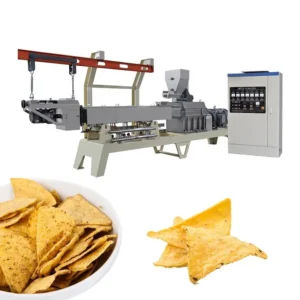
| Bugles and tortilla chip production | Corn grits, corn flour, and masa-based recipes |
| Rice crust and rice cracker manufacturing | Rice flour blends with starch modifiers |
| Shaped fried crisps (fish, duck, tree, triangle forms) | Wheat, corn, and multi-grain flour mixtures |
| Corn curls and sala snack production | Corn meal with optional legume or pulse flour additions |
| Core-filled or co-extruded fried snack formats | Dual-material recipes requiring filling injection |
Why "Rated Capacity" Means Nothing Without Your Recipe
A fried puffs snack production line turnkey only performs at its stated output when the raw material, moisture content, and recipe match the basis used for that rating.
I have seen lines quoted at a nominal throughput that collapsed the moment the buyer switched from standard corn flour to a blend containing bean powder or higher fiber content. The extruder barrel pressure shifts, expansion ratios drop, and the fryer suddenly cannot keep pace because the product enters with a different moisture profile. One project in the Middle East involved a recipe with a significant legume flour proportion, and the oil absorption rate nearly doubled compared to the test runs. The finished product was too greasy for packaging. We spent days in the workshop adjusting barrel temperatures and screw speeds before the line stabilized [NEED_CITE: impact of legume flour ratio on oil absorption in extruded fried snacks].
When sourcing a fried puffs snack production line turnkey, the capacity figure on the quotation sheet is only the starting conversation. What matters is whether that number was derived from your actual formulation.
Screw Configuration Determines What Your Recipe Actually Becomes
The twin-screw extruder at the heart of this fried puffs snack production line turnkey uses interchangeable screw elements and die plates configured to the buyer’s specific raw material and target product geometry. A recipe high in corn starch requires a different compression ratio and residence time than one heavy in rice flour or protein-rich legume blends. The screw pitch, kneading block arrangement, and die orifice diameter collectively control how much mechanical shear the dough receives, which directly governs expansion behavior when the product exits the die and enters the fryer.
Fryer Integration Is Where Most Lines Fail
The fryer on this line operates across a 0–260 °C range, covering the full spectrum of frying profiles required for puffed snack formats. However, temperature range alone does not guarantee product quality. The critical factor is whether the fryer’s throughput capacity aligns with the extruder’s actual output on the buyer’s recipe. If the extruder delivers product faster than the fryer can process it, the product piles up, cools unevenly, and absorbs oil inconsistently. This station-to-station throughput matching is verified during pre-shipment trial runs [NEED_CITE: importance of throughput synchronization in continuous frying lines].
What the Power and Dimension Figures Tell a Plant Engineer
The installed power ranges from 142 kW on the MT65 to 370 kW on the MT95, while operating power sits noticeably lower — between 100 kW and 280 kW respectively. That gap between installed and operating power reflects the headroom built into the motor and heating systems for recipe variation and startup loads. The line dimensions stretch from 22 meters to 30 meters in length, which dictates the minimum workshop bay a buyer must prepare. The powder mixer handles 150 kg per batch at 385 rpm with a 10-minute mixing cycle, setting the cadence for how frequently the extruder hopper needs replenishing. The fryer section measures 4,500×1,350×2,350 mm and requires dedicated ventilation and oil filtration infrastructure alongside the main line footprint.
The Hidden Cost of Skipping Pre-Shipment Verification
Lines assembled from separate vendors often arrive with mismatched capacities — an extruder rated for one output feeding a fryer built for a different one, followed by a flavoring drum that cannot keep up with either. The result is not just lost throughput; it is inconsistent product quality, excessive oil absorption, and seasoning distribution that varies from batch to batch. Buyers who skip the trial run phase often discover these imbalances only after installation, when reconfiguring screw elements, adjusting fryer belt speed, or resizing the flavoring drum becomes a costly on-site engineering exercise [NEED_CITE: costs of post-installation line rebalancing in snack manufacturing].
Why This Supplier Approach Differs
The fried puffs snack production line turnkey is sourced from a single supplier, meaning every station — mixer, extruder, fryer, flavoring drum, dryer — is throughput-matched during the design phase rather than bolted together from separate catalogs. The in-house testing workshop allows trial runs on the buyer’s actual raw material before the line ships, catching recipe-specific issues like unexpected oil absorption or density shifts early. Screw and die configurations are documented and recorded for each project, so replacement wear parts match the original setup precisely. Electrical schematics are confirmed to the buyer’s local voltage and frequency standards before production begins, preventing commissioning delays caused by incorrect motor wiring or control panel specifications.
Documentation & Verification
- Line layout drawing showing throughput calculation across mixer, extruder, fryer, and flavoring stations
- Trial run report conducted on buyer’s actual raw material recipe in the testing workshop
- Screw element arrangement and die configuration record matched to target snack shape and texture
- Electrical schematic with voltage, frequency, and control language confirmed to destination market
- Factory acceptance test record with operating power and temperature verification before dispatch
- CE declaration of conformity and ISO certificate for export compliance
Installation, Commissioning & Support
- Workshop floor must accommodate line lengths from 22 m (MT65) to 30 m (MT95) with clearance for maintenance access
- Electrical supply must match confirmed voltage and frequency; dedicated circuit required for extruder main motor at 30 kW
- Fryer section requires gas supply line, exhaust ventilation, and oil filtration connection within the 4,500 mm footprint
- Pre-shipment trial run results used as baseline for on-site commissioning parameter settings
- Operator training covers screw speed adjustment, fryer temperature profiling, and flavoring drum calibration
- Wear parts list including screws, dies, and mixer blades provided with recommended replacement intervals
What We Need to Size Your Line Correctly
To configure a fried puffs snack production line turnkey that holds its rated output on your actual recipe, we need your raw material formulation including any legume flour, fiber, or starch modifier proportions. Provide your target hourly output, available workshop dimensions including ceiling height, and local voltage and frequency standards. If you have existing upstream batching or downstream packaging equipment, share those specifications so the line interfaces cleanly with your current setup.
Frequently Asked Questions
Q: How is line capacity verified on my specific raw material and recipe before shipment?
A: We conduct trial runs in our in-house testing workshop using your actual raw material blend. The extruder screw speed, barrel temperature profile, and die configuration are adjusted until the target expansion and density are achieved. A full trial run report documenting throughput, oil absorption rate, and product quality parameters is provided before the line leaves the factory.
Q: What is the phased installation and commissioning schedule for a complete fried snack line?
A: Installation proceeds station by station — mixer and extruder first, then fryer and ventilation, followed by flavoring and drying sections. Commissioning uses the pre-shipment trial run data as the baseline, with on-site adjustments for local ambient temperature and humidity. Operator training runs concurrently during the final commissioning phase.
Q: How do I ensure throughput matching between extruder, fryer, and flavoring drum for my target output?
A: Each station is sized during the layout design phase based on your confirmed recipe and target capacity. The capacity calculation document shows the rated throughput at every station, ensuring no single piece of equipment creates a bottleneck. This matching is validated again during the pre-shipment trial run.
Q: What utility planning is required for the full line?
A: You need to prepare electrical supply matching the confirmed voltage and frequency, gas supply for the fryer, exhaust ventilation ductwork, compressed air for pneumatic controls, and floor space accommodating line lengths up to 30 meters depending on model selection. Detailed utility requirement documents are provided during the layout proposal stage.
Q: What operator training is included, and how are wear parts supplied?
A: Training covers extruder screw speed and temperature adjustment, fryer oil temperature profiling, flavoring drum speed and seasoning rate calibration, and routine maintenance procedures. A wear parts list identifying screws, dies, mixer blades, and fryer belt components is included, with replacement parts available for ordering throughout the equipment’s service life.
Related products
-
Automatic Rice Crust Chips Making Machine Bugles Pizza Rolls Fried Snack Food Processing Line Machine
¥8,570.00 Select options This product has multiple variants. The options may be chosen on the product page -
Fried Bugles Chips Production Line Fried Doritos Tortilla Snack Food Extruder
¥100.00 Select options This product has multiple variants. The options may be chosen on the product page -
New 100-200kgh Automatic Fried Nimko Extruder Machine Food Grade Stainless Steel for High Productivity Fried Snacks Processing
¥8,575.00 Select options This product has multiple variants. The options may be chosen on the product page -
Frying Crispy 3D Corn Bugles Pellets Fried Chips Snacks Food Machine Production Line Bugles Making Extruder
¥100.00 Select options This product has multiple variants. The options may be chosen on the product page