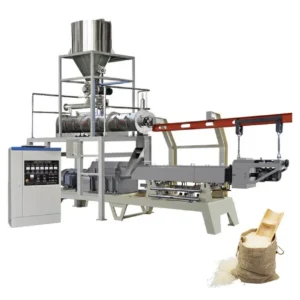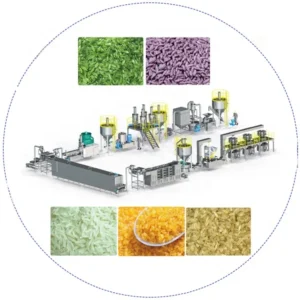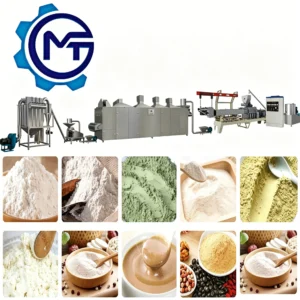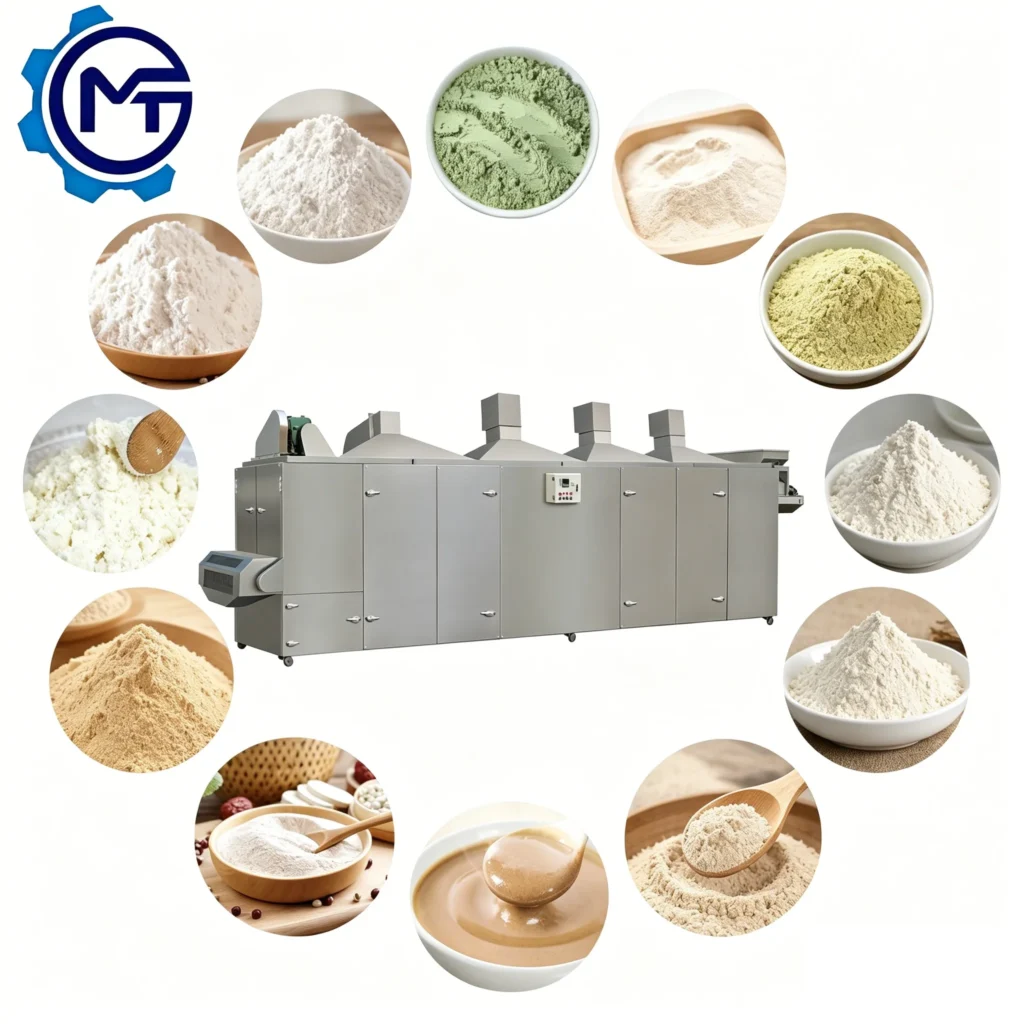
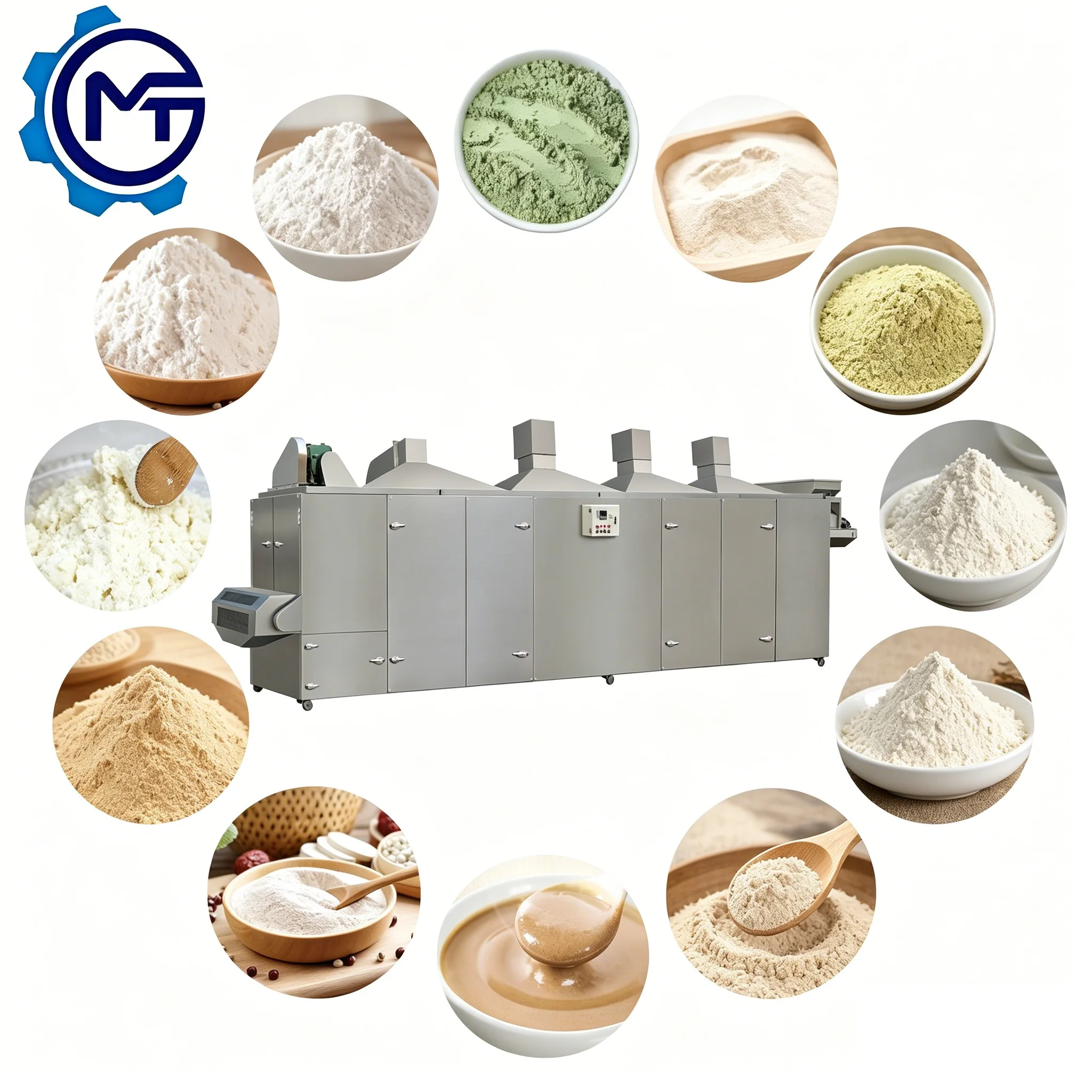
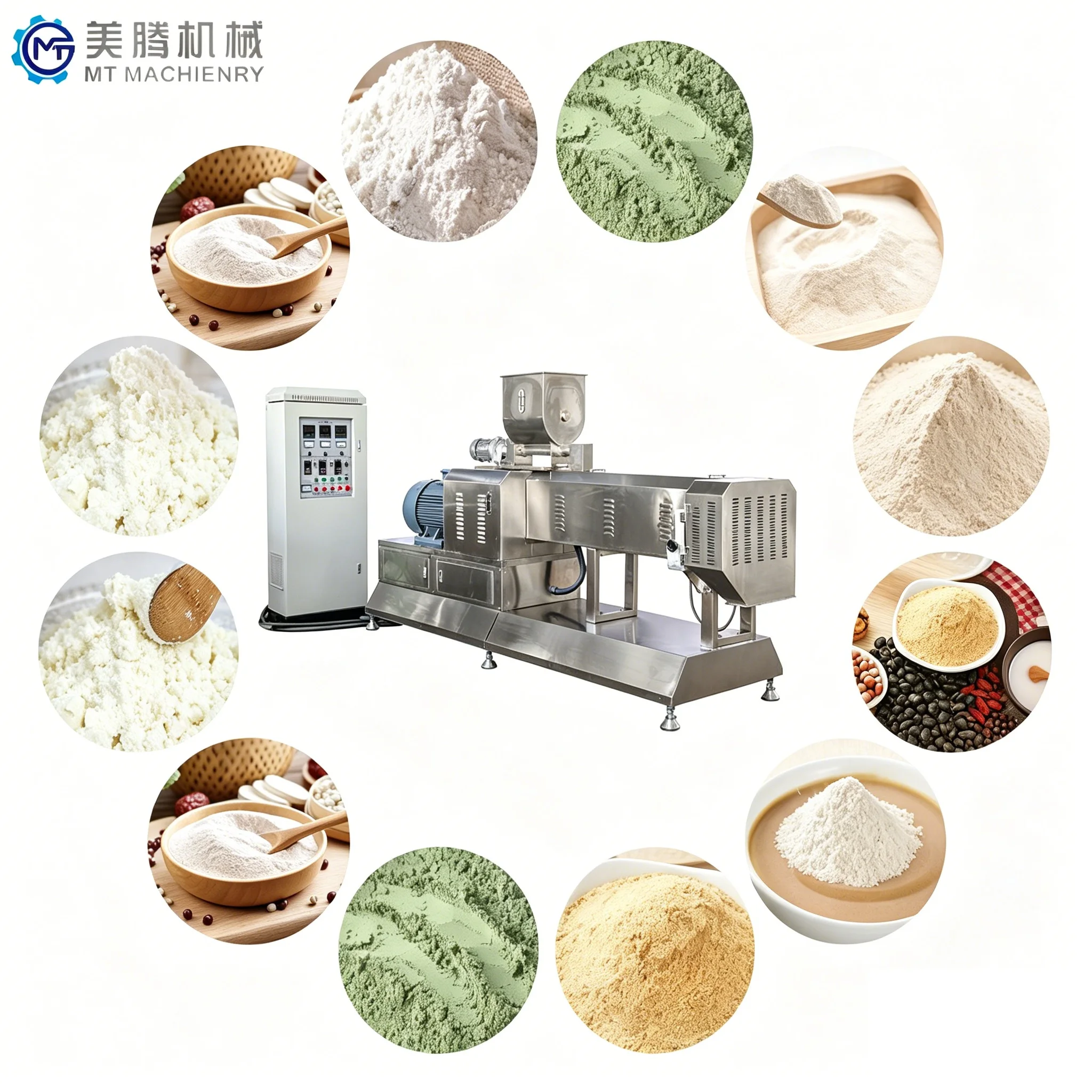

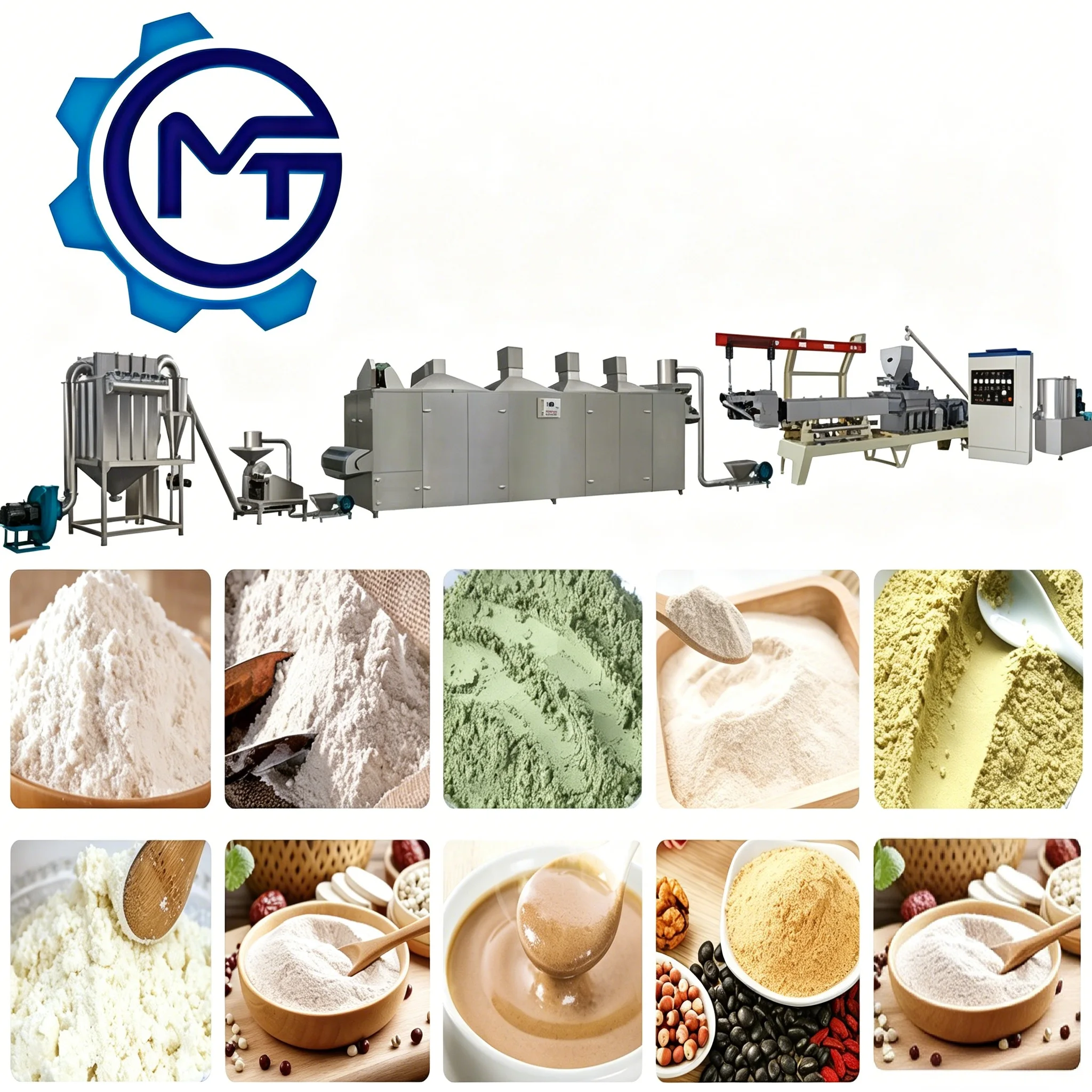


Infant Nutrition Powder Processing Line, 200-500 kg/h, PLC Control, Food-Grade 304 SS — configured for grain-based formulations including rice, corn, and beans, with twin-screw extrusion matched to target powder granularity. Heat source flexible across electric, gas, or steam based on buyer’s factory utilities. Designed as a throughput-balanced turnkey project from batching through drying to packing.
- Line capacity verified on buyer’s actual raw material in the in-house testing workshop before shipment
- Screw and die configuration specified to grain blend behaviour and infant food hygiene standards
- Electrical schematic and control language confirmed to target market prior to production
Description
Integrated Line Engineering — throughput across every infant nutrition powder processing station is calculated against your grain blend’s actual gelatinisation behaviour, not a generic catalogue rating.
Technical Specifications
| Parameter | Value |
|---|---|
| Product Type | Infant Nutrition Powder Processing Line |
| Output Capacity | 200–500 kg/h (basis not stated in source — confirm raw material type, moisture content, formulation) |
| Construction Material | Food-grade 304 stainless steel (product contact zones) |
| Control System | PLC with touch control panel and digital monitoring |
| Heat Source Options | Electric / Gas / Steam configurable |
| Assembly State | Complete integrated line — mixing, extrusion, drying, packing stations |
| Line Stations | Batching and mixing, twin-screw extrusion, drying ovens, cooling, flavouring, packing |
| Warranty | 1-year warranty |
| After-Sales Service | Overseas engineer service available |
| Certification | CE |
Application Suitability
| Application | Material or Output |
|---|---|
| Infant rice powder production | Rice flour, rice grits, pre-gelatinised rice base |
| Baby food porridge powder | Multi-grain blends including corn, oats, and millet |
| Fortified nutrition powder | Grain base with vitamin and mineral premix addition |
| Weaning food powder | Legume and cereal composite formulations |
| Instant infant cereal | Corn, beans, and mixed grain raw materials |
What "Rated Capacity" Conceals in Infant Powder Lines
A 500 kg/h infant nutrition powder production line turnkey quotation means little if the extruder cannot hold that output on your specific rice-to-legume ratio at your target moisture.
I have watched lines arrive at a buyer’s facility rated for a particular throughput, only to find that the starch gelatinisation window of the buyer’s own rice variety required longer barrel residence time. The extruder then ran slower, the dryer received less material per hour than it was sized for, and the downstream packing station sat idle for stretches. The problem was not any single machine — it was the absence of a line-level capacity calculation built on the buyer’s formulation. [NEED_CITE: starch gelatinisation temperature variation across rice cultivars] This is the gap that separates a catalogue number from a working infant nutrition powder production line turnkey project.
Barrel Profile and Starch Behaviour Under Twin-Screw Extrusion
The twin-screw configuration in this infant nutrition powder production line turnkey system is specified to match the buyer’s raw material blend. Barrel segments are arranged so that moisture injection, shear intensity, and temperature ramp align with the gelatinisation onset of the specific grain matrix being processed. Screw pitch and flight depth at each segment determine how long the material stays under heat and pressure — critical when infant-grade rice powder demands a narrow gelatinisation window to achieve the correct solubility without scorching.
Moisture Control and Its Effect on Powder Granularity
Moisture content at the preconditioner and along the barrel directly governs expansion ratio and, ultimately, the particle size distribution of the milled powder. Too much moisture and the extrudate exits dense, requiring more energy in the dryer and producing a coarser grind. Too little and the starch fails to gelatinise uniformly, leaving hard specks in the finished infant nutrition powder. The PLC touch panel allows operators to log moisture set-points per formulation, maintaining batch-to-batch consistency that infant food regulators require. [NEED_CITE: food safety traceability requirements for infant cereal products]
Reading the Specs That Actually Matter
The 200–500 kg/h capacity range must be confirmed against your formulation’s moisture, fat, and fibre content before the line is built. Food-grade 304 stainless steel contact surfaces are non-negotiable for infant food production — any carbon steel component in the product path risks iron migration that discolours light-coloured rice powder. The PLC control system with digital monitoring is what allows formulation parameters to be stored and recalled, so a Monday morning batch matches Friday afternoon’s output. Heat source flexibility — electric, gas, or steam — matters because utility costs and availability vary sharply between export markets, and a line locked into one fuel type can become uneconomical to operate. Screw configuration and die aperture are set after the trial run, not copied from a standard build, which is what keeps powder bulk density within specification.
The Cost of Skipping the Trial Run
When a line ships without a factory trial on the buyer’s actual grain blend, the first real test happens during commissioning — with raw material already on the warehouse floor and a production deadline looming. Mismatched screw elements mean sending the extruder barrel back for reconfiguration. A dryer sized for a different moisture profile means either over-drying the powder or leaving residual moisture that shortens shelf life. Packing stations calibrated for a bulk density the line never actually produces lead to underweight or overweight sachets. Every one of these corrections costs time, material, and the confidence of the buyer’s own downstream customers. [NEED_CITE: commissioning delays caused by untested raw material behaviour]
Why This Line Is Configured as a Single Project
Every station in this infant nutrition powder production line turnkey system is throughput-matched under one supplier, so the mixer, extruder, dryer, and packing line share a common capacity calculation rather than being assembled from independent vendors with conflicting ratings. Screw and die geometry is set after a trial run on the buyer’s grain formulation in the in-house testing workshop, not guessed from a catalogue. Electrical schematics are drawn with the buyer’s target market voltage and frequency confirmed before production starts. The line arrives with a documented screw configuration record matched to the buyer’s raw material, so reorder of wear parts is straightforward. Pre-sales consultation continues through on-site installation, commissioning, and operator training — the same engineering team that designed the layout is present when the first production batch runs.
Documentation & Verification
- Line layout drawing with throughput matched across mixing, extrusion, drying, and packing stations
- Trial run report on buyer’s actual grain blend conducted before shipment
- Screw and die configuration record tied to buyer’s formulation and target powder granularity
- Electrical schematic with voltage and frequency confirmed to buyer’s market
- Operation and maintenance manual with wear parts list for extruder screws and dies
- CE declaration of conformity and factory test record
Installation, Commissioning & Support
- Foundation plan accounts for extruder weight distribution and dryer footprint across the full line length
- Dedicated electrical circuit sized for PLC panel peak load and heat source selection
- Line arrives in modular sections for staged assembly inside facilities with limited door clearance
- First-run parameter setting covers barrel temperature ramp, moisture injection rate, and die pressure
- Operator training includes formulation recall on the touch panel and screw element replacement procedure
- Wear parts inventory covers initial screw segments, die plates, and dryer belt sections
What We Need to Size Your Line
Provide the grain varieties and their ratios in your formulation, the target moisture content of the finished powder, and the daily output volume your market requires. Confirm your facility’s available voltage, frequency, and whether steam, gas, or electric heat is preferred for the dryer and oven sections. Share your workshop floor dimensions so the layout can be drawn to fit existing infrastructure, and let us know if you want to send a batch of your raw material for a pre-shipment trial run.
Frequently Asked Questions
Q: How is line capacity verified on my specific grain formulation before the order is confirmed?
A: We run your actual raw material blend through the extruder in our in-house testing workshop. The trial measures output rate, gelatinisation degree, and powder bulk density under production-representative conditions. Results are documented in a trial run report shared before you commit, so the quoted capacity reflects your formulation, not a generic benchmark.
Q: What is the phased installation and commissioning schedule for a complete turnkey nutrition powder line?
A: Installation follows a station-by-station sequence — mixing and extrusion first, then dryer and cooling, then packing. Our engineers remain on site through the first full production run, calibrating PLC parameters to your live output. The total commissioning period depends on line length and facility readiness, and is confirmed during the layout approval stage.
Q: How are upstream batching and downstream packing stations matched to extruder throughput?
A: Every station shares a single capacity calculation based on your formulation’s bulk density and moisture profile. The mixer batch size is timed to the extruder feed rate, and the dryer belt speed is set so residence time matches the extrudate moisture at exit. Packing speed is then aligned to the cooled powder flow, preventing bottlenecks at any point.
Q: How are voltage, frequency, and control language confirmed for my target market before production begins?
A: During the specification confirmation stage, we review your facility’s electrical supply and the local grid standard. The electrical schematic is drawn to match, and the PLC interface language is set to your operators’ preference. This prevents rewiring or reprogramming delays once the line arrives on site.
Related products
-
150-500kg/h Twin Screw Extruder Baby Rice Flour Making Machine
¥9,500.00 Select options This product has multiple variants. The options may be chosen on the product page -
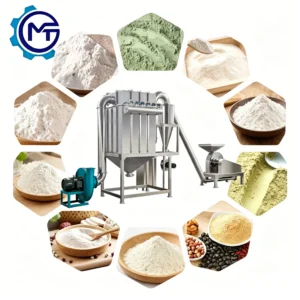
Compact Automatic Baby Cereal Nutrition Powder Production Line with 500kg/h Capacity and PLC Control
¥9,500.00 Add to cart -
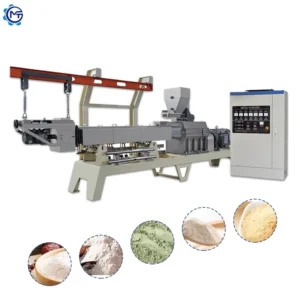
CE cerelac Instant Baby Food Porridge Making Machine Production Line
¥35,000.00 Select options This product has multiple variants. The options may be chosen on the product page -
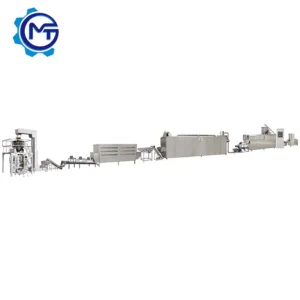
Automatic Nutritional Powder Making Machine Safe Rice Cereal for Babies
¥30.00 Select options This product has multiple variants. The options may be chosen on the product page