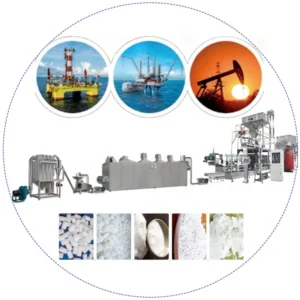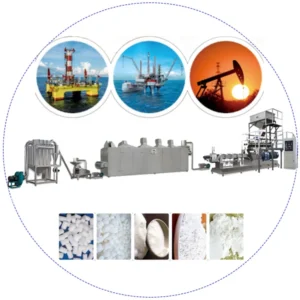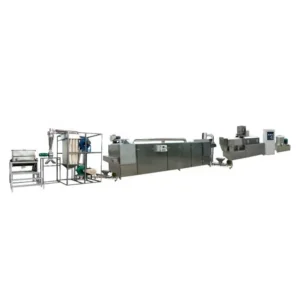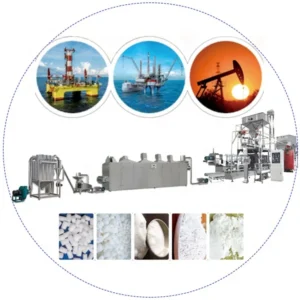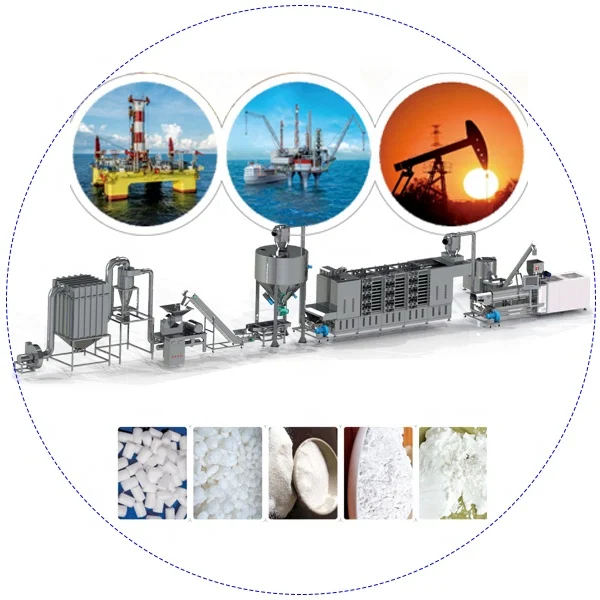


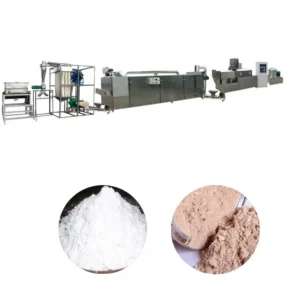
MT65 / MT70 / MT85 Modified Starch Extrusion Production Line, Twin-Screw, PLC/MCC Control — engineered as a single integrated project with throughput matched across mixing, extruding, drying and cooling stations.
- Screw modules and die design specified to raw starch type and target modification
- Dryer belt speed and temperature profile integrated into line-wide control
Backed by in-house trial runs on your raw material before shipment, plus documented layout and capacity calculation for every station.
Description
Matched throughput across every station — our modified starch extrusion line is engineered as one integrated project so the mixer, extruder, dryer and cooler all run at the same target capacity without bottlenecking each other.
Technical Specifications
| Parameter | Value |
|---|---|
| Model | MT65 / MT70 / MT85 |
| Product Type | Modified Starch Extrusion Production Line |
| Screw Type | Twin screw (co-rotating, sectional modules) |
| Installed Power | MT65 72 kW / MT70 92 kW / MT85 108 kW |
| Power Consumption | MT65 50 kW / MT70 65 kW / MT85 75 kW |
| Output Capacity | MT65 140–160 kg/h (basis to be confirmed) / MT70 240–260 kg/h (basis to be confirmed) / MT85 500–600 kg/h (basis to be confirmed) |
| Overall Dimensions (L×W×H) | MT65 2200×1000×2300 mm / MT70 2600×1000×2300 mm / MT85 4500×1000×2600 mm |
| Control System | PLC / MCC (configurable) |
| Mixer | Stainless steel structure, safety interlock on top cover and discharge hole |
| Dryer | Net belt speed controllable, temperature controllable |
| Line Stations | Feeding, extruding, cutting, heating, conveying, cooling |
| Assembly State | Complete turnkey line |
| Warranty | 24 months, lifetime service |
| Certification | CE, ISO |
Application Suitability
| Application | Material or Output |
|---|---|
| Pre-gelatinized starch for food processing | Corn starch, cassava starch, tapioca starch |
| Denatured starch for textile sizing | Corn starch with cross-linking modification |
| Modified starch for paper making | Cassava and tapioca starch with viscosity adjustment |
| Functional starch for building materials | Corn starch with pregelatinization |
| Industrial starch for casting and oil drilling | Various native starch sources with targeted modification |
Why Nominal Extruder Capacity Misses the Real Output
A modified starch production line turnkey project only delivers its rated output when every station — mixer, extruder, dryer and cooler — is matched to the same throughput.
I have watched starch processors invest in an extruder rated for a certain hourly output, only to find the dryer cannot keep up. Moisture levels at the dryer inlet climb, the belt slows, and the entire modified starch production line turnkey backs up. The extruder sits idle waiting for downstream clearance. In Southeast Asia, where cassava starch behaves differently from corn starch in both gelatinization temperature and expansion, this mismatch becomes expensive fast [NEED_CITE: starch gelatinization temperature variance by source material].
How Layout Decisions Prevent Downstream Bottlenecks
When we plan a modified starch production line turnkey project, the layout starts with the dryer capacity and works backward to the extruder. If the target output requires a specific moisture reduction rate, the dryer belt length and temperature zones are calculated first. The extruder is then selected so its actual output on the buyer’s starch type does not exceed what the dryer can handle continuously. This sequencing prevents the common failure where the extruder pushes more material than the downstream stations can process.
Throughput Matching Across Five Station Types
The mixer must deliver a consistent feed rate into the extruder barrel. If the mixer batch cycle is too slow, the extruder starves and screw fill drops, changing the shear profile inside the barrel. The modified starch production line turnkey layout documents the batch cycle time against the extruder feed rate so both run continuously. Downstream, the cutting system, cooling conveyor and packing buffer are each specified to handle peak extruder output rather than average output, because startup transients and recipe changeovers produce short periods of higher flow.
Reading the Specs: What the Power and Dimension Data Actually Mean
The installed power figures — 72 kW for MT65, 92 kW for MT70, 108 kW for MT85 — include the main drive motor plus heating zones and auxiliary drives. Power consumption values are lower because heating elements cycle on and off as barrel zones reach setpoint. The twin-screw co-rotating design with sectional modules means screw elements can be rearranged along the barrel to change the shear and residence time profile. For pre-gelatinized starch, longer residence in the heating zone drives complete gelatinization; for denatured starch, a shorter, higher-shear profile may be required. Barrel dimensions differ across the three models, so floor space planning must account for the full length plus maintenance clearance on both sides. The PLC and MCC control system manages barrel temperature zones, screw speed and feeder rate from one interface, which matters for batch-to-batch consistency when operators change recipes.
The Hidden Cost of Underspecifying the Dryer
When the dryer belt speed and temperature profile are not matched to the extruder output, two problems compound. First, residual moisture in the starch causes clumping during storage, and the buyer faces rejection from their end customer. Second, the line spends more time in unplanned stops than in production, because operators constantly adjust belt speed to compensate. I have seen projects where the dryer was specified by a separate vendor who never saw the extruder data sheet [NEED_CITE: multi-vendor line integration failure modes]. The result was a modified starch line that ran at roughly half its expected throughput for the first three months while the dryer was retrofitted.
Why This Sourcing Approach Works for Complete Line Projects
Every station from feeding to cooling is sourced under one responsibility, so throughput calculations are cross-checked before fabrication rather than discovered during commissioning. The screw and die configuration is specified to the buyer’s actual starch source and target modification — not copied from a generic build. An in-house testing workshop allows trial runs on the buyer’s raw material before the line ships, catching gelatinization and expansion issues early. The documentation package includes a line layout with capacity calculations at every station, an electrical schematic with confirmed voltage and frequency, and a trial run report. On-site installation covers phased mechanical assembly, electrical connection, parameter setting and operator training tailored to the local team’s experience level.
Documentation & Verification
- Line layout drawing with throughput matched at every station from mixer to cooler
- Screw and die configuration record specified to your starch type and target modification
- Factory trial run report on your raw material before dispatch
- Electrical schematic with voltage, frequency and control language confirmed for your market
- CE declaration of conformity and ISO certificate for customs and regulatory submission
- Operation and maintenance manual with wear parts list and replacement intervals
Installation, Commissioning & Support
- Foundation requirements calculated from MT85 footprint of 4500×1000×2600 mm and dynamic load
- Dedicated power circuit sized for 108 kW installed load with voltage and frequency confirmed before production
- Sectional barrel and screw modules shipped in labeled crates for sequenced on-site assembly
- First-run parameter setting including barrel temperature profile, screw speed and dryer belt calibration
- Operator training on PLC interface covering recipe storage, alarm response and daily maintenance checklist
- Wear parts list with screw elements, die plates and seals identified for first reorder cycle
What We Need to Size Your Line Correctly
To prepare an accurate layout and throughput calculation, share your starch source — corn, cassava or tapioca — along with the target modification type and any functional specifications your end customer requires. Provide your workshop dimensions including ceiling height, plus the local voltage and frequency standard. Let us know if you have existing upstream or downstream equipment that the new line must connect to, and whether you want to send a raw material sample for a pre-shipment trial run.
Frequently Asked Questions
Q: How is line capacity verified on my specific starch raw material and moisture level?
A: We run a trial in our testing workshop using your actual raw material and document the output rate, moisture profile and product quality. The trial run report becomes part of the shipment documentation, so you see verified numbers before the line leaves our factory rather than relying on nominal capacity figures.
Q: How do you ensure throughput is matched between extruder, dryer and downstream stations?
A: Every station is calculated against the same target output during the layout phase. The dryer belt length, temperature zones and air flow are sized to handle the extruder’s verified output on your starch type. The line layout document shows the capacity at each station so the matching is transparent.
Q: What does the turnkey scope include for layout, utility planning and commissioning?
A: The scope covers line layout with station placement, utility connection points for power, water and compressed air, phased mechanical and electrical installation, parameter commissioning on your raw material, and operator training. A commissioning schedule with milestones is agreed before installation begins.
Q: Can we run a trial on our raw material in your testing workshop before shipment?
A: Yes. You send a sample of your starch, and we configure the screw and die setup to your target modification. The trial produces actual product that we ship back to you for evaluation. The results inform the final screw configuration and control parameters loaded into the PLC before dispatch.
Q: How are voltage, frequency and control language confirmed for our target market before production?
A: We collect your site electrical specification during the inquiry stage and confirm it in writing before production starts. The electrical schematic is drawn to your voltage and frequency, and the PLC interface language is set to your preference. This avoids rewiring or reprogramming delays during commissioning [NEED_CITE: industrial equipment electrical standards by country].
Related products
-
Cassava & Pregelatinized Corn Starch Extrusion Equipment – CE Certified Industrial Twin-Screw Modified Starch Line
¥65.00 Select options This product has multiple variants. The options may be chosen on the product page -
Pre-gelatinized Starch Production Line – Modified Starch Integrated Puffing Equipment
¥65.00 Select options This product has multiple variants. The options may be chosen on the product page -
Modified Starch for Construction Adhesives Production – Custom Built Double Screw Extruder Line
¥65.00 Select options This product has multiple variants. The options may be chosen on the product page -
Automatic Modified Starch Making Machine Oil Drilling Starch Processing Production Line
¥30.00 Select options This product has multiple variants. The options may be chosen on the product page