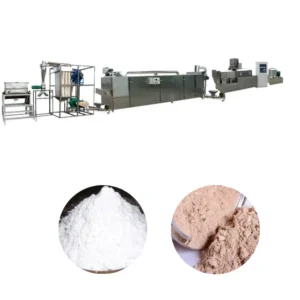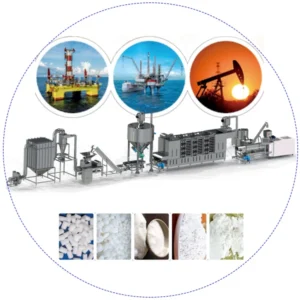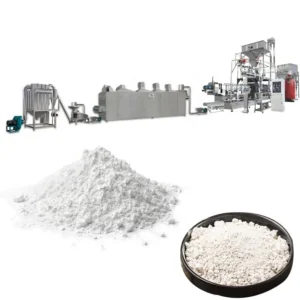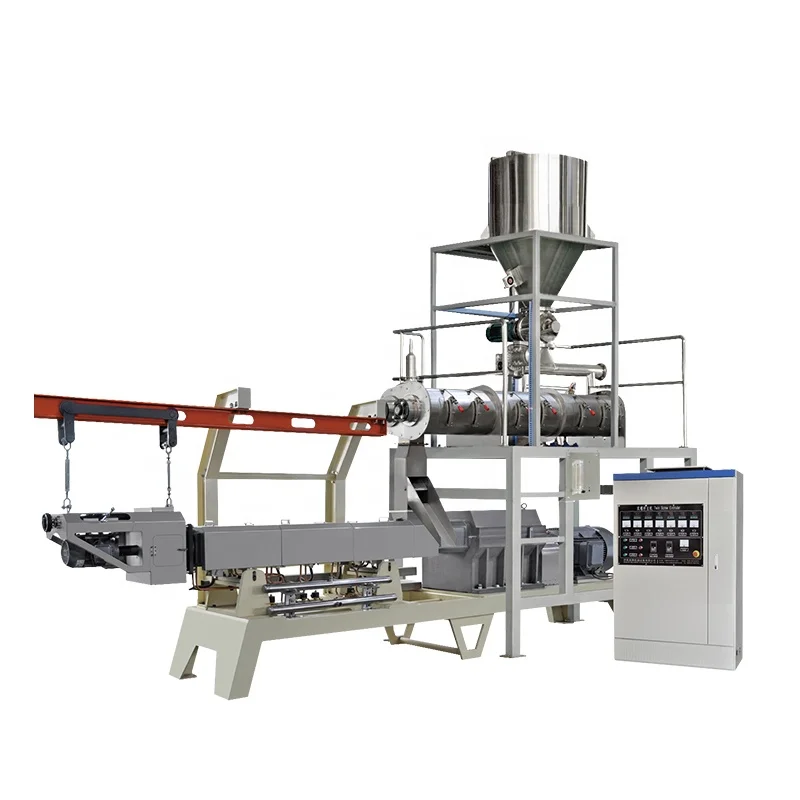


MT65 / MT70 / MT75 Modified Starch Twin-Screw Extrusion Line, 110-190 kW — configured for corn, cassava, and rice flour processing with matched throughput across mixing, extrusion, drying, and grinding stations.
- Twin-screw extrusion with dedicated screw and die geometry selectable for modified or denatured starch targets
- Frequency conversion control on feeding and spindle drives for precise gelatinisation tuning
- Dryer with round-trip chain drive and adjustable residence time for uniform moisture removal
- Pulse grinder delivering 100-120 mesh output aligned to line capacity
Every station is throughput-matched under one supplier, eliminating bottlenecks. Trial runs on your raw material are completed before shipment to validate process parameters.
Description
Integrated Line Throughput — every station from flour mixing to pulse grinding is sized against one output target, eliminating the bottlenecks that typically emerge when starch processors assemble equipment from separate vendors.
Technical Specifications
| Parameter | Value |
|---|---|
| Model | MT65 / MT70 / MT75 |
| Product Type | Modified Starch Twin-Screw Extrusion Line |
| Screw Type | Twin-screw |
| Installed Power | MT65: 110 kW; MT70: 160 kW; MT75: 190 kW |
| Power Consumption | MT65: 90 kW; MT70: 140 kW; MT75: 150 kW |
| Output Capacity | MT65: 100–150 kg/h (basis not stated in source); MT70: 150–200 kg/h (basis not stated in source); MT75: 300–350 kg/h (basis not stated in source) |
| Overall Dimensions (L×W×H) | MT65: 40000×1500×2200 mm; MT70: 41000×1500×2200 mm; MT75: 43000×1500×3200 mm |
| Mixer Batch Capacity | 20–30 kg / 70–80 kg / 170–180 kg per batch |
| Mixer Power Options | 4 kW / 7.5 kW / 15 kW |
| Mixer Voltage | 380 V, 50 Hz, Three Phase |
| Mixer Stainless Steel Options | 201 S.S. / 304 S.S. |
| Pulse Grinder Drive Motor | 15 kW |
| Pulse Grinder Mesh Number | 100–120 mesh |
| Dryer Heating Options | Fuel / Gas / Electricity |
| Dryer Drive | Double pitch roller chain drive, round-trip drying |
| Control System | Control cabinet with frequency conversion (feeding, rotary cutting, spindle) |
| Raw Materials | Corn, rice, cassava, and various grains |
| Warranty | 1 year complete guarantee, lifetime maintenance service |
Application Suitability
| Application | Material or Output |
|---|---|
| Industrial modified starch for textile sizing | Corn and cassava flour processed to specified viscosity |
| Pregelatinised starch for food ingredient blending | Rice and corn starch gelatinised through twin-screw extrusion |
| Denatured starch for oil drilling fluids | Cassava-based formulations dried to target moisture |
| Modified starch for paper coating and construction | Corn and grain blends extruded and ground to 100–120 mesh |
| Nutritional powders (baby rice powder, sesame paste, bean powder) | Multi-grain formulations through same line with recipe adjustment |
| Fortified artificial rice with vitamins and dietary fiber | Rice flour blended with nutrient premix and extruded |
Why "Rated Capacity" Means Little Without Your Raw Material
A modified starch production line turnkey proposal that quotes throughput without specifying the flour type, moisture content, and target modification level is quoting a number you may never see on your factory floor. Capacity is only meaningful when tied to your exact formulation.
Starch from different botanical sources — corn, cassava, rice — behaves differently inside a twin-screw extruder. Gelatinisation temperature, shear sensitivity, and expansion ratio all shift with the raw material profile. A line that holds its rated output on one starch may fall short on another because the screw configuration and barrel temperature profile were not matched to it. This is the gap between a catalogue figure and a real production number. [NEED_CITE: starch gelatinisation behaviour across botanical sources]
Barrel Temperature Profiles and Starch Modification Control
Twin-screw extrusion for starch modification relies on precise thermal and mechanical energy input along the barrel length. The barrel zones on this line are independently controllable, allowing operators to set temperature profiles that match the specific modification target — whether cross-linking, esterification, or simple pregelatinisation. The screw configuration is selected to deliver the required shear and residence time for the intended degree of modification. A modified starch production line turnkey installation that does not document its screw and die geometry against your target product leaves you starting from scratch during commissioning.
Dryer Residence Time and Final Moisture Consistency
The round-trip chain-drive dryer on this line provides extended residence time with adjustable temperature across drying zones. Uniform moisture removal before grinding is essential because uneven moisture leads to inconsistent particle size at the pulse grinder stage, which directly affects downstream application performance. Starch intended for textile sizing and starch intended for food-grade pregelatinised applications have different final moisture specifications, and the dryer must be configured accordingly. [NEED_CITE: moisture specifications for industrial versus food-grade starch]
What the Power and Control Numbers Mean in Practice
The installed power ratings — ranging from 110 kW on the MT65 to 190 kW on the MT75 — reflect the combined motor load across extruder main drive, feeder, and cutter. The frequency conversion control on feeding, rotary cutting, and spindle drives allows operators to fine-tune the ratio between feed rate and screw speed in real time. This is particularly important during starch gelatinisation, where small changes in shear rate alter the degree of molecular breakdown and the final viscosity of the modified starch. The control cabinet centralises these adjustments so process parameters remain reproducible across production runs.
The Cost of Mismatched Stations Downstream
When an extruder is specified in isolation without matching the mixer batch cycle, dryer capacity, or grinder throughput, the weakest station determines the actual line output. A flour mixer that cannot feed fast enough starves the extruder; a dryer with insufficient residence time forces the extruder to slow down; a pulse grinder rated below the extruder output creates a backlog that halts production entirely. These mismatches are rarely apparent until the line is running on the buyer’s actual raw material. [NEED_CITE: throughput bottlenecking in multi-station food processing lines]
Why Procurement Through a Single Supplier Changes the Outcome
Every station on this line — flour mixer, screw conveyor, twin-screw extruder, air conveyor, roasting oven, pulse grinder — is specified under one engineering scope, so throughput calculations are performed against a single target rather than assembled from independent vendor datasheets. The screw configuration and die design are documented against the buyer’s raw material and modification target before production begins. An in-house testing workshop runs your specific flour formulation through the extruder before shipment, generating a trial run report that becomes the baseline for on-site commissioning. Electrical schematics, voltage confirmation, and control language are verified during the specification phase rather than discovered during installation. CE and ISO certified documentation accompanies every line delivered. [NEED_CITE: CE machinery directive compliance for food extrusion equipment]
Documentation & Verification
- Line layout and capacity calculation matched to your starch formulation and target output
- Screw and die configuration record specific to your modification target and viscosity requirement
- Trial run report on your raw material from the in-house testing workshop before dispatch
- Electrical schematic with voltage, frequency, and control language confirmed for your site
- Operation and maintenance manual with wear parts list for screws, dies, and grinder screens
Installation, Commissioning & Support
- Foundation and utility planning based on the MT75 footprint of 43000×1500×3200 mm and 190 kW installed power
- Dedicated electrical circuit sized to the selected model’s power consumption, with voltage confirmed pre-production
- Factory-assembled stations delivered for on-site positioning, alignment, and utility connection
- First-run commissioning using trial run parameters as baseline, with operator training on frequency conversion controls
- Wear parts supply programme covering twin-screw elements, die plates, and pulse grinder screens at 100–120 mesh
What We Need to Configure Your Line
To size this modified starch production line turnkey system accurately, we need your raw material type and source (corn, cassava, rice, or a blend), the target modification or gelatinisation specification, and your required daily output. Please also provide your facility voltage and frequency, the control panel language preference, and the available floor space with ceiling height. If you have existing upstream milling or downstream packing equipment, share the interface requirements so the line can be integrated without bottlenecks.
Frequently Asked Questions
Q: How is the quoted output capacity verified against my raw material?
A: Output figures are based on specific raw material and moisture conditions. Before shipment, your flour formulation is run through our in-house testing workshop, generating a trial run report that documents achievable throughput under your actual conditions. Commissioning then starts from this verified baseline rather than a generic catalogue figure.
Q: How do you configure the screw and die for different starch modification targets?
A: Screw element arrangement and die geometry are selected based on the required degree of modification — cross-linked, esterified, or pregelatinised. The configuration record is documented before production and matched to your target viscosity and end-use application, ensuring the extruder delivers the correct shear and residence time.
Q: Can the dryer be matched to our local climate and final moisture target?
A: Yes. The round-trip chain-drive dryer allows adjustment of temperature and residence time across drying zones. We configure the dryer based on your ambient humidity, incoming moisture from the extruder, and the final moisture specification required for your starch application before grinding.
Q: What electrical and control confirmations happen before production starts?
A: Voltage, frequency, and control panel language are confirmed during the specification phase and documented in the electrical schematic. This prevents delays during commissioning caused by incompatible power supply or unreadable control interfaces at your facility.
Q: What does on-site installation and operator training cover?
A: Installation covers station positioning, utility connection, and alignment across the full line length. Commissioning replicates the trial run parameters on your production floor. Operator training covers frequency conversion adjustments, screw and die changeover procedures, and daily maintenance routines for the extruder and pulse grinder.
Related products
-
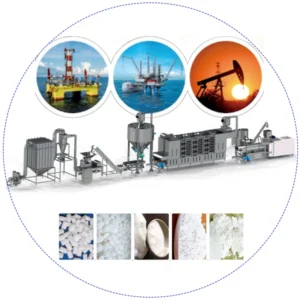
Big Capacity Modified Starch Production Line Making Machine
¥30.00 Select options This product has multiple variants. The options may be chosen on the product page -
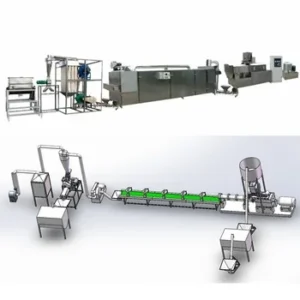
2025 New Design Modified Starch Big Capacity Industrial Use Food Additives Core Components Motor Bearing
¥50.00 Select options This product has multiple variants. The options may be chosen on the product page -
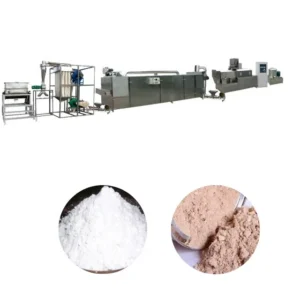
Modified Starch Production Line Industrial Drilling Twin Screw Extruder 304 Stainless Steel High Efficiency Flour Mill CE
¥50.00 Select options This product has multiple variants. The options may be chosen on the product page -
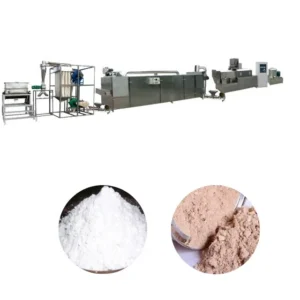
Big Capacity Modified Starch Industrial Use and Food Additives
¥50.00 Select options This product has multiple variants. The options may be chosen on the product page